
Introduction
When a PVC pipe manufacturing line changes from one pipe size to another, the belling section also requires careful attention. The tooling, heating arrangement, pipe positioning and socket-forming conditions must match the new product specification. If the changeover is not completed correctly, manufacturers may experience inconsistent socket dimensions, poor joint fitting, surface marks or production interruptions.
PVC Pipe Belling Machine Changeover is an important activity in PVC pipe manufacturing because it prepares the machine to produce a different pipe size, socket design or product specification. A well-managed changeover helps maintain consistent socket quality and reduces unnecessary production losses during product transitions.
The changeover process involves checking the machine configuration, selecting the correct heating and forming tools, preparing the pipe end, adjusting the operating conditions and inspecting the first finished sockets.
This guide explains the important stages of PVC pipe belling machine changeover, the equipment that requires attention, common problems during setup and practical checks that production teams can follow.
What Is a PVC Pipe Belling Machine?
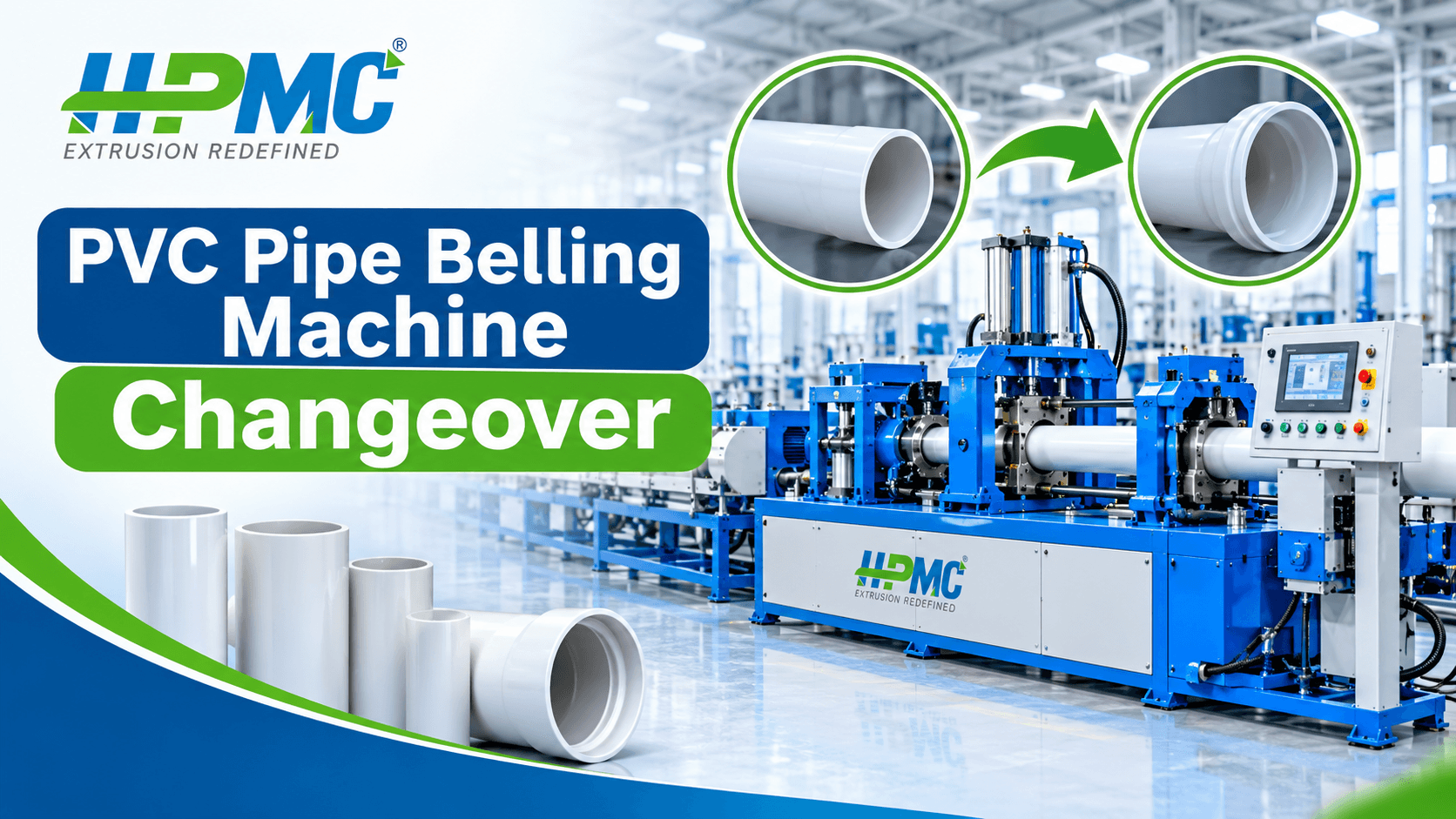
A PVC pipe belling machine is used to form an enlarged socket at one end of a PVC pipe. The socket allows another pipe of a compatible specification to fit into it and form a joint.
Depending on the product design, the socket may be manufactured for solvent cement joining or an elastomeric sealing ring arrangement.
During the process, the pipe end is heated under controlled conditions until the material becomes suitable for forming. The heated end is then shaped using the appropriate forming tool or mandrel.
After forming, the socket is cooled and inspected to confirm that it meets the required product dimensions.
A typical belling arrangement may include:
- Pipe feeding and positioning system.
- Heating chamber or heating station.
- Heating elements and temperature controls.
- Socket-forming mandrel or tooling.
- Pipe holding and clamping arrangement.
- Cooling system.
- Pneumatic or hydraulic operating mechanism.
- Control panel and safety interlocks.
The exact arrangement depends on the machine design and socket manufacturing method.
Why Is PVC Pipe Belling Machine Changeover Important?
Different PVC pipe products require different socket dimensions and tooling configurations. A machine operating with the previous product setup cannot automatically produce the required socket for a new pipe specification.
Changeover prepares the equipment for the next production requirement.
1. Maintaining Socket Dimensions
The socket must match the required dimensions and product specification. Incorrect tooling or positioning can result in an oversized or undersized socket.
2. Achieving Consistent Joint Quality
The socket must allow the intended joining arrangement to work correctly. Consistent forming conditions help maintain proper fitting and sealing performance.
3. Reducing Production Rejection
An incorrect setup can produce deformed sockets, surface defects or dimensional variations. Checking the machine before production helps identify these issues early.
4. Reducing Changeover Downtime
A planned changeover allows operators to prepare the required tools, inspect the machine and arrange the next production setup before restarting the process.
5. Maintaining Production Consistency
A documented changeover procedure helps different operators follow the same setup requirements across production shifts.
When Is a PVC Pipe Belling Machine Changeover Required?
A changeover may be necessary whenever the existing machine configuration no longer matches the next production requirement.
Common situations include:
- Changing from one pipe diameter to another.
- Changing socket dimensions.
- Switching between different socket designs.
- Changing the forming mandrel or tooling.
- Moving to another PVC pipe product specification.
- Replacing worn or damaged forming tools.
- Changing the production arrangement after maintenance.
A changeover should be planned according to the machine manufacturer's instructions and the approved product setup documentation.
How to Prepare for PVC Pipe Belling Machine Changeover
Preparation is an important part of a successful changeover. Before removing existing tooling or changing machine settings, the production team should confirm the requirements of the next product.
Confirm the New Pipe Specification
Identify the outside diameter, wall thickness, pipe standard and required socket design.
Check the approved product drawing or manufacturing specification to confirm the dimensions that must be achieved.
Identify the Required Tooling
Select the appropriate forming mandrel, socket tooling, clamps and supporting components for the next pipe size.
Check the condition of each tool before installation. Worn, damaged or contaminated tooling may affect the finished socket.
Prepare the Heating System
Identify the heating arrangement required for the new product. Review the approved temperature settings and heating sequence for the specific PVC compound and machine configuration.
Do not assume that the previous product's heating conditions will automatically suit the new pipe size.
Check the Cooling Arrangement
Confirm that the cooling system is suitable for the intended socket configuration.
Cooling conditions influence the final shape and dimensional stability of the formed socket.
Arrange Tools and Safety Equipment
Prepare the required maintenance tools and personal protective equipment.
Follow the machine's approved shutdown, isolation and lockout procedures before carrying out tooling replacement or maintenance work.
Step-by-Step PVC Pipe Belling Machine Changeover Process
The exact procedure varies between automatic, semi-automatic and manual belling machines. The following stages provide a general production framework.
Step 1. Stop the Previous Production Run
Complete the previous production batch according to the plant's production procedure.
Remove remaining pipes from the feeding and belling areas. Make sure that the machine is in the approved shutdown condition before beginning the changeover.
Record the previous product specification and identify any operating issues observed during the last production run.
Step 2. Isolate the Machine Before Tooling Replacement
Follow the manufacturer's safety instructions to isolate the relevant electrical, pneumatic and hydraulic energy sources.
Verify the safe condition of the equipment before accessing the tooling or heating area.
Hot surfaces, moving mechanisms and stored pneumatic or hydraulic energy can create serious hazards during maintenance.
Only trained and authorized personnel should perform these activities.
Step 3. Remove the Existing Forming Tooling
Remove the previous mandrel, socket-forming components and other product-specific tooling according to the machine instructions.
Inspect the removed components for wear, deformation, surface damage and material deposits.
Keep the tooling identified by pipe size and product specification so that it can be stored and reused correctly.
Step 4. Install the New Mandrel or Forming Tool
Install the tooling selected for the next production requirement.
Confirm that the components are correctly positioned and secured according to the machine manufacturer's instructions.
Check the alignment between the pipe path and the forming arrangement. Incorrect positioning can produce uneven socket formation or damage the pipe end.
Step 5. Adjust the Pipe Holding Arrangement
The pipe must remain correctly positioned during heating and forming.
Review the clamping arrangement, pipe supports and feeding guides for the new pipe diameter.
Confirm that the pipe can enter the machine without unnecessary interference or excessive movement.
For different pipe sizes, the holding arrangement may require a corresponding adjustment.
Step 6. Review the Heating Conditions
The heating system prepares the pipe end for socket formation.
During changeover, review the approved heating settings for the new product and material.
Important factors include:
- Heating temperature.
- Heating duration.
- Heater position.
- Heat distribution around the pipe circumference.
- Pipe positioning inside the heating area.
- Condition of heating elements and temperature sensors.
Uniform heating is important for consistent socket formation. Uneven heating can cause one part of the pipe end to become softer than another.
Use the approved machine and material processing instructions rather than applying an arbitrary temperature setting.
Step 7. Check the Cooling System
Inspect the cooling arrangement and confirm that the required cooling components are correctly installed.
Check water circulation, cooling connections and the condition of the cooling fixtures where applicable.
The cooling process should support the formed socket in retaining its intended shape.
Step 8. Review the Machine Control Settings
Before restarting production, check the relevant operating settings on the control panel.
Depending on the machine, these may include heating time, forming sequence, clamping operation, transfer movement, cooling time and cycle control.
Verify that the safety interlocks and operating controls function correctly.
Step 9. Conduct a Trial Production Run
After completing the changeover and the required safety checks, produce trial pipes using the approved startup procedure.
Do not immediately release the first sockets for regular production.
Inspect the trial pieces for forming quality, dimensions, surface condition and compatibility with the specified joining arrangement.
Step 10. Approve the New Production Setup
Compare the first finished sockets with the approved product specification.
If the socket meets the required inspection criteria, record the new machine setup and release production according to the plant's quality procedure.
If the sample shows a defect, identify the affected process stage before making further adjustments.
Important Machine Settings During PVC Pipe Belling Changeover
Several operating conditions require attention when switching between pipe sizes or socket designs.
Heating Temperature and Duration
Heating conditions must be appropriate for the PVC material, pipe wall thickness and belling arrangement.
Insufficient heating may make the pipe end difficult to form. Excessive heating may cause deformation, discoloration or other material damage.
Mandrel Positioning
The forming mandrel must be suitable for the required socket dimensions.
Incorrect alignment can create uneven socket walls or affect the internal dimensions.
Pipe Clamping
The pipe should remain stable during the forming operation.
Incorrect clamping may cause movement, surface marks or dimensional inconsistencies.
Forming Sequence
The sequence of heating, transfer, forming and cooling must follow the machine's intended operating arrangement.
An interruption or incorrect timing can affect socket quality.
Cooling Conditions
Cooling helps stabilize the formed socket.
Insufficient or inconsistent cooling may cause the socket to lose its intended shape after removal from the forming tool.
Common Problems During PVC Pipe Belling Machine Changeover
Changeover problems should be investigated by identifying where the defect first appears. A socket defect may originate during heating, forming, cooling or pipe positioning.
Problem 1. Socket Diameter Is Not Consistent
Check whether the correct mandrel and forming tooling have been installed.
Review tooling alignment, pipe positioning and the condition of the forming components.
Compare the first finished sample with the approved socket dimensions.
Problem 2. Socket Surface Shows Marks
Inspect the forming tool and pipe-contact surfaces for scratches, deposits or damage.
Review the clamping arrangement and pipe transfer path.
If marks appear repeatedly in the same location, document their position and compare it with the tooling contact area.
Problem 3. Pipe End Is Not Heated Uniformly
Review the heater condition and the position of the pipe inside the heating chamber.
Check whether the heating elements are operating consistently and whether the pipe is positioned correctly.
Compare the affected pipe with a sample from a stable production run.
Problem 4. Socket Deforms After Forming
Review the forming and cooling stages separately.
Check whether the socket is adequately supported during cooling and whether the machine releases the pipe at the appropriate stage.
Also confirm that the heating conditions match the product setup.
Problem 5. Socket Forming Is Incomplete
Check the tooling configuration and the forming sequence.
Review the pipe end condition, heating uniformity and mandrel alignment.
Do not compensate for an incorrect tooling setup by making uncontrolled changes to heating settings.
Problem 6. Changeover Takes Longer Than Expected
Review whether the required tooling was prepared before the previous production run ended.
Check the availability of setup documentation, replacement components and maintenance tools.
A planned changeover can reduce avoidable delays caused by searching for tooling or confirming product specifications during machine downtime.
How to Check Socket Quality After Changeover
The first production samples should receive particular attention because they confirm whether the new setup is suitable for regular manufacturing.
Check Socket Dimensions
Inspect the socket dimensions according to the applicable product standard and approved drawing.
The inspection may include socket depth, internal diameter, wall condition and other specified dimensional requirements.
Check Surface Condition
Inspect the internal and external socket surfaces for cracks, discoloration, wrinkles, scratches or other visible defects.
Check Pipe Alignment
Confirm that the socket is formed correctly in relation to the pipe body.
Uneven forming may indicate an issue with positioning, tooling alignment or heating distribution.
Check Joint Compatibility
Where applicable, verify the socket using the approved joining components and inspection method.
The fitting should be assessed according to the intended joining system and product specification.
Record the Inspection Results
Record the product identification, tooling used, operating conditions, sample time and inspection outcome.
This record helps the next shift understand the approved production setup.
For related information about production quality, see HPMC's guide to Common PVC Pipe Extrusion Defects and Their Causes.
How to Reduce PVC Pipe Belling Machine Changeover Time
A faster changeover should not come at the expense of socket quality or operator safety.
Manufacturers can improve the process by organizing tooling, documentation and inspection activities.
Maintain Identified Tooling Sets
Keep mandrels and product-specific components clearly identified according to their pipe sizes and socket specifications.
This reduces the possibility of installing incorrect tooling.
Prepare the Next Product Setup in Advance
Review the next production order before the current batch ends.
Prepare the required tooling, product specifications and inspection documents.
Maintain a Changeover Checklist
Use a consistent checklist for shutdown, tooling replacement, heater inspection, cooling checks and trial production.
Keep Maintenance Records
Record tooling condition and replacement history.
Repeated problems involving the same mandrel or heater can then be investigated using previous service information.
Train Machine Operators
Operators should understand the purpose of each setup adjustment and know how to identify common socket defects.
Training helps reduce incorrect adjustments and improves consistency between shifts.
What to Include in a PVC Pipe Belling Machine Changeover Checklist
A practical checklist helps production and maintenance teams complete the same important checks during each product transition.
Before Changeover
- Confirm the next pipe specification.
- Identify the required mandrel and tooling.
- Prepare maintenance tools and safety equipment.
- Record the previous production condition.
- Follow the approved machine shutdown procedure.
During Changeover
- Isolate the equipment as required.
- Remove and inspect existing tooling.
- Install the correct forming components.
- Check pipe supports and clamping arrangements.
- Review heating and cooling systems.
- Confirm control settings and safety interlocks.
After Changeover
- Follow the approved restart procedure.
- Produce trial samples.
- Inspect socket dimensions and surface condition.
- Verify joint compatibility where applicable.
- Record the approved settings and inspection results.
The checklist should be adapted to the installed machine and the manufacturer's operating instructions.
What to Share When Requesting Technical Support
If a belling machine does not produce the expected socket after changeover, provide the equipment team with specific production information.
Share the previous pipe size and the new pipe specification. Include the tooling identification, heating conditions, forming arrangement and cooling configuration.
Describe the defect and mention whether it appears on every pipe or only during certain production cycles.
Photographs of the finished socket and the installed tooling can also help explain the issue.
Mention the last acceptable production sample and the first sample that showed a problem. This information gives the technical team a clearer starting point for investigating the changeover.
For equipment-related guidance, visit HPMC's Technical Assistance section.
Conclusion
PVC Pipe Belling Machine Changeover is an important part of maintaining consistent socket quality when changing pipe sizes or product specifications.
The process requires attention to tooling selection, mandrel alignment, pipe positioning, heating conditions, cooling arrangements and finished socket inspection.
A structured changeover procedure helps operators identify setup problems before regular production begins. Maintaining tooling records, preparing the next product configuration and checking trial samples also helps reduce avoidable downtime.
Manufacturers should follow the machine manufacturer's instructions and the applicable product requirements during every changeover.
Contact HPMC
HPMC (Hindustan Plastics and Machinery Corporation) provides plastic extrusion machinery solutions for industrial manufacturing applications.
For machinery-related enquiries, share your pipe size, socket design, production requirement and machine configuration.
Address: 5, Category II, DSIDC Industrial Area, Nangloi, Delhi – 110041, India.
Website: https://www.hindustanplastics.com/
Phone: +91 95605 96392.
Email: info@hindustanplastics.com.
Contact HPMC to discuss your plastic pipe manufacturing machinery requirements and technical assistance.
Frequently Asked Questions
Find quick answers to the most common questions about this topic.
PVC Pipe Belling Machine Changeover is the process of preparing a belling machine for a different pipe size, socket design or product specification by changing the required tooling and reviewing the operating conditions.
Changeover is required when the next production order needs different socket dimensions, forming tooling or machine settings. It helps ensure that the machine matches the new product specification.
Depending on the machine, changeover may involve the forming mandrel, socket tooling, pipe clamps, supports, guides and other product-specific components.
Yes. Different pipe diameters may require different forming tools, holding arrangements and heating conditions. The setup should match the approved product specification.
Heating makes the pipe end suitable for forming. Uniform and controlled heating helps produce a consistent socket without unnecessary material deformation.
Uneven socket formation may result from incorrect tooling alignment, inconsistent heating, poor pipe positioning or unsuitable forming conditions.
Manufacturers can prepare tooling in advance, maintain identified tooling sets, use a changeover checklist and keep product setup documentation readily available.
Inspect socket dimensions, depth, surface condition and overall shape according to the approved product specification. Verify joining compatibility using the appropriate inspection procedure.
Damaged or worn tooling may affect socket dimensions and surface quality. Inspection helps identify problems before the next production run begins.
Share the pipe diameter, wall thickness, socket specification, tooling identification, machine model, heating conditions and details of any production defects. Photographs of the tooling and finished socket can also be useful.