
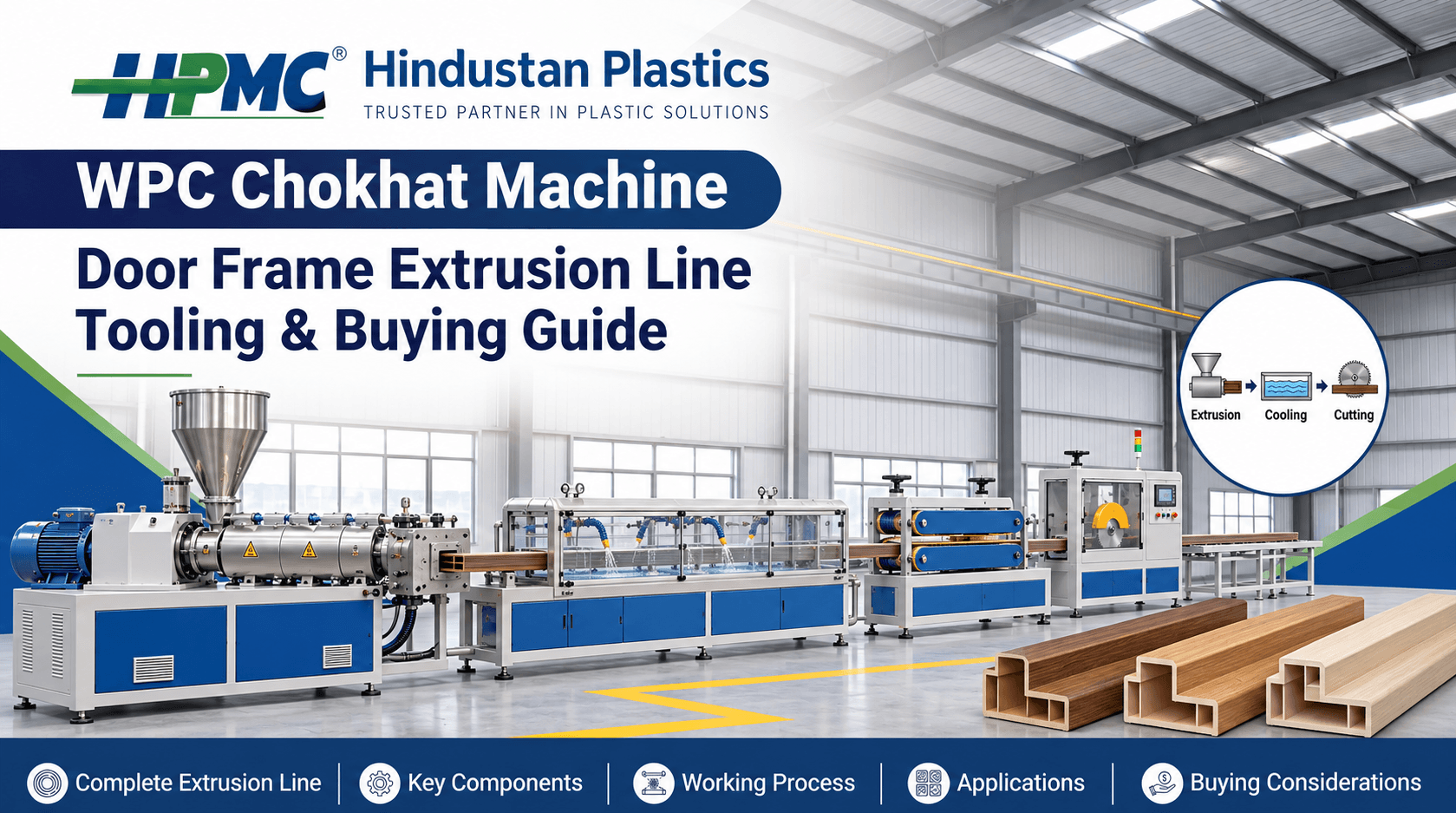
A door frame can look right as it leaves the die and still be difficult to assemble after cooling. A slight twist can prevent a mitred joint from closing neatly. An inconsistent groove can change how the door fits. If the line has to slow down whenever you switch to a heavier section, the output shown during a demo may bear little resemblance to what you produce in a week.
These are the details that matter when comparing WPC chokhat machine manufacturers. Start with the frames you intend to sell, then ask each supplier to explain how the proposed line will make them. A useful comparison covers the extrusion system, profile tooling, cooling, cutting, output and the support available after installation.
What Is a WPC Chokhat Machine?
A WPC chokhat machine is an extrusion line used to make door frame profiles from a wood-plastic composite. WPC formulations combine a thermoplastic with a wood-based filler, such as wood flour, and additives selected for the application. The extruder processes the compound, and a profile die gives the material its cross-sectional shape. Calibration, cooling, pulling and cutting turn that continuous profile into lengths ready for the next manufacturing step.
The term WPC frame machine often refers to the complete line, but what a quote includes can vary. Ask the supplier to list the extruder, die, calibration tooling, cooling equipment, haul-off and cutter separately. Check whether material preparation equipment is included, especially if you intend to prepare the formulation in-house. For a door frame application, review the equipment listed on HPMC’s WPC Profile (Chokhat) Plant page.
How Does a WPC Door Frame Extrusion Line Work?
1. Prepare and Feed the Compound
Confirm whether the proposed machine takes a ready-made compound or relies on a separate preparation stage. Tell the supplier which material you plan to run and what can change between batches. If the trial uses a different formulation from your production material, record the difference so you can interpret the results.
2. Process the Material and Form the Profile
The extruder processes and conveys the compound through the die. The die forms the features in your frame drawing, including faces, corners and any rebate or groove. Give the supplier a dimensioned cross-section and mark the surfaces that will remain visible after installation. HPMC’s guide to window profile machine manufacturers explains the shared principles of profile extrusion and calibration using a separate PVC and UPVC application.
3. Calibrate and Cool the Frame
After the profile leaves the die, the calibration and cooling stages help it retain the intended shape. Inspect the frame after it has cooled, particularly if your range includes wider or heavier sections. Check the areas that affect assembly, such as a rebate that has to remain uniform along the full length.
4. Pull, Cut and Inspect the Profile
The haul-off moves the profile through the line at a controlled speed, and the cutter produces the required lengths. Check the cut ends as well as the length. A frame section can meet its length requirement and still need rework if the end is out of square or chipped. Assemble a few trial pieces and check how the joints fit.
How to Compare WPC Chokhat Machine Manufacturers
1. Share Your Profile Drawings Before Asking for a Quote
Send drawings for your highest-volume frame, your largest section and any design with a deep rebate or narrow groove. Include the finished length, target weight per metre and critical dimensions where available. If the door frame will be laminated, machined or fitted with hardware, describe those steps too. A supplier can then explain which features need dedicated tooling and which checks should be part of the trial.
2. Check Tooling and Changeover Requirements
Ask how many dies and calibrators the quote includes. If you plan to offer three frame sizes, find out which tools are needed for each size and what stays on the line during a changeover. Request a breakdown of the time spent changing tools, restarting production and reaching acceptable quality. On short orders, that restart time can take up a meaningful part of the shift.
3. Compare Saleable Output Using Your Own Profile
Ask for both kilograms per hour and usable lengths per hour. A line can produce a high weight of material without delivering the number of acceptable frames you need. During a trial, record the time, frame size, length, rejected pieces and interruptions. Use those figures to compare suppliers under similar conditions.
For example, suppose a one-hour trial produces 120 lengths. If 10 fail dimensional checks and five are damaged during cutting, the usable output is 105 lengths per hour. Check whether each supplier’s quoted figure includes startup waste, stops or rejects before you compare it with your production target.
4. Review Utilities, Layout and Staffing
Ask for a line layout that shows where operators load material, inspect the profile and remove finished lengths. Check space for tooling changes and routine service, along with the quoted electrical and cooling-water requirements. If the line is going into an existing factory, share the floor plan and identify where raw material and finished frames will be stored. Confirm which utilities and handling equipment you need to arrange separately.
5. Check Commissioning, Training and Parts Support
Ask who will install the equipment, train operators and help your team run the first approved profiles. Clarify what the commissioning trial will cover and who supplies the material and tooling. For ongoing production, ask which wear parts the supplier stocks and what information is needed to order a replacement. HPMC outlines its technical assistance services and spare parts support on separate pages.
What to Check During a WPC Frame Machine Trial
Bring a drawing, a representative batch of material and a written list of acceptable results. Ask for samples from the start, middle and end of the run. Label them with the profile, time and material batch so you can trace any variation you find later. Measure the same points on each sample after cooling, and keep one approved piece as a reference for commissioning.
CheckWhat to inspect
Cross-section
Overall width, depth, groove position and rebate dimensions
Straightness and twist
How the cooled length sits against a reference surface
Surface finish
Visible marks, roughness and colour variation on exposed faces
Cut quality
Finished length, squareness and chipping at the ends
Assembly fit
Joint gaps and whether the frame fits the intended hardware or trim
Repeatability
Variation between pieces taken at different points in the run
If your finished frame is sold with a surface finish, test a sample through that step as well. A profile that passes dimensional inspection can still reveal a surface problem when it is laminated or machined. Agree on which checks belong in the machine acceptance trial and which belong in your own finished-product testing.
Before the trial, agree on when the supplier will start counting accepted pieces. If the line needs a warm-up or several adjustments, record that time separately so you can estimate daily output more realistically.
Common WPC Door Frame Problems and What to Inspect
ProblemAreas to review
Bowing or twisting after cooling
Tool alignment, cooling consistency and support along the line
Rebate or groove varies along the length
Tooling dimensions, process stability and the condition of the cooled sample
Rough patches or visible marks
Material consistency, tooling condition and recent process changes
Chipped or uneven ends
Cutter condition, profile support and the cutting setup
Weight per metre varies
Feed consistency and changes in extrusion or haul-off conditions
Record when a defect begins and whether it appears on every piece or only after a change. If the frame starts to twist after a tooling change, compare samples from before and after the change. Review the measurements and process records with the supplier before deciding what to adjust.
WPC Chokhat Line vs WPC Board Line
A chokhat line produces a shaped frame section with features such as grooves and rebates. A board line produces a flat product, so buyers usually specify overall width, thickness and surface requirements. If you plan to make both products, send drawings for both and ask the supplier to explain which equipment and tooling each one requires. HPMC’s WPC Board Plant page provides a separate reference for flat-board projects.
The finished products also call for different inspection priorities. On a door frame, a small change in the rebate can affect how the door closes. On a board, thickness variation across the width may matter more for the next operation. Build the trial around the measurements that affect the final product you intend to sell.
What to Include in a WPC Chokhat Machine Enquiry
- Frame range — Send the cross-sectional drawings, finished lengths and expected order quantities for each size.
- Material — Share the intended formulation or compound grade and whether it will arrive ready to feed.
- Production target — Give your target saleable lengths per shift and the mix of profiles you expect to run.
- Tooling scope — List the dies and calibrators you need at launch and any sizes planned for later.
- Factory details — Share the available space, utilities and any equipment you want to retain.
- Acceptance checks — Identify the dimensions, finish, cut quality and assembly checks that trial samples must pass.
Put the same brief in front of each supplier. When the quotes come back, compare what each one includes and how each supplier plans to demonstrate the output. If a detail is missing, ask for it in writing before comparing prices.
How to Compare Two WPC Chokhat Machine Quotes
Check What the Quoted Price Includes
Ask each manufacturer to list what is included in the base price and what is quoted separately. Compare the number of dies and calibrators, the cutting equipment, the cooling setup and the scope of installation. If one supplier includes tooling for only one profile, request the cost of the other sizes you need at launch. This lets you compare the cost of getting both lines ready for the same production job.
Put the Trial Acceptance Criteria in Writing
Agree on the profile drawing, material, finished length and dimensions that will be checked before the demonstration. Ask how many samples you can take and how the supplier will record rejects and interruptions. If you need straight lengths for mitred joints, include an assembly check so both sides know what a passing sample looks like.
Plan for the First Production Order
Choose a representative order to run during commissioning under normal conditions. Include your most common frame size and, if your schedule calls for frequent size changes, a second profile that needs different tooling. Record the time needed to change over and produce the first acceptable length again.
Conclusion
The most informative comparison starts with your frame drawings and ends with cooled, cut pieces you can measure and assemble. Check whether the line can deliver your required profile range, how long it takes to change sizes and how many acceptable lengths it produces under representative conditions. Those checks help you choose a WPC chokhat machine that fits your product range and production schedule.
Contact HPMC
HPMC (Hindustan Plastics and Machinery Corporation)
Share your door frame drawings, material details and target output with HPMC to discuss the extrusion line and tooling required for your project.
Address
5, Category II, DSIDC Industrial Area, Nangloi, Delhi – 110041, India
Phone+91 95605 96392
Frequently Asked Questions
Find quick answers to the most common questions about this topic.
It produces wood-plastic composite door frame profiles. The line forms the profile through a die, cools it, pulls it through the equipment and cuts it into the required lengths.
For door frames, both terms commonly refer to a profile extrusion line. Ask whether the quote includes the complete line and tooling for your specific frame design.
A line may support several sizes within its design range. Ask which sizes require separate dies and calibration tooling, and request an estimate of changeover time.
A WPC formulation generally combines a thermoplastic, a wood-based filler and suitable additives. Confirm the intended formulation and feeding requirements with the compound and equipment suppliers.
Send a dimensioned cross-section showing the width, depth, rebates, grooves and any other critical features. Include the finished length and intended assembly or finishing steps.
Request a timed trial with your material and profile tooling. Compare the kilograms processed and the number of acceptable finished lengths, including any downtime and rejects.
Possible factors include tooling alignment, uneven cooling and inadequate support along the line. Check cooled samples and review what changed in the process with the supplier.
A board plant is configured for flat products. A door frame has a shaped cross-section, so ask the supplier which equipment and profile tooling your frame drawing requires.
Check critical dimensions, straightness, surface finish and cut quality after cooling. Assemble sample pieces to see whether the joints close and whether the intended hardware fits.
Ask for the machine configuration, included dies and calibrators, utilities, trial conditions, installation, operator training and parts support. Request a separate list of any equipment you need to source yourself.