
Introduction
CPVC (Chlorinated Polyvinyl Chloride) is a thermoplastic material used in piping systems designed for applications such as hot and cold water distribution and certain industrial fluid-handling requirements. Manufacturing CPVC pipes requires appropriate material formulation, controlled processing conditions, suitable extrusion equipment, and consistent quality checks.
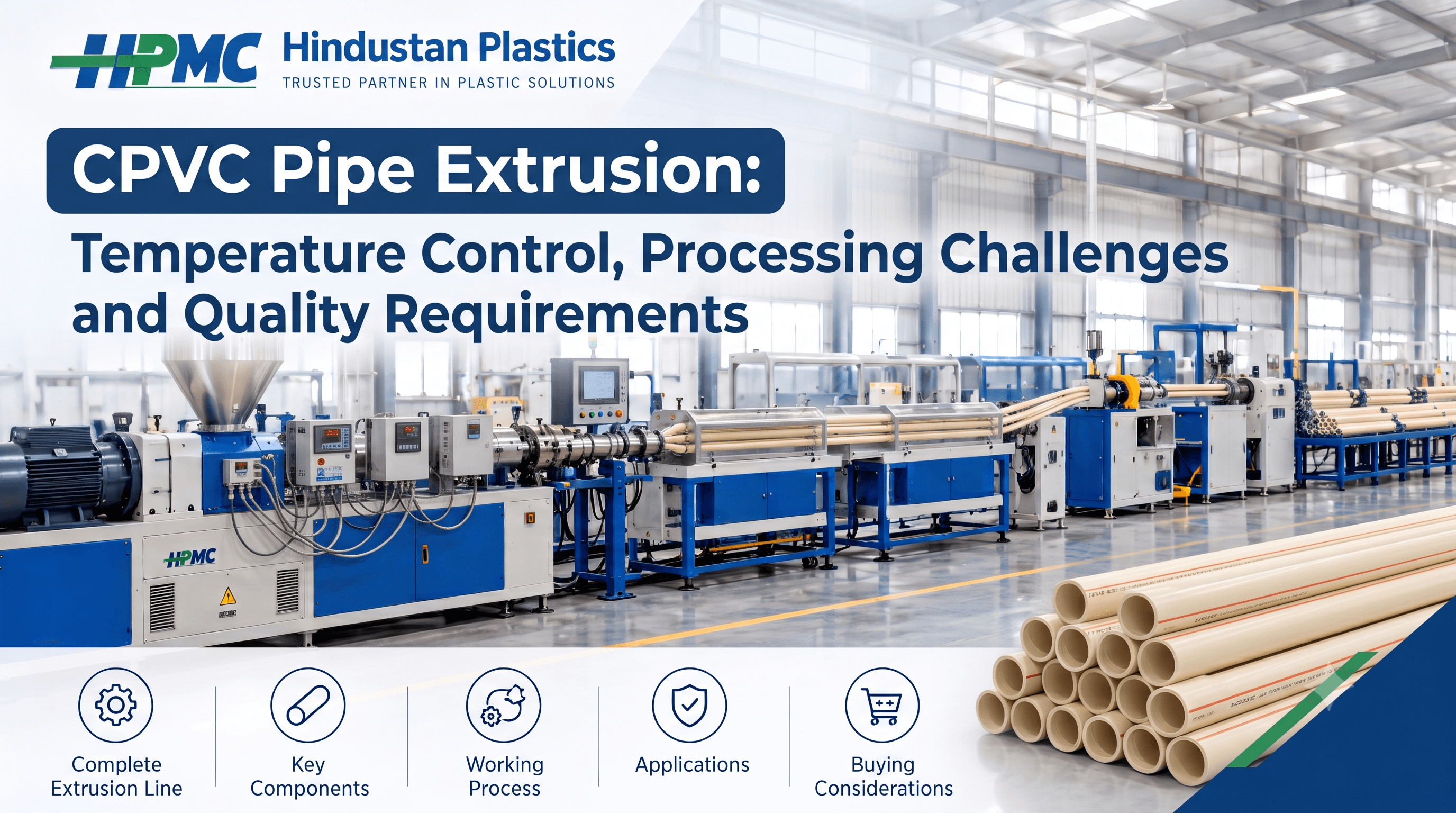
CPVC pipe extrusion is a continuous manufacturing process in which a prepared CPVC compound is processed through an extruder and shaped into a pipe using a specially designed die. The pipe then passes through calibration, cooling, haul-off, and cutting equipment before inspection and packaging.
One important consideration in CPVC manufacturing is temperature management. The processing conditions must be suitable for the compound being used because inappropriate heat exposure or excessive processing can affect material quality and finished-pipe performance.
For manufacturers planning a new production facility or upgrading an existing line, understanding the extrusion process and its quality requirements can help with equipment selection and production planning.
Hindustan Plastics & Machine Corporation (HPMC) offers a Twin Screw Plant for CPVC Pipe. This guide explains the CPVC extrusion process, temperature-control considerations, common production challenges, quality checks, and important machinery selection factors.
What Is CPVC Pipe Extrusion?
CPVC pipe extrusion is a manufacturing process used to convert a prepared CPVC compound into continuous pipes with specified dimensions and properties.
The process generally involves feeding the compound into an extruder, processing it under controlled conditions, forming the pipe through a die, and stabilising its shape through calibration and cooling.
A typical CPVC pipe extrusion line includes:
- A suitable feeding system.
- A conical twin screw extruder.
- A CPVC pipe die.
- A vacuum calibration system.
- Cooling equipment.
- A haul-off unit.
- A cutting system.
- A pipe collection or stacking arrangement.
- An electrical control system.
The exact configuration depends on the pipe diameter, wall thickness, compound formulation, production target, and applicable product requirements.
The equipment should be selected specifically for CPVC processing rather than assuming that every PVC pipe extrusion setup is automatically suitable for CPVC.
Understanding the CPVC Pipe Manufacturing Process
The production process consists of several connected stages. Each stage contributes to the consistency and quality of the finished pipe.
1. CPVC Compound Preparation
The process begins with a prepared CPVC compound formulated for the intended application.
Depending on the formulation, the compound may contain CPVC resin and suitable additives that support processing and the required finished-product properties.
Manufacturers should follow the compound supplier's recommendations for material handling, storage, and processing. Changes in formulation can affect how the material behaves during extrusion.
Consistent material preparation is important because variations in the compound can influence processing stability and finished-pipe performance.
2. Feeding the Material
The prepared compound is supplied to the extruder through an appropriate feeding arrangement.
Consistent feeding helps maintain a stable supply of material to the processing section. Irregular feeding can contribute to fluctuations in output and make process control more difficult.
The feeding system should be compatible with the compound's characteristics and the requirements of the selected extruder.
3. Extrusion and Plasticisation
Inside the extruder, the screw system conveys and processes the CPVC compound under controlled operating conditions.
The combination of mechanical action and heat helps prepare the material for forming. Screw geometry, screw speed, barrel design, and temperature settings all influence processing behaviour.
The equipment must provide suitable conveying, mixing, and output for the selected compound and required pipe specifications.
4. Pipe Formation Through the Die
After processing, the compound passes through a pipe die that forms the required pipe shape.
The die must be suitable for the target diameter, wall thickness, and material flow characteristics.
Incorrect tooling, unsuitable settings, or inconsistent material flow can contribute to dimensional variation and surface irregularities.
5. Calibration and Initial Cooling
After leaving the die, the pipe passes through a calibration system designed to help establish its required dimensions.
Vacuum calibration may be used, depending on the line configuration and pipe specifications. Cooling then helps the pipe retain its shape as it moves through the production line.
Calibration and cooling should be coordinated with the extrusion output to support consistent dimensions.
6. Haul-Off
The haul-off unit pulls the pipe through the downstream equipment at a controlled speed.
The pulling speed must be coordinated with extrusion output. If the settings are not properly matched, pipe dimensions and wall thickness may vary.
A suitable haul-off arrangement helps maintain consistent pipe movement during production.
7. Cutting and Collection
The cutting unit separates the continuous pipe into the required lengths.
The cutting system should operate in coordination with the line speed and product specifications. The finished pipes are then collected for inspection, handling, and packaging.
Before dispatch, the manufacturer should verify that the pipes meet the relevant dimensional, material, and performance requirements.
Why Is Temperature Control Important in CPVC Pipe Extrusion?
Temperature control is a critical consideration when processing CPVC compounds. The required conditions depend on the formulation, equipment design, screw configuration, and production requirements.
The objective is to process the compound under suitable conditions while maintaining consistent material flow and the required finished-product properties.
1. Supporting Consistent Material Processing
The compound needs appropriate thermal and mechanical conditions to pass through the extruder and die consistently.
If the process conditions are unsuitable, material flow may become unstable, making it more difficult to maintain consistent production.
2. Reducing the Risk of Material Degradation
Excessive heat exposure or unsuitable processing conditions can cause thermal degradation in heat-sensitive compounds.
Degradation may affect material appearance, processing behaviour, and the properties of the finished pipe.
Suitable temperature control, appropriate residence time, and adherence to the compound supplier's processing guidance help manage this risk.
3. Maintaining Production Stability
Stable operating conditions help manufacturers maintain a consistent process across production runs.
Changes in feed rate, screw speed, material formulation, or equipment condition may require the process to be reviewed according to the machine manufacturer's recommendations.
4. Supporting Consistent Pipe Quality
Temperature control works together with die design, calibration, cooling, and haul-off settings to influence finished-pipe quality.
Temperature alone cannot guarantee dimensional accuracy or performance. Quality depends on the complete manufacturing process.
Important Temperature-Control Considerations
Manufacturers should:
- Follow the processing guidance supplied for the specific CPVC compound.
- Monitor the relevant barrel and die temperature zones.
- Check that temperature sensors and control systems operate correctly.
- Avoid making arbitrary temperature adjustments.
- Record process settings when investigating recurring production issues.
- Review material condition and equipment performance when unusual defects occur.
There is no single temperature setting suitable for every CPVC formulation and machine. The operating range should be established using the compound supplier's recommendations and the equipment manufacturer's guidance.
Common CPVC Pipe Extrusion Challenges
Production issues can arise from material preparation, processing conditions, tooling, calibration, cooling, or downstream equipment. A systematic investigation is more useful than making random machine adjustments.
1. Surface Discolouration
Unexpected colour changes may indicate a material, formulation, contamination, or processing issue.
Possible areas to inspect include the incoming compound, material handling, temperature-control system, and actual operating conditions.
Discolouration alone does not establish a specific cause, so the material and process should be assessed before changes are made.
2. Uneven Pipe Wall Thickness
Wall-thickness variation can affect whether a pipe meets its specified dimensions.
Potential areas to review include die alignment, material distribution, calibration, haul-off speed, and the consistency of the extrusion process.
Measurements should be taken at suitable locations to determine the extent and pattern of variation.
3. Dimensional Variation
Pipes may fail to maintain their intended diameter or dimensions if calibration, cooling, or pulling conditions are unsuitable.
The die, calibration system, cooling arrangement, and haul-off settings should be checked together rather than in isolation.
4. Rough or Irregular Surface Finish
Surface irregularities can result from several factors, including compound consistency, contamination, die condition, or unsuitable processing conditions.
Inspecting the compound and extrusion tooling can help narrow down the cause.
5. Inconsistent Production Output
Fluctuations in output may be associated with inconsistent feeding, changes in material characteristics, process instability, or equipment-related issues.
Manufacturers should review production records and operating parameters to identify recurring patterns.
6. Pipe Deformation After Extrusion
A pipe may lose its intended shape if calibration, cooling, handling, or downstream support is unsuitable.
The condition of the pipe as it moves through the line should be inspected to identify where the deformation begins.
These challenges should be investigated according to the compound supplier's guidance, machine documentation, and the applicable pipe specifications.
CPVC Pipe Quality-Control Requirements
Quality control helps manufacturers verify that finished pipes meet the intended product requirements.
A suitable inspection process should cover material consistency, dimensions, surface appearance, and any performance tests required by the applicable product standard.
1. Raw Material Inspection
Incoming compounds should be checked against the manufacturer's purchasing specifications and supplier documentation.
Material identification and batch records can help trace production issues back to a particular material lot.
2. Pipe Diameter Measurement
The outer diameter should be measured using suitable inspection equipment and compared with the required specification.
Measurements should be taken consistently so that variations can be identified during production.
3. Wall-Thickness Measurement
Wall thickness is an important dimensional characteristic of pressure piping.
Measurements should follow the applicable product specification and inspection procedure. A suitable sampling plan helps identify variations across production batches.
4. Surface and Visual Inspection
Inspect the pipe for visible irregularities, unexpected discolouration, deformation, or other defects.
Visual inspection is useful, but it does not replace dimensional measurements or performance testing.
5. Length Verification
The finished pipes should be checked to ensure that their lengths meet the order or product requirements.
The cutting system should be reviewed if repeated length variations occur.
6. Applicable Performance Testing
Depending on the intended use and governing standard, CPVC pipes may require additional testing, such as pressure-related or other material-performance tests.
Manufacturers should identify the relevant standard and test requirements for the specific product instead of assuming that a single inspection method covers every application.
7. Production Record Keeping
Recording material batches, machine settings, inspection results, and rejected products can help manufacturers investigate recurring issues and maintain traceability.
A consistent record-keeping process also supports communication between production and quality-control teams.
How to Select a CPVC Pipe Extrusion Machine
Choosing a suitable machine requires evaluating the entire production requirement rather than focusing only on the extruder.
1. Define the Required Pipe Specifications
Identify the pipe diameters, wall thicknesses, lengths, and intended applications.
These requirements influence the extruder configuration, die design, calibration system, and downstream equipment.
2. Confirm CPVC Processing Compatibility
Ask the machinery supplier to confirm that the proposed extruder and production line are suitable for the intended CPVC compound.
Discuss screw configuration, feeding, processing conditions, temperature controls, and the expected production range.
3. Evaluate Production Capacity
Capacity should be assessed against the specific pipe sizes and compound being processed.
Request model-specific output information and clarify the conditions under which the stated output can be achieved.
A maximum capacity figure should not be assumed to apply to every pipe specification.
4. Review Temperature-Control Systems
Ask how the machine manages its processing zones and how operators monitor relevant operating parameters.
The control system should support the processing requirements of the selected compound and the manufacturer's operating procedures.
5. Check Calibration and Cooling
The calibration and cooling arrangement should be suitable for the intended pipe dimensions and production speed.
These systems should be evaluated as part of the complete extrusion line.
6. Consider Cutting and Stacking Equipment
The downstream equipment should match the pipe size range, finished lengths, and expected output.
Confirm which cutting and stacking components are included in the proposed machine configuration.
7. Review Installation and Service Support
Discuss installation, commissioning, operator training, maintenance instructions, spare parts, and technical support.
These services can be important when establishing a new production facility or upgrading existing equipment.
8. Compare the Total Project Cost
The total investment may include the extrusion machine, dies, calibration and cooling equipment, cutting systems, installation, utilities, and other required accessories.
Request a detailed quotation so that the included equipment and any additional costs are clearly identified.
Why Is a Conical Twin Screw Extruder Used for CPVC Pipe Production?
A conical twin screw extruder is one type of extrusion system used for processing rigid thermoplastic compounds, including suitable CPVC formulations.
Its suitability depends on the screw design, machine configuration, compound formulation, and required production conditions.
When evaluating a conical twin screw extruder for CPVC, manufacturers should consider the following:
- Screw configuration: The screw geometry should be suitable for the compound and required processing conditions.
- Temperature control: The system should support appropriate control of the processing zones.
- Feeding and conveying: The feeding arrangement should provide a consistent material supply.
- Output requirements: The machine should be matched to the intended pipe dimensions and production targets.
- Downstream compatibility: The extruder should work effectively with the selected die, calibration, cooling, haul-off, and cutting equipment.
- Maintenance requirements: Spare parts, service access, and maintenance procedures should be considered before purchase.
A conical twin screw extruder should not be selected on the basis of its name alone. Manufacturers should confirm the complete machine specifications and suitability for their specific CPVC compound.
CPVC Pipe Extrusion vs. PVC Pipe Extrusion
CPVC and PVC are related thermoplastic materials, but they are not interchangeable in every processing application.
CPVC has a higher chlorine content than conventional PVC, which contributes to differences in material properties and application suitability. However, the actual performance of a finished pipe depends on its formulation, manufacturing quality, design, and applicable product requirements.
FactorPVC Pipe ExtrusionCPVC Pipe Extrusion
Material
PVC compound
CPVC compound
Processing requirements
Depend on PVC formulation and equipment
Must be appropriate for the specific CPVC compound
Temperature management
Requires suitable thermal control
Requires suitable thermal control for CPVC processing
Machine selection
Based on the intended PVC product
Must be confirmed for the intended CPVC formulation
Applications
Vary by formulation and product specification
Includes suitable hot and cold water plumbing and certain industrial piping applications
Quality requirements
Depend on the product and applicable standard
Depend on the product and applicable standard
Manufacturers should not assume that a machine configured for one material can process the other without checking the formulation, screw design, processing window, and equipment specifications.
For further reading on extrusion equipment, see HPMC's guide to Twin Screw Extruder vs. Single Screw Extruder.
Applications of CPVC Pipes
CPVC pipes are used in applications where their material characteristics meet the system's requirements.
Hot and Cold Water Plumbing
CPVC piping is used in suitable residential and commercial plumbing systems for hot and cold water distribution.
The pipe and fitting system must meet the applicable installation and product requirements.
Commercial Buildings
Commercial buildings may use CPVC piping in plumbing installations where the specified product is suitable for the operating conditions.
Industrial Fluid Handling
Certain CPVC pipe systems are used for industrial fluid handling, depending on the chemical compatibility, pressure, temperature, and other service requirements.
Fire Protection Systems
Some CPVC products are designed for specific fire sprinkler applications. Only products approved or listed for the intended system and installation should be used.
The intended application determines the relevant material formulation, pipe design, testing, and certification requirements. Manufacturers should verify these requirements before producing or supplying pipes for a particular market.
Maintenance Practices for CPVC Pipe Extrusion Equipment
Regular maintenance supports stable operation and helps manufacturers identify equipment issues before they affect production.
Inspect Temperature Sensors and Controls
Check that the relevant sensors, displays, and control functions operate according to the equipment manufacturer's instructions.
Inspect the Die and Material Flow Path
Follow the recommended inspection and cleaning procedures for the die and other material-contact components.
Monitor Screw and Drive Performance
Review operating records and inspect the drive system according to the machine's maintenance schedule.
Maintain Cooling and Calibration Equipment
Check the cooling-water system, spray nozzles, calibration components, and other relevant parts as instructed by the equipment manufacturer.
Check Haul-Off and Cutting Systems
Inspect the pulling mechanism, cutting equipment, and associated controls for wear, alignment, and correct operation.
Keep Maintenance Records
Record inspections, maintenance work, recurring issues, and replaced parts. These records help support troubleshooting and maintenance planning.
All inspection and maintenance work should follow the manufacturer's safety procedures and equipment documentation.
Why Consider HPMC for CPVC Pipe Extrusion Machinery?
Hindustan Plastics & Machine Corporation (HPMC) manufactures extrusion machinery for plastic processing applications and provides a dedicated product offering for CPVC pipe production.
The company's Twin Screw Plant for CPVC Pipe page provides information about its extrusion equipment, machine models, and line components.
Manufacturers considering a CPVC pipe production project should discuss the intended compound, pipe sizes, production target, and required downstream equipment with HPMC.
Before finalising a purchase, request current technical specifications, confirm the expected output for your application, and clarify installation, commissioning, and service arrangements.
Conclusion
CPVC pipe extrusion requires suitable machinery, consistent compound preparation, controlled processing conditions, and effective quality checks. Temperature management is an important part of the process, but finished-pipe quality also depends on die design, calibration, cooling, haul-off, and material consistency.
Manufacturers can improve process monitoring by checking pipe dimensions, wall thickness, surface appearance, finished lengths, and any performance characteristics required by the applicable product standard.
Selecting a suitable extrusion line involves evaluating the intended CPVC compound, production capacity, machine configuration, downstream equipment, installation requirements, and technical support.
For businesses planning to manufacture CPVC pipes, reviewing the available machinery specifications and discussing application-specific requirements with HPMC can help establish an appropriate production setup.
Frequently Asked Questions
Find quick answers to the most common questions about this topic.
CPVC pipe extrusion is a continuous manufacturing process in which a prepared CPVC compound is processed through an extruder, shaped through a die, calibrated, cooled, and cut into finished pipe lengths.
Suitable temperature control helps maintain stable processing conditions and manage the risk of material degradation. The appropriate settings depend on the compound and equipment configuration.
CPVC pipes are manufactured using a suitable pipe extrusion line. Depending on the application, the line may include a conical twin screw extruder, pipe die, calibration system, cooling equipment, haul-off, cutter, and stacking arrangement.
Not automatically. The machine's configuration, screw design, temperature-control capability, and compatibility with the intended compound should be confirmed with the machinery supplier.
Possible causes include material inconsistency, contamination, unsuitable processing conditions, or thermal degradation. Inspection is necessary to determine the actual cause.
Suitable die design, stable material feeding, calibration, cooling, and coordinated haul-off settings can help maintain dimensional consistency. Finished pipes should also be measured against the required specifications.
Depending on the product specification, checks may include outer diameter, wall thickness, length, surface appearance, and relevant performance testing.
Output depends on the machine model, compound formulation, pipe dimensions, screw configuration, tooling, operating conditions, and downstream equipment.
Suitable CPVC pipes are used in hot and cold water plumbing, selected industrial fluid-handling applications, and certain approved fire protection systems.
Maintenance frequency should follow the equipment manufacturer's recommended schedule. Inspection records and operating conditions can also help determine when additional checks are needed.
Evaluate compound compatibility, pipe dimensions, required output, temperature controls, die and calibration systems, cooling, cutting, installation, maintenance, and technical support.