
What is an Extruder?
An extruder is the heart of every plastic extrusion machine. It melts, mixes, compresses, and conveys raw plastic material through a die to manufacture products such as PVC pipes, profiles, conduits, cables, sheets, granules, and compounds.
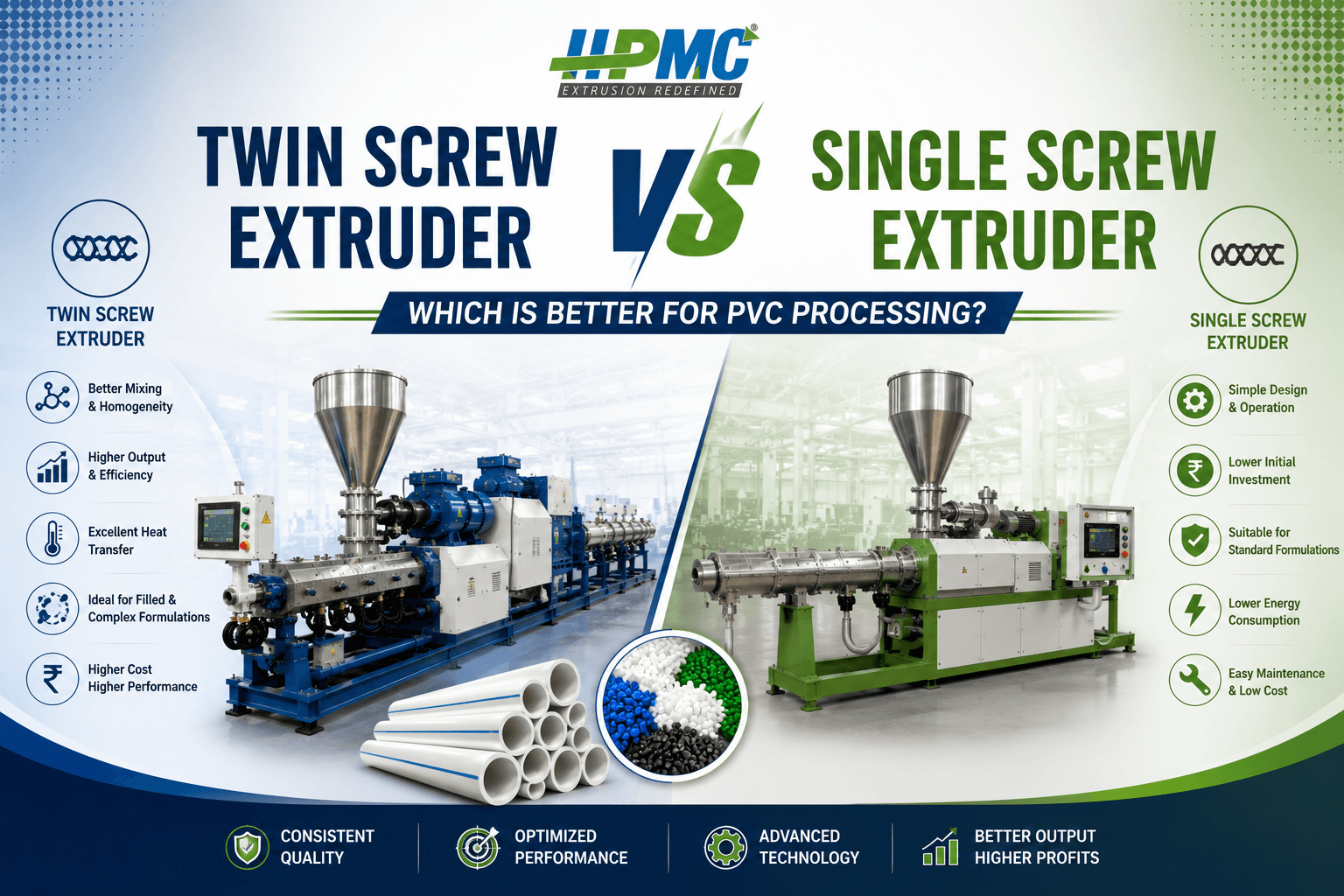
When selecting an extrusion machine, manufacturers often compare Twin Screw Extruders and Single Screw Extruders to determine which system best suits their production requirements. Although both machines perform the same basic function, their design, processing capability, and applications differ significantly.
Understanding these differences is essential before investing in an extrusion line.
What is a Single Screw Extruder?
A Single Screw Extruder consists of one rotating screw housed inside a heated barrel. As plastic material moves through the barrel, it melts due to friction and external heating before being forced through the extrusion die.
Single Screw Extruders are widely used for processing materials that require relatively simple melting and conveying operations.
Advantages of Single Screw Extruders
- Simple machine design
- Lower initial investment
- Easy operation
- Lower maintenance requirements
- Suitable for recycled plastics
- Ideal for PE, PP and similar materials
Limitations
Although efficient for many plastic materials, Single Screw Extruders provide limited mixing capability. They are generally not the preferred choice for rigid PVC processing because PVC requires precise temperature control and uniform material mixing.
What is a Twin Screw Extruder?
A Twin Screw Extruder uses two intermeshing screws rotating inside the barrel. The dual-screw design provides superior mixing, better material dispersion, and more stable processing conditions.
For PVC processing, Twin Screw Extruders are considered the industry standard because they offer greater control over temperature, pressure, and material flow.
These machines are commonly used for manufacturing:
- PVC pipes
- CPVC pipes
- PVC conduit pipes
- Window profiles
- WPC profiles
- PVC compounds
- Cable compounds
Their advanced design ensures consistent product quality and higher production efficiency.
Why Twin Screw Extruders Are Preferred for PVC Processing
PVC is a heat-sensitive material that requires controlled processing conditions to avoid degradation.
A Twin Screw Extruder offers several advantages during PVC processing.
Superior Mixing
The dual-screw design distributes additives uniformly throughout the material, resulting in consistent compound quality.
Better Temperature Control
PVC processing demands accurate temperature management. Twin Screw Extruders provide stable heat distribution, reducing the risk of material degradation.
Higher Production Capacity
Twin Screw Extruders deliver continuous, high-output production while maintaining dimensional accuracy.
Improved Product Quality
Better plasticization results in smoother surfaces, improved mechanical strength, and consistent wall thickness in finished products.
Lower Material Waste
Efficient processing minimizes production scrap and improves raw material utilization.
Which Extruder Should You Choose?
The right choice depends on your manufacturing requirements.
Choose a Single Screw Extruder if you:
- Process PE or PP materials
- Require basic extrusion applications
- Have limited production requirements
- Want a lower initial investment
Choose a Twin Screw Extruder if you:
- Manufacture PVC pipes
- Produce CPVC products
- Manufacture PVC compounds
- Produce window profiles
- Need high production capacity
- Require excellent product consistency
- Want long-term production efficiency
For most PVC applications, Twin Screw Extruders provide better performance and higher long-term returns.
Applications of Twin Screw Extruders
Twin Screw Extruders are widely used across the plastics industry for:
- PVC Pipe Manufacturing
- CPVC Pipe Production
- PVC Conduit Pipe Manufacturing
- PVC Profile Extrusion
- WPC Profile Manufacturing
- PVC Compound Manufacturing
- Cable Grade PVC Compound
- Plastic Recycling
- Engineering Plastic Compounding
- Masterbatch Production
Their versatility makes them one of the most important machines in modern plastic processing plants.
Conclusion
Choosing between a Twin Screw Extruder and a Single Screw Extruder depends on your production requirements, material type, and desired product quality. While Single Screw Extruders are suitable for simple extrusion applications, Twin Screw Extruders deliver superior mixing, consistent processing, and excellent product quality for PVC manufacturing.
For manufacturers involved in PVC pipes, profiles, compounds, and recycling, investing in a Twin Screw Extruder provides long-term operational benefits, improved productivity, and better return on investment.
Frequently Asked Questions
Find quick answers to the most common questions about this topic.
Twin Screw Extruders are generally preferred because they provide better mixing, stable temperature control, and superior product quality.
Yes, but it is generally suitable for limited PVC applications. Most industrial PVC pipe and profile manufacturers prefer Twin Screw Extruders.
Proper mixing ensures uniform distribution of additives, improving product strength, appearance, and processing stability.
Modern Twin Screw Extruders often provide better overall energy efficiency because of optimized processing and reduced material wastage.
Twin Screw Extruders are widely used in PVC pipe manufacturing, PVC compounding, WPC production, cable compound manufacturing, plastic recycling, and engineering plastics.