
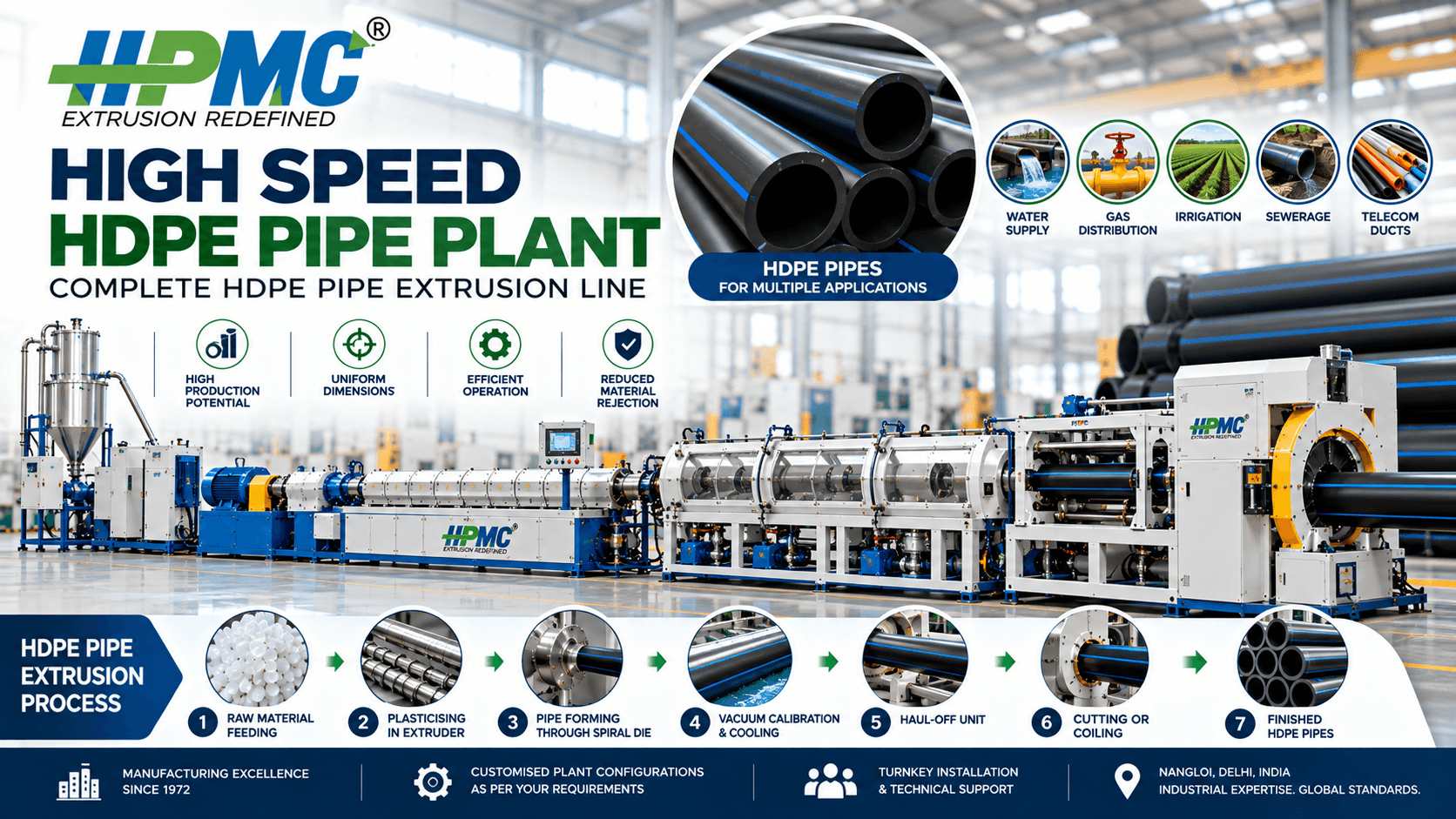
The demand for high-quality HDPE pipes continues to grow across water distribution, irrigation, gas infrastructure, drainage, sewerage and telecommunications. Manufacturers serving these sectors need reliable production equipment that can maintain consistent pipe dimensions, deliver stable output and support efficient manufacturing operations.
A High Speed HDPE Pipe Plant is designed to manufacture high-density polyethylene (HDPE) and other suitable polyethylene (PE) pipes through a continuous extrusion process. The production line melts and homogenises the polymer, forms it through a pipe die, calibrates the pipe dimensions, cools the product and cuts or coils it according to the required specifications.
Hindustan Plastics and Machinery Corporation (HPMC), based in Delhi, India, manufactures plastic processing and extrusion machinery for industrial applications. With experience dating back to 1972, HPMC provides extrusion solutions designed around production requirements, product specifications and plant operating needs.
For manufacturers planning to establish a new pipe production facility or upgrade an existing setup, the HDPE Pipe Extrusion Line offers a solution for producing pipes for a wide range of infrastructure and industrial applications.
What Is a High Speed HDPE Pipe Plant?
A High Speed HDPE Pipe Plant is an integrated extrusion system used to convert HDPE or suitable PE resin into continuous pipes of specified diameters and wall thicknesses.
The process begins with feeding the polymer material into a single screw extruder. Inside the barrel, the material is heated, melted, mixed and conveyed towards the extrusion die. The die forms the molten polymer into a tubular shape, after which the pipe passes through calibration and cooling equipment.
A haul-off unit pulls the pipe through the production line at a controlled speed. Depending on the pipe diameter, wall thickness and application, the finished pipe is cut into fixed lengths or collected using a coiler.
The line's speed and output depend on several factors, including the extruder's configuration, resin grade, pipe dimensions, cooling capacity, downstream equipment and operating conditions. Therefore, a high-speed production line should be selected according to the manufacturer's actual product mix rather than speed alone.
How Does an HDPE Pipe Extrusion Line Work?
A modern HDPE Pipe Manufacturing Plant integrates several stages to transform raw polymer into a finished pipe.
1. Raw Material Feeding
HDPE or suitable PE resin is supplied to the extrusion system. Material preparation and feeding must be appropriate for the resin grade and production requirements.
Consistent feeding helps maintain a stable material supply to the extruder and supports uniform processing.
2. Plasticising and Melt Homogenisation
The grooved-feed single screw extruder conveys the polymer through a heated barrel. As the screw rotates, the material undergoes heating, melting, mixing and pressurisation.
A properly selected screw and barrel configuration helps achieve stable melt delivery. Consistent melt quality is important for maintaining pipe dimensions, surface finish and production continuity.
3. Pipe Formation Through a Spiral Die
The molten polymer enters the spiral die, which distributes the material around the pipe circumference before forming the continuous tubular profile.
Uniform melt distribution is important for achieving consistent wall thickness. Die design, temperature settings, material properties and process adjustments all influence the final pipe quality.
4. Vacuum Calibration
The newly extruded pipe enters the calibration section, where the equipment helps establish and maintain the required outside diameter.
Vacuum calibration is particularly important for controlling pipe dimensions during the early stages of cooling. The appropriate calibration arrangement depends on the pipe diameter and production specification.
5. Spray Cooling
Cooling tanks use controlled water cooling to help the pipe solidify and retain its shape.
Cooling capacity and the arrangement of the tanks must match the required production speed, pipe dimensions and material characteristics. Effective cooling helps maintain dimensional stability as the pipe moves through the line.
6. Haul-Off and Speed Control
The haul-off unit grips and pulls the pipe through the downstream equipment at a controlled speed.
Coordination between the extruder output and haul-off speed is essential. Incorrect speed settings can affect wall thickness, dimensions and overall production stability.
7. Cutting or Coiling
The final stage depends on the pipe diameter, wall thickness, length and intended application.
- Cutting system: Suitable for pipes manufactured in predetermined lengths.
- Coiling system: Used for compatible smaller-diameter pipes supplied in coils.
The finished pipe is then checked against the required dimensional and quality specifications.
8. PLC-Based Process Control
A PLC-based control system helps operators manage and monitor relevant production settings, depending on the machine configuration.
Centralised controls can support repeatable operating procedures and simplify monitoring of the extrusion line. Operators still need to follow suitable process settings, quality checks and maintenance procedures.
Key Features of HPMC's High Speed HDPE Pipe Plant
The plant configuration can be selected according to the intended pipe range, output requirements and production environment.
High-Efficiency Grooved-Feed Single Screw Extruder
The extruder is responsible for melting, conveying and delivering the polymer to the die. A suitable grooved-feed design can support stable material feeding and consistent extrusion when matched with the selected resin and operating conditions.
Spiral Pipe Die
The spiral die distributes the melt around the circumference of the pipe. Correct die selection and adjustment are important for producing pipes with consistent dimensions and wall thickness.
Vacuum Calibration and Spray Cooling Tanks
Calibration and cooling equipment help the pipe maintain its required shape as it transitions from molten polymer to a finished product.
The configuration should be matched to the required diameter range, wall thickness and production speed.
Controlled Haul-Off System
The haul-off unit maintains controlled pipe movement through the line. Stable pulling speed helps coordinate extrusion output with the downstream cooling and sizing process.
Cutting or Coiling Arrangement
The plant can be configured with a cutting or coiling arrangement according to the finished product's dimensions and handling requirements.
PLC-Based Control System
PLC-based controls help manage relevant process parameters and provide operators with a central point for monitoring the production line.
Energy-Conscious Production Design
Energy efficiency depends on the complete machine configuration, motor and drive selection, heating system, operating settings and production load. An appropriately configured line can help manufacturers manage energy consumption while maintaining the required product quality.
Technical Support and Installation
HPMC offers turnkey installation and technical service for customers planning to establish or expand their pipe manufacturing operations. The scope of installation and support should be confirmed according to the project requirements.
Applications of an HDPE Pipe Manufacturing Plant
HDPE pipes are used in infrastructure, utilities, agriculture and industrial installations. The final application determines the required pipe dimensions, resin grade and applicable product standards.
1. Water Supply and Distribution
HDPE pipes are widely used in water distribution networks because suitable pipe grades can provide durability, flexibility and resistance to corrosion.
Manufacturers supplying this sector must maintain the specified dimensions, pressure rating and quality requirements for the intended use.
2. Gas Distribution
Specially designed PE pipes are used in approved gas distribution applications. These pipes require suitable raw materials, controlled manufacturing processes and compliance with the applicable safety and product standards.
A production line intended for gas pipes should be specified according to the required standards and product range.
3. Agricultural Irrigation
HDPE and PE pipes are used in irrigation systems for transporting water across farms, agricultural installations and distribution networks.
Pipe manufacturers can select suitable line configurations according to the diameters, wall thicknesses and quantities required by their customers.
4. Sewerage and Drainage
Suitable PE pipes are used in drainage and sewerage applications, including underground utility systems. The pipe design must meet the mechanical and dimensional requirements of the intended installation.
5. Telecom and Cable Ducts
PE ducts help protect telecommunications and other cables during installation and service. Manufacturers may require a different production configuration for small-diameter ducts compared with larger water or sewerage pipes.
6. Industrial Fluid Transportation
Suitable HDPE pipes can be used in selected industrial applications where the material's chemical compatibility, pressure rating and operating conditions meet the requirements of the installation.
Benefits of Investing in a High Speed HDPE Pipe Extrusion Line
Selecting a suitable production line can help pipe manufacturers improve manufacturing consistency and support business expansion.
Higher Production Potential
A high-speed extrusion line is designed to support efficient continuous production. Actual output depends on pipe diameter, wall thickness, material grade, line configuration, cooling capacity and operating conditions.
Manufacturers should evaluate achievable output for their intended pipe specifications rather than relying on a speed figure alone.
Consistent Pipe Dimensions
A coordinated extrusion, calibration, cooling and haul-off system helps maintain dimensional consistency. Stable processing is especially important for pipes that must meet defined outside diameter, wall thickness and pressure-class requirements.
Improved Melt Quality
Appropriate screw design, temperature control and material feeding help support a uniform melt. Consistent processing can reduce variations in the finished pipe and improve production repeatability.
Potential Reduction in Material Rejection
Correct machine selection, stable process settings, preventive maintenance and regular quality checks can help reduce defects and rejected material.
However, rejection rates also depend on resin quality, operator practices, tooling condition and adherence to the required manufacturing standards.
Efficient Production Management
A PLC-based control system can help operators monitor relevant settings and maintain repeatable production procedures. This can be useful for facilities producing several pipe sizes or managing frequent production changes.
Support for Different Infrastructure Markets
Depending on the machine configuration, a PE pipe extrusion line can serve water supply, irrigation, drainage, telecom ducts and other compatible pipe applications.
The required diameter range, material and compliance specifications should be finalised before ordering the equipment.
Long-Term Operational Planning
A production line should be evaluated not only on its purchase price but also on energy use, tooling, maintenance, spare parts, operator training and expected production requirements.
HPMC's installation and technical support services can form part of the equipment planning process.
How to Choose the Right HDPE Pipe Making Machine
Before purchasing an HDPE Pipe Making Machine, manufacturers should define their production requirements in detail.
1. Identify the Pipe Diameter Range
Determine the minimum and maximum pipe diameters required for your product portfolio.
The intended diameter range affects the extruder size, die tooling, calibration equipment, cooling arrangement and downstream machinery.
2. Specify Wall Thickness and Pressure Requirements
Pipe wall thickness varies according to the pipe's dimensions, material grade, pressure classification and applicable product standard.
Provide the manufacturer with the intended specifications so that the production line can be configured appropriately.
3. Define the Required Output
Estimate production demand based on expected sales, operating hours, product mix and planned capacity utilisation.
Remember that output in kilograms per hour and output in metres per minute are not interchangeable. The weight per metre changes with the pipe diameter and wall thickness.
4. Select the Appropriate Extruder Configuration
The extruder should be matched to the polymer grade, pipe dimensions, desired output and operating requirements.
A larger extruder is not automatically the best option for every manufacturer. The appropriate configuration should balance production demand, operating efficiency and investment cost.
5. Evaluate Calibration and Cooling Capacity
The calibration and cooling system must be capable of supporting the required line speed without compromising dimensional stability.
Insufficient cooling or poorly coordinated line settings can limit usable production speed even when the extruder has additional output capacity.
6. Choose Cutting or Coiling Equipment
The choice depends on the pipe's diameter, stiffness, length and intended market.
Discuss handling and downstream requirements with the machinery supplier before finalising the line configuration.
7. Review Automation and Quality Control
Evaluate the control system, operator interface, process monitoring and quality-checking arrangements available with the proposed configuration.
The plant should support the checks needed to verify dimensions, wall thickness and other product-specific requirements.
8. Confirm Installation and After-Sales Support
Before purchasing, confirm the scope of installation, commissioning, operator training, maintenance guidance, spare parts availability and technical assistance.
You can also explore HPMC's technical assistance services, field services and machine manuals for information about equipment support resources.
High Speed HDPE Pipe Plant Price in India
The price of a High Speed HDPE Pipe Plant depends on its technical specifications and the level of customisation required.
Factors influencing the quotation include:
- Required pipe diameter range and wall thickness.
- Target production output and operating speed.
- Extruder size and configuration.
- Pipe die and tooling requirements.
- Vacuum calibration and cooling tank configuration.
- Haul-off and cutting or coiling equipment.
- PLC controls and automation features.
- Installation, commissioning and training requirements.
- Additional accessories and project-specific arrangements.
A lower initial purchase price does not necessarily represent the lowest long-term operating cost. Manufacturers should compare equipment configurations, energy requirements, expected production performance, maintenance needs and after-sales support.
HPMC provides quotations based on customer requirements. To request a price, share your intended pipe diameter range, wall thickness, application, material and target output.
Why Choose HPMC for an HDPE Pipe Extrusion Line?
Hindustan Plastics and Machinery Corporation has served the plastics processing machinery industry since 1972.
When evaluating HPMC for an HDPE pipe production project, customers can discuss their required product range, production targets and plant configuration with the company.
Key considerations include:
- Industry experience: Experience in plastics processing and extrusion machinery since 1972.
- Application-focused configuration: Equipment planning around the intended pipe range and manufacturing requirements.
- Integrated production line: Extrusion, die, calibration, cooling, haul-off and finishing equipment selected according to the project.
- Turnkey installation: Installation and commissioning support, subject to the agreed project scope.
- Technical assistance: Support for equipment operation and maintenance.
- Long-term planning: Access to relevant technical resources and service discussions.
Explore HPMC's official website to learn more about its machinery and services.
Related HPMC Products and Resources
If you are evaluating plastic extrusion equipment for your manufacturing facility, the following HPMC pages may also be useful:
- PVC Conduit Pipe Plant — for manufacturers exploring PVC conduit pipe production.
- Two-Pipe PVC Conduit Plant — for specific multi-strand PVC conduit production requirements.
- Four-Pipe PVC Conduit Plant — for manufacturers evaluating a four-pipe PVC conduit configuration.
- Twin Screw Plant for CPVC Pipe — for CPVC pipe extrusion applications.
- Spare Parts — for information about machine spare parts.
- Extrusion Hints — for additional extrusion-related guidance.
- Troubleshooting Resources — for equipment troubleshooting information.
- Frequently Asked Questions — for general information about HPMC and its services.
These products and resources cover different machinery and processing requirements. Confirm compatibility and configuration with HPMC before making a purchase decision.
Conclusion
A High Speed HDPE Pipe Plant is an important investment for manufacturers supplying water distribution, irrigation, sewerage, gas infrastructure, telecom ducts and other compatible PE pipe applications. The right extrusion line should combine suitable melt processing, accurate pipe formation, effective calibration and cooling, controlled haul-off and reliable finishing equipment.
HPMC manufactures plastic processing and extrusion machinery and has served the industry since 1972. By defining the required pipe specifications, production targets and application standards, manufacturers can work towards selecting an appropriate HDPE Pipe Extrusion Line for their facility.
For machine configuration, pricing, installation and technical support, contact Hindustan Plastics and Machinery Corporation.
Contact Hindustan Plastics and Machinery Corporation (HPMC)
Company: Hindustan Plastics and Machinery Corporation (HPMC)
Address: 5, Category II, DSIDC Industrial Area, Nangloi, Delhi – 110041, India
Phone: +91 95605 96392
Email: info@hindustanplastics.com
Website: https://www.hindustanplastics.com/
Request a Quote: Contact HPMC
Google Business Profile: View HPMC on Google
Contact HPMC with your pipe diameter range, wall thickness, intended application and expected production output to discuss a suitable machine configuration and request a quotation.
Frequently Asked Questions
Find quick answers to the most common questions about this topic.
A High Speed HDPE Pipe Plant is a production line that melts and extrudes HDPE or suitable PE resin into continuous pipes. It typically includes an extruder, pipe die, calibration and cooling equipment, haul-off and cutting or coiling equipment.
Depending on the machine configuration and finished pipe specifications, an HDPE Pipe Extrusion Line can produce pipes for water supply, irrigation, sewerage, drainage, telecom ducts, cable protection and suitable industrial applications. Special requirements apply to gas distribution pipes.
The described HPMC plant uses a high-efficiency grooved-feed single screw extruder. The appropriate extruder configuration depends on the required pipe dimensions, resin grade and production targets.
A spiral die distributes molten polymer around the pipe circumference before shaping it into a tube. Proper die selection and process adjustment help support consistent melt distribution and uniform wall thickness.
Vacuum calibration helps establish and maintain the required outside diameter while the extruded pipe begins cooling. Correct calibration is important for achieving the specified dimensions.
A line may support a defined range of pipe diameters when the appropriate dies, calibration components and downstream arrangements are available. The compatible range should be confirmed with HPMC before ordering.
Output depends on extruder capacity, resin properties, pipe diameter, wall thickness, die configuration, cooling capacity, haul-off speed and operating conditions. The achievable output should be evaluated for the intended product specifications.
The price depends on the machine configuration, pipe diameter range, production requirements, tooling, automation and installation scope. Contact HPMC for a quotation based on your specific requirements.
HPMC offers turnkey installation and technical service. Confirm the exact scope of commissioning, training, maintenance support and other services while discussing your project quotation.
Visit the HPMC contact page, call +91 95605 96392 or email info@hindustanplastics.com. Share your pipe specifications, intended application and production targets to help determine a suitable configuration.