
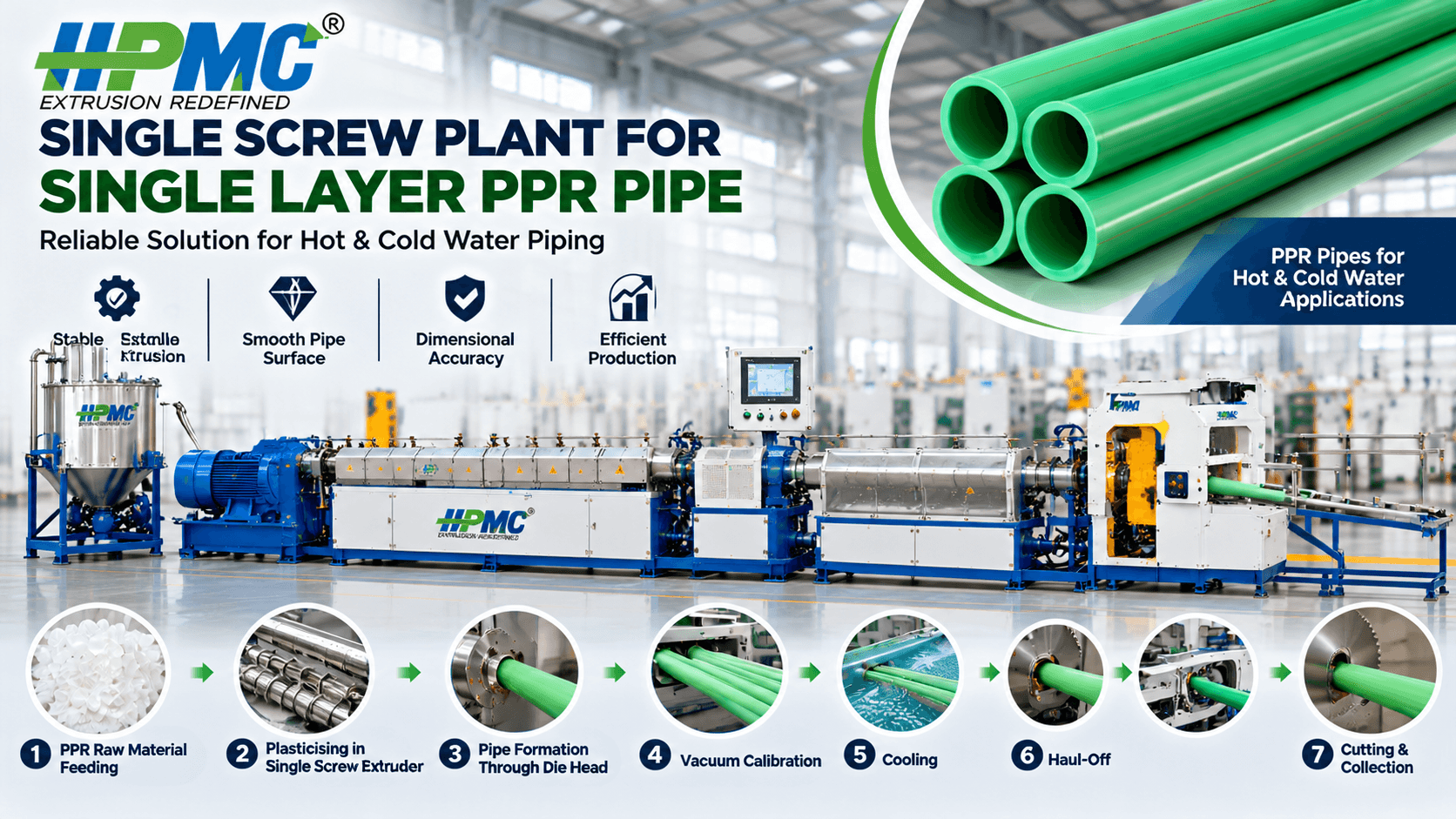
Polypropylene random copolymer (PPR) pipes are widely used in plumbing and building services for hot and cold water distribution. Manufacturers supplying this market require dependable extrusion machinery capable of producing pipes with consistent dimensions, a smooth surface and suitable material properties for the intended application.
A Single Screw Plant for Single Layer PPR Pipe is designed to manufacture single-layer PPR pipes through a continuous plastic extrusion process. The line combines material melting, pipe formation, vacuum calibration, cooling, haul-off and cutting to convert suitable PPR raw material into finished pipes.
Hindustan Plastics and Machinery Corporation (HPMC), based in Delhi, India, manufactures plastic processing and extrusion machinery. With experience dating back to 1972, HPMC serves manufacturers looking for equipment suited to their production requirements and industrial applications.
For businesses planning to enter the PPR pipe market or expand an existing manufacturing facility, a properly configured PPR Pipe Extrusion Line can support consistent production for plumbing and construction applications.
What Is a Single Layer PPR Pipe Plant?
A Single Layer PPR Pipe Plant is an extrusion system used to produce pipes from suitable PPR material with a single material layer. Unlike multilayer pipe systems, a single-layer line forms the pipe from one primary material layer, subject to the specified resin and product requirements.
The production process begins when PPR raw material enters the single screw extruder. The screw conveys and melts the polymer inside a heated barrel before pushing it through a pipe die head. The molten material is shaped into a continuous pipe, which then passes through vacuum calibration and cooling equipment.
A haul-off unit pulls the pipe through the production line at a controlled speed, and a cutter divides it into the required lengths.
The final quality depends on material selection, extruder configuration, die design, calibration, cooling and operating conditions. These factors must work together to achieve the dimensions and product specifications required by the manufacturer.
How Does a Single Screw PPR Pipe Extrusion Line Work?
A PPR pipe production line follows several connected stages.
1. Raw Material Feeding
Suitable PPR resin is supplied to the extruder according to the required pipe specification.
Consistent material feeding supports stable processing and helps reduce variations in production. The material grade should be appropriate for the intended hot or cold water application and applicable product requirements.
2. Plasticising in the Single Screw Extruder
The single screw extruder conveys the PPR material through a heated barrel. As the screw rotates, the material is heated, melted and homogenised before being delivered to the die head.
Proper temperature control and screw operation help maintain a consistent melt suitable for pipe formation.
3. Pipe Formation Through the Die Head
The molten PPR material passes through a pipe die head, which shapes it into a continuous tubular profile.
The die must be matched to the required pipe diameter and production specifications. Correct die adjustment helps support uniform material distribution and consistent wall thickness.
4. Vacuum Calibration
After leaving the die, the newly formed pipe enters the vacuum calibration tank.
The calibration system helps establish and maintain the required outside diameter while the pipe begins to cool. Proper calibration is important for achieving consistent pipe dimensions.
5. Cooling
The pipe passes through the cooling section, where controlled cooling helps the material solidify and retain its shape.
Cooling capacity must be appropriate for the pipe diameter, wall thickness and production speed. Insufficient or poorly controlled cooling can affect dimensional stability and limit achievable line output.
6. Haul-Off
The haul-off unit pulls the pipe through the production line at a controlled speed.
The haul-off speed must be coordinated with extruder output. Correct coordination helps maintain consistent dimensions and supports stable production.
7. Cutting and Finished Pipe Handling
Once the pipe has cooled sufficiently, the cutter divides it into predetermined lengths.
The finished pipes can then be inspected for dimensions, surface quality and other requirements specified for the intended application.
Key Features of HPMC's Single Layer PPR Pipe Plant
High-Efficiency Single Screw Extruder
The single screw extruder is responsible for melting, homogenising and conveying the PPR material. A suitably configured extruder helps maintain a stable melt supply to the die head.
The appropriate configuration depends on the required pipe sizes, resin grade and production targets.
Precision Pipe Die Head
The die head forms the molten polymer into a pipe. Proper tooling selection and adjustment help achieve the required diameter and wall thickness.
Vacuum Calibration Tank
Vacuum calibration supports dimensional control as the pipe begins to cool. It plays an important role in maintaining the specified outside diameter.
Cooling System
The cooling section helps solidify the extruded pipe and maintain its shape. The required cooling arrangement depends on production speed and pipe specifications.
Controlled Haul-Off Unit
The haul-off unit maintains steady pipe movement through the downstream equipment. Coordinated pulling speed supports consistent production and helps reduce dimensional variations.
Pipe Cutting System
The cutter produces pipes in the required lengths. The cutting arrangement should be appropriate for the intended pipe dimensions and production requirements.
Straightforward Operation
A well-configured production line allows operators to manage important process settings, monitor output and follow repeatable operating procedures. Actual ease of operation depends on the machine configuration and operator training.
Energy-Conscious Production
Power consumption depends on extruder size, motor and drive selection, heating requirements, operating speed and production load. Selecting the appropriate equipment configuration can help manufacturers manage energy consumption without compromising required product quality.
Applications of Single Layer PPR Pipes
Single-layer PPR pipes are used in plumbing and building services where the selected material and pipe specifications are suitable for the application.
1. Hot Water Plumbing
PPR pipes manufactured for suitable temperature and pressure conditions can be used in hot water distribution systems. Manufacturers must select the appropriate resin and ensure the finished pipe meets the requirements for its intended operating conditions.
2. Cold Water Distribution
PPR pipes are used in cold water plumbing networks in residential, commercial and selected industrial buildings.
Consistent pipe dimensions are important for installation, fitting compatibility and reliable plumbing connections.
3. Residential Plumbing Systems
Single-layer PPR pipes can be used in suitable domestic water distribution systems, including installations in apartments, houses and residential developments.
4. Commercial Buildings
Offices, hotels, educational institutions and other commercial facilities require dependable plumbing systems. PPR pipes can serve these installations when selected according to the required specifications.
5. Building and Plumbing Supply Markets
Pipe manufacturers can supply distributors, plumbing contractors, construction companies and building material retailers. The required pipe sizes, pressure ratings and product standards depend on the target market.
6. Selected Industrial Water Systems
PPR pipes may be suitable for certain industrial water applications, subject to material compatibility, temperature, pressure and operating requirements. Suitability should be confirmed for each application.
Benefits of Investing in a PPR Pipe Manufacturing Plant
Choosing the right PPR Pipe Manufacturing Plant can help manufacturers establish a consistent production process and serve plumbing and construction markets.
Consistent Pipe Quality
A coordinated extruder, die, calibration and cooling system helps support uniform pipe dimensions and a smooth surface. Consistency is particularly important for fitting compatibility and finished-product quality.
Stable Production
Suitable material feeding and controlled extrusion conditions help maintain a steady production process. Stable operation can make it easier to plan manufacturing schedules and manage output.
Efficient Manufacturing Operations
A properly selected single screw extrusion line can support continuous pipe production. The actual output depends on the machine configuration, pipe dimensions, resin properties and operating conditions.
Potentially Lower Power Consumption
Energy use depends on the complete line design and how the machine is operated. Manufacturers should evaluate motor specifications, heating systems, production load and energy consumption when comparing equipment.
Straightforward Process Management
The production line uses a sequence of connected stages: extrusion, pipe formation, calibration, cooling, haul-off and cutting. With appropriate training and operating procedures, this can support repeatable production management.
Reduced Production Waste Potential
Stable processing, correct tooling, suitable raw material and regular quality checks can help minimise dimensional defects and rejected pipes. Actual rejection levels depend on material quality, process control, maintenance and operator practices.
Support for Plumbing and Construction Markets
A suitable PPR pipe line can help manufacturers supply pipe products for residential plumbing, commercial construction and other compatible applications.
The required diameter range, wall thickness, pressure rating and applicable standards should be established before equipment selection.
How to Choose the Right PPR Pipe Making Machine
Before purchasing a Single Layer PPR Pipe Plant, manufacturers should assess their expected production requirements.
1. Define the Required Pipe Sizes
Identify the minimum and maximum pipe diameters you plan to manufacture. The required range affects the extruder configuration, die tooling, calibration tank and downstream equipment.
2. Specify Wall Thickness and Pressure Requirements
Different applications require different pipe dimensions and pressure ratings. Share the intended pipe specifications and applicable standards with the machinery supplier before finalising the line.
3. Confirm the PPR Material Grade
Select raw materials suitable for the intended hot or cold water application. Material characteristics influence processing conditions and the performance requirements of the finished pipe.
4. Evaluate Production Targets
Estimate the output needed to meet customer demand and planned operating hours. Ask the manufacturer to assess the expected output for your intended pipe sizes rather than relying on a general capacity estimate.
5. Review Die and Calibration Requirements
The die head and calibration equipment must be compatible with the pipe sizes and tolerances required. Confirm the available tooling and any additional components needed for product changes.
6. Assess Cooling Capacity
The cooling arrangement should support the intended line speed while maintaining pipe dimensions and surface quality. Cooling requirements vary with pipe diameter, wall thickness and production conditions.
7. Check Cutting and Handling Equipment
Confirm that the cutting system can accommodate the required pipe lengths and production workflow. Consider how finished pipes will be collected, inspected, stored and transported.
8. Consider Installation and Technical Support
Before placing an order, clarify the scope of installation, commissioning, operator training, maintenance guidance and spare parts support.
HPMC also provides technical resources through its technical assistance services, field services and machine manuals.
Single Layer PPR Pipe Plant Price in India
The price of a Single Layer PPR Pipe Plant depends on the production requirements and the configuration selected.
Important factors affecting the quotation include:
- Required pipe diameter range.
- Pipe wall thickness and pressure specifications.
- Extruder size and configuration.
- Die head and tooling requirements.
- Vacuum calibration tank design.
- Cooling system configuration.
- Haul-off and cutting equipment.
- Automation and control features.
- Installation, commissioning and training requirements.
- Additional accessories and project-specific needs.
When comparing machinery quotations, manufacturers should consider more than the initial purchase price. Equipment compatibility, energy requirements, maintenance, production consistency and technical support can all influence long-term operating costs.
HPMC provides quotations based on the customer's requirements. To discuss pricing, share the intended pipe sizes, wall thicknesses, target output and application.
Why Choose HPMC for a PPR Pipe Extrusion Line?
Hindustan Plastics and Machinery Corporation has been serving the plastics processing machinery industry since 1972.
Manufacturers considering HPMC for a PPR pipe production project can discuss their required specifications, expected output and production setup with the company.
Key considerations include:
- Industry experience: Serving the plastics machinery sector since 1972.
- Application-focused planning: Machine configuration based on pipe dimensions and production requirements.
- Integrated production equipment: Extruder, die head, calibration, cooling, haul-off and cutting equipment.
- Installation support: Turnkey installation services, subject to the agreed project scope.
- Technical assistance: Support resources for equipment operation and maintenance.
- Production planning: Opportunity to discuss machine configuration according to the intended product range.
Visit the official HPMC website to explore the company's machinery and services.
Related HPMC Products and Resources
The following HPMC pages may be useful when researching plastic pipe and extrusion machinery:
- Twin Screw Plant for CPVC Pipe — for manufacturers exploring CPVC pipe extrusion.
- PVC Conduit Pipe Plant — for PVC conduit pipe production requirements.
- Two-Pipe PVC Conduit Plant — for a specific two-pipe PVC conduit configuration.
- Four-Pipe PVC Conduit Plant — for four-pipe PVC conduit manufacturing requirements.
- Technical Assistance — for technical support information.
- Spare Parts — for information about machine spare parts.
- Extrusion Hints — for additional extrusion guidance.
- Troubleshooting Resources — for troubleshooting information.
- Frequently Asked Questions — for general information about HPMC.
These pages cover different equipment types and technical requirements. Confirm the suitability of a particular machine for PPR pipe production directly with HPMC.
Conclusion
A Single Screw Plant for Single Layer PPR Pipe is designed to manufacture PPR pipes for suitable hot and cold water plumbing applications. Its performance depends on the coordination of the extruder, die head, vacuum calibration tank, cooling system, haul-off and cutter.
For manufacturers serving the plumbing and construction sectors, selecting a line based on pipe dimensions, material requirements, production targets and applicable standards is essential for establishing a dependable manufacturing process.
Hindustan Plastics and Machinery Corporation has served the plastics machinery industry since 1972 and offers extrusion machinery, installation and technical support services. Contact HPMC to discuss your requirements and request a quotation for a suitable PPR pipe production line.
Contact Hindustan Plastics and Machinery Corporation (HPMC)
Company: Hindustan Plastics and Machinery Corporation (HPMC)
Address: 5, Category II, DSIDC Industrial Area, Nangloi, Delhi – 110041, India
Phone: +91 95605 96392
Email: info@hindustanplastics.com
Website: https://www.hindustanplastics.com/
Request a Quote: Contact HPMC
Google Business Profile: View HPMC on Google
When contacting HPMC, share your required pipe diameters, wall thicknesses, intended applications and production targets to help the team assess a suitable machine configuration.
Frequently Asked Questions
Find quick answers to the most common questions about this topic.
It is an extrusion production line that converts suitable PPR raw material into single-layer pipes. The line generally includes a single screw extruder, die head, vacuum calibration tank, cooling system, haul-off and cutter.
Single-layer PPR pipes are used in suitable hot and cold water plumbing systems in residential, commercial and selected industrial buildings. The intended application must match the pipe's material, temperature and pressure specifications.
The described HPMC line uses a single screw extruder. The appropriate configuration depends on the required pipe sizes, material grade and production targets.
The vacuum calibration tank helps establish and maintain the pipe's outside diameter while the material begins cooling. Proper calibration supports dimensional consistency.
Cooling helps the extruded pipe solidify and retain its shape. The cooling arrangement must match the pipe dimensions and production speed to support dimensional stability.
A line may support multiple pipe sizes when compatible die tooling and calibration components are available. Confirm the supported range and tooling requirements with HPMC before purchasing.
Output depends on extruder configuration, resin grade, pipe diameter, wall thickness, die design, cooling capacity and operating conditions. The achievable output should be evaluated against the intended pipe specifications.
The price depends on the machine configuration, required pipe sizes, tooling, production targets, control features and installation requirements. Contact HPMC for a project-specific quotation.
HPMC offers turnkey installation and technical service. Confirm the exact scope of commissioning, training, maintenance guidance and other support services while discussing the quotation.
Visit the HPMC contact page, call +91 95605 96392 or email info@hindustanplastics.com. Include your pipe dimensions, intended application and production targets.