
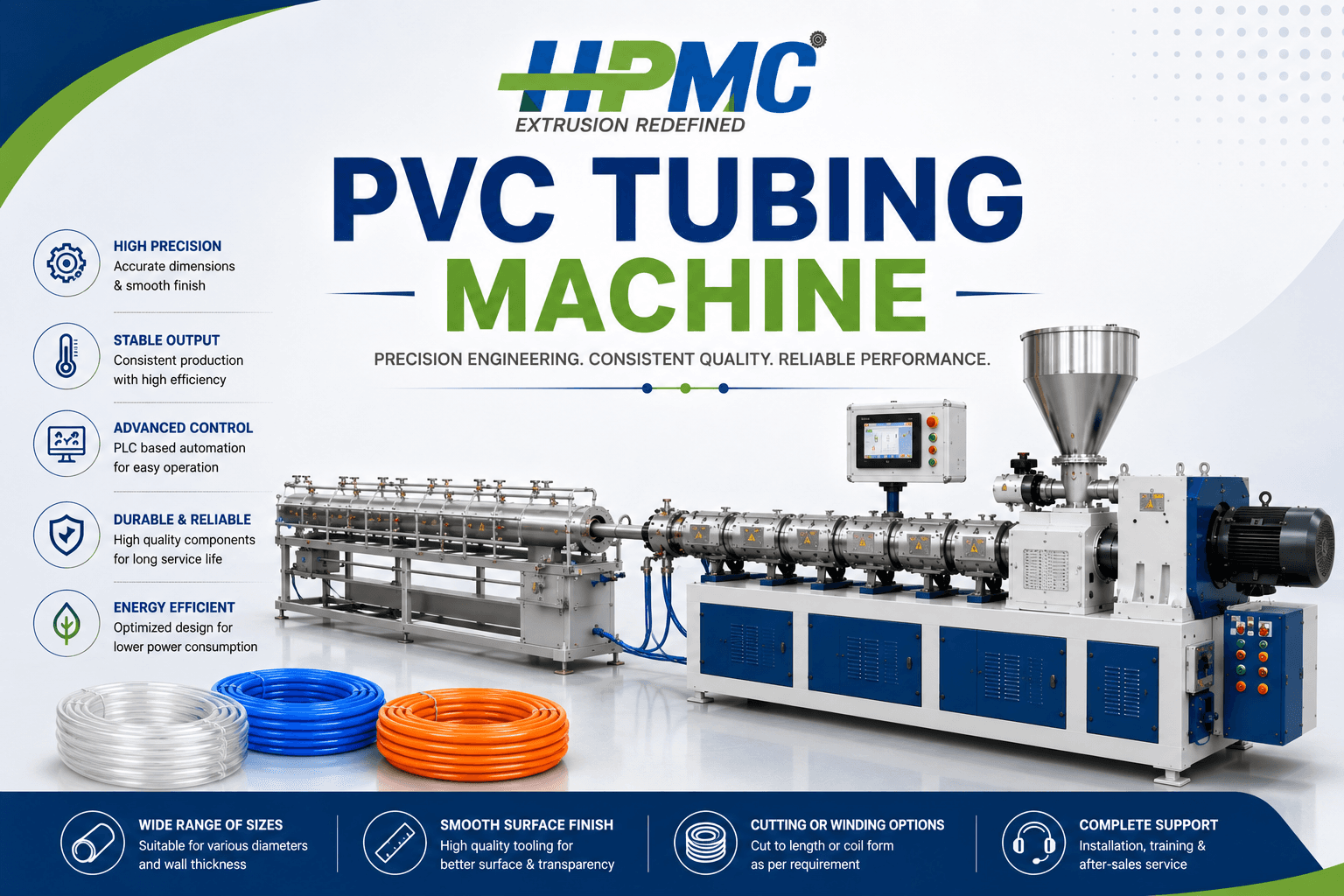
PVC tubing is used across multiple industries because of its flexibility, durability, chemical resistance, and versatile processing characteristics. From industrial hoses and medical applications to electrical protection and fluid transportation, PVC tubing is available in different sizes, thicknesses, hardness levels, and formulations.
Manufacturing high-quality PVC tubing requires a properly designed extrusion system. A reliable PVC Tubing Machine helps manufacturers maintain consistent dimensions, controlled wall thickness, smooth surface finish, and stable production output.
For businesses searching for PVC Tubing Machine Manufacturers, selecting the right machinery partner is an important investment decision. Factors such as extrusion technology, production capacity, tooling, temperature control, automation, machine components, and after-sales support should be carefully evaluated before purchasing a machine.
What is a PVC Tubing Machine?
A PVC Tubing Machine is an extrusion-based production system used to manufacture PVC tubes and tubing products.
The machine processes PVC material through a controlled extrusion process and forms it into the required tube shape using a specialized die. The extruded tubing then passes through calibration, cooling, haul-off, and cutting or winding equipment.
A typical PVC tubing extrusion line may include:
- Raw material feeding system
- Extruder
- Screw and barrel
- Tubing extrusion die
- Calibration system
- Cooling tank
- Haul-off unit
- Cutting or winding system
- Electrical control panel
The exact configuration depends on the type of tubing, diameter, wall thickness, production capacity, and required level of automation.
How Does a PVC Tubing Extrusion Machine Work?
The PVC tubing manufacturing process begins with preparing the required PVC formulation. The formulation may include PVC resin along with stabilizers, plasticizers, lubricants, pigments, and other additives depending on the desired properties of the finished tubing.
The prepared material is fed into the extruder, where controlled heating and mechanical action help plasticize and process the PVC.
The processed material is then pushed through a specially designed tubing die. The die determines the initial shape and dimensions of the tube.
After leaving the die, the tubing passes through a calibration and cooling system. This stage helps stabilize the tubing and maintain the required diameter and wall thickness.
A haul-off unit continuously pulls the tubing through the line at a controlled speed. Depending on the application, the finished tubing can then be cut into specific lengths or wound into coils.
Types of PVC Tubing
PVC tubing can be manufactured in different formulations according to its intended application.
Flexible PVC Tubing
Flexible PVC tubing contains plasticizers that provide flexibility and ease of handling. It can be used for hoses, fluid transportation, and various industrial applications.
Rigid PVC Tubing
Rigid PVC tubing has greater dimensional stability and is used where a firm and durable tube structure is required.
Transparent PVC Tubing
Transparent tubing allows users to visually inspect the material or fluid passing through it and can be manufactured using suitable PVC formulations and processing conditions.
Reinforced PVC Tubing
Some applications require additional strength. Reinforced tubing may incorporate suitable reinforcement structures depending on the product design and manufacturing process.
Key Features of a High-Quality PVC Tubing Machine
When evaluating PVC Tubing Machine Manufacturers, consider the complete extrusion system rather than focusing only on the extruder.
Efficient Extrusion Technology
The extruder should provide stable material conveying, plasticization, and output. Proper screw and barrel design contributes to consistent PVC processing.
Precise Temperature Control
PVC requires controlled processing temperatures. A reliable temperature control system helps maintain stable extrusion conditions and consistent tubing quality.
Accurate Tooling
The extrusion die is critical to tubing production. Proper die design helps achieve the required tube diameter, wall thickness, and surface quality.
Effective Cooling System
The cooling system stabilizes the tubing after extrusion and helps maintain dimensional accuracy during continuous production.
Stable Haul-Off
Consistent haul-off speed is important because changes in pulling speed can affect tubing dimensions and wall thickness.
Automated Cutting or Winding
Depending on the product, the line can be configured with cutting equipment for fixed-length tubing or winding systems for continuous coils.
PLC-Based Automation
Modern control systems allow operators to monitor and adjust important production parameters such as temperature, extrusion speed, and haul-off speed.
How to Choose PVC Tubing Machine Manufacturers
Selecting the right manufacturer requires careful evaluation of technical and commercial factors.
Check Manufacturing Experience
Look for a manufacturer with experience in plastic extrusion machinery and PVC processing. Experience with tubing applications can help ensure the correct machine and tooling configuration.
Determine Production Capacity
Calculate your required production output before selecting a machine. The extruder size, motor capacity, cooling system, and downstream equipment should match your production requirements.
Consider Tube Specifications
Clearly define the required tube diameter, wall thickness, hardness, colour, transparency, length, and application before discussing machine specifications with the manufacturer.
Evaluate Tooling Capabilities
Different tubing sizes and designs require suitable dies and calibration systems. Choose a manufacturer capable of supplying tooling according to your product requirements.
Consider Automation
Automated temperature control, speed adjustment, cutting, winding, and monitoring systems can improve production consistency and reduce manual intervention.
Evaluate After-Sales Support
Installation, commissioning, operator training, troubleshooting, spare parts, and technical support are important for maintaining long-term production efficiency.
Applications of PVC Tubing
PVC tubing is used in a wide range of industrial and commercial applications.
Common applications include:
- Industrial fluid transportation
- Water handling
- Air and fluid lines
- Medical and laboratory applications
- Electrical applications
- Agricultural systems
- Chemical handling
- Industrial equipment
- Packaging and processing systems
- General-purpose tubing
The formulation and construction of the tubing should always be selected according to the specific application requirements.
Benefits of Investing in a Modern PVC Tubing Machine
A properly designed PVC Tubing Machine can provide several benefits to manufacturers.
Consistent Tubing Quality
Controlled extrusion, calibration, and cooling help maintain uniform dimensions and surface finish.
Higher Production Efficiency
Continuous extrusion allows manufacturers to produce tubing consistently while reducing manual operations.
Reduced Material Waste
Stable processing and accurate tooling can help reduce defective products and improve material utilization.
Flexible Production
With suitable dies and calibration equipment, manufacturers can produce different tubing sizes and configurations.
Better Process Control
Automated controls allow operators to monitor important production parameters and make adjustments during operation.
Long-Term Reliability
High-quality components and appropriate machine design can reduce maintenance requirements and unexpected production downtime.
PVC Tubing Machine and PVC Profile Manufacturing
PVC tubing is another important application of plastic extrusion technology. Similar extrusion principles are used in the manufacturing of PVC profiles, conduits, trunking, and other specialized products.
Manufacturers planning to produce multiple PVC products should discuss their complete product range with the machinery manufacturer. Depending on the equipment configuration, a suitable extrusion system and interchangeable tooling can provide greater production flexibility.
You can also explore the PVC Profile Machine category for other PVC extrusion applications.
Why Choose HPMC for PVC Tubing Machinery?
HPMC provides plastic extrusion machinery for PVC, UPVC, WPC, and other polymer processing applications.
Our extrusion solutions can be configured according to product specifications, production capacity, material requirements, and desired automation level.
Businesses searching for PVC Tubing Machine Manufacturers can discuss their tubing dimensions, material formulation, production capacity, and application requirements with HPMC to determine a suitable machine configuration.
The focus is on appropriate extrusion technology, reliable machine components, process control, and technical support for long-term manufacturing requirements.
Conclusion
Choosing the right PVC Tubing Machine Manufacturers is essential for businesses planning to manufacture consistent and high-quality PVC tubing. A properly configured extrusion line can help manufacturers achieve accurate dimensions, stable wall thickness, smooth surface finish, and efficient continuous production.
Before purchasing a PVC Tubing Machine, evaluate your product specifications, material formulation, required production capacity, tooling requirements, automation level, and future expansion plans. The manufacturer should also be able to provide installation, commissioning, technical support, and spare parts when required.
For businesses looking to establish or expand PVC tubing production, selecting an experienced machinery partner can provide the extrusion technology and customized solution required for reliable long-term manufacturing.
Frequently Asked Questions
Find quick answers to the most common questions about this topic.
A PVC Tubing Machine is an extrusion-based production system used to manufacture PVC tubes and tubing in different sizes, wall thicknesses, and formulations.
PVC tubing is manufactured using PVC resin and may include plasticizers, stabilizers, lubricants, pigments, and other additives depending on the required properties.
Yes. With a suitable PVC formulation, extrusion configuration, and tooling, machines can be used to manufacture flexible PVC tubing.
Material formulation, extrusion temperature, die design, calibration, cooling, haul-off speed, and process control can all influence the quality and dimensional consistency of PVC tubing.
Consider the manufacturer's experience, extrusion technology, production capacity, tooling capabilities, automation, machine component quality, customization options, and after-sales technical support.