
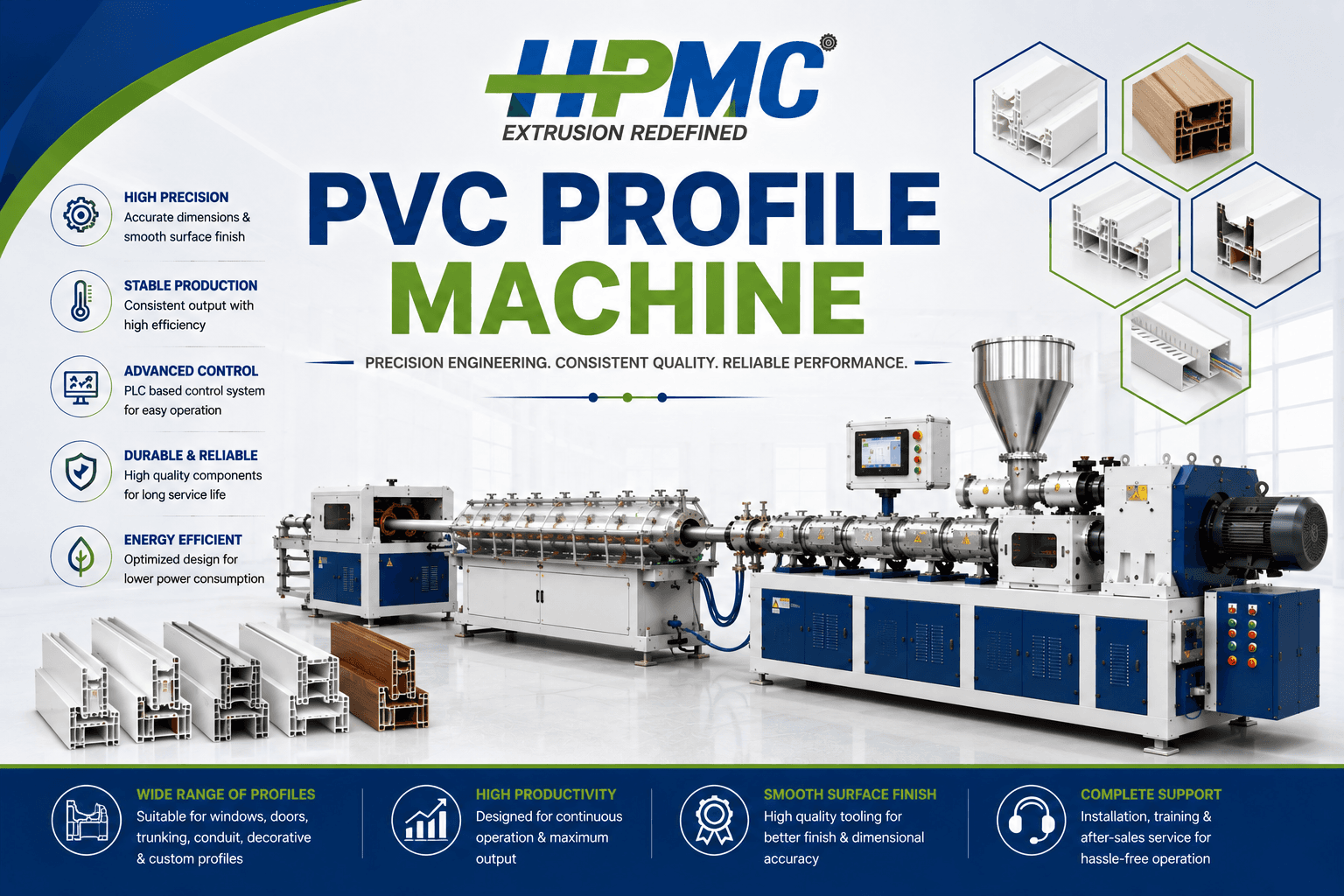
PVC profiles are widely used in construction, electrical, furniture, interior, and industrial applications. Products such as window profiles, door profiles, trunking, conduit sections, decorative profiles, and other specialized sections can be manufactured using PVC extrusion technology.
As demand for durable, low-maintenance, and cost-effective profile products continues to grow, manufacturers require reliable machinery that can deliver consistent dimensions, accurate shapes, smooth surfaces, and stable production.
A PVC Profile Machine is designed to process PVC material through an extrusion system and continuously form it into a specific profile shape using customized tooling.
For businesses searching for PVC Profile Machine Manufacturers, selecting the right machinery supplier is an important investment decision. Production capacity, extrusion technology, tooling, automation, machine components, energy efficiency, and after-sales support should all be considered before purchasing equipment.
What is a PVC Profile Machine?
A PVC Profile Machine is an extrusion-based manufacturing system used to produce continuous PVC profiles in different shapes, sizes, and designs.
Unlike conventional injection moulding, profile extrusion produces continuous sections that can be cut into required lengths after extrusion.
A typical PVC Profile Extrusion Line may include:
- Raw material feeding system
- Extruder
- Screw and barrel
- Profile extrusion die
- Vacuum calibration table
- Cooling system
- Haul-off unit
- Cutting machine
- Stacking system
- Electrical control panel
The exact configuration depends on the profile design, dimensions, material formulation, production capacity, and level of automation required.
How Does a PVC Profile Extrusion Machine Work?
The manufacturing process begins with preparing the required PVC formulation. PVC resin may be combined with stabilizers, lubricants, pigments, fillers, processing aids, and other additives depending on the intended application.
The prepared material is fed into the extruder.
Inside the extrusion system, controlled heat and mechanical action plasticize and homogenize the material. The processed PVC is then continuously pushed through a specially designed profile die.
The die determines the shape and dimensions of the finished profile.
After exiting the die, the hot profile passes through a calibration unit. Vacuum calibration helps maintain the required shape and dimensions while the profile is cooled.
The haul-off system then pulls the profile through the line at a controlled speed. Finally, the profile is cut into predetermined lengths and transferred to the stacking or collection system.
The finished profiles can then undergo inspection, finishing, packaging, and dispatch.
Types of PVC Profiles
PVC extrusion technology can be used to manufacture a wide variety of profiles.
PVC Window Profiles
PVC and UPVC window profiles are used to manufacture window frames and related components for residential and commercial buildings.
PVC Door Profiles
Door frame and door-related profiles can be manufactured according to specific dimensions and design requirements.
PVC Trunking Profiles
PVC trunking profiles are used for organizing and protecting electrical cables in buildings and industrial facilities.
PVC Conduit Profiles
PVC conduit products are used to provide protection and routing for electrical wiring.
Decorative PVC Profiles
Specialized PVC profiles can be manufactured for interior decoration, furniture, wall panels, and other applications.
The final product range depends on the machine configuration and available extrusion tooling.
Key Features of a High-Quality PVC Profile Machine
When evaluating PVC Profile Machine Manufacturers, manufacturers should assess the entire production line rather than focusing only on the extruder.
Efficient Extrusion Technology
The extruder should provide stable conveying, melting, and plasticization of PVC material. Appropriate screw and barrel design contributes to consistent processing.
Precise Temperature Control
PVC requires controlled processing conditions. Accurate temperature monitoring across different heating zones helps maintain stable extrusion.
High-Quality Profile Tooling
The extrusion die plays a critical role in determining the final shape and dimensions of the profile. Proper die design helps achieve consistent output and surface quality.
Accurate Calibration
A reliable calibration system helps maintain profile dimensions and shape after the material exits the die.
Efficient Cooling
Effective cooling stabilizes the profile and helps maintain dimensional accuracy during continuous production.
Stable Haul-Off
The haul-off system should maintain a consistent pulling speed. Variations in haul-off speed can affect profile dimensions and production quality.
Automated Cutting
Automatic cutting systems help produce profiles in consistent lengths and reduce manual intervention.
PLC-Based Controls
Modern PLC-based control systems allow operators to monitor and adjust important parameters such as temperature, extrusion speed, haul-off speed, and cutting length.
How to Choose PVC Profile Machine Manufacturers
Selecting the right manufacturer requires careful evaluation of technical capabilities and long-term support.
Check Manufacturing Experience
Choose a manufacturer with experience in plastic extrusion and PVC profile machinery. Understanding PVC processing requirements is important for designing a suitable production line.
Determine Production Capacity
Your required output should determine the extruder size, motor capacity, cooling system, haul-off configuration, and other machine components.
Clearly define your expected hourly and daily production before selecting equipment.
Consider Profile Specifications
Identify the exact profile dimensions, shape, wall thickness, length, and application requirements before discussing machine specifications.
Evaluate Tooling Capabilities
Different profiles require different extrusion dies and calibration systems. Select a manufacturer capable of providing suitable tooling for your required profile design.
Consider Customization
If you plan to manufacture several PVC profiles, choose a manufacturer capable of supporting multiple dies and production configurations.
Evaluate Machine Components
Review the specifications and quality of major components such as the screw, barrel, gearbox, motor, heating system, die, calibration table, cooling system, haul-off, and electrical controls.
Consider After-Sales Support
Installation, commissioning, operator training, troubleshooting, maintenance assistance, and spare parts availability are important for maintaining production continuity.
Applications of PVC Profile Machines
PVC profiles are used across a wide range of industries.
Common applications include:
- Window manufacturing
- Door manufacturing
- Electrical cable management
- Construction
- Interior decoration
- Furniture manufacturing
- Wall panel systems
- Partition systems
- Industrial applications
- Decorative products
The specific application depends on the profile design, PVC formulation, and required performance characteristics.
Benefits of Investing in a Modern PVC Profile Machine
A properly designed PVC Profile Machine can provide several advantages.
Consistent Profile Quality
Controlled extrusion and calibration help manufacturers maintain uniform dimensions and surface finish.
Higher Production Efficiency
Continuous profile extrusion allows manufacturers to maintain consistent production with reduced manual intervention.
Reduced Material Waste
Stable extrusion conditions and accurate tooling can help minimize defective profiles and improve material utilization.
Flexible Production
Different dies can allow manufacturers to produce multiple profile designs and sizes, depending on the machine configuration.
Better Process Control
Automated temperature and speed controls allow operators to maintain more consistent production conditions.
Lower Long-Term Operating Costs
Efficient motors, heating systems, and process controls can help reduce energy consumption and operating expenses.
Important Factors Before Setting Up a PVC Profile Production Line
Manufacturers should evaluate their complete production requirements before purchasing a PVC Profile Extrusion Line.
Important considerations include:
- Required profile dimensions
- Production capacity
- PVC formulation
- Number of profile designs
- Extruder configuration
- Tooling requirements
- Calibration system
- Cooling capacity
- Factory space
- Electrical requirements
- Automation requirements
- Operator training
- Spare parts availability
- Technical support
Providing accurate product specifications to the machinery manufacturer can help ensure the production line is properly configured from the beginning.
PVC Profile Machine and Other Extrusion Applications
PVC profile extrusion is part of a broader plastic extrusion process. Similar extrusion technology is used to manufacture PVC trunking, conduit products, window profiles, door profiles, tubing, and other specialized products.
However, each application may require different tooling, screw configuration, calibration, cooling, and downstream equipment.
Businesses planning to manufacture several types of PVC products should discuss their complete product range with the machinery manufacturer to determine the most suitable production setup.
You can also explore the PVC Trunking Machine, PVC Tubing Machine, and Window Profile Machine categories for other PVC extrusion applications.
Why Choose HPMC for PVC Profile Machinery?
HPMC provides plastic extrusion machinery for PVC profiles, pipes, WPC products, compounding, recycling, and other polymer processing applications.
Our extrusion solutions can be configured according to product specifications, production capacity, material requirements, profile design, and desired automation level.
Businesses searching for PVC Profile Machine Manufacturers can discuss their required profile dimensions, production capacity, material formulation, and application requirements with HPMC to determine a suitable machine configuration.
The focus is on appropriate extrusion technology, reliable machine components, process control, and technical support for long-term manufacturing requirements.
Conclusion
Choosing the right PVC Profile Machine Manufacturers is essential for businesses planning to manufacture high-quality PVC profiles efficiently. A properly configured extrusion line can help achieve consistent dimensions, stable production, smooth surface finish, and efficient material utilization.
Before investing in a PVC Profile Machine, evaluate your product specifications, production capacity, PVC formulation, tooling requirements, automation level, and future expansion plans.
The manufacturer should also be able to provide installation, commissioning, operator training, technical assistance, and spare parts support.
For businesses looking to establish or expand PVC profile production, selecting an experienced machinery manufacturer can provide the extrusion technology and customized production solution required for reliable long-term operation.
Frequently Asked Questions
Find quick answers to the most common questions about this topic.
A PVC Profile Machine is an extrusion-based production system used to manufacture continuous PVC profiles in different shapes and dimensions.
PVC Profile Machines can be used for products such as window profiles, door profiles, trunking, conduit sections, decorative profiles, and other specialized PVC sections.
Calibration helps maintain the required shape and dimensions of the profile after it exits the extrusion die.
Depending on the machine configuration and tooling, different PVC profiles can be manufactured using suitable dies and calibration equipment.
Evaluate manufacturing experience, extrusion technology, production capacity, tooling capabilities, machine components, automation, customization options, energy efficiency, and after-sales support.