
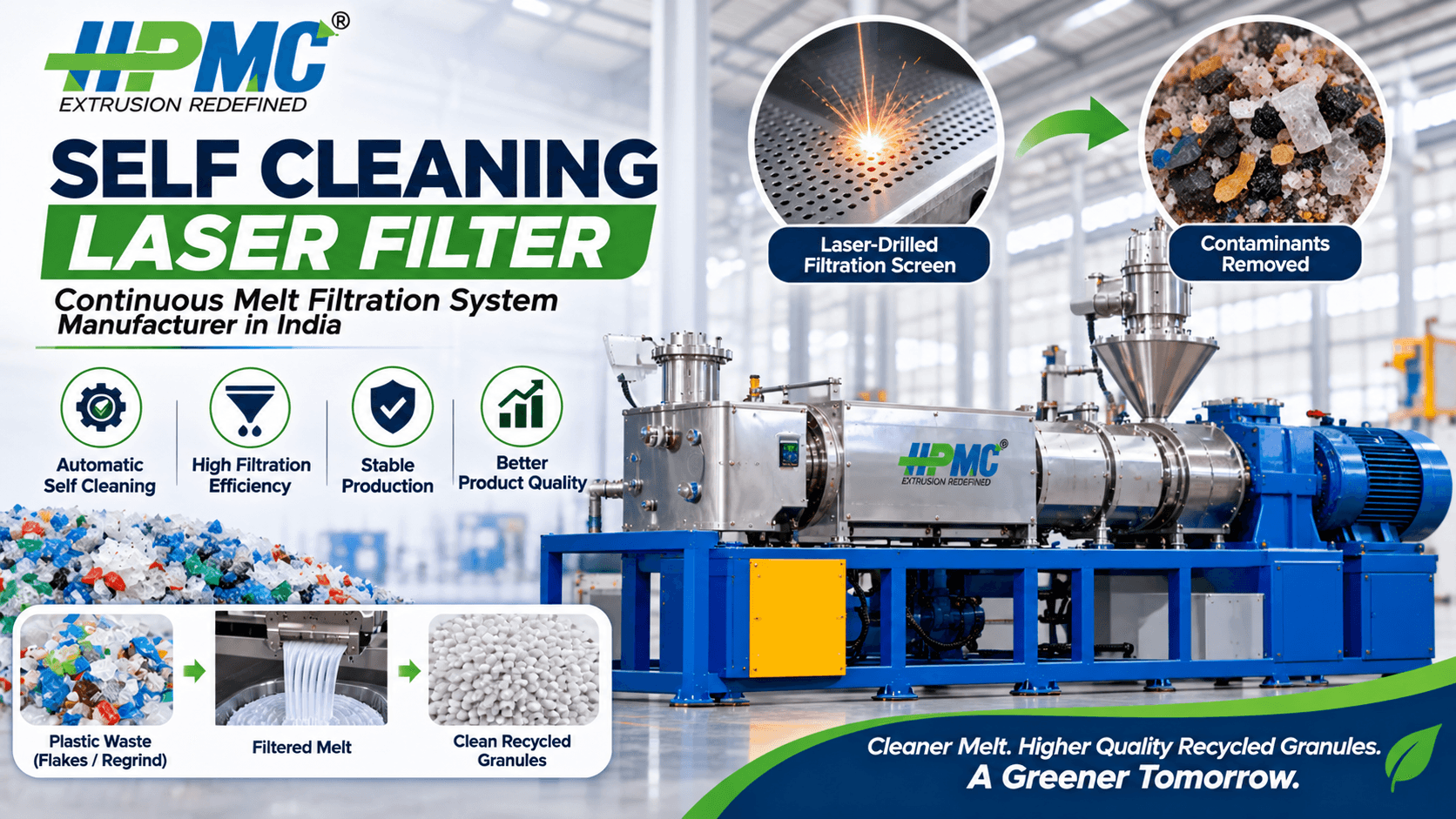
Plastic recycling and reprocessing involve converting recovered plastic waste into reusable material through controlled melting, filtration and extrusion. However, recycled feedstock can contain contaminants such as paper, wood, rubber, metal particles, dirt and other foreign matter. If these contaminants remain in the polymer melt, they can affect product appearance, processing stability and the quality of the final recycled granules.
A Self Cleaning Laser Filter is a melt filtration system designed to remove suitable solid contaminants from molten plastic during extrusion. It uses a precision laser-drilled filtration screen and an automatic cleaning mechanism to remove accumulated contaminants while maintaining the filtration process under suitable operating conditions.
For recycling businesses handling variable-quality feedstock, continuous melt filtration can reduce the need for frequent manual screen changes and help maintain a more consistent production process.
Hindustan Plastics & Machine Corporation (HPMC), a plastic processing machinery manufacturer based in Nangloi, Delhi, offers a Self Cleaning Laser Filter for suitable plastic recycling and extrusion applications.
Explore the HPMC Self Cleaning Laser Filter to learn more about the system and enquire about a suitable configuration for your production line.
What Is a Self Cleaning Laser Filter?
A Self Cleaning Laser Filter is an industrial melt filtration system installed in a plastic extrusion line to remove suitable solid contaminants from molten polymer.
The system uses a precision-manufactured filtration screen with small openings to retain particles while allowing the molten plastic to pass through. As contaminants accumulate on the filtration surface, an automatic cleaning mechanism removes the collected material.
Unlike conventional filtration arrangements that may require production interruptions for manual screen replacement, a self-cleaning system is designed to support continuous operation while cleaning takes place.
A typical system may include:
- Melt inlet and outlet
- Laser-drilled filtration screen
- Filtration chamber
- Automatic cleaning mechanism
- Contaminant removal or discharge arrangement
- Heating system
- Pressure monitoring and controls, depending on configuration
- Electrical control system
The precise design, cleaning mechanism, filtration level and operating limits depend on the selected model.
It is important to understand that a melt filter removes suitable solid contaminants. It does not replace upstream sorting, washing or other preprocessing, and it cannot automatically remove every type of dissolved impurity or incompatible polymer.
How Does an Automatic Self Cleaning Laser Filter Work?
The filtration process generally takes place after the plastic has been melted inside the extruder.
1. Plastic Melting
Plastic waste, flakes or regrind are fed into a compatible extrusion system. The extruder conveys and melts the polymer under controlled processing conditions.
2. Molten Plastic Enters the Filter
The molten polymer enters the filtration chamber. The filter must be compatible with the polymer, melt temperature, pressure and required throughput.
3. Contaminant Retention
As the melt passes through the laser-drilled filtration screen, suitable solid particles are retained on the filtration surface.
The effectiveness of this process depends on the screen's filtration characteristics, the size and type of contaminants, and the properties of the polymer melt.
4. Automatic Cleaning
As contaminants accumulate, the filtration system's cleaning mechanism removes the collected material from the screen or filtration area.
The exact cleaning cycle and mechanism depend on the filter design. Some systems use pressure or other operating parameters to control cleaning.
5. Contaminant Discharge
The removed contaminants are directed towards the system's designated discharge arrangement. The amount of material removed and the resulting melt loss depend on feedstock contamination and the filter's design and operating settings.
6. Continued Melt Filtration
The system is designed to continue filtering molten plastic while automatic cleaning takes place, reducing the need for routine manual screen changes.
7. Downstream Processing
The filtered melt proceeds towards the die, pelletizing unit or other downstream equipment, depending on the extrusion line configuration.
This process can support continuous recycling operations when the filter is correctly sized and operated within its specified limits.
Key Features of HPMC's Self Cleaning Laser Filter
Precision Laser-Drilled Screen
The filtration screen uses precision-made openings to retain suitable solid contaminants from the molten polymer. The appropriate filtration level depends on the feedstock and the final product requirements.
Automatic Self-Cleaning Mechanism
The cleaning mechanism removes accumulated contaminants from the filtration area. This is designed to reduce reliance on frequent manual screen replacement.
Continuous Melt Filtration
The system is intended to maintain filtration while cleaning takes place under suitable operating conditions. Actual production continuity depends on the filter design, operating parameters and feedstock quality.
Support for Plastic Recycling Applications
The filter can be considered for suitable recycling and reprocessing extrusion lines where the incoming material contains solid contaminants.
Process Monitoring
Pressure monitoring and automated controls, where included in the selected configuration, can help operators monitor filtration conditions and identify changes during production.
Integration with Existing Extrusion Lines
A suitable filter may be considered for a new recycling line or as a retrofit for an existing extrusion system. Retrofit suitability must be confirmed against the existing line's pressure, temperature, throughput, connection dimensions and control requirements.
Industrial Operation
The filter should be selected according to the expected operating conditions, including melt temperature, polymer type, production rate and contamination load.
Important: Confirm the exact model specifications, cleaning mechanism, filtration level, maximum operating pressure, temperature range and compatibility with your extrusion line directly with HPMC.
Which Contaminants Can a Self Cleaning Laser Filter Remove?
The filter is designed to remove suitable solid contaminants that remain in the molten plastic after upstream preparation.
Paper
Paper particles may enter plastic recycling streams through packaging waste, labels or mixed post-consumer materials. A suitable melt filter can retain compatible solid paper contaminants that do not pass through the selected filtration openings.
Metal Particles
Small metal particles may be present in contaminated feedstock. Suitable filtration can capture particles within the system's capabilities, but larger metal objects should be removed before extrusion to protect equipment.
Wood
Wood fragments and other solid organic contaminants may be retained by the filtration screen when their size and characteristics are compatible with the filtration system.
Rubber
Rubber fragments can contaminate recycled polymer melt. A suitable filter may capture solid rubber particles, depending on their size and behaviour under processing conditions.
Dirt and Other Solid Impurities
Residual dirt, unmelted particles and other solid foreign matter may also be retained when the filter is configured appropriately.
Note: Filtration performance depends on particle size, contaminant type, polymer characteristics, screen design and operating conditions. A melt filter should not be treated as a substitute for effective material sorting and cleaning.
Applications of a Self Cleaning Laser Filter
Plastic Recycling Plants
Recycling plants processing post-consumer or post-industrial plastic waste can use continuous melt filtration to reduce suitable solid contaminants before pelletizing.
Plastic Film Recycling
Recycled film feedstock may contain paper, labels, dirt and other impurities. An appropriate melt filter can provide an additional filtration stage during extrusion.
Plastic Pelletizing Plants
Manufacturers producing recycled granules can use melt filtration to help improve consistency and reduce the presence of suitable solid contaminants in the output.
Plastic Extrusion
Suitable filtration systems can be integrated into extrusion lines where contaminant control is important for the downstream product.
Plastic Compounding
Compounding operations processing recycled or reclaimed polymers may require melt filtration depending on the material and product specification.
Industrial Plastic Reprocessing
Manufacturers recycling production scrap can consider a self-cleaning filter where the feedstock contains solid impurities and continuous operation is desirable.
Recycled Polymer Manufacturing
The filter can support applications where the quality of recycled material depends partly on the removal of solid contaminants before further processing.
The appropriate configuration depends on the polymer, contaminant load, required filtration level and production rate.
Benefits of a Self Cleaning Laser Filter
1. Reduced Manual Screen Changes
Automatic cleaning can reduce the frequency of manual screen replacement, helping lower routine operator intervention.
2. Support for Continuous Production
The system is designed to clean the filtration area while processing continues under suitable operating conditions. This can help reduce interruptions associated with conventional manual screen changes.
3. Improved Contaminant Control
A properly selected filtration screen can retain suitable solid impurities before the melt reaches the die or pelletizing system.
4. More Stable Filtration Conditions
An automatic cleaning mechanism can help manage contaminant accumulation. Melt pressure and filtration stability still depend on the feedstock, system design and operating settings.
5. Potential Reduction in Material Waste
A suitable filter configuration can help control the amount of polymer removed with contaminants. Actual melt loss depends on the contaminant load, cleaning method and operating parameters.
6. Lower Routine Operator Intervention
Automation can reduce the frequency of manual cleaning tasks, although regular inspection and maintenance remain necessary.
7. Potential Improvement in Recycled Pellet Quality
Removing suitable solid contaminants can contribute to cleaner recycled material. Final pellet quality also depends on polymer compatibility, washing, degassing, extrusion conditions and downstream processing.
8. Retrofit Possibilities
For compatible extrusion lines, a retrofit installation may provide continuous filtration without replacing the entire recycling system. Compatibility and integration costs should be assessed before making a decision.
Self Cleaning Laser Filter vs. Conventional Melt Filter
A conventional melt filtration system may require an operator to stop or interrupt production to replace or clean a blocked screen, depending on its design.
A self-cleaning laser filter is designed to remove accumulated contaminants automatically during operation, potentially reducing the need for manual screen changes.
The main differences include:
- Cleaning method: Manual screen replacement versus an automatic cleaning mechanism.
- Production continuity: Conventional systems may require interruptions, while self-cleaning systems are designed to maintain filtration during cleaning under suitable conditions.
- Operator involvement: Automatic cleaning can reduce routine manual intervention.
- Contaminant handling: Both systems need a suitable method to retain and remove contaminants.
- Maintenance: Both require inspection and maintenance, although the components and procedures may differ.
- Investment: An automatic filter may have a higher initial cost than a simpler filtration arrangement, depending on configuration.
A conventional filter may be adequate for clean feedstock or applications with limited contamination. A self-cleaning filter may be worth evaluating when contamination levels are variable and reducing screen-change interruptions is important.
The correct choice depends on the feedstock, production target, filtration requirements and total operating cost.
Self Cleaning Laser Filter in a Plastic Recycling Line
A melt filtration system is one stage in the wider plastic recycling process. Its position and configuration depend on the extrusion and pelletizing arrangement.
A typical process may include:
Sorting → Shredding → Washing, if required → Drying or Moisture Management → Feeding → Extrusion → Melt Filtration → Die → Pelletizing → Cooling → Recycled Granules
The filter generally operates after the polymer has melted. It removes suitable solid contaminants that remain after upstream preparation.
For recycling applications requiring additional degassing, HPMC's Vented Recycling Plant may be relevant. Where two-stage extrusion is required, explore the Two Stage Recycling Plant.
For lightweight film that requires compaction before extrusion, consider the Recycling Plant with Compactor.
These systems perform different functions. The final line should be designed according to the feedstock condition, filtration needs and desired recycled product.
How to Choose the Right Self Cleaning Laser Filter
Before selecting a melt filtration system, evaluate the following factors.
Polymer Type
Identify whether the material is PP, PE, HDPE, LDPE, LLDPE, PVC, ABS, PET or another polymer. The filter must be suitable for the polymer's processing temperature and melt characteristics.
Contamination Level
Estimate the type and quantity of contaminants in the feedstock. High contamination loads may affect cleaning frequency, contaminant discharge and overall system performance.
Required Filtration Level
Define the level of filtration required for the final product. The screen specification should match the contaminant characteristics and downstream application.
Production Capacity
Determine the required melt throughput in kilograms per hour. The filter must be sized to handle the extrusion line's expected output without creating unacceptable pressure drop or processing limitations.
Melt Temperature and Pressure
Confirm the normal and maximum operating temperature and pressure of the extrusion line. The filter must be compatible with the system's operating limits.
Cleaning and Contaminant Discharge
Ask how the automatic cleaning mechanism works, how contaminants are discharged, and how the system handles different contaminant loads.
Melt Loss
Request information on expected polymer loss under representative operating conditions. Melt loss can vary considerably with the type and quantity of contaminants.
Retrofit Compatibility
For an existing extrusion line, provide the extruder model, connection dimensions, production capacity, melt pressure and temperature range. HPMC can then assess whether a retrofit configuration is technically feasible.
Maintenance and After-Sales Support
Confirm maintenance procedures, spare parts availability, screen service requirements, operator training and technical support.
Self Cleaning Laser Filter Price in India
The price of a Self Cleaning Laser Filter depends on the technical requirements of the extrusion line and the selected filtration configuration.
Factors affecting the price include:
- Required melt throughput
- Polymer type
- Filtration level and screen design
- Operating pressure and temperature
- Automatic cleaning mechanism
- Contaminant discharge arrangement
- Heating and control systems
- Integration with the extruder and downstream equipment
- Retrofit requirements
- Installation, commissioning and after-sales support
HPMC's product page does not provide a single confirmed current price for every filter configuration. Contact the manufacturer with your extrusion line details to request a suitable quotation.
When comparing suppliers, evaluate more than the purchase price. Consider expected maintenance, screen service life, cleaning performance, melt loss, production interruptions and compatibility with your existing equipment.
Why Choose HPMC for Melt Filtration Solutions?
Hindustan Plastics & Machine Corporation (HPMC) manufactures plastic processing and recycling machinery from its facility in Nangloi, Delhi.
Businesses evaluating a self-cleaning melt filtration system can discuss their application with HPMC and determine the required configuration according to the polymer, contamination level, throughput and downstream process.
Before finalising a purchase, confirm the technical specifications, filtration performance, operating limits, installation requirements, maintenance procedures and availability of spare parts.
Explore the HPMC website for its range of plastic recycling and extrusion machinery.
Related HPMC Products and Resources
- Self Cleaning Laser Filter — product information and enquiry details for the continuous melt filtration system.
- Vented Recycling Plant — for recycling applications requiring a vented extrusion system.
- Two Stage Recycling Plant — for applications where two-stage extrusion is appropriate.
- Recycling Plant with Compactor — for suitable lightweight plastic waste requiring compaction before extrusion.
- Wet Recycling Extrusion Line — for compatible wet plastic films and flakes.
- HPMC Frequently Asked Questions — additional information about HPMC machinery.
Conclusion
A Self Cleaning Laser Filter is designed to provide continuous melt filtration in suitable plastic recycling and extrusion applications. Its precision filtration screen and automatic cleaning mechanism can help remove solid contaminants while reducing the need for frequent manual screen changes.
For businesses processing recycled plastic with variable contamination levels, the right melt filtration system can support more consistent processing and help improve the cleanliness of the recycled output. However, actual performance depends on the polymer, contaminant type, screen specification, melt pressure and machine configuration.
Hindustan Plastics & Machine Corporation (HPMC), based in Nangloi, Delhi, offers a Self Cleaning Laser Filter for suitable plastic recycling and extrusion applications. Contact HPMC to discuss your feedstock, production capacity, filtration requirements and retrofit needs before requesting a configuration-specific quotation.
Contact Hindustan Plastics & Machine Corporation (HPMC)
Company: Hindustan Plastics & Machine Corporation (HPMC)
Address: 5, Category II, DSIDC Industrial Area, Nangloi, Delhi – 110041, India
Phone: +91 95605 96392
Email: info@hindustanplastics.com
Website: https://www.hindustanplastics.com/
Google Business Profile: https://share.google/lBK4uD53HqY891ynv
Product Page: https://www.hindustanplastics.com/self-cleaning-laser-filter
Contact HPMC to discuss your polymer type, melt throughput, contamination level, filtration requirements and machine integration.
Frequently Asked Questions
Find quick answers to the most common questions about this topic.
A Self Cleaning Laser Filter is a melt filtration system that uses a precision filtration screen and an automatic cleaning mechanism to remove suitable solid contaminants from molten plastic during extrusion.
Molten plastic passes through a filtration screen that retains suitable solid contaminants. An automatic mechanism removes accumulated contaminants from the filtration area so filtration can continue under suitable operating conditions.
Depending on the filter configuration, it can remove suitable solid contaminants such as paper, wood, rubber, metal particles, dirt and other foreign matter. Performance depends on particle size and the filtration specification.
Depending on the model and operating conditions, melt filtration systems may be used with PP, PE, HDPE, LDPE, LLDPE, PVC, ABS, PET and other compatible polymers. Confirm compatibility with HPMC for your specific application.
The system is designed to clean the filtration area while filtration continues under suitable operating conditions. Confirm the cleaning cycle, operating limits and production-continuity requirements for the specific model.
Potential advantages include reduced manual screen changes, less operator intervention, continuous filtration under suitable conditions and improved removal of solid contaminants from the polymer melt.
Effective filtration can reduce suitable solid contaminants in the melt and contribute to cleaner recycled granules. Final quality also depends on material sorting, polymer compatibility, degassing, extrusion conditions and other process stages.
A retrofit may be possible if the filter is compatible with the existing extruder, melt pressure, temperature range, throughput and downstream equipment. Technical assessment is required before installation.
The price depends on throughput, screen specification, cleaning mechanism, operating pressure, automation and integration requirements. Contact HPMC for a quotation based on your extrusion line.
Consider the polymer, contamination level, required filtration level, production capacity, operating pressure and temperature, melt loss, maintenance requirements and compatibility with the existing line.
Contact Hindustan Plastics & Machine Corporation (HPMC) in Nangloi, Delhi, at +91 95605 96392 or info@hindustanplastics.com, or visit the official Self Cleaning Laser Filter page.