
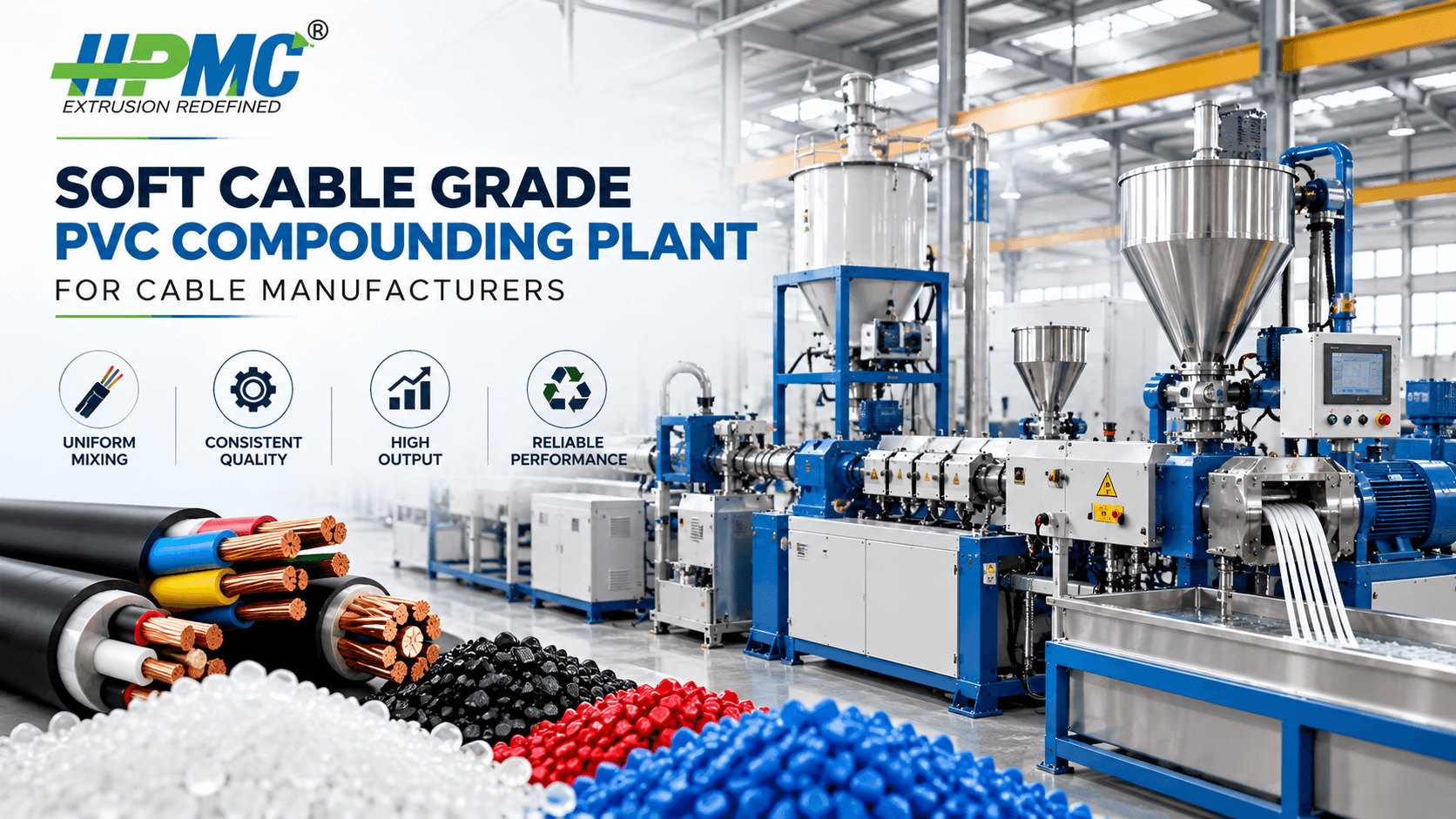
Flexible PVC compounds are widely used in the electrical and cable manufacturing industries. They provide formulation-dependent properties such as flexibility, processability, insulation performance, and resistance to environmental conditions. These characteristics make cable-grade PVC compounds important for manufacturing wire insulation, cable sheathing, control cables, and other flexible PVC products.
A Soft Cable Grade PVC Compounding Plant is an industrial production system designed to combine PVC resin with plasticizers and other additives to create a consistent compound for downstream cable manufacturing.
The quality of the finished compound depends on several factors, including the formulation, raw material quality, mixing process, extrusion conditions, temperature control, and pelletizing method. Manufacturers therefore need to select equipment that matches their required output and product specifications.
Hindustan Plastics & Machine Corporation (HPMC), based in Delhi, India, manufactures plastic extrusion and compounding machinery for industrial applications. Businesses can explore the HPMC Soft Cable Grade PVC Compounding Plant to learn more about the machine and request a quotation.
What Is a Soft Cable Grade PVC Compounding Plant?
A Soft Cable Grade PVC Compounding Plant is a production system used to blend and process PVC resin with plasticizers, stabilizers, fillers, lubricants, pigments, and other additives according to a specified formulation.
The purpose of compounding is to produce a uniform material with the properties required for the intended cable application.
Soft PVC compounds are generally formulated to achieve the flexibility and processing characteristics needed for cable insulation or sheathing. The exact electrical, mechanical, thermal, and environmental properties depend on the formulation and the applicable cable standards.
A typical PVC compounding line may include:
- High-speed mixer
- Cooling mixer
- Raw material feeding system
- Compounding extruder
- Temperature control and drive systems
- Die head
- Die-face or strand pelletizing system
- Pellet cooling arrangement
- Drying equipment
- Screening and material collection equipment, where required
The exact configuration varies according to production capacity, formulation, pellet specifications, and the selected machine design.
For related machinery, explore HPMC's Twin Screw Extruder for PVC Compounding.
What Is Soft Cable Grade PVC Compound?
Soft cable-grade PVC compound is a flexible PVC formulation developed for use in electrical wire and cable manufacturing.
PVC resin forms the base material, while additives are incorporated to achieve the properties required for the intended application.
Common Ingredients Used in Soft PVC Compounding
PVC resin: Forms the base polymer of the compound.
Plasticizers: Help provide flexibility and influence the compound's processing behaviour.
Heat stabilizers: Help improve the material's resistance to heat-related degradation during processing and use.
Lubricants and processing aids: Help support processing and material flow when appropriately selected.
Fillers: Can be incorporated to adjust formulation cost and selected physical properties.
Pigments and colourants: Provide the required colour and appearance.
Specialty additives: Depending on the application, these may be used to meet particular flame, weathering, thermal, or other performance requirements.
Not every formulation uses the same ingredients or proportions. Cable manufacturers should define their electrical and mechanical requirements before selecting the formulation and processing equipment.
Applications of a Soft Cable Grade PVC Compounding Plant
A properly configured PVC compounding plant can support the production of flexible PVC compounds for various cable and industrial applications.
1. Electrical Wire Insulation
Soft PVC compounds are used in insulation applications where the formulation must meet the required electrical, mechanical, and thermal specifications.
2. Power Cable Sheathing
PVC compounds can be used for outer sheathing in suitable power cable designs. The formulation must be appropriate for the cable's intended operating environment.
3. Control Cables
Flexible PVC compounds are used in selected control cable applications found in industrial equipment and electrical installations.
4. Communication Cables
Certain communication cable designs use PVC-based insulation or sheathing materials, depending on the product specification.
5. Automotive Wiring
PVC compounds may be used in automotive wiring applications where the selected formulation meets the relevant temperature, flexibility, and performance requirements.
6. Flexible PVC Products
With an appropriate formulation and machine configuration, PVC compounding technology may also be used for selected hoses, flexible profiles, and other PVC products.
For applications that require the actual application of insulation or sheathing onto a conductor, HPMC also offers a High-Speed Two-Layer Cable Plant. A compounding plant produces the material, while a cable extrusion plant applies the material to the cable.
How Does a Soft Cable Grade PVC Compounding Plant Work?
The production process involves preparing the raw materials, mixing the ingredients, compounding the formulation, pelletizing the processed material, and cooling and collecting the finished granules.
Step 1: Raw Material Preparation
PVC resin, plasticizers, stabilizers, fillers, and other formulation ingredients are selected and prepared according to the product specification.
Accurate formulation and consistent raw material quality are important for repeatable production.
Step 2: High-Speed Mixing
The ingredients are mixed in a high-speed mixer to distribute the formulation components. Mixing conditions must be selected according to the material recipe and equipment design.
Step 3: Cooling and Blend Preparation
The hot blend may be transferred to a cooling mixer to bring its temperature to a suitable level for the next processing stage.
The cooling process helps prepare the material for controlled feeding into the extruder.
Step 4: Feeding into the Extruder
The prepared blend is supplied to the compounding extruder. A consistent feed rate supports stable processing.
Step 5: Compounding and Homogenisation
The extruder conveys and processes the formulation. Its screw design, temperature settings, drive system, and operating conditions influence the mixing and material quality.
Step 6: Extrusion and Pelletizing
The processed compound exits through the selected die arrangement and is converted into granules.
Depending on the configuration, the plant may use a die-face pelletizer or a strand pelletizing system.
Step 7: Cooling and Drying
The granules are cooled and, where required, dried or conditioned according to the process design.
Step 8: Quality Inspection and Packaging
The finished granules are checked against the manufacturer's formulation and product specifications before packaging and dispatch.
Main Components of a Soft Cable Grade PVC Compounding Plant
High-Speed Mixer
The mixer blends PVC resin and formulation ingredients to support uniform distribution before extrusion.
Cooling Mixer
The cooling mixer reduces the temperature of the prepared blend as required by the production process.
Compounding Extruder
The extruder processes the material under controlled conditions. The choice between twin-screw and other suitable configurations depends on the formulation, required output, and process requirements.
Screw and Barrel Assembly
The screw and barrel design affects material conveying, mixing, heat transfer, and processing performance.
Drive System and Gearbox
These components provide and transmit the mechanical power required for the extrusion process.
Temperature Control System
The system helps maintain the processing conditions required for the selected formulation.
Die Head
The die head delivers the processed compound to the selected pelletizing arrangement.
Pelletizing System
A die-face pelletizer or strand pelletizer converts the processed compound into granules. The suitable method depends on the machine configuration and required pellet characteristics.
Cooling and Drying Arrangement
These systems prepare the granules for collection and subsequent handling.
Electrical Control Panel
The control panel allows operators to monitor and adjust relevant machine settings.
When requesting a quotation, confirm which of these components are included in the proposed supply.
Benefits of a Soft Cable Grade PVC Compounding Plant
Selecting the right compounding equipment can support consistent production and help manufacturers meet their product requirements.
Uniform Material Mixing
Appropriate mixing and compounding conditions help distribute additives throughout the formulation.
Consistent Pellet Quality
A correctly configured process can support consistent pellet size, appearance, and material properties.
Formulation Flexibility
The equipment can be selected for the intended cable-grade PVC formulations and other compatible applications.
Production Planning
A suitable capacity and feeding arrangement can help manufacturers plan production around their material requirements and delivery schedules.
Integration with Cable Manufacturing
The plant produces PVC compound that can be supplied to downstream cable extrusion operations, provided the material meets the cable manufacturer's specifications.
Configuration-Based Selection
Manufacturers can discuss different extrusion and pelletizing arrangements based on their formulation, production targets, and operating requirements.
Potential for Efficient Operation
Appropriate equipment selection, preventive maintenance, and process control can help reduce avoidable downtime and support efficient production.
Actual output, energy consumption, pellet consistency, and operating costs depend on the equipment configuration, formulation, process conditions, and maintenance practices.
Soft Cable Grade PVC Compounding Plant Price in India
The price of a Soft Cable Grade PVC Compounding Plant depends on the selected extrusion configuration, capacity, mixing equipment, pelletizing system, automation, and the scope of supply.
The HPMC official product page provides information about the plant and a way to request a quotation. A current official price for every configuration is not listed on the product page.
For preliminary budgeting, a third-party HPMC product listing has advertised a soft cable-grade PVC compounding plant at approximately ₹78 lakh per unit, with a stated capacity of 200–600 kg/hr. The same listing also shows a price range of ₹60–70 lakh, so these figures should be treated as indicative marketplace pricing rather than a confirmed current HPMC quotation. <Cite refs={["turn189672search2"]}/>
The final price may vary based on:
- Required production capacity
- Extruder type and screw configuration
- High-speed and cooling mixer capacity
- Die-face or strand pelletizing arrangement
- Cooling and drying equipment
- Automation and control system
- Electrical and utility requirements
- Installation and commissioning
- Transportation, taxes, and commercial terms
How to get an accurate quotation: Share your target output in kg/hr, PVC formulation, desired pellet type, required automation level, and whether you need a complete line or selected equipment. HPMC can then assess the project requirements and provide a relevant quotation.
Contact HPMC at +91 95605 96392 or visit the official website.
How to Choose the Right PVC Compounding Plant
Before investing in a Soft Cable Grade PVC Compounding Plant, consider the following factors.
1. Define the Cable Application
Identify whether the compound is intended for wire insulation, power cable sheathing, control cables, automotive wiring, or another application.
2. Establish the Required Output
Calculate the required production capacity in kg/hr based on expected demand, operating hours, and production schedules.
3. Confirm the Formulation
Share the PVC recipe and material characteristics with the equipment manufacturer. Different formulations may require different processing conditions.
4. Evaluate Mixing Requirements
Consider the required mixing uniformity and the role of the high-speed mixer and cooling mixer in the production process.
5. Select the Extruder Configuration
Evaluate the available extrusion technology according to the formulation, output, mixing requirements, and intended pelletizing system.
HPMC's Twin Screw Extruder for PVC Compounding is a relevant starting point for manufacturers comparing PVC compounding machinery.
6. Choose the Pelletizing Method
Discuss whether die-face or strand pelletizing is appropriate for your process and finished pellet requirements.
7. Review Process Controls
Check temperature control, drive systems, feeding arrangements, and the ability to monitor key operating parameters.
8. Consider Energy and Maintenance Requirements
Ask the manufacturer about connected load, expected utilities, routine maintenance, spare parts, and recommended operating practices.
9. Check Quality Requirements
Identify the electrical, mechanical, thermal, and other product tests required for your cable-grade compound. Confirm that the production process is suitable for meeting those specifications.
10. Compare Complete Project Costs
Compare the equipment scope, installation, commissioning, utilities, training, spare parts, and ongoing operating requirements—not only the initial machine price.
Quality Control in Soft Cable Grade PVC Compounding
Quality control is important because cable-grade PVC compounds must meet the requirements of their intended applications.
The exact testing programme should be determined by the formulation, customer specification, and applicable cable standards.
Formulation Accuracy
Incorrect ingredient proportions can affect the final material properties. Maintain controlled recipes and raw material records.
Mixing Consistency
Uneven mixing may lead to variations in compound appearance, processing behaviour, or material properties.
Pellet Appearance and Uniformity
Inspect the granules for consistency, contamination, and other visible defects.
Electrical Performance
Cable compounds must be evaluated using the relevant electrical tests for the intended cable application.
Mechanical Properties
Depending on the product specification, testing may include tensile properties, elongation, flexibility, and other mechanical characteristics.
Thermal and Environmental Performance
The required tests depend on the operating conditions and relevant cable standards.
A suitable compounding machine supports the manufacturing process, but finished-product compliance must be established through appropriate formulation control and testing.
Maintenance Tips for a PVC Compounding Plant
Preventive maintenance helps support stable operation and reduce avoidable interruptions.
Recommended practices include:
- Inspecting screws, barrels, and material-contact components according to the manufacturer's instructions
- Checking gearbox lubrication and drive-system condition
- Inspecting mixer blades and mixing vessels
- Checking heating and temperature-control components
- Cleaning the die and pelletizing equipment using approved procedures
- Inspecting cooling and drying systems
- Checking electrical connections and safety systems
- Monitoring unusual vibration, noise, or changes in output
- Maintaining records of production parameters and maintenance activities
Maintenance schedules should follow the equipment manual and manufacturer recommendations.
Why Consider HPMC for a Soft Cable Grade PVC Compounding Plant?
Hindustan Plastics & Machine Corporation (HPMC) manufactures extrusion and compounding machinery for industrial plastic processing applications. Its product range includes equipment for PVC compounding and cable-related manufacturing requirements.
Businesses evaluating a Soft Cable Grade PVC Compounding Plant Manufacturer in India can explore the following HPMC resources:
- Soft Cable Grade PVC Compounding Plant — product information and quotation enquiries.
- Twin Screw Extruder for PVC Compounding — PVC compounding machinery and related specifications.
- Co-Rotating Twin Screw Extruder for Compounding and Recycling — compounding and polymer processing applications.
- High-Speed Two-Layer Cable Plant — downstream cable insulation and sheathing applications.
- HPMC Official Website — explore the wider machinery range.
Before finalising a project, discuss your material formulation, production target, pelletizing requirements, plant layout, utility availability, and quality specifications with HPMC.
Conclusion
A Soft Cable Grade PVC Compounding Plant is an important part of the manufacturing process for flexible PVC compounds used in cable insulation and sheathing. By combining PVC resin with plasticizers, stabilizers, and other formulation ingredients, the plant produces material intended to meet the processing and performance requirements of downstream cable manufacturing.
Selecting the right plant requires careful evaluation of production capacity, formulation, mixer and extruder configuration, pelletizing method, temperature control, quality testing, maintenance, and total project cost.
Hindustan Plastics & Machine Corporation (HPMC) offers PVC compounding and extrusion machinery for industrial applications. Manufacturers planning a new facility or upgrading existing equipment can explore the HPMC Soft Cable Grade PVC Compounding Plant and contact the team to discuss a suitable configuration and obtain a project-specific quotation.
Contact HPMC
Company: Hindustan Plastics & Machine Corporation (HPMC)
Address: 5, Category II, DSIDC Industrial Area, Nangloi, Delhi – 110041, India
Website: https://www.hindustanplastics.com/
Product Page: Soft Cable Grade PVC Compounding Plant
Google Business Profile: https://share.google/lBK4uD53HqY891ynv
Phone: +91 95605 96392
Email: info@hindustanplastics.com
Frequently Asked Questions
Find quick answers to the most common questions about this topic.
It is a production system used to mix and process PVC resin with plasticizers, stabilizers, fillers, and other additives to manufacture flexible PVC compounds for cable insulation and sheathing.
It is used in suitable wire and cable applications, including insulation, outer sheathing, control cables, and selected automotive wiring applications. The formulation must meet the relevant product specifications.
Third-party marketplace listings for particular HPMC configurations have advertised prices around ₹60–78 lakh. This is indicative pricing, not a confirmed current quotation. The final price depends on capacity, equipment configuration, automation, pelletizing method, and installation requirements.
Capacity varies by model and configuration. A third-party listing for a particular HPMC configuration states 200–600 kg/hr. Confirm the achievable output for your formulation with HPMC before making a purchase.
Common ingredients include PVC resin, plasticizers, stabilizers, lubricants, fillers, pigments, and application-specific additives. The exact formulation depends on the required cable properties.
A typical line may include a high-speed mixer, cooling mixer, extruder, die head, pelletizing system, cooling arrangement, and drying equipment. The actual supply scope depends on the selected configuration.
A compounding plant manufactures the PVC material in granule form. A cable extrusion plant applies insulation or sheathing material to a conductor to manufacture a cable.
Die-face pelletizing cuts the compound at or near the die outlet. Strand pelletizing forms continuous strands that are cooled and then cut into pellets. The appropriate method depends on the formulation and production requirements.
Consistency depends on formulation accuracy, raw material control, mixing, extrusion conditions, pelletizing, and quality testing. The testing programme should match the intended cable application and relevant standards.
A suitable plant may be configured for different formulations, but suitability depends on the equipment design, recipe requirements, cleaning procedures, and product specifications. Confirm the intended applications with the manufacturer.
Compare the manufacturer's relevant product experience, equipment specifications, production capacity, available configurations, installation support, spare parts, and after-sales service. Request a quotation based on your actual formulation and output requirements.
Visit the HPMC Soft Cable Grade PVC Compounding Plant page, call +91 95605 96392, or email info@hindustanplastics.com. Share your target output, formulation, pelletizing requirements, and project scope to request a suitable quotation.