
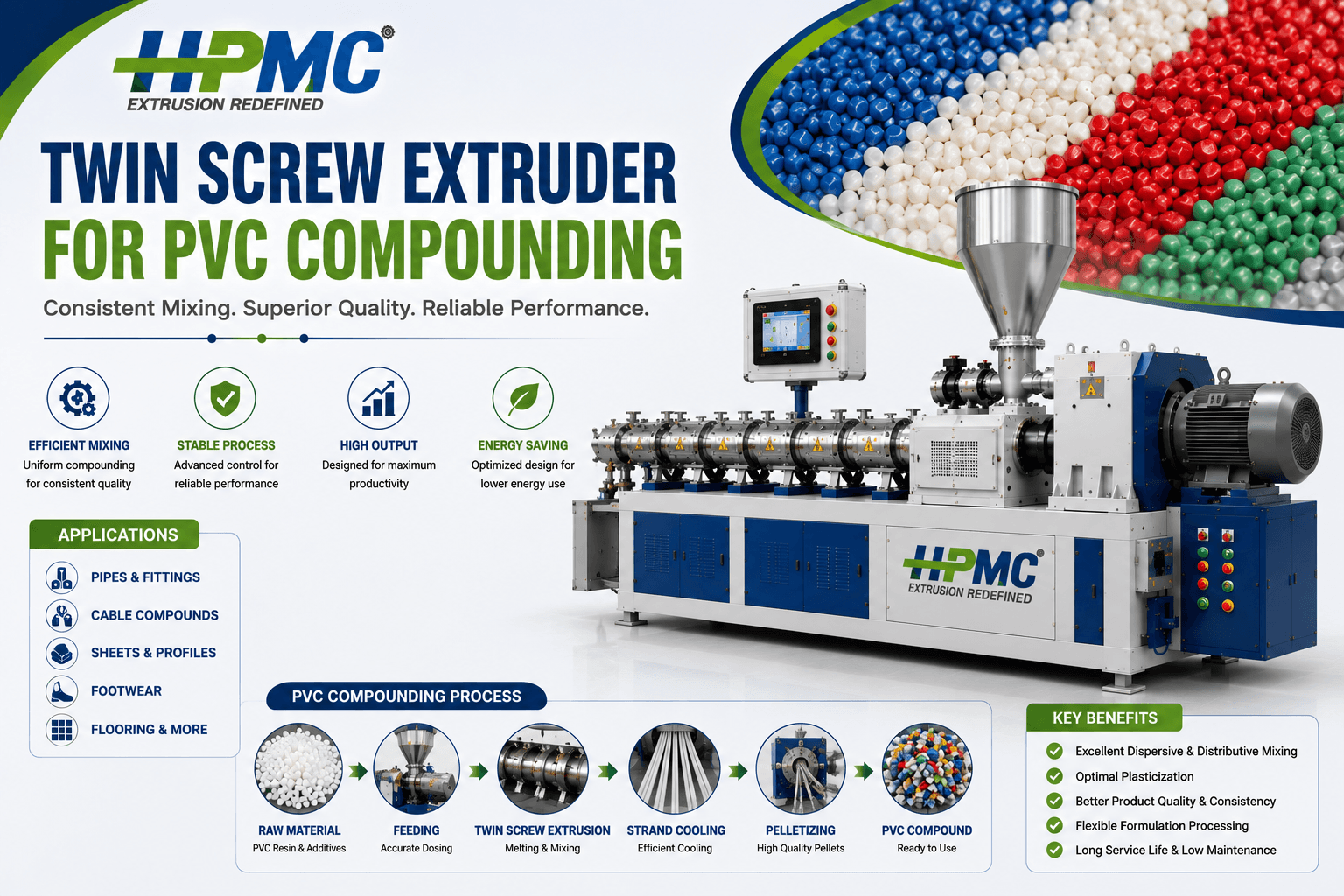
PVC is one of the most widely processed thermoplastics and is used in applications ranging from pipes and profiles to cables, flooring, sheets, footwear, and other industrial products. However, PVC resin is rarely processed alone. Different additives, stabilizers, plasticizers, fillers, pigments, and processing aids may be incorporated into the formulation to achieve the required properties for a specific application.
The compounding process is therefore an important stage in PVC processing. A Twin Screw Extruder for PVC Compounding is designed to provide controlled mixing, conveying, melting, and homogenization of PVC formulations.
For manufacturers planning to produce PVC compounds, selecting the right extrusion technology is important for achieving consistent material quality and reliable production.
Businesses searching for a Twin Screw Extruder for PVC Compounding in Delhi should consider factors such as screw configuration, material formulation, production capacity, temperature control, feeding system, torque, machine construction, and after-sales support.
This guide explains the working process, major components, applications, benefits, and key factors to consider before purchasing a PVC compounding extruder.
What is a Twin Screw Extruder for PVC Compounding?
A Twin Screw Extruder for PVC Compounding is an extrusion machine equipped with two screws designed to process and homogenize PVC formulations.
The two screws work together to convey, mix, and process PVC resin along with selected additives and other ingredients.
Depending on the application, the formulation may include:
- PVC resin
- Stabilizers
- Lubricants
- Plasticizers
- Fillers
- Pigments
- Processing aids
- Impact modifiers
- Other formulation-specific additives
The exact formulation depends on the final product and its required properties.
A typical PVC compounding extrusion system can include:
- Raw material feeding system
- Metering feeders
- Twin screw extruder
- Screw and barrel assembly
- Heating and cooling system
- Vacuum or venting arrangement where required
- Die head
- Cooling arrangement
- Pelletizing system
- Control panel
The complete configuration depends on the material formulation and required output.
Why is PVC Compounding Important?
PVC compounding allows manufacturers to modify the properties of PVC according to the requirements of the final application.
Pure PVC resin does not necessarily provide all the properties required for a finished product. Different additives can be incorporated into the formulation to influence characteristics such as flexibility, stability, processing behaviour, colour, impact performance, and other application-specific properties.
For example, formulations for rigid PVC products can differ significantly from formulations used for flexible PVC applications.
Similarly, cable-grade PVC compounds require a formulation appropriate for electrical insulation and cable manufacturing requirements.
The compounding machine must therefore provide sufficient mixing and process control to produce a consistent formulation.
How Does a Twin Screw Extruder for PVC Compounding Work?
The process begins with accurately preparing and feeding the PVC formulation into the extrusion system.
The PVC resin and additives may be pre-mixed before entering the extruder, depending on the production setup.
The materials are then fed into the twin screw extruder through the appropriate feeding system.
Inside the barrel, the two screws rotate and transport the material through different processing zones.
Mechanical action and controlled heating help distribute the ingredients throughout the polymer.
The screw configuration provides conveying and mixing as the material moves through the barrel.
Temperature control is maintained across different zones according to the material formulation and processing requirements.
The compounded PVC then moves toward the die head, where it exits the extrusion system in a suitable form for downstream pelletizing.
The material can subsequently be cooled and converted into PVC granules or pellets for storage and further manufacturing.
Major Components of a PVC Compounding Extruder
Understanding the main components is important when evaluating a PVC Compound Machine.
Twin Screws
The twin screws are the central processing components of the machine.
Their geometry, length-to-diameter ratio, rotation characteristics, and configuration influence conveying and mixing performance.
The screw design should be selected according to the PVC formulation and required production conditions.
Barrel
The barrel houses the twin screws and is divided into different processing zones.
Each zone can be controlled independently to establish the required temperature profile.
Feeding System
Accurate feeding is essential because PVC formulations often contain multiple ingredients that need to be introduced at controlled rates.
Depending on the formulation, the system may use different feeding arrangements for resin and additives.
Heating and Cooling System
Temperature control is important throughout the compounding process.
Heating systems help establish the required processing temperature, while cooling arrangements can help prevent excessive temperature rise during intensive mixing.
Vacuum or Venting System
Depending on the formulation and material condition, venting or vacuum degassing may be incorporated into the extrusion line.
Die Head
The die head provides the required exit geometry for the compounded PVC material before pelletizing.
Pelletizing System
The pelletizing system converts the compounded material into manageable pellets or granules suitable for storage, transportation, and subsequent processing.
Control System
A PLC-based control system can allow operators to monitor temperature, screw speed, feeding conditions, motor load, and other important operating parameters.
Types of PVC Compounds That Can Be Produced
A properly configured PVC Compounding Extruder can be used for different PVC formulations.
Depending on the formulation and machine configuration, applications may include:
- Rigid PVC compounds
- Soft PVC compounds
- Cable-grade PVC compounds
- PVC compounds for profiles
- PVC compounds for pipes
- PVC compounds for sheets
- PVC compounds for flooring
- PVC compounds for selected industrial applications
Each formulation may require different ingredients, mixing characteristics, temperature conditions, and screw configurations.
Twin Screw Extruder for PVC Compounding Applications
PVC compounding machinery can support several downstream manufacturing industries.
Cable Industry
Cable-grade PVC compounds are used for suitable insulation and sheathing applications.
Pipe Manufacturing
PVC compounds can be formulated for rigid pipe applications and subsequently processed through appropriate pipe extrusion machinery.
Profile Manufacturing
PVC compounds can be used to manufacture profiles for windows, doors, construction, furniture, and other applications.
Flooring and Sheet Applications
Specific PVC formulations can be processed into flooring, sheets, and related products.
Flexible PVC Products
Soft PVC compounds can be formulated for applications where flexibility is required.
The formulation and processing conditions should always be developed according to the intended application and relevant product requirements.
Benefits of a Twin Screw Extruder for PVC Compounding
A properly designed Twin Screw Extruder for PVC Compounding can provide several manufacturing benefits.
Efficient Mixing
The interaction between the two screws provides controlled mixing and distribution of PVC ingredients.
Consistent Compound Quality
Stable feeding, temperature control, and screw configuration can support more consistent compound production.
Continuous Processing
Twin screw extrusion allows PVC compounds to be produced continuously at an industrial scale.
Flexible Formulation
The machine can be configured for different PVC formulations depending on the intended application.
Controlled Processing
Independent temperature zones and adjustable screw speed allow operators to control important processing conditions.
Improved Production Efficiency
An appropriately configured compounding line can integrate feeding, extrusion, filtration where required, and pelletizing into a continuous production process.
How to Choose a Twin Screw Extruder for PVC Compounding
Choosing the right machine requires careful consideration of your formulation and production requirements.
Identify the PVC Formulation
Start by defining the PVC formulation you intend to process.
Different formulations can have different mixing, feeding, temperature, and processing requirements.
Determine Production Capacity
Calculate the required output in kilograms per hour.
The screw diameter, motor capacity, feeding system, gearbox, and pelletizing system should be appropriately matched to the target production rate.
Evaluate Screw Configuration
Screw design is one of the most important factors in a twin screw extrusion system.
The configuration should provide suitable conveying and mixing for the intended PVC formulation without causing unnecessary thermal or mechanical stress.
Consider Temperature Control
PVC processing requires controlled temperature management.
The extrusion barrel should provide suitable heating and cooling across the required processing zones.
Evaluate Feeding Accuracy
If the formulation contains multiple additives, accurate feeding becomes particularly important.
Consider the type and accuracy of feeders used for resin, fillers, stabilizers, plasticizers, pigments, and other ingredients.
Check Torque and Drive System
The drive system should provide sufficient torque for the intended formulation and production capacity.
Consider Pelletizing System
The pelletizing arrangement should be selected according to the desired pellet size, shape, cooling requirements, and production capacity.
Evaluate Automation
PLC-based controls can improve process monitoring and make it easier to maintain consistent production parameters.
Check After-Sales Support
Installation, commissioning, operator training, maintenance, spare parts, and technical support should be considered before purchasing the equipment.
Twin Screw Extruder for PVC Compounding in Delhi
Businesses searching for a Twin Screw Extruder for PVC Compounding in Delhi should evaluate machinery suppliers based on both technical capability and long-term support.
Important factors include:
- Experience in PVC compounding
- Twin screw extrusion technology
- Screw and barrel design
- Feeding systems
- Temperature control
- Drive and gearbox configuration
- Pelletizing system
- Automation
- Machine customization
- Spare parts availability
- Installation and commissioning
- Technical support
The machine manufacturer should understand the intended PVC formulation and production requirements before recommending a specific extrusion configuration.
Twin Screw Extruder vs Other PVC Compounding Machines
Different PVC compounding applications can require different machine configurations.
Twin screw extrusion is commonly selected when controlled mixing and continuous compounding are important. However, the appropriate screw configuration, screw geometry, rotation arrangement, and downstream system depend on the specific PVC formulation.
Some applications may also use specialized two-stage or other extrusion arrangements.
Therefore, manufacturers should select the equipment based on the actual material formulation, production capacity, desired compound characteristics, and processing requirements rather than choosing a machine solely based on its nominal output.
PVC Compound Machine and Downstream Production
A PVC compounding line is often part of a larger manufacturing process.
For example, a manufacturer may first produce PVC compound pellets and subsequently use them in a pipe or profile extrusion line.
The overall production flow can therefore involve:
Raw Material Preparation → Feeding → Twin Screw Compounding → Pelletizing → Cooling → Packaging → Final Product Extrusion
For pipe production, the compounded material may subsequently be processed through a PVC Pipe Extrusion Line.
For profile manufacturing, it may be processed through a PVC Profile Extrusion Line.
This integrated approach allows manufacturers to control their raw material formulation and final product production more effectively.
Maintenance of a PVC Compounding Extruder
Regular maintenance is essential for reliable long-term operation.
Important areas to inspect include:
- Twin screws
- Barrel sections
- Gearbox
- Bearings
- Heating zones
- Cooling system
- Feeding equipment
- Die head
- Pelletizing system
- Electrical controls
- Vacuum or venting system
Screw and barrel wear should be monitored because changes in processing surfaces can affect extrusion performance.
Manufacturers should follow the equipment supplier's recommended maintenance schedule and operating procedures.
Why Choose HPMC for PVC Compounding Machinery?
HPMC provides extrusion machinery for PVC compounding, plastic recycling, pipe extrusion, profile extrusion, WPC processing, and other polymer processing applications.
Our Twin Screw Extruder for PVC Compounding solutions can be configured according to material formulation, required production capacity, feeding requirements, screw configuration, pelletizing requirements, and desired automation level.
Businesses looking for a PVC Compound Machine can discuss their formulation, output requirements, and application with HPMC to determine a suitable machine configuration.
The focus is on appropriate extrusion technology, reliable machine components, controlled processing, and technical support for long-term production requirements.
Conclusion
A Twin Screw Extruder for PVC Compounding is an important piece of equipment for manufacturers producing consistent PVC compounds for pipes, profiles, cables, sheets, flooring, and other applications.
The twin screw system provides controlled conveying and mixing, while temperature control, accurate feeding, suitable screw configuration, and pelletizing equipment contribute to the overall performance of the compounding line.
Before purchasing a PVC compounding extruder, manufacturers should evaluate their formulation, required production capacity, feeding requirements, screw configuration, temperature-control needs, pelletizing system, automation, and future production plans.
Businesses searching for a Twin Screw Extruder for PVC Compounding in Delhi should also evaluate the manufacturer's technical expertise, customization capabilities, installation support, spare parts availability, and after-sales service.
Selecting the right extrusion technology based on the actual PVC formulation and production requirements can help manufacturers establish a reliable and efficient PVC compounding operation.
Frequently Asked Questions
Find quick answers to the most common questions about this topic.
A Twin Screw Extruder for PVC Compounding is an extrusion machine that uses two screws to convey, mix, and homogenize PVC resin with additives and other formulation ingredients.
Twin screw systems can provide controlled conveying and mixing, making them suitable for continuous compounding applications where consistent distribution of formulation ingredients is important.
Depending on the machine configuration and formulation, PVC compounding systems can be used for rigid PVC, soft PVC, cable-grade PVC, profile compounds, pipe compounds, and other specialized formulations.
Important factors include the PVC formulation, production capacity, screw design, feeding system, temperature profile, drive capacity, pelletizing arrangement, automation, and required technical support.
Yes, a properly configured twin screw extrusion system can be used for suitable cable-grade PVC compounding applications. The machine configuration should be matched to the specific formulation and production requirements.
Yes. Twin screw extrusion technology is suitable for continuous industrial compounding when the machine is properly configured for the material and production requirements.