
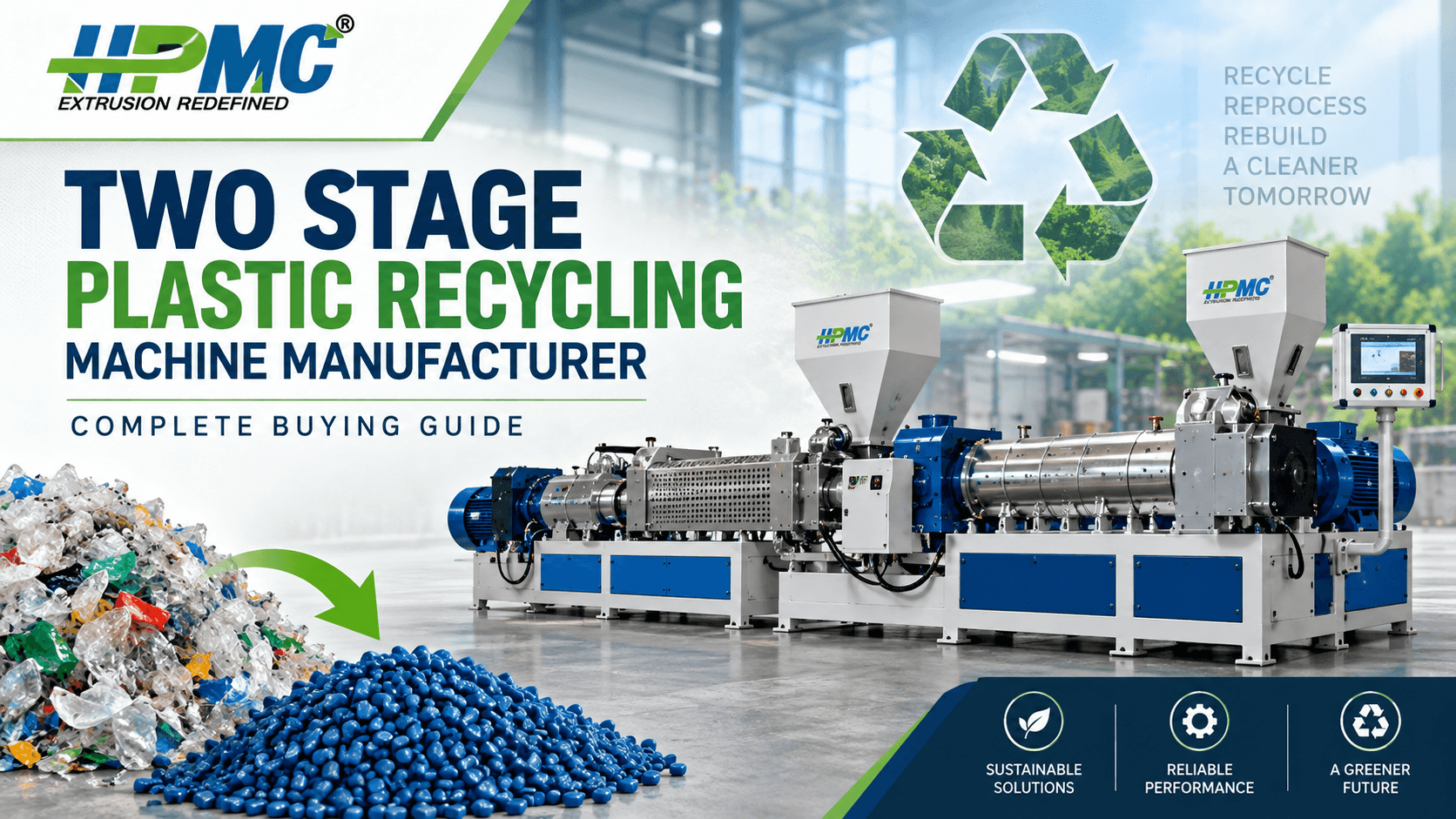
Plastic recycling has become an important part of modern plastic manufacturing as businesses look for effective ways to process suitable plastic waste, production scrap, and recovered materials.
However, different types of plastic waste can have different levels of contamination, moisture, volatile content, and material consistency. These characteristics can make a single processing stage unsuitable for certain recycling applications.
A Two Stage Plastic Recycling Machine uses two connected extrusion stages to process plastic material through a controlled recycling and reprocessing operation. This configuration can provide additional processing flexibility by separating different functions between the first and second extrusion stages.
For businesses planning to establish a recycling plant, choosing the right Two Stage Plastic Recycling Machine Manufacturer is an important decision. The manufacturer needs to understand the feedstock, recycling process, filtration requirements, production target, pelletizing system, and overall plant configuration.
This guide explains how a two-stage plastic recycling machine works, its major components, applications, benefits, and the factors to consider when selecting a Two Stage Plastic Recycling Machine Manufacturer.
What is a Two Stage Plastic Recycling Machine?
A Two Stage Plastic Recycling Machine is a plastic recycling extrusion system consisting of two extrusion stages arranged in sequence.
The first stage generally focuses on feeding, melting, initial homogenization, and processing of the incoming plastic material.
The second stage further processes the polymer melt and can provide additional homogenization, filtration, pressure control, and preparation for pelletizing, depending on the machine configuration.
A simplified process is:
Plastic Waste → Feeding → Melting → Initial Processing → Second Stage Extrusion → Filtration → Pelletizing → Recycled Granules
The exact configuration varies according to the type of plastic being recycled and the desired output.
A two-stage system can be considered when the feedstock or processing requirements demand more controlled processing than a simpler recycling extrusion arrangement.
Why Choose a Two Stage Plastic Recycling Machine?
Plastic waste can contain different challenges depending on its source.
Production scrap may be relatively clean, while post-consumer or industrial waste may contain moisture, contaminants, volatile materials, or inconsistent material characteristics.
A two-stage extrusion arrangement can separate different processing functions between the two stages.
Potential advantages include:
- Improved processing flexibility
- Additional homogenization
- Better control over material processing
- Support for contaminated feedstock
- Improved melt handling
- Integration with filtration systems
- Controlled preparation for pelletizing
- Suitability for different recycling applications
The actual benefits depend on the material, machine configuration, operating conditions, and downstream process.
How Does a Two Stage Plastic Recycling Machine Work?
The working process begins with preparing the plastic waste for recycling.
The material may undergo sorting, size reduction, washing, drying, and other preprocessing depending on its condition.
The extrusion process can then be represented as:
Sorting → Size Reduction → Feeding → First Stage Extrusion → Melting/Homogenization → Second Stage Extrusion → Melt Filtration → Pelletizing → Cooling → Recycled Granules
First Stage: Feeding and Plastic Processing
The prepared plastic material enters the first extrusion stage.
The screw conveys the material through the barrel while heat and mechanical energy support melting and plasticization.
The first stage can also assist in initial homogenization of the polymer melt.
Transfer to Second Stage
The processed polymer melt moves from the first stage to the second extrusion stage.
The arrangement allows different processing functions to be performed across the two stages.
Second Stage: Further Homogenization
The second stage continues processing the polymer melt.
It can provide additional homogenization and controlled melt transport before the material reaches the filtration and pelletizing sections.
Melt Filtration
A suitable filtration system can remove remaining solid contaminants from the polymer melt.
The appropriate filtration arrangement depends on the feedstock and required recycled material quality.
Pelletizing
The filtered polymer melt is converted into recycled plastic granules through an appropriate pelletizing system.
The resulting granules can then be cooled, collected, screened, and packed for further use.
Major Components of a Two Stage Plastic Recycling Machine
Feeding System
The feeding system introduces prepared plastic material into the first extrusion stage.
Its design should be suitable for the physical characteristics of the feedstock.
First Stage Extruder
The first extrusion stage performs initial melting, conveying, plasticization, and homogenization.
Its configuration depends on the plastic material and recycling requirements.
Second Stage Extruder
The second extrusion stage provides additional processing and melt handling before filtration and pelletizing.
The two-stage arrangement allows different extrusion functions to be distributed between the stages.
Screws and Barrels
The screw and barrel design plays an important role in material conveying, melting, mixing, and processing.
Their configuration should be selected according to the polymer and application.
Heating and Cooling System
Controlled heating supports plastic melting, while cooling can help manage processing temperatures where required.
Melt Filtration System
A suitable filter removes solid contaminants from the polymer melt.
Filtration technology should be selected according to contamination levels and material requirements.
Pelletizing System
The pelletizing system converts the processed polymer melt into granules.
The pelletizing arrangement depends on the desired granule characteristics and production requirements.
Cooling System
Cooling helps solidify the newly formed plastic granules.
Control System
The control system allows operators to monitor and manage important process parameters across the recycling line.
What Materials Can Be Processed?
The suitability of a Two Stage Plastic Recycling Machine depends on the machine configuration and feedstock.
Potential applications can include suitable:
- LDPE
- HDPE
- PP
- Plastic films
- Packaging plastic
- Industrial plastic scrap
- Production waste
- Post-consumer plastic
- Agricultural plastic waste
- Processed plastic regrind
Different materials can require different preprocessing, feeding, extrusion, filtration, and pelletizing configurations.
Material sorting is particularly important when different polymers are present in the waste stream.
Applications of Two Stage Plastic Recycling Machines
Plastic Film Recycling
Suitable plastic film waste can be processed through a two-stage recycling system after appropriate sorting and preparation.
Industrial Plastic Scrap Recycling
Manufacturing facilities can process suitable plastic scrap and production waste into reusable recycled material.
Post-Consumer Plastic Recycling
Selected post-consumer plastic waste can be processed after appropriate sorting, washing, drying, and size reduction.
Packaging Plastic Recycling
Suitable packaging waste can be recycled into granules for further plastic processing.
Agricultural Plastic Recycling
Suitable agricultural plastic waste can be processed after removing soil and other contaminants.
Plastic Reprocessing
A two-stage extrusion system can be used as part of a broader Plastic Reprocessing Machine setup for converting recovered plastic into usable recycled granules.
Benefits of Working with a Two Stage Plastic Recycling Machine Manufacturer
Choosing an experienced Two Stage Plastic Recycling Machine Manufacturer is about more than purchasing an extruder.
The manufacturer should be able to understand the complete recycling process and help match the machinery configuration with the feedstock.
Important benefits can include:
Application-Based Machine Selection
The machine can be designed or configured according to the type of plastic and recycling application.
Complete System Integration
The manufacturer can consider feeding, extrusion, filtration, pelletizing, cooling, and material handling as part of the overall system.
Technical Support
Technical assistance can be important during installation, commissioning, and operation.
Process Understanding
A manufacturer with experience in plastic recycling can help evaluate the relationship between feedstock characteristics and machine configuration.
Maintenance Support
Access to appropriate spare parts, maintenance guidance, and technical assistance can help support long-term machine operation.
How to Choose the Right Two Stage Plastic Recycling Machine Manufacturer
Selecting the right manufacturer requires more than comparing machine prices.
Evaluate Manufacturing Expertise
Look for a manufacturer with experience in plastic recycling, extrusion, and reprocessing machinery.
The manufacturer should understand different types of plastic feedstock and their processing requirements.
Understand Your Feedstock
Before contacting a manufacturer, identify:
- Polymer type
- Material source
- Feed size
- Contamination level
- Moisture level
- Required output
- Desired recycled product
This information helps the manufacturer recommend an appropriate system.
Check Machine Configuration
Evaluate the complete machine configuration, including:
- Feeding system
- First extrusion stage
- Second extrusion stage
- Screw and barrel design
- Heating and cooling
- Filtration
- Pelletizing
- Cooling
- Control system
Evaluate Filtration Requirements
Contamination level is an important factor when selecting the melt filtration system.
A suitable filtration solution should be selected according to the type and quantity of contaminants.
Consider Production Requirements
Determine the desired production output and ensure that the complete recycling system is appropriately matched.
Check Automation and Controls
Modern control systems can help operators monitor temperatures, screw operation, feeding, pressure, and other important parameters depending on the machine configuration.
Evaluate Installation and Commissioning
Ask about installation, commissioning, operator training, and technical support.
Consider Spare Parts and After-Sales Service
Long-term machinery performance also depends on access to wear components, spare parts, maintenance support, and technical assistance.
Two Stage Plastic Recycling Machine vs Single Stage Recycling Machine
A single-stage recycling extruder performs the recycling process through one primary extrusion stage.
A two-stage system uses two extrusion stages arranged sequentially.
A two-stage system may be considered when additional processing, homogenization, melt handling, or process separation is required.
The choice depends on:
- Type of plastic waste
- Feedstock contamination
- Moisture and volatile content
- Required material quality
- Filtration requirements
- Production output
- Downstream pelletizing
- Overall plant design
A relatively clean and consistent feedstock may require a simpler recycling configuration, while more challenging material may benefit from a two-stage arrangement.
The appropriate system should therefore be selected based on the actual recycling application.
Two Stage Plastic Recycling Machine for Granule Production
One of the major applications of plastic recycling extrusion is recycled granule production.
A typical process can be:
Plastic Waste → Sorting → Shredding → Washing/Drying if Required → Feeding → First Extrusion → Second Extrusion → Melt Filtration → Pelletizing → Cooling → Screening → Recycled Granules
The resulting recycled granules can be used in suitable plastic manufacturing applications depending on their material characteristics and quality.
The consistency of the final granules depends on the quality of the input material, processing conditions, filtration, pelletizing system, and overall machine configuration.
Factors Affecting Recycling Machine Performance
Feedstock Quality
Clean and properly sorted material can simplify the recycling process.
Material Moisture
Moisture can affect extrusion and final material quality, making suitable drying important for applicable feedstocks.
Contamination
The type and amount of contamination influence the filtration and processing requirements.
Screw Design
Screw geometry influences conveying, melting, mixing, and homogenization.
Temperature Control
Appropriate temperature management supports stable polymer processing.
Feeding Consistency
Stable feeding contributes to consistent extrusion and output.
Filtration
The filtration system must be appropriate for the contamination level and material characteristics.
Pelletizing
The pelletizing system affects the form and handling characteristics of the recycled granules.
Maintenance of a Two Stage Plastic Recycling Machine
Regular maintenance is essential for reliable operation.
Important areas include:
- Feeding system
- Screws
- Barrels
- Die
- Melt filtration system
- Heating zones
- Cooling system
- Gearbox
- Motors
- Bearings
- Pelletizing equipment
- Control system
Screws and barrels should be inspected for wear according to operating conditions.
The feeding system should be kept clean and checked for material buildup.
Filtration components should be maintained according to the selected filtration technology.
The gearbox, bearings, motors, and electrical systems should be inspected according to the manufacturer's recommended maintenance schedule.
Why Choose HPMC as a Two Stage Plastic Recycling Machine Manufacturer?
HPMC provides machinery solutions for plastic recycling, reprocessing, extrusion, compounding, and related polymer processing applications.
As a Two Stage Plastic Recycling Machine Manufacturer, HPMC can evaluate the material type, feedstock characteristics, contamination level, production requirements, filtration needs, and downstream pelletizing process when developing a suitable recycling system.
Businesses planning to establish or upgrade a plastic recycling plant can discuss their specific application with HPMC to determine an appropriate machine configuration.
A complete recycling solution should consider the entire process, from material preparation and feeding to extrusion, filtration, pelletizing, cooling, and final granule collection.
Conclusion
A Two Stage Plastic Recycling Machine Manufacturer plays an important role in helping businesses select and implement suitable plastic recycling equipment.
A two-stage extrusion system can provide additional processing flexibility by distributing different functions between two sequential extrusion stages. It can be integrated with feeding, filtration, pelletizing, cooling, and material handling systems to create a complete recycling line.
However, the right machine should always be selected according to the actual plastic feedstock, contamination level, moisture, required production output, recycled material requirements, and downstream application.
When evaluating a Two Stage Plastic Recycling Machine Manufacturer, businesses should consider manufacturing expertise, machine configuration, technical support, installation, maintenance, spare parts, and complete system integration.
For manufacturers planning to convert suitable plastic waste and production scrap into reusable recycled granules, a properly configured two-stage recycling system can form an important part of an efficient plastic reprocessing operation.
Frequently Asked Questions
Find quick answers to the most common questions about this topic.
A Two Stage Plastic Recycling Machine is a recycling extrusion system that uses two sequential extrusion stages to process plastic waste and prepare it for filtration and pelletizing.
Two extrusion stages can provide additional processing flexibility and allow different material-processing functions to be distributed between the first and second stages.
Depending on the configuration, suitable LDPE, HDPE, PP, plastic films, industrial scrap, packaging waste, agricultural plastic, and other compatible plastic materials can be processed.
A single-stage system uses one primary extrusion stage, while a two-stage system uses two sequential extrusion stages. The appropriate choice depends on the feedstock, contamination, processing requirements, and desired output.
Yes. A suitable two-stage recycling system can be integrated with a melt filtration and pelletizing system to produce recycled plastic granules.
Washing depends on the condition of the feedstock. Contaminated materials may require sorting, washing, drying, and other preprocessing before extrusion.
Melt filtration can remove remaining solid contaminants from the polymer melt. The appropriate filtration system depends on the feedstock and required recycled material quality.
Evaluate the manufacturer's experience in plastic recycling and extrusion, machine configuration, feedstock understanding, filtration solutions, production requirements, technical support, installation, spare parts, and after-sales service.
The machine configuration can be selected according to the type of plastic, feedstock condition, processing requirements, production target, filtration needs, and pelletizing system.