
Introduction
Plastic compounding and recycling are important processes in modern plastic manufacturing. Manufacturers often need to combine polymers with fillers, pigments, additives or reinforcing materials to achieve specific material properties. Recycling operations, meanwhile, focus on processing suitable plastic waste into reusable material for further manufacturing.
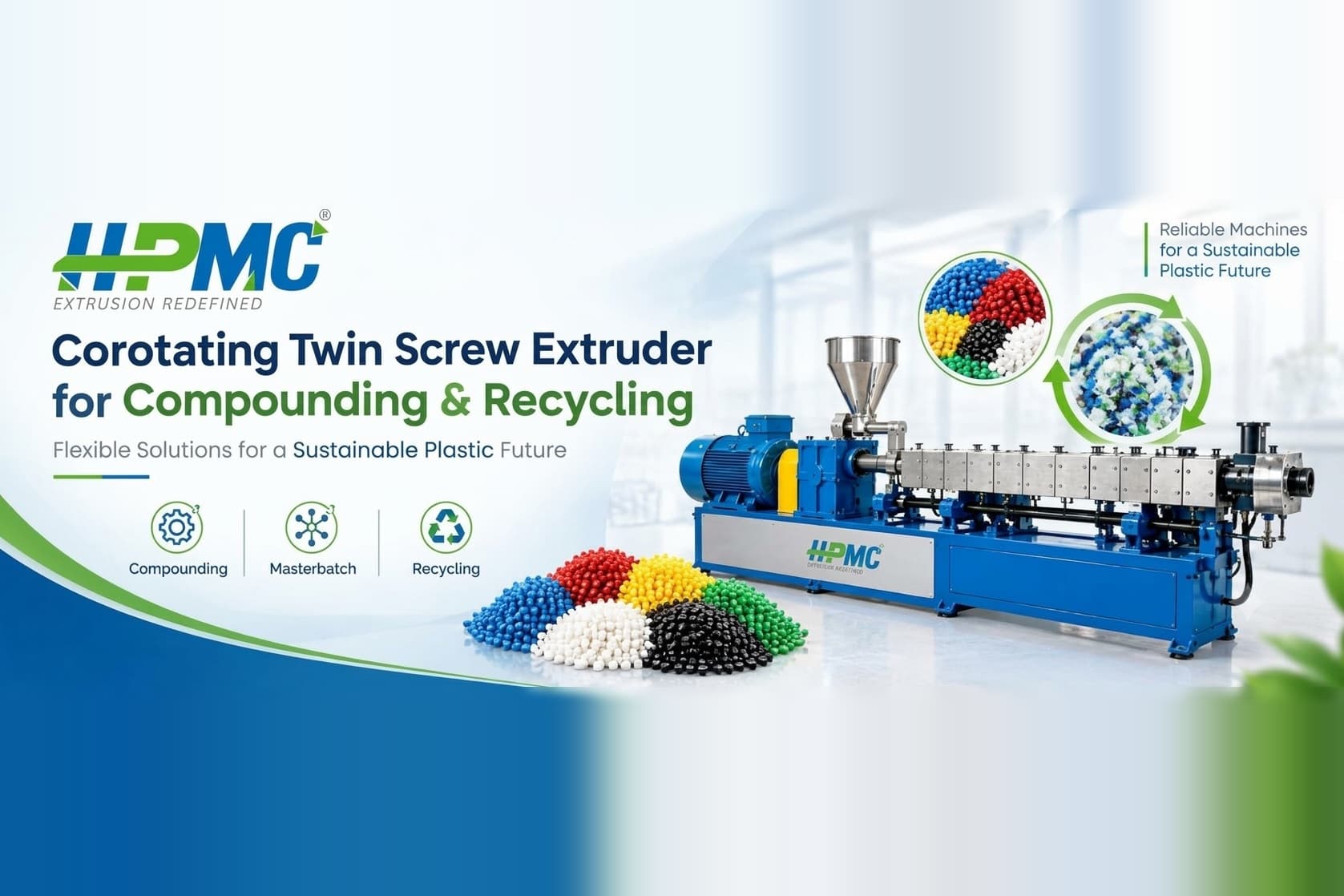
A Corotating Twin Screw Extruder for Compounding and Recycling can support both applications through controlled material conveying, melting, mixing and homogenization. The system uses two screws rotating in the same direction inside a barrel, allowing materials to pass through different processing zones.
Hindustan Plastics & Machine Corporation (HPMC) provides co-rotating twin screw extrusion solutions for polymer compounding, masterbatch production, high-filler formulations and recycling applications. The appropriate machine configuration depends on the material, required output, processing conditions and final product specifications.
This guide explains how twin screw extrusion supports compounding and recycling, the applications it can serve, important machine components and the factors manufacturers should evaluate when planning an extrusion line.
What Is a Corotating Twin Screw Extruder?
A corotating twin screw extruder is an industrial plastic processing machine equipped with two screws that rotate in the same direction within a barrel.
As material moves through the machine, the screws help convey, mix, melt and homogenize the polymer under controlled processing conditions. Screw geometry, temperature settings, feeding arrangements and operating parameters influence how the material behaves during extrusion.
Unlike equipment selected primarily for straightforward material extrusion, a twin screw compounding extruder is particularly useful for formulations that require the incorporation and dispersion of multiple ingredients.
Depending on the configuration, the system can support applications such as:
- Polymer compounding
- Colour and additive masterbatch production
- Filler masterbatch manufacturing
- Glass fibre reinforced compounds
- Engineering plastic processing
- Plastic recycling and reprocessing
- Selected polymer blending applications
The correct configuration should be selected according to the formulation, material characteristics and intended manufacturing process.
How Does Twin Screw Compounding Work?
Twin screw compounding involves combining a base polymer with other ingredients to create a material that meets specific processing or end-use requirements.
A typical compounding process includes the following stages.
1. Raw Material Preparation
The process begins with selecting and preparing the polymer, fillers, pigments and additives. Depending on the formulation, materials may require drying, weighing or other preparation before entering the extrusion line.
Consistent raw material preparation helps support stable feeding and repeatable processing.
2. Feeding and Dosing
The prepared ingredients are supplied to the extruder through an appropriate feeding arrangement. Different formulations may require separate feeders to control the amount of polymer, filler or additive entering the machine.
Accurate dosing is important because variations in ingredient proportions can affect the final compound.
3. Melting and Mixing
Inside the barrel, controlled heating and mechanical action help soften and melt the polymer. The rotating screws convey and mix the ingredients as they move through the processing zones.
The screw configuration should suit the material and the required level of mixing and dispersion.
4. Homogenization
The mixing process helps distribute compatible fillers, pigments and additives throughout the polymer matrix. The required degree of homogenization depends on the formulation and the intended product.
5. Filtration and Pelletizing
Where required, the molten material can pass through a suitable filtration arrangement before reaching the die and pelletizing system. The processed material is then converted into granules or pellets using a suitable downstream setup.
The exact production line depends on the material, product specifications and operating requirements.
Applications of a Corotating Twin Screw Extruder for Compounding and Recycling
The versatility of twin screw extrusion makes it relevant to several polymer processing applications. However, material compatibility and the machine configuration must always be considered.
Colour Masterbatch Production
Colour masterbatch manufacturing involves dispersing pigments within a polymer carrier. Effective mixing is important for achieving a uniform distribution of colour throughout the material.
A suitable colour masterbatch extruder can help manufacturers process pigment-containing formulations according to their required colour and quality specifications.
Filler Masterbatch Production
Filler masterbatch formulations incorporate materials such as calcium carbonate or talc into a suitable polymer base.
The required filler loading, feeding arrangement and screw configuration influence the processing requirements. HPMC's published co-rotating twin screw extruder range includes configurations intended for high-filler applications.
Glass Fibre Reinforced Compounds
Glass fibre can be incorporated into compatible polymers to produce reinforced compounds for industrial applications.
Processing requirements depend on the polymer, fibre content and desired product properties. The screw configuration and feeding arrangement should be selected carefully to suit the formulation.
PP and PE Compounding
Polypropylene (PP) and polyethylene (PE) are widely used thermoplastics. Depending on the intended product, these polymers may be compounded with fillers, pigments or other compatible additives.
A twin screw compounding extruder can support controlled mixing of these ingredients when configured for the specific formulation.
Engineering Plastics
Engineering plastic formulations may require controlled processing, mixing and dispersion. The appropriate extrusion setup depends on the polymer type, additives, thermal requirements and production target.
Plastic Recycling and Reprocessing
Suitable post-industrial and post-consumer plastic materials may be processed through a properly configured recycling extrusion line.
Depending on the feedstock, the process may involve material preparation, feeding, melting, degassing, melt filtration and pelletizing. The required stages depend on the condition of the waste and the intended use of the recycled output.
Key Features of a Twin Screw Compounding and Recycling System
The features required for an extrusion line depend on the application and the material being processed.
Modular Screw Design
A modular screw arrangement can allow the processing configuration to be adapted for different materials and applications. The selected screw elements influence conveying, mixing, melting and material residence time.
Screw and Barrel Construction
The screw and barrel materials should be appropriate for the polymer, fillers and operating conditions. Abrasive ingredients, including certain high-filler formulations, may require particular attention to wear resistance.
Where hardened components are specified, their suitability should be confirmed against the intended formulation and operating requirements.
Feeding and Dosing Systems
Different raw materials have different flow characteristics. A suitable feeding arrangement helps maintain consistent material supply and supports controlled formulation proportions.
Multiple feeders may be required when a process incorporates several ingredients.
Venting and Vacuum Degassing
Some materials may introduce moisture, trapped air or volatile components during processing. Depending on the application, a venting section or vacuum degassing system may be incorporated into the extrusion line.
The required arrangement depends on the feedstock and process conditions.
Melt Filtration
A melt filtration system can remove suitable solid contaminants from molten polymer before it reaches the downstream equipment. Filtration requirements depend on the feedstock quality, contamination level and final product specifications.
Filtration should be selected as part of the complete extrusion process rather than treated as a standalone solution to every feedstock issue.
Pelletizing System
Pelletizing converts processed polymer into manageable granules for storage, transportation or further manufacturing.
The appropriate pelletizing method depends on the polymer, melt characteristics, required output and final pellet specifications.
Temperature and Process Controls
Temperature control and suitable operating controls help operators manage the extrusion process. The required monitoring and automation depend on the machine configuration and production requirements.
How to Select the Right Extruder for Your Application
Choosing an extrusion system requires more than identifying the type of machine. Manufacturers should evaluate the complete process and the characteristics of the materials they intend to handle.
Identify the Material
Determine whether the application involves PP, PE, colour masterbatch, calcium-filled compounds, glass fibre reinforced compounds or suitable recycled plastics.
Different formulations can require different screw designs, temperature settings and feeding arrangements.
Define the Required Output
Establish the target production rate in kilograms per hour. The selected model should suit the required throughput and processing conditions.
A higher-capacity machine is not automatically the right choice if its capacity does not match actual production needs.
Review the Formulation
Identify the polymer, fillers, pigments, additives and their proportions. This information helps determine the feeding system, screw configuration and other process requirements.
Evaluate the Feedstock
For recycling applications, assess the plastic type, contamination, moisture, shape and consistency of the incoming material.
Sorting, washing, drying or size reduction may be required before extrusion, depending on the waste stream.
Confirm Filtration and Degassing Requirements
Discuss the required filtration level and whether venting or vacuum degassing is necessary. These decisions should reflect the condition of the material and the quality requirements for the final output.
Plan the Complete Production Line
Consider auxiliary equipment such as feeders, cooling systems, filtration units, pelletizers and material handling systems. Confirm which components are included in the proposed supply.
Consider Maintenance and Technical Support
Evaluate access to spare parts, maintenance guidance, installation assistance and technical support. These requirements are important when planning the long-term operation of industrial machinery.
Why Choose HPMC for Compounding and Recycling Machinery?
Hindustan Plastics & Machine Corporation (HPMC) provides extrusion and plastic processing machinery for industrial applications. Its published co-rotating twin screw extruder range supports polymer compounding, masterbatch production, engineering plastics, high-filler formulations and selected recycling applications.
HPMC's product range includes different machine models and production capacities. The appropriate configuration depends on the intended material, required output and process requirements.
Businesses evaluating a Corotating Twin Screw Extruder for Compounding and Recycling should share details about their formulation, filler content, target production rate and downstream requirements when requesting technical guidance.
For additional information, explore HPMC's co-rotating twin screw extruder range and its co-rotating twin screw extruder for compounding and recycling product page.
Conclusion
A corotating twin screw extruder can support a range of plastic compounding and recycling applications by combining controlled conveying, melting, mixing and homogenization in a continuous process.
Its suitability depends on the polymer, formulation, filler content, feedstock condition, production target and required downstream equipment. Feeding systems, screw configuration, venting, filtration and pelletizing should therefore be evaluated together when planning an extrusion line.
Manufacturers should define their material and production requirements before selecting equipment. Reviewing the complete process helps identify a configuration suited to the intended application.
HPMC offers co-rotating twin screw extrusion solutions for industrial polymer processing. Contact the team to discuss your application, technical specifications and quotation requirements.
Contact HPMC
For information about co-rotating twin screw extrusion machinery, compounding applications and recycling solutions, contact Hindustan Plastics & Machine Corporation.
- Website: https://www.hindustanplastics.com/
- Email: info@hindustanplastics.com
- Google Business Profile: https://share.google/lBK4uD53HqY891ynv
- TEL:095605 96392
Contact HPMC to discuss your application, request technical specifications and enquire about a suitable extrusion solution.
Frequently Asked Questions
Find quick answers to the most common questions about this topic.
A corotating twin screw extruder is used for polymer compounding, masterbatch production, filler incorporation, engineering plastic processing and suitable recycling applications. The exact use depends on the machine configuration and material requirements.
Compounding combines a base polymer with ingredients such as fillers, pigments or additives to produce a specified formulation. Recycling processes suitable plastic waste into material that can be reused in manufacturing. Some extrusion lines can support both types of application when appropriately configured.
A suitably configured twin screw extruder can process compatible PP and PE formulations. The appropriate setup depends on the material grade, additives, required output and processing conditions.
Yes, a suitably configured twin screw compounding extruder can be used for colour masterbatch production. Pigment selection, polymer carrier, feeding arrangement and mixing requirements influence the process.
Venting and vacuum degassing may help remove moisture, trapped air and certain volatile components during processing. Whether they are required depends on the material and its condition.
Melt filtration helps remove solid contaminants from molten polymer before downstream processing. The suitable filtration arrangement depends on the feedstock, contamination level and final product requirements.
Important information includes the polymer or feedstock, formulation, filler content, target output, required product specifications, feeding requirements, filtration needs and downstream equipment.
HPMC publishes different co-rotating twin screw extruder models with varying technical specifications and output ranges. The appropriate model should be confirmed against the intended material and operating conditions.
Share your material details, intended application, target production rate and equipment requirements with HPMC. The team can then discuss the relevant machine configuration and quotation requirements.