
Introduction
PVC profiles are widely used in construction, interior design, window and door systems, and decorative applications. Products such as UPVC window frames, door profiles, ceiling profiles, skirting, wall panels, and decorative sections require suitable extrusion machinery to achieve the required shape, dimensions, and surface finish.
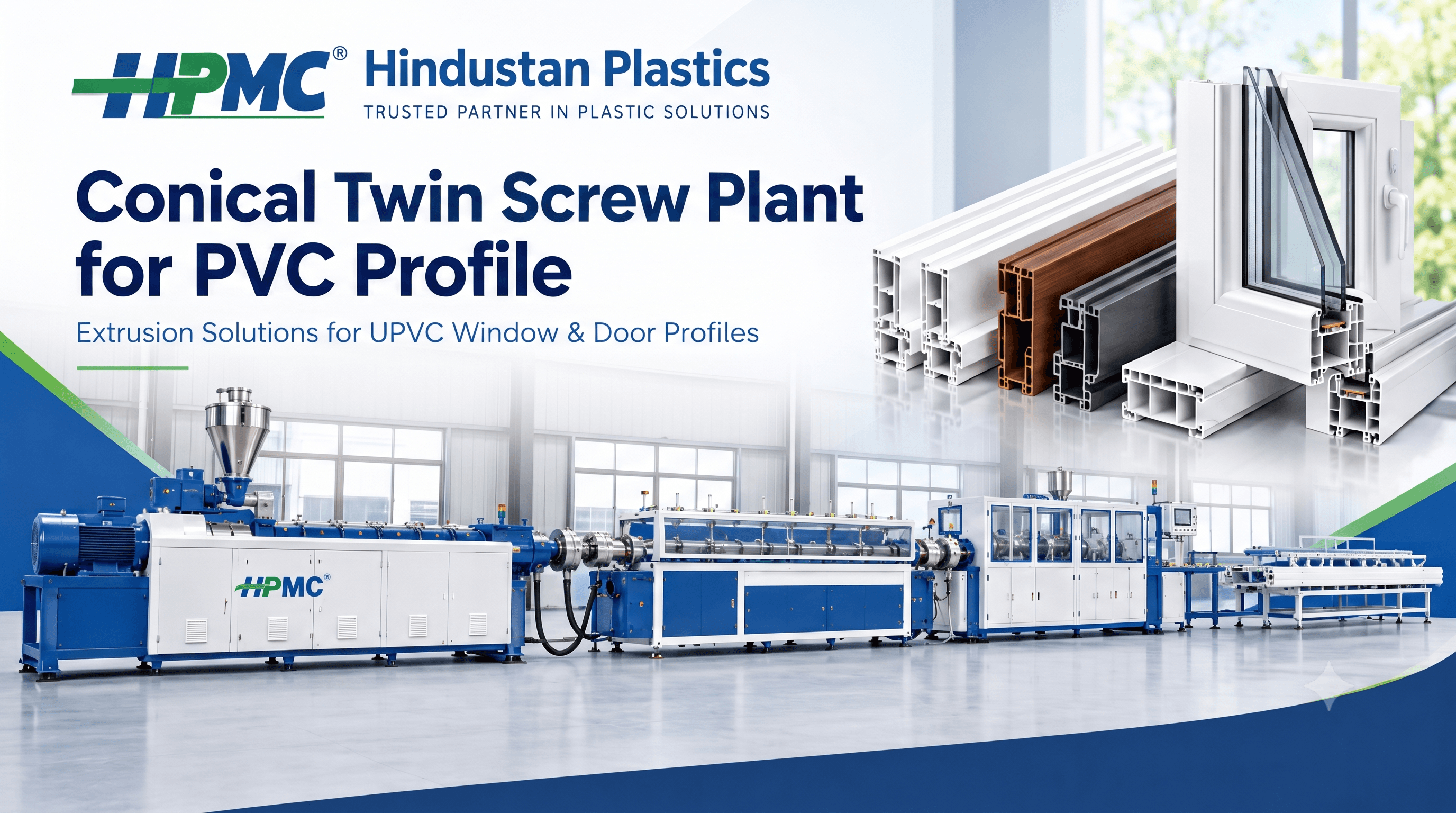
A Conical Twin Screw Plant for PVC Profile is an extrusion system designed to process PVC compounds and form them into continuous profiles using customised tooling. The production line generally combines an extruder, profile die, vacuum calibration system, haul-off unit, cutter, and stacking arrangement.
For manufacturers, selecting the right PVC profile extrusion machine involves more than comparing machine capacity. Profile geometry, material formulation, tooling requirements, cooling arrangements, production targets, and maintenance support all influence the suitability of a plant.
Hindustan Plastics & Machine Corporation (HPMC), based in Delhi, India, offers a Twin Screw Plant for PVC Profile for profile manufacturing applications.
This guide explains how the plant works, its main components, common applications, the importance of die changeover, and factors to consider before investing in PVC profile extrusion machinery.
What Is a Conical Twin Screw Plant for PVC Profile?
A Conical Twin Screw Plant for PVC Profile is a manufacturing system that uses a conical twin screw extruder to process a PVC compound before shaping it into a specific profile.
The two screws operate inside a matching barrel and convey the material through the processing section. Controlled heating and mechanical action help prepare the compound for extrusion through a profile die.
The die determines the cross-sectional shape of the finished product. After leaving the die, the profile passes through calibration and cooling equipment before being pulled, cut, and collected.
A typical production line may include:
- PVC compound feeding system.
- Conical twin screw extruder.
- Heating and temperature-control system.
- Customised profile die.
- Vacuum calibration unit.
- Cooling arrangement.
- Haul-off unit.
- Cutting machine.
- Stacking or collection equipment.
- Electrical control panel.
The precise configuration depends on the profile design, dimensions, material formulation, production capacity, and level of automation required.
How Does a PVC Profile Extrusion Plant Work?
The PVC profile manufacturing process consists of several connected stages. Each stage must be configured appropriately for the material and finished product.
1. PVC Compound Preparation
The process begins with preparing a PVC compound suitable for the intended profile.
Depending on the formulation, the compound may contain PVC resin, stabilisers, processing aids, lubricants, pigments, and other additives.
The formulation must be suitable for the intended product and extrusion equipment. Consistent material preparation helps support stable processing and a uniform finished profile.
2. Feeding the Material
The prepared compound is supplied to the extruder through a suitable feeding arrangement.
Consistent feeding helps maintain a stable supply of material during production. The feeding system should match the characteristics of the compound and the requirements of the selected machine.
3. Processing Through the Conical Twin Screw Extruder
Inside the extruder, the two conical screws convey and process the PVC compound.
The screw and barrel configuration, temperature settings, screw speed, and feed rate influence material processing and output.
The operating conditions should be established according to the formulation, machine specifications, and intended profile.
4. Profile Formation Through the Die
The processed PVC material passes through a customised profile die that forms the required cross-sectional shape.
Different products may require different dies. For example, a UPVC window frame, a ceiling profile, and a decorative skirting section have different geometries and tooling requirements.
Die design and setup are important for achieving the intended dimensions and material distribution.
5. Vacuum Calibration
After leaving the die, the profile enters the calibration section.
A vacuum calibration system helps control the profile's dimensions and shape as the material begins to cool. Calibration equipment must be compatible with the profile geometry and the production requirements.
6. Cooling
The profile continues through the cooling arrangement, allowing it to stabilise before downstream handling.
Cooling requirements depend on the profile's thickness, geometry, material formulation, and production speed.
7. Haul-Off
The haul-off unit pulls the profile through the line at a controlled speed.
The haul-off speed should be coordinated with the extrusion output. An unsuitable pulling speed can contribute to dimensional variation or deformation.
8. Cutting and Stacking
The cutting machine separates the continuous profile into the required lengths.
The finished sections are then transferred to a stacking or collection arrangement for inspection, handling, and storage.
The complete line should be coordinated so that extrusion, calibration, cooling, pulling, and cutting work together effectively.
Main Components of a Conical Twin Screw PVC Profile Plant
Understanding the main components helps manufacturers evaluate whether a machine is appropriate for their production requirements.
1. Conical Twin Screw Extruder
The extruder processes the PVC compound before it enters the profile die.
Its screw geometry, barrel configuration, drive system, and temperature controls influence the material-processing capability. The extruder should be selected according to the intended formulation and profile requirements.
2. Profile Die
The profile die determines the cross-sectional shape of the product.
Since different profiles require different geometries, tooling selection is an important part of the project. Manufacturers planning to produce multiple designs should discuss additional die requirements with the supplier.
3. Vacuum Calibration Unit
The calibration unit helps maintain the intended shape and dimensions of the profile after it leaves the die.
Its configuration should suit the product's cross-section, dimensions, and cooling requirements.
4. Cooling System
The cooling arrangement helps stabilise the profile before it reaches the haul-off and cutting sections.
Suitable cooling conditions are important for maintaining the intended shape and reducing deformation during production.
5. Haul-Off Unit
The haul-off unit pulls the profile through the production line.
It should provide controlled movement that is compatible with the extrusion output and profile dimensions.
6. Cutting Machine
The cutting machine produces profiles in the specified lengths.
Cutting arrangements should be suitable for the profile geometry and the production line's operating speed.
7. Stacking System
The stacking or collection system organises finished profiles after cutting.
Suitable handling can help keep profiles organised and reduce unnecessary movement during collection and storage.
8. Electrical Control System
The control system allows operators to monitor relevant operating parameters according to the machine configuration.
Depending on the system, these may include temperature, screw speed, haul-off speed, and cutting operations.
Applications of PVC Profile Extrusion Machinery
A PVC profile extrusion plant can be configured for several types of products. The actual products that can be manufactured depend on the die, machine configuration, material formulation, and required specifications.
1. UPVC Window Profiles
UPVC profiles are used in window systems for residential and commercial buildings.
The extrusion line must support the profile's cross-sectional geometry, dimensions, and surface-finish requirements.
2. PVC Door Profiles
PVC door profiles are used in suitable door systems and related construction applications.
The die and calibration setup should be designed around the intended profile shape and dimensions.
3. PVC Ceiling Profiles
Ceiling profiles are used in interior finishing and decorative applications.
Manufacturers should consider profile width, thickness, surface appearance, and the requirements of the installation system.
4. PVC Skirting Profiles
PVC skirting is used along the lower edges of interior walls to provide a finishing detail.
The profile design may vary according to the intended appearance and installation method.
5. PVC Wall Panels
PVC extrusion machinery can be configured for certain wall-panel products where the machine, die, and downstream equipment support the required dimensions.
Manufacturers should confirm whether a particular panel design is compatible with the proposed line.
6. Decorative PVC Sections
Custom dies can be used to manufacture suitable decorative sections, trims, and other specialised profiles.
The tooling and production setup should be evaluated against the intended cross-section and finished-product specifications.
Why Is Die Changeover Important in PVC Profile Manufacturing?
Manufacturers producing multiple profile designs need to consider how easily the production line can be adapted when changing products.
The die is responsible for forming the profile's cross-section, so a different product design may require different tooling.
A quick die changeover arrangement can help organise product changeovers, but the actual time required depends on the machine design, tooling, operator procedures, and any necessary calibration adjustments.
Key Considerations for Die Changeover
- Tooling compatibility: Confirm that the machine supports the intended range of profile dies.
- Changeover procedure: Understand the steps required to remove, install, and set up a die.
- Calibration requirements: Different profile shapes may require adjustments to the calibration equipment.
- Trial production: New tooling may require testing and process adjustments before production is approved.
- Operator training: Staff should understand the manufacturer's recommended setup and safety procedures.
Manufacturers should ask the supplier to explain the die changeover process and confirm what tooling and accessories are included in the quotation.
Benefits of a Conical Twin Screw Plant for PVC Profiles
A suitably configured profile extrusion plant can support several manufacturing requirements.
Consistent Profile Formation
Appropriate extrusion, tooling, calibration, and cooling can help manufacturers maintain the intended profile shape and dimensions.
Multiple Profile Applications
With compatible dies and the appropriate machine configuration, a plant may be used to manufacture different profile designs.
Each product must be evaluated for tooling compatibility and processing requirements.
Coordinated Production
An integrated line combines extrusion, calibration, cooling, haul-off, cutting, and collection equipment into a coordinated workflow.
Production Planning Flexibility
Manufacturers producing different profiles can plan production around product demand, die availability, changeover requirements, and material preparation.
Controlled Processing
Temperature controls and operating adjustments help operators manage the extrusion process according to the compound and machine specifications.
Potential Operating Efficiency
A well-matched production line may support efficient use of materials and operating resources. Actual energy consumption, output, labour requirements, and production cost depend on the machine model, product specifications, and operating conditions.
These benefits depend on appropriate equipment selection, process control, operator training, and maintenance.
How to Choose the Right PVC Profile Extrusion Machine
Before purchasing a PVC profile plant, manufacturers should evaluate the complete production requirement.
1. Define the Profile Design
Identify the products you plan to manufacture, such as window profiles, door profiles, ceiling sections, skirting, or decorative trims.
Provide drawings or samples where possible so the supplier can evaluate the tooling and machine requirements.
2. Confirm Material Compatibility
Discuss the intended PVC formulation with the machine supplier.
The extruder configuration and process controls should be appropriate for the compound and the required finished-product properties.
3. Evaluate Production Capacity
Capacity should be assessed for the actual profile design and formulation.
Ask for model-specific output information and clarify the conditions under which the stated output can be achieved.
A general maximum-output figure should not be assumed to apply to every profile.
4. Review Die and Tooling Requirements
Confirm which die is included and whether additional dies are required for other products.
Also ask about tooling lead times, changeover procedures, and any required calibration changes.
5. Check Calibration and Cooling
The calibration and cooling arrangement should suit the profile's geometry, dimensions, and intended production speed.
These components should be evaluated as part of the complete line.
6. Assess Cutting and Stacking Equipment
Check that the cutting and collection arrangements are compatible with the profile dimensions and finished lengths.
7. Consider Installation and Utilities
Review the installation space, electrical requirements, cooling-water arrangements, material handling, and maintenance access needed for the complete line.
8. Evaluate Service and Maintenance Support
Discuss installation, commissioning, operator training, maintenance procedures, spare parts, and technical assistance.
9. Compare the Total Project Cost
The total investment may include the extruder, dies, calibration equipment, cooling system, haul-off, cutter, stacker, installation, and other necessary accessories.
Request a detailed quotation that identifies the included components and any additional costs.
Common PVC Profile Extrusion Challenges
Several production issues may occur if material preparation, tooling, processing conditions, or downstream equipment are not properly matched.
Observed issueAreas to investigate
Uneven profile dimensions
Die setup, calibration, cooling, and haul-off speed
Rough surface finish
Material consistency, contamination, die condition, and processing settings
Profile deformation
Cooling, calibration, handling, and pulling conditions
Inconsistent profile thickness
Die design, material distribution, and operating parameters
Colour variation
Compound consistency, pigment distribution, and process records
Incorrect cut length
Cutting synchronisation and line-speed settings
These are general troubleshooting starting points rather than confirmed diagnoses. The actual cause should be identified through inspection and the equipment manufacturer's guidance.
Recommended Quality Checks
Manufacturers should establish an inspection routine that may include:
- Checking incoming compound consistency.
- Measuring profile dimensions against the required specification.
- Inspecting surface appearance and colour.
- Checking the profile's shape and straightness.
- Verifying finished lengths.
- Recording production settings and recurring defects.
- Following the recommended machine maintenance schedule.
The appropriate inspection and testing requirements depend on the intended product and applicable standards.
PVC Profile Plant vs. PVC Pipe Plant
Although both systems use extrusion technology, they are designed for different product shapes.
A PVC pipe plant forms a hollow cylindrical product through a pipe die and typically uses pipe calibration equipment.
A PVC profile plant forms a customised cross-section, such as a window frame, door section, skirting, or decorative trim. Its tooling and calibration equipment must match the profile geometry.
FactorPVC Pipe PlantPVC Profile Plant
Main product
Pipes
Custom-shaped profiles
Tooling
Pipe die
Profile die
Calibration
Designed for pipe dimensions
Designed for the profile cross-section
Typical products
Plumbing, drainage, or conduit pipes
Window profiles, door profiles, skirting, panels, and trims
Tooling changes
Depend on pipe sizes and die design
Depend on profile designs and die compatibility
The correct plant should be selected according to the product being manufactured rather than assuming that pipe and profile lines are interchangeable.
Why Consider HPMC for PVC Profile Extrusion Machinery?
Hindustan Plastics & Machine Corporation (HPMC) supplies extrusion machinery for plastic processing applications.
The company offers a Twin Screw Plant for PVC Profile for manufacturing PVC profiles used in construction and other suitable applications.
Manufacturers considering this equipment should discuss their intended profile designs, material formulation, required output, tooling requirements, and downstream equipment with HPMC.
Before placing an order, request the current technical specifications and a detailed quotation. Confirm the machine configuration, included dies, installation arrangements, and available service support.
Conclusion
A Conical Twin Screw Plant for PVC Profile is designed to process PVC compounds and manufacture customised profiles for applications such as UPVC windows and doors, ceiling sections, skirting, panels, and decorative products.
The complete production line combines an extruder, profile die, calibration and cooling equipment, haul-off, cutting machine, and stacking arrangement.
Choosing the right plant requires careful evaluation of the profile design, compound compatibility, required capacity, die changeover needs, downstream equipment, and installation requirements.
Manufacturers should compare complete machine configurations and confirm application-specific specifications before investing in a PVC profile extrusion system.
For businesses planning to manufacture PVC profiles, HPMC's Twin Screw Plant for PVC Profile is an option to evaluate according to their production requirements.
Contact HPMC
Company: Hindustan Plastics & Machine Corporation (HPMC)
Address: 5, Category II, DSIDC Industrial Area, Nangloi, Delhi – 110041, India
Website: https://www.hindustanplastics.com/
Phone: +91 95605 96392
Email: info@hindustanplastics.com
Google Business Profile: https://share.google/lBK4uD53HqY891ynv
Contact HPMC to discuss your PVC profile extrusion requirements and request current machine specifications.
Frequently Asked Questions
Find quick answers to the most common questions about this topic.
It is an extrusion system that processes PVC compound through a conical twin screw extruder and forms it into customised profiles using a profile die.
Depending on the machine configuration and tooling, it may manufacture UPVC window and door profiles, ceiling sections, skirting, wall panels, and decorative profiles.
The profile die determines the cross-sectional shape of the product. Different designs may require different dies and tooling arrangements.
Vacuum calibration helps control the profile's dimensions and shape as the material cools after leaving the die.
t may be possible when the machine supports the required dies and the calibration and downstream arrangements are compatible. Confirm tooling and changeover requirements with the supplier.
Quick die changeover refers to a machine arrangement and procedure intended to make changing profile tooling more convenient. The actual changeover time depends on the machine and production setup.
Output depends on the machine model, compound formulation, profile dimensions, die design, operating conditions, cooling, and downstream equipment.
Possible causes include material inconsistency, die setup, calibration, cooling, and haul-off conditions. Inspection is necessary to identify the actual cause.
Consider the profile designs, material formulation, required output, dies, calibration, cooling, cutting, installation, maintenance, and technical support.
No. A profile plant forms customised cross-sections, while a pipe plant is configured to produce pipes. Their dies and calibration arrangements differ.