
Introduction
Producing PVC profiles requires more than selecting an extruder with suitable capacity. The profile die, calibration tooling, cooling arrangement, haul-off system, and cutting equipment must work together to produce the intended shape and dimensions.
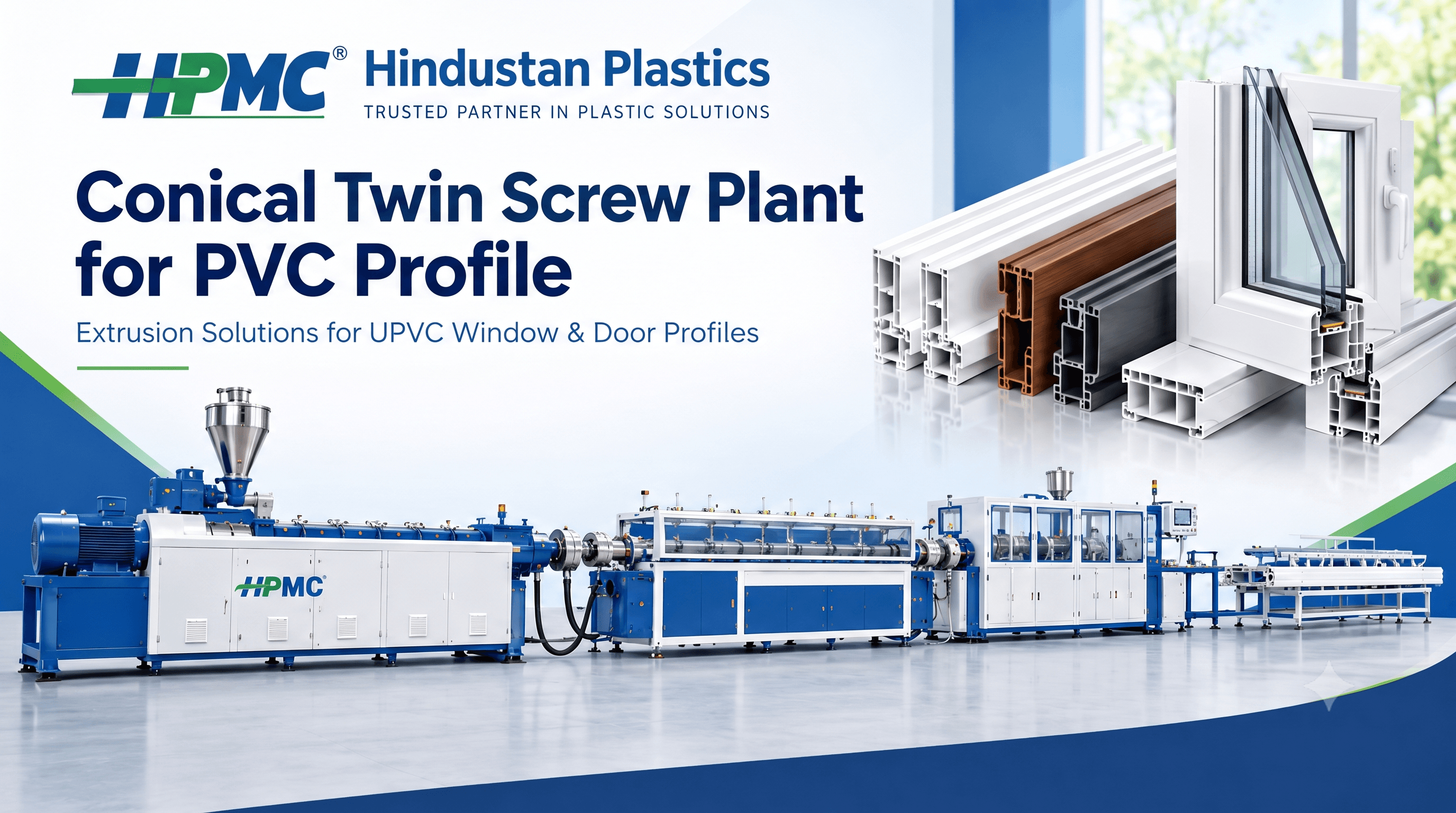
A Conical Twin Screw Plant for PVC Profile can be configured for applications such as UPVC window and door profiles, ceiling sections, skirting, panels, and decorative profiles. However, each product may have different cross-sectional dimensions, wall thicknesses, cooling requirements, and tooling needs.
For manufacturers planning a new production line or expanding their existing product range, understanding these setup requirements can help them make better equipment decisions.
This guide focuses on profile tooling, calibration, production-line coordination, and changeover planning rather than repeating a general overview of PVC extrusion machinery.
1. Why Profile Die Selection Matters
The profile die is responsible for forming the PVC compound into the required cross-sectional shape. Its design influences material flow through the die and contributes to the dimensions and surface quality of the extruded profile.
A die designed for one profile cannot automatically be assumed to work for another profile without appropriate engineering and testing.
Important factors in die selection
Profile cross-section: The die must be designed around the required shape, including chambers, grooves, ribs, and other features.
Wall thickness: Variations in wall thickness and geometry influence material flow and the cooling behaviour of the profile.
Material formulation: PVC formulations can differ in their processing characteristics. Die design and operating conditions should be suitable for the intended compound.
Dimensional requirements: The finished profile must meet the specified dimensions and tolerances after calibration and cooling.
Expected production conditions: The die should be considered alongside the intended output, extrusion conditions, and downstream equipment.
Before finalising a die, manufacturers should provide a technical drawing or representative sample to the tooling supplier. This gives the engineering team a clearer basis for evaluating the required geometry.
2. Calibration Tooling and Dimensional Accuracy
After PVC material exits the die, the hot profile must retain its intended shape as it cools. Calibration equipment supports this process and helps establish the required dimensions.
The calibration system must be compatible with the profile geometry rather than selected only according to the extruder size.
What should manufacturers evaluate?
- Tooling compatibility: The calibration tooling must correspond to the profile cross-section and required dimensions.
- Vacuum arrangement: Where vacuum calibration is used, its design and operating settings should suit the product.
- Cooling distribution: Uneven cooling can contribute to dimensional variation or deformation.
- Profile support: The hot profile needs suitable support while its shape stabilises.
- Inspection access: Operators should be able to inspect the profile and identify dimensional changes during production.
Calibration problems should not automatically be attributed to the extruder. The die, cooling arrangement, pulling speed, and material formulation may also need to be assessed.
3. Coordinating Cooling and Haul-Off Speed
Cooling and haul-off are closely connected parts of a profile extrusion line.
The cooling system helps stabilise the extruded material, while the haul-off pulls the profile through the downstream equipment at a controlled speed. If these stages are poorly coordinated, the finished product may not retain its intended dimensions.
Common setup considerations
Cooling capacity: The arrangement should suit the profile dimensions, wall thickness, material characteristics, and target production conditions.
Pulling speed: The haul-off speed should be coordinated with extrusion output and the cooling process.
Profile alignment: Misalignment through calibration and haul-off equipment may contribute to deformation.
Surface contact: Belts, rollers, and other contact surfaces should be appropriate for the profile being produced.
Cutting coordination: The cutting system should be configured for the intended profile length and production speed.
When investigating a quality problem, manufacturers should evaluate these stages together instead of changing several machine settings at once.
4. Planning Die Changeovers for Different PVC Profiles
Manufacturers producing multiple profile designs need a practical plan for changing tooling between products.
The time and work involved depend on the machine design, die construction, calibration arrangement, operating procedures, and the difference between the products.
A practical changeover checklist
- Confirm the new profile drawing and required dimensions.
- Identify the correct die and matching calibration tooling.
- Check that the tooling is compatible with the intended PVC formulation.
- Follow the manufacturer's safe shutdown and tooling-change procedures.
- Inspect and install the tooling according to the equipment instructions.
- Verify the required process settings before restarting production.
- Inspect initial samples for dimensions, shape, and surface quality.
- Record the approved settings for future production runs.
Quick die changeover should be evaluated as part of the complete production setup. A convenient die mounting arrangement alone does not guarantee a fast or trouble-free changeover.
5. Matching the Extruder to the Profile Application
The conical twin screw extruder must be suitable for the PVC compound and intended profile. Selecting an extruder solely on the basis of a headline output figure may overlook important production requirements.
Manufacturers should discuss the following points with their machinery supplier.
Selection factorWhy it matters
PVC formulation
Material composition influences processing behaviour.
Profile dimensions
Cross-section and wall thickness affect tooling and cooling requirements.
Target output
The complete line must support the intended production rate.
Screw and barrel configuration
The design must suit the material and application.
Die and calibration
Both must match the required profile geometry.
Cooling and haul-off
These systems must coordinate with extrusion output.
Product changeovers
Tooling arrangements should support the planned product range.
Technical support
Installation, training, maintenance, and troubleshooting support are important.
The appropriate machine configuration should be confirmed against the actual product specifications and production conditions.
For product-specific information, manufacturers can explore the HPMC Twin Screw Plant for PVC Profile and discuss their requirements with the company.
6. Establishing a Production Setup Checklist
Before starting commercial production, it is useful to document the intended operating and inspection requirements.
A production setup checklist can include:
Material preparation
- Confirm the approved PVC formulation.
- Check material consistency and preparation procedures.
- Verify that the formulation is suitable for the intended profile.
Tooling preparation
- Confirm the die identification and profile drawing.
- Verify calibration tooling compatibility.
- Inspect tooling condition before use.
Machine preparation
- Follow the equipment manufacturer's startup instructions.
- Check relevant heating, cooling, and control systems.
- Confirm that the downstream equipment is correctly aligned.
Initial production checks
- Inspect the cross-sectional dimensions.
- Check the profile shape and surface finish.
- Review cooling and haul-off behaviour.
- Verify cutting length and finished-product handling.
Production documentation
- Record approved machine settings.
- Document inspection results.
- Note recurring defects and corrective actions.
- Maintain tooling and maintenance records.
These records can help operators repeat an approved production setup and investigate variations between batches.
7. Troubleshooting Profile Quality During Production
The same visible defect can have more than one possible cause. Troubleshooting should therefore begin with observation and systematic checks rather than assuming a single component is responsible.
Observed issueAreas to investigate
Profile dimensions vary
Die condition, calibration, cooling, pulling speed, and material consistency
Profile shape changes after leaving the die
Calibration support, cooling uniformity, and haul-off alignment
Surface finish is inconsistent
Material condition, die surfaces, processing settings, and contamination
Profile bends or deforms
Cooling conditions, profile support, alignment, and pulling speed
Cut lengths vary
Cutting settings, measurement method, and coordination with line speed
Operators should follow the machine manual and approved operating procedures when making adjustments. Persistent problems may require inspection by a qualified technician or tooling specialist.
8. Maintenance of Dies and Calibration Equipment
The die and calibration system directly interact with the profile being manufactured. Their condition and cleanliness are therefore important parts of production maintenance.
Useful practices include:
- Inspect dies and calibration tooling according to the manufacturer's maintenance schedule.
- Clean components using approved methods that will not damage their surfaces.
- Check for wear, damage, deposits, or signs of uneven material flow.
- Inspect cooling connections and relevant vacuum components.
- Check haul-off belts, rollers, and alignment.
- Record tooling repairs and changes.
- Store removed tooling appropriately to protect working surfaces.
Maintenance frequency should depend on the equipment instructions, material being processed, operating hours, and actual tooling condition.
9. Questions to Discuss With an Extrusion Machinery Manufacturer
Before purchasing or modifying a production line, manufacturers should prepare the information needed for a technical discussion.
Share the following details:
- Profile drawing or sample
- Required profile dimensions and wall thickness
- PVC formulation and intended application
- Expected production output
- Number of different profiles planned
- Expected frequency of die changeovers
- Available factory floor space
- Required cutting lengths and handling arrangements
- Installation, training, and after-sales support requirements
These details help the supplier evaluate the complete line instead of recommending equipment based on an incomplete description.
Conclusion
A conical twin screw plant for PVC profile manufacturing must be evaluated as a coordinated production system. The extruder, die, calibration tooling, cooling arrangement, haul-off, and cutting equipment all contribute to the final product.
For manufacturers producing several types of PVC profiles, die compatibility, calibration requirements, changeover planning, and documented production settings deserve particular attention.
Defining the required profile dimensions, material formulation, output, and tooling needs before purchasing machinery can help manufacturers select a more suitable configuration and plan their production process effectively.
Contact HPMC
Hindustan Plastics & Machine Corporation (HPMC)
Address: 5, Category II, DSIDC Industrial Area, Nangloi, Delhi – 110041, India
Website: https://www.hindustanplastics.com/
Phone: +91 95605 96392
Email: info@hindustanplastics.com
Google Business Profile: https://share.google/lBK4uD53HqY891ynv
Contact HPMC to discuss your PVC profile extrusion requirements and request product information.
Frequently Asked Questions
Find quick answers to the most common questions about this topic.
The die forms the profile cross-section. Its design affects material flow and contributes to the finished profile's dimensions and surface quality.
A technical drawing or sample, required dimensions, wall thickness, material formulation, and intended production conditions provide a useful starting point.
Calibration helps establish and maintain the required profile shape and dimensions as the extruded material cools.
Not necessarily. Tooling must be compatible with the profile geometry and required dimensions.
Cooling helps stabilise the profile after extrusion. Unsuitable or uneven cooling may contribute to dimensional variation or deformation.
The haul-off pulls the profile through the line. Its speed must be compatible with extrusion output and cooling conditions to support consistent dimensions.
Confirm the correct die, matching calibration tooling, profile drawing, material requirements, and the manufacturer's tooling-change procedure.
Possible factors include die condition, material consistency, calibration, cooling, and haul-off settings. The complete production process should be assessed.
Documenting approved process settings, inspection results, material details, and tooling information can help operators repeat a validated setup.
Maintenance frequency depends on the tooling, material, operating conditions, and manufacturer's recommendations. Inspection records can help determine when servicing is needed.