Introduction
Double Wall Corrugated (DWC) pipes are widely used in underground drainage, sewerage, stormwater management and cable protection applications. Their double-wall construction combines a corrugated outer surface with a relatively smooth inner wall, providing structural performance and functional benefits. Manufacturing these pipes requires proper coordination between the extruder, double-wall die, corrugator, cooling system and downstream equipment.
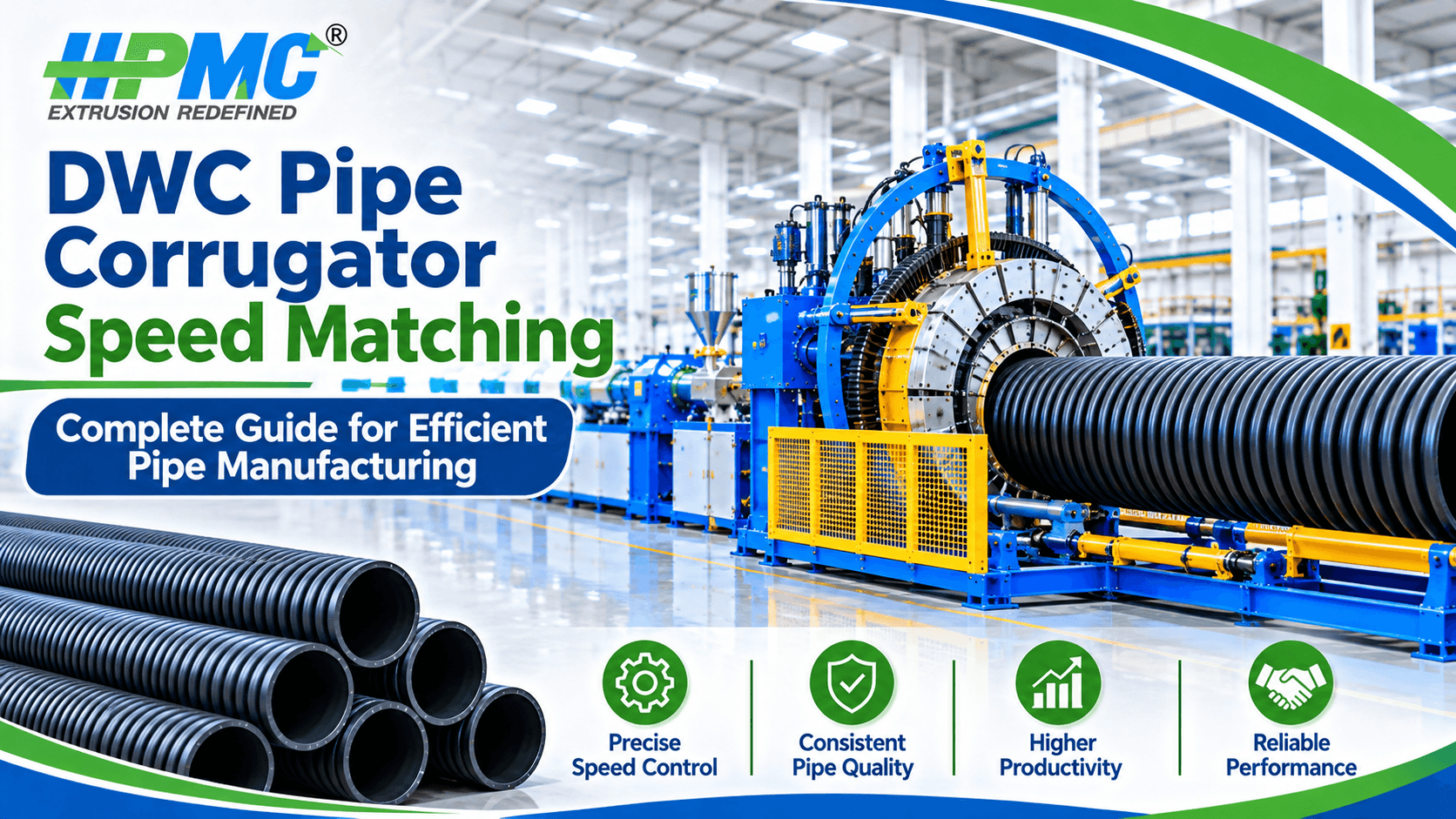
DWC Pipe Corrugator Speed Matching is an important part of maintaining consistent pipe quality during production. The corrugator must operate in coordination with polymer output from the extruder to form uniform corrugations and maintain the required pipe dimensions. If the speed relationship is not properly adjusted, manufacturers may experience irregular corrugation, wall thickness variations, poor wall bonding and production instability.
In a modern DWC pipe extrusion line, speed matching involves more than setting the corrugator motor speed. It requires understanding material flow, mould block movement, forming conditions, cooling performance and downstream haul-off operation. Each section must work together to maintain stable production.
Hindustan Plastics & Machine Corporation (HPMC) provides plastic extrusion machinery solutions for industrial manufacturing applications. Manufacturers interested in understanding the complete production process can also explore HPMC's DWC HDPE Corrugated Pipe Plant Guide.
This guide explains how corrugator speed matching works, which factors influence synchronization, common production problems and practical ways to improve manufacturing consistency.
What Is DWC Pipe Corrugator Speed Matching?
DWC Pipe Corrugator Speed Matching refers to coordinating the operating speed of the corrugator with the extrusion output and other connected production equipment.
The corrugator contains moving mould blocks that form the external corrugated profile of the pipe. As molten polymer enters the forming section, the mould blocks create the required corrugation pattern while the inner wall is formed and joined with the outer wall.
For consistent production, the material supplied by the extruder must match the forming capacity of the corrugator.
If the corrugator moves too quickly compared with the available melt output, the material may be stretched or distributed unevenly. If it operates too slowly, excessive material may accumulate around the forming area, potentially affecting the profile and wall dimensions.
Proper speed matching helps maintain a stable relationship between material delivery and mould movement.
How Does a DWC Pipe Corrugator Work?
A DWC pipe corrugator is a specialized forming machine used to produce the corrugated outer wall of double-wall pipes.
The manufacturing process generally begins when HDPE or another suitable polymer enters the extrusion system. The material is melted and conveyed towards the double-wall die.
The die distributes the molten material into the required inner and outer wall arrangements. The outer wall enters the corrugator, where moving mould blocks form the external corrugated structure.
At the same time, the inner wall is formed and joined with the outer wall at the designed bonding regions.
Cooling and vacuum arrangements help maintain the required pipe geometry during forming. Once the pipe leaves the corrugator, additional cooling and downstream handling may be used depending on the production line configuration.
The complete process requires coordinated operation between the extruder and corrugator to maintain uniform pipe formation.
Important Components Involved in Corrugator Speed Matching
Several machine components influence speed synchronization and overall production stability.
1. Extruder
The extruder melts and conveys polymer towards the double-wall die. Its output determines the quantity of molten material supplied to the forming section.
Consistent material output is important because fluctuations can affect wall thickness, corrugation formation and bonding quality.
Screw speed, temperature settings, material properties and feeding conditions influence extrusion performance.
2. Double-Wall Die Head
The double-wall die distributes molten polymer into the inner and outer wall structures.
Its design influences material flow, wall thickness distribution and the quality of the connection between both walls.
An incorrectly adjusted die may create uneven material distribution, making speed synchronization more difficult.
3. Corrugator
The corrugator is responsible for forming the external profile of the DWC pipe.
Its mould blocks move continuously through the forming section and create the required corrugation geometry.
The corrugator speed must match the extrusion output and forming requirements. Stable movement helps maintain consistent corrugation spacing and shape.
4. Vacuum System
The vacuum system supports the forming process by helping the outer wall take the shape of the mould blocks.
Insufficient or fluctuating vacuum may result in incomplete corrugation formation or profile irregularities.
Vacuum performance should be monitored alongside corrugator speed rather than treated as an independent setting.
5. Cooling System
Cooling helps stabilize the formed pipe and maintain its geometry.
If the pipe does not receive suitable cooling during the forming process, the corrugated structure may deform before reaching the next production stage.
Cooling capacity should therefore be suitable for the material, pipe dimensions and production speed.
6. Haul-Off Unit
The haul-off unit supports the movement of finished pipe through downstream equipment.
In a DWC line, its operation must be coordinated with the corrugator. It should not independently pull the pipe at a speed that stretches the still-warm product.
Correct synchronization helps prevent unnecessary tension, buckling and deformation.
Why Is Corrugator Speed Matching Important?
Correct speed matching supports consistent production and helps manufacturers maintain the required pipe quality.
Uniform Corrugation Formation
Corrugation geometry depends on the relationship between mould block movement and material delivery.
Stable synchronization helps maintain consistent corrugation depth, spacing and shape throughout the pipe.
Consistent Wall Thickness
Extruder output and corrugator movement influence how material is distributed during forming.
Incorrect speed relationships may contribute to uneven wall thickness or changes in material distribution.
Better Inner and Outer Wall Bonding
The inner and outer walls must join properly during the forming process.
Stable material delivery and forming conditions help maintain consistent bonding at the designed contact regions.
Reduced Production Defects
Incorrect synchronization can create profile deformation, irregular corrugation and other manufacturing problems.
Maintaining suitable speed settings helps reduce avoidable quality variations.
Improved Production Stability
A properly coordinated line operates more smoothly because the extruder, corrugator, cooling system and haul-off work according to the production requirements.
Factors Affecting DWC Pipe Corrugator Speed Matching
Several operating and mechanical factors influence the correct speed relationship.
Extruder Output
The quantity of polymer supplied by the extruder directly affects forming conditions.
If material output fluctuates, the corrugator may not receive a consistent supply for maintaining the required pipe structure.
Manufacturers should monitor screw speed, material feeding and melt conditions.
Pipe Diameter and Corrugation Design
Different pipe diameters and corrugation profiles require different forming conditions.
Larger pipes may require different material distribution and forming arrangements compared with smaller diameters.
Speed settings should therefore be established according to the actual pipe specification and machine configuration.
Material Temperature
Material temperature influences melt flow and forming behaviour.
If the polymer is too hot or too cold for the selected processing conditions, the forming process may become unstable.
Manufacturers should follow suitable temperature settings recommended for the material and machine.
Mould Block Condition
Mould blocks directly influence corrugation formation.
Wear, damage, contamination or incorrect alignment can affect the external profile even when the corrugator speed is stable.
Regular inspection helps maintain consistent forming conditions.
Vacuum and Cooling Performance
Vacuum and cooling are important for maintaining the shape of the corrugated structure.
Fluctuations in either system may affect pipe quality and create problems that appear similar to speed synchronization issues.
Drive and Control System
The corrugator drive system controls mould block movement.
Motor performance, drive settings, feedback signals and PLC communication should be checked when speed variations occur.
How to Match Extruder and Corrugator Speeds
Speed matching should be performed according to the machine manufacturer's operating instructions and the intended pipe specification.
Step 1: Check Extruder Output
Begin by verifying that the extruder is delivering consistent material output.
Inspect material feeding, screw operation, temperature conditions and melt flow.
Stable output provides a suitable starting point for corrugator adjustment.
Step 2: Verify Corrugator Movement
Inspect the corrugator drive and confirm that mould blocks move smoothly through the forming section.
Check for unusual vibration, mechanical resistance, wear or irregular movement.
Step 3: Establish the Required Speed Relationship
The corrugator should operate according to the forming requirements and available extrusion output. Avoid selecting speed settings based only on motor frequency or an assumed universal ratio. The correct operating relationship depends on the pipe design, material, die configuration and machine specifications.
Step 4: Check Vacuum and Cooling
Verify that vacuum pressure and cooling performance remain stable during production.
These conditions influence how effectively the molten material takes and retains the required corrugated shape.
Step 5: Inspect Finished Pipe Quality
Examine the corrugation profile, inner wall, outer wall and bonding regions. If irregularities appear, identify whether they originate from extrusion output, forming speed, tooling, vacuum or cooling.
Step 6: Record Production Settings
Maintain records of the operating conditions used for different pipe sizes and material grades. This makes future production changeovers easier and helps operators identify deviations. For additional information about extrusion output and production performance, read HPMC's HDPE Pipe Extrusion Line Output Calculation Guide.
Common DWC Pipe Corrugator Speed Matching Problems
Manufacturers may experience several problems when the extruder and corrugator are not properly coordinated.
Irregular Corrugation Profile
Incorrect forming speed or unstable material delivery may affect corrugation spacing and shape. Check the corrugator drive, mould block condition and extrusion output.
Uneven Wall Thickness
Wall thickness variation may result from inconsistent extrusion output, incorrect die settings or unsuitable speed coordination. Inspect material distribution and verify the operating conditions.
Poor Inner and Outer Wall Bonding
Poor bonding may be associated with unsuitable material temperature, inconsistent flow or incorrect forming conditions.
Check the die configuration, melt condition and wall contact during production.
Corrugation Deformation
Corrugations may become distorted when the material has not sufficiently stabilized or when downstream pulling forces are excessive.
Inspect cooling performance and haul-off synchronization.
Production Speed Fluctuations
Unstable motor operation, drive problems or control-system issues may create variations in corrugator movement.
Inspect the motor, gearbox, drive settings and feedback signals.
Excessive Machine Vibration
Mechanical wear, poor alignment or loose connections may affect corrugator operation.
Carry out an appropriate mechanical inspection before making process adjustments.
Practical Ways to Improve Corrugator Speed Matching
Manufacturers can improve synchronization by following a consistent operating and maintenance routine.
Maintain Stable Extruder Output: Keep material feeding and screw operation consistent to reduce fluctuations in polymer delivery.
Inspect Corrugator Mould Blocks: Check mould surfaces, alignment and movement for signs of wear or damage.
Monitor Drive Performance: Inspect motor operation, gearbox condition and speed control settings.
Maintain Vacuum Stability: Check vacuum pumps, pipelines and connections for leakage or performance changes.
Improve Cooling Conditions: Ensure that the cooling system operates according to the pipe dimensions and production requirements.
Coordinate Haul-Off Speed: Ensure downstream equipment supports pipe movement without creating excessive tension or compression.
Train Operators: Operators should understand the relationship between extrusion output, corrugator movement and finished-pipe quality.
Maintain Production Records: Record important settings and inspection results for each product specification.
Role of Automation in DWC Corrugator Speed Matching
Modern extrusion lines may use PLC-based control systems and variable frequency drives to coordinate equipment operation.
A PLC can monitor selected production parameters and help operators control different machine functions through a centralized control panel.
Variable frequency drives allow suitable motor speed adjustments according to the machine configuration.
Depending on the equipment design, automation may also support speed monitoring, alarms, process adjustments and production data recording.
However, automation alone does not guarantee consistent production. Mechanical condition, material properties, temperature, vacuum and cooling performance remain important.
Operators should verify the actual production results and follow the equipment manufacturer's recommended operating procedures.
How to Select the Right DWC Pipe Corrugator
Selecting a suitable corrugator is important for manufacturers planning a new DWC pipe production line or upgrading an existing facility.
Before purchasing equipment, manufacturers should evaluate the following factors:
- Required pipe diameter range.
- Corrugation profile and mould design.
- Compatible polymer materials.
- Expected production capacity.
- Extruder output compatibility.
- Corrugator drive and speed control.
- Vacuum and cooling arrangements.
- PLC and automation features.
- Maintenance and spare parts availability.
- Installation and technical support.
Manufacturers should also confirm whether the proposed corrugator can support their intended pipe specifications without compromising forming stability.
HPMC's Frequently Asked Questions section provides additional information about plastic extrusion machinery selection and production considerations.
Why Choose HPMC for Plastic Extrusion Machinery?
Hindustan Plastics & Machine Corporation (HPMC) has been associated with plastic extrusion machinery manufacturing since 1972.
The company provides machinery solutions for different plastic processing applications, including HDPE pipe extrusion technology.
For DWC pipe manufacturing requirements, buyers should discuss the required double-wall configuration, pipe diameter, corrugation profile, expected output and automation requirements directly with the HPMC technical team.
A suitable machinery configuration should be selected according to the complete production requirement rather than individual machine speed specifications.
Manufacturers should also evaluate installation, commissioning, operator training and after-sales support before finalizing an equipment purchase.
Maintenance Tips for DWC Pipe Corrugator
Regular maintenance supports reliable corrugator operation and helps reduce avoidable production interruptions.
Inspect the mould blocks and their movement regularly. Check the drive motor, gearbox, bearings and mechanical connections according to the manufacturer's maintenance schedule.
Clean forming surfaces and remove material deposits using approved maintenance procedures.
The vacuum system should be checked for leakage, while cooling equipment should be inspected for proper water circulation.
Electrical connections, sensors and PLC-related components should also be checked by qualified personnel.
Any unusual noise, vibration or repeated speed fluctuation should be investigated before continuing normal production.
For additional troubleshooting guidance, manufacturers can refer to HPMC's Common Pipe Extrusion Defects and Their Causes.
Conclusion
DWC Pipe Corrugator Speed Matching is an essential part of maintaining stable double-wall corrugated pipe manufacturing. The relationship between extruder output, corrugator movement, vacuum, cooling and downstream haul-off influences the final pipe structure and production consistency.
Incorrect synchronization may result in irregular corrugations, wall thickness variations, poor bonding and deformation. Manufacturers can reduce these problems by maintaining stable material delivery, inspecting mould blocks, monitoring drive performance and coordinating downstream equipment.
Selecting suitable machinery and following a consistent operating procedure helps support reliable production over time.
HPMC provides plastic extrusion machinery solutions for industrial manufacturing applications. Manufacturers planning a DWC pipe production project can contact the company to discuss their technical requirements and suitable machinery configurations.
Contact Hindustan Plastics & Machine Corporation (HPMC)
Company: Hindustan Plastics & Machine Corporation (HPMC)
Address: 5, Category II, DSIDC Industrial Area, Nangloi, Delhi – 110041, India
Phone: +91 95605 96392
Email: info@hindustanplastics.com
Website: https://www.hindustanplastics.com/
Frequently Asked Questions
Find quick answers to the most common questions about this topic.
DWC Pipe Corrugator Speed Matching is the process of coordinating corrugator movement with extruder output and other connected equipment to maintain consistent double-wall pipe formation.
Corrugator speed influences the formation of the external profile. Proper coordination helps maintain consistent corrugation geometry, wall distribution and production stability.
If the corrugator runs too fast compared with material delivery, the molten polymer may experience excessive drawing, potentially causing profile or wall thickness variations.
An unsuitable low speed may cause excess material accumulation or unstable forming conditions, depending on the machine configuration and extrusion output.
Extruder output determines the amount of molten polymer supplied to the forming section. The corrugator must operate according to this material delivery and the required pipe structure.
Yes. An unsuitable relationship between material output and forming speed can contribute to uneven material distribution and wall thickness variations.
Vacuum supports the forming process by helping the outer wall take the required shape of the corrugator mould blocks.
Cooling helps stabilize the formed pipe and retain its corrugated geometry. Inadequate cooling may contribute to deformation or dimensional instability.
Manufacturers should maintain stable extrusion output, inspect mould blocks, monitor drive performance, maintain vacuum and cooling systems, and coordinate downstream equipment.
Inspection frequency should follow the machine manufacturer's maintenance schedule. Regular checks of mould blocks, drives, bearings, vacuum equipment and electrical systems help maintain reliable operation.