
Introduction
Production output is one of the most important factors in the plastic pipe manufacturing industry. For manufacturers operating an HDPE pipe extrusion plant, understanding production capacity helps in planning raw material consumption, monitoring machine performance, controlling manufacturing costs and meeting customer delivery schedules.
HDPE Pipe Extrusion Line Output Calculation
helps manufacturers determine how much finished pipe a machine can produce per hour, per shift or per day. However, actual production depends on several factors, including screw design, screw speed, material properties, pipe dimensions, die head configuration, cooling efficiency and haul-off speed.
A proper output calculation also helps manufacturers compare actual production with the machine's rated capacity and identify opportunities for improving efficiency.
Hindustan Plastics & Machine Corporation (HPMC), based in Delhi, India, manufactures plastic extrusion machinery for different industrial applications. With manufacturing experience dating back to 1972, HPMC offers HDPE pipe extrusion solutions designed for consistent production and reliable machine performance.
In this guide, we will explain the HDPE pipe extrusion output calculation method, important production factors, practical examples and ways to improve extrusion line productivity.
What Is HDPE Pipe Extrusion Line Output?
HDPE pipe extrusion line output refers to the quantity of finished HDPE pipe manufactured by an extrusion line within a specific period.
It is generally measured in:
- Kilograms per hour (kg/hr)
- Kilograms per shift
- Kilograms per day
- Metres per hour (m/hr)
- Metres per day
Manufacturers commonly use kg/hr to monitor the mass production capacity of an extrusion machine. Metres per hour is also useful when measuring the length of pipe produced at a particular diameter and wall thickness.
Both measurements are important because two pipes with different dimensions may have different weights per metre even when produced at the same line speed.
For accurate production planning, manufacturers should monitor both the pipe length and the actual weight of finished production.
How Does an HDPE Pipe Extrusion Line Work?
An HDPE pipe extrusion line uses a continuous manufacturing process to convert HDPE raw material into finished pipes.
The production process generally includes the following stages:
1. Raw Material Feeding
HDPE granules are supplied to the extruder through a hopper or suitable material feeding arrangement.
Consistent material feeding is important for maintaining stable production.
2. Melting and Plasticisation
The material enters the screw and barrel assembly, where controlled heating and screw rotation help melt and convey the polymer.
The screw design and operating conditions influence material flow and plasticisation.
3. Pipe Formation Through Die Head
The molten HDPE material passes through the die head, which forms it into a continuous pipe.
A suitable die configuration helps maintain the required pipe diameter and wall thickness.
4. Vacuum Sizing and Cooling
The newly formed pipe enters the vacuum sizing tank, where its outside diameter and roundness are controlled.
The cooling system removes heat from the pipe as it travels through the production line.
5. Haul-Off Operation
The haul-off unit pulls the pipe at a controlled speed.
The haul-off speed directly influences the length of pipe produced over a given period.
6. Pipe Cutting and Collection
The cutting machine cuts the pipe into the required lengths. Depending on the pipe diameter and line configuration, a coiler may be used for suitable smaller-diameter pipes.
All these stages work together to maintain continuous production and consistent pipe quality.
Factors Affecting HDPE Pipe Extrusion Line Output
The production capacity of an HDPE pipe extrusion machine depends on several interconnected factors.
1. Screw Diameter and Screw Design
The screw is one of the most important components of an extrusion machine.
Its diameter, length-to-diameter ratio, channel geometry and mixing arrangement influence material conveying, melting and plasticisation.
A larger screw does not automatically guarantee higher production. The complete screw and barrel design must match the polymer and intended production requirements.
2. Screw RPM
Screw rotation speed influences the rate at which material is conveyed and processed.
However, increasing RPM does not always increase output proportionally. Material melting, motor load, melt quality and process stability must also be considered.
3. HDPE Raw Material Properties
Different HDPE grades can have different melt flow characteristics and processing requirements.
Material grade, density, additives and the consistency of the raw material can influence extrusion performance.
Manufacturers should use suitable material specifications and maintain consistent feeding conditions.
4. Pipe Diameter and Wall Thickness
Pipe dimensions influence the quantity of material required per metre.
A larger or thicker pipe generally requires more material than a smaller or thinner pipe.
Therefore, manufacturers should consider pipe OD and wall thickness when estimating the expected output in metres and kilograms.
5. Die Head Design
The die head distributes molten material into the required pipe shape.
Proper die design and material flow distribution are important for maintaining consistent wall thickness and pipe dimensions.
An unsuitable die configuration can affect production stability and finished pipe quality.
6. Cooling System Efficiency
The vacuum sizing tank and cooling system help control pipe dimensions and remove heat from the extruded pipe.
Cooling capacity and process stability should be matched to the intended pipe size and production speed.
7. Haul-Off Speed
The haul-off unit controls the speed at which the pipe moves through the extrusion line.
Its operation must remain coordinated with material output, pipe dimensions and cooling conditions.
8. Machine Maintenance
Regular maintenance of the screw, barrel, gearbox, motors, heaters, die head and cooling equipment supports reliable operation.
Worn components or process-related problems may contribute to production variation and downtime.
How to Improve HDPE Pipe Extrusion Line Output
Manufacturers can improve production performance by monitoring important machine and process parameters.
1. Maintain Consistent Material Feeding
Ensure a steady supply of suitable HDPE raw material to avoid unnecessary interruptions and feeding variation.
2. Optimise Screw Speed
Operate the screw within the recommended machine and material processing range. Monitor output, motor load and melt quality rather than increasing RPM without checking process stability.
3. Maintain Correct Temperature Settings
Monitor barrel and die temperature settings according to the material grade and machine configuration.
4. Check Die Head Condition
Inspect the die head regularly to identify material deposits, wear or flow-related problems.
5. Maintain Cooling Performance
Ensure the vacuum sizing and cooling arrangement is working correctly for the required pipe dimensions and line speed.
6. Synchronise Haul-Off and Extrusion
The haul-off speed should be coordinated with material output to maintain the required pipe dimensions and wall thickness.
7. Reduce Unplanned Downtime
Regular inspections, preventive maintenance and operator training can help reduce avoidable production interruptions.
For further guidance, manufacturers can explore HPMC's Plastic Extrusion Hints.
Common Reasons for Low HDPE Pipe Extrusion Output
If an extrusion line is producing less than its expected capacity, manufacturers should investigate the complete production process.
Common areas to check include:
- Inconsistent raw material feeding.
- Incorrect screw speed or process settings.
- Unsuitable temperature profile.
- Screw and barrel wear.
- Die head flow restrictions.
- Cooling-system limitations.
- Incorrect haul-off speed.
- Frequent machine stoppages.
- Material quality variations.
- Unplanned maintenance requirements.
A proper production assessment should compare the machine's rated capacity with actual measured output under defined operating conditions.
For machine-related issues, HPMC offers Troubleshooting Support.
How to Select the Right HDPE Pipe Extrusion Machine?
Choosing an appropriate machine is important for achieving the required output and product quality.
Before selecting an extrusion line, manufacturers should evaluate:
- Required HDPE pipe diameter range.
- Minimum and maximum wall thickness.
- Required hourly production capacity.
- HDPE raw material grade.
- Screw diameter and machine configuration.
- Die head design.
- Vacuum sizing and cooling requirements.
- Haul-off and cutting arrangement.
- Available factory space and utilities.
- Installation, commissioning and technical support.
The machine should be selected according to actual production requirements rather than maximum output figures alone.
You can also read HPMC's guide on HDPE Pipe Machine Manufacturers: How to Choose the Right Machine for Your Business.
Why Choose HPMC for HDPE Pipe Extrusion Machinery?
Hindustan Plastics & Machine Corporation (HPMC) has been associated with plastic extrusion machinery manufacturing since 1972.
The company provides extrusion machinery solutions for different plastic processing applications, including HDPE pipe manufacturing.
HPMC's published HDPE pipe plant information highlights:
- Screw and barrel technology.
- PLC-based control system.
- Spiral type die head.
- Vacuum sizing tank.
- High-speed spray vortex cooling system.
- Multiple-arm haul-off.
- Planetary cutting saw.
- Single and double station coiler configurations.
The correct machine configuration depends on the required pipe dimensions, production target, material grade and operating conditions.
Manufacturers planning a new HDPE pipe extrusion project can contact HPMC to discuss their technical requirements.
For machine installation, commissioning and process guidance, explore HPMC's Technical Assistance and Field Services.
Conclusion
HDPE Pipe Extrusion Line Output Calculation is essential for manufacturers who want to understand production capacity, monitor machine performance and plan manufacturing operations effectively.
By measuring actual pipe weight per metre and line speed, manufacturers can estimate hourly output. Daily production can then be calculated by considering working hours and production efficiency.
However, actual output depends on several factors, including screw design, RPM, raw material properties, pipe dimensions, die head configuration, cooling performance and haul-off speed.
Selecting the right extrusion machine and maintaining stable operating conditions can support consistent production and efficient manufacturing.
HPMC offers HDPE pipe extrusion machinery solutions designed for different production requirements. Contact HPMC to discuss your pipe dimensions, target output and machine configuration.
Contact Hindustan Plastics and Machinery Corporation (HPMC)
Company: Hindustan Plastics and Machinery Corporation
Address: 5, Category II, DSIDC Industrial Area, Nangloi, Delhi – 110041, India
Phone: +91 95605 96392
Email: info@hindustanplastics.com
Website: https://www.hindustanplastics.com/
When contacting HPMC, share your required pipe diameter, wall thickness, HDPE material grade, target kg/hr output and expected operating hours to discuss a suitable machine configuration.
Frequently Asked Questions
Find quick answers to the most common questions about this topic.
HDPE pipe extrusion line output calculation is the process of determining how much finished HDPE pipe an extrusion machine produces within a specific period. It is commonly measured in kg/hr or metres per hour.
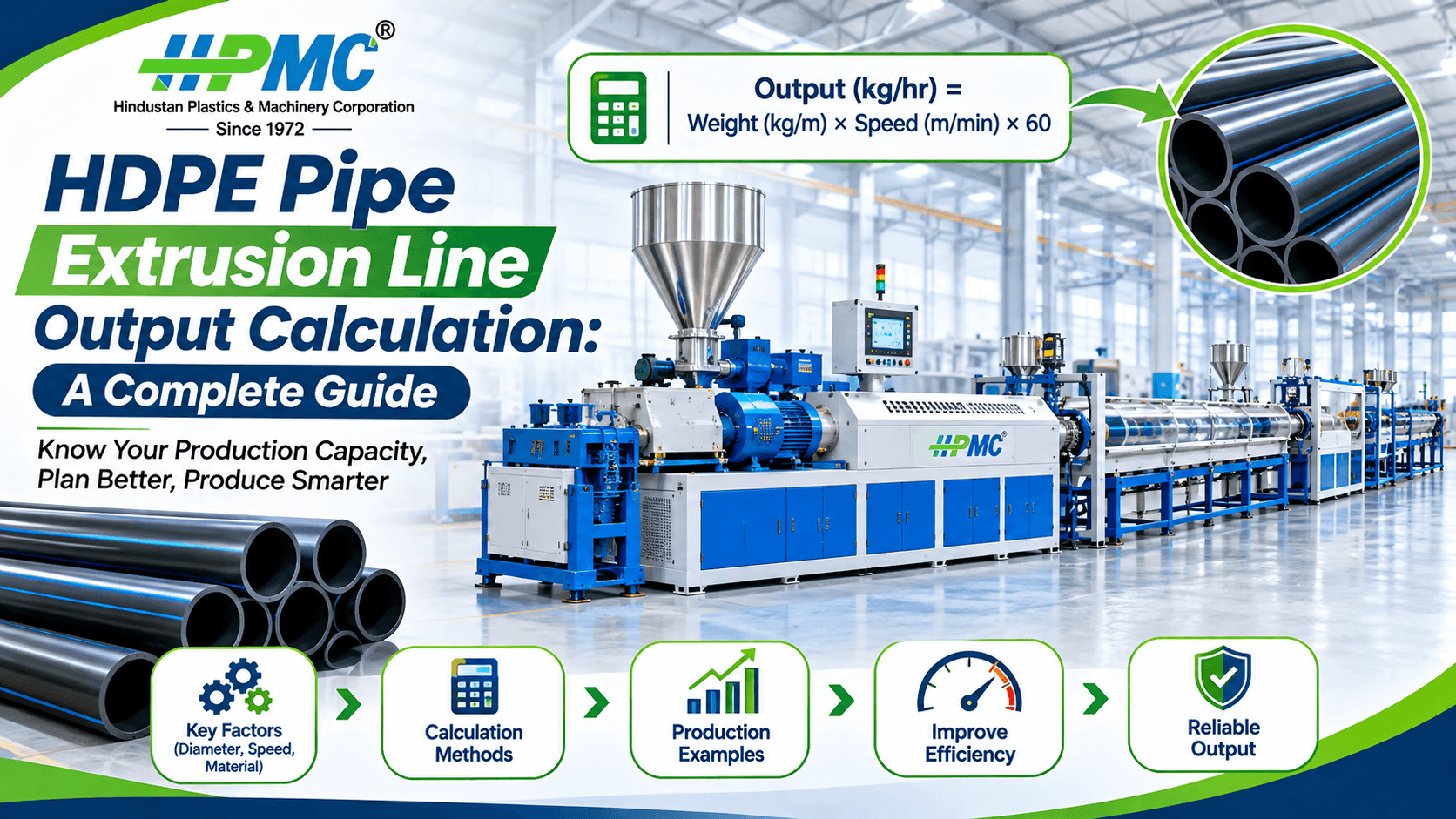
Multiply the actual weight of one metre of finished pipe (kg/m) by the pipe line speed (m/min) and then multiply the result by 60 to calculate hourly output.
Important factors include screw diameter, screw design, RPM, HDPE material grade, pipe dimensions, die head design, cooling efficiency, haul-off speed and machine maintenance.
Yes. Screw RPM influences material conveying and processing. However, output does not always increase proportionally with RPM because melting performance, motor load and process stability also matter.
Multiply hourly output by the number of operating hours and the production efficiency expressed as a decimal. For example, 60 kg/hr × 8 hours × 90% efficiency gives 432 kg per day.
Kg/hr measures the weight of pipe produced per hour, whereas metres per hour measures its length. Pipe weight per metre depends on its outside diameter, wall thickness and material.
Yes. A thicker pipe generally requires more material per metre. This influences the relationship between line speed and hourly production weight.
HPMC's published model specification table lists maximum outputs of 40, 60, 90 and 120 kg/hr for HPMC 65, 75, 90 and 100 respectively. Confirm the exact configuration and current specification with HPMC.
Manufacturers can monitor raw material feeding, optimise process settings, maintain screw and barrel components, inspect the die head, maintain cooling performance and reduce unplanned machine downtime.
Consider pipe diameter, wall thickness, HDPE material grade, required hourly output, screw configuration, die head, cooling system, haul-off arrangement and available technical support before selecting a machine.