
INTRODUCTION
Double wall corrugated pipes are an important part of modern drainage, sewerage, stormwater management, and underground cable protection systems. Their distinctive construction combines a corrugated outer wall with a relatively smooth inner surface, providing a balance of structural performance and functional design.
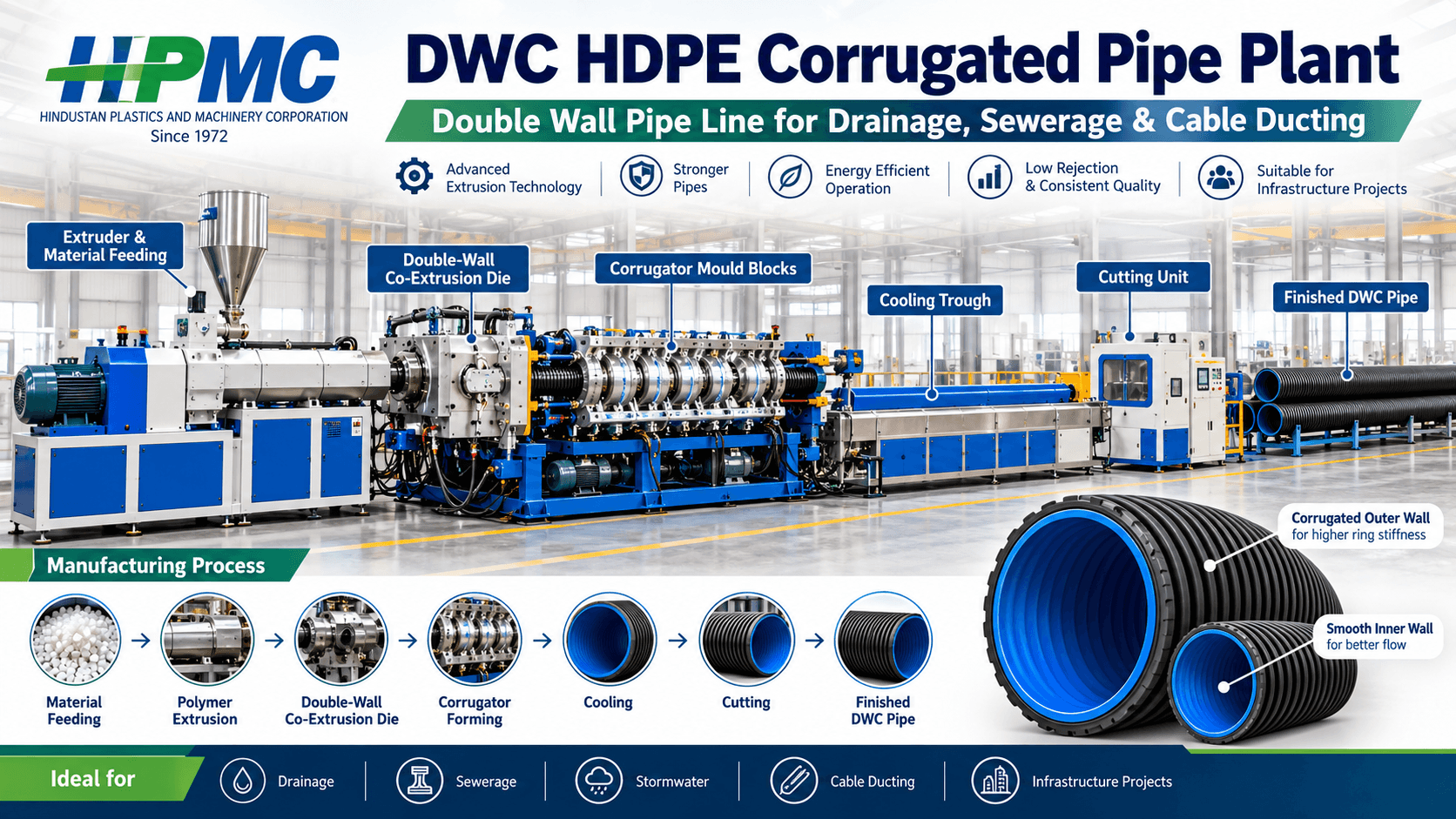
Manufacturing these pipes requires specialized extrusion and forming technology. A DWC HDPE Corrugated Pipe Plant uses coordinated polymer extrusion, a double-wall die, corrugator moulds, cooling, and downstream equipment to manufacture pipes with the required geometry and performance characteristics.
HPMC (Hindustan Plastics and Machinery Corporation), Delhi, India, has been associated with plastic extrusion machinery manufacturing since 1972.
This guide focuses on the technology that makes a Double Wall Pipe Line different from conventional pipe extrusion, including wall formation, corrugator operation, ring stiffness, quality inspection, and common manufacturing problems.
What Is a DWC HDPE Corrugated Pipe Plant?
A DWC HDPE Corrugated Pipe Plant is a specialized extrusion system used to manufacture double wall corrugated pipes from suitable high-density polyethylene materials.
Compatible polypropylene formulations may also be used where the equipment is designed for them.
Unlike conventional smooth-wall pipes, a DWC pipe consists of two connected wall structures:
- Corrugated outer wall: An engineered external profile that contributes to resistance against external deformation.
- Smooth inner wall: A relatively smooth internal surface suitable for the intended drainage, sewerage, or cable protection application.
The two walls are formed and joined during manufacturing.
Their dimensions, connection quality, and material properties influence the performance of the finished pipe.
How Does a Double Wall Pipe Line Work?
The manufacturing process involves coordinated material delivery, double-wall formation, corrugation, cooling, and product handling.
A typical process follows:
Material Feeding → Polymer Extrusion → Double-Wall Die → Corrugator Forming → Wall Bonding → Cooling → Cutting → Inspection
1. Polymer Extrusion
The process begins with suitable HDPE or PP material entering the extrusion equipment.
The polymer is melted and conveyed towards the double-wall die.
Separate, coordinated melt streams are commonly used to form the inner and outer walls.
Consistent melt delivery is important because variations can influence wall thickness and profile formation.
For general HDPE extrusion technology, HPMC's High Speed HDPE Pipe Plant provides information about a related smooth-wall pipe manufacturing system.
2. Double-Wall Die Formation
The die assembly distributes molten polymer into the required inner and outer wall arrangements.
The outer material stream is prepared for corrugation, while the inner stream forms the smoother internal surface.
Important considerations include melt distribution, wall thickness, die geometry, and compatibility with the selected polymer.
The die must be designed for the required pipe diameter and double-wall structure.
3. Corrugator Forming
The corrugator creates the external corrugated profile.
Moving mould blocks form the outer wall into the intended shape while the pipe travels through the forming section.
The mould arrangement must operate in coordination with polymer delivery.
Stable forming conditions support consistent corrugation dimensions and wall geometry.
4. Inner and Outer Wall Bonding
The two walls join at designed contact regions during forming.
Proper bonding is important for the structural integrity of the pipe.
Material temperature, flow consistency, forming conditions, and die configuration can influence the quality of this connection.
5. Cooling and Shape Stabilization
Cooling helps the newly formed pipe retain its geometry.
The cooling arrangement must suit the polymer formulation, pipe dimensions, and production conditions.
Uneven cooling may contribute to dimensional instability or deformation.
6. Cutting and Quality Inspection
The pipe is handled and cut or collected according to the product and line configuration.
Finished products are inspected for dimensional accuracy, surface quality, corrugation consistency, and other specified requirements.
How the Corrugator Shapes DWC Pipe Performance
The corrugator is a defining component of a double wall corrugated pipe plant.
Its function extends beyond creating the visible external pattern.
Corrugation Geometry
The profile's shape, spacing, and depth influence the structural characteristics of the pipe.
These dimensions must be selected according to the intended product design.
Mould Block Accuracy
Mould blocks establish the external geometry during forming.
Wear, damage, or alignment problems may affect corrugation consistency.
Forming Stability
Stable forming conditions help maintain the intended pipe profile.
Extruder and Corrugator Synchronization
The forming equipment must operate at a suitable speed relative to the extrusion output.
Poor synchronization may contribute to irregular corrugation, inconsistent wall distribution, or other dimensional problems.
Cooling Within the Forming Process
The forming arrangement must provide appropriate cooling conditions so the pipe retains its intended geometry.
Double Wall Bonding: Why It Matters
A DWC pipe depends on the connection between its inner and outer walls.
The walls are not simply two separate pipes placed together.
They must form an integrated structure at the designed bonding regions.
Poor bonding can affect pipe integrity and may result in failure to meet the required product specification.
Important factors influencing bonding include:
- Polymer compatibility
- Melt temperature and consistency
- Die configuration
- Material distribution
- Forming conditions
- Cooling behaviour
Manufacturers should evaluate wall bonding as part of their quality control process.
What Is Ring Stiffness in DWC Pipes?
Ring stiffness is a measure of a pipe's resistance to deformation under specified external loading conditions.
It is particularly relevant for underground drainage and sewerage applications.
The pipe must withstand the conditions associated with its intended installation and service environment.
Ring stiffness depends on the complete pipe structure rather than one individual dimension.
Factors Influencing Ring Stiffness
Corrugation Profile: The outer wall geometry contributes to the pipe's structural behaviour.
Wall Thickness Distribution: The amount and distribution of polymer in the inner and outer walls affect performance.
Material Properties: The polymer formulation influences stiffness and deformation behaviour.
Pipe Dimensions: Diameter and structural geometry influence the required product characteristics.
Manufacturing Consistency: Stable production conditions help maintain the intended design.
The required ring stiffness classification should be determined from the applicable product standard and project specification.
Ring Stiffness vs Ring Flexibility
Ring stiffness and ring flexibility are related but different pipe performance characteristics.
ParameterRing StiffnessRing Flexibility
Main purpose
Evaluates resistance to deformation
Evaluates behaviour under specified deformation
Assessment
Defined loading test
Defined deformation test
Relevance
Structural performance
Ability to withstand deformation without unacceptable failure
Requirement
Depends on product standard
Depends on product standard
Both may be relevant when evaluating DWC pipes for underground applications.
Common DWC Pipe Manufacturing Defects
Understanding production defects helps manufacturers identify potential problems in the extrusion and forming process.
1. Irregular Corrugation Profile
Possible causes:
- Unstable polymer delivery
- Incorrect corrugator synchronization
- Mould wear or alignment issues
- Inconsistent forming conditions
Recommended checks:
Review the extrusion stability, mould condition, and corrugator operation.
2. Poor Inner and Outer Wall Bonding
Possible causes:
- Unsuitable melt conditions
- Inconsistent material distribution
- Incorrect forming conditions
- Material compatibility issues
Recommended checks:
Inspect the die configuration, material formulation, and wall-forming process.
3. Uneven Wall Thickness
Possible causes:
- Unbalanced melt flow
- Die-related problems
- Unstable extrusion
- Inconsistent forming conditions
Recommended checks:
Evaluate the die assembly, extrusion consistency, and forming process.
4. Pipe Deformation
Possible causes:
- Inadequate cooling
- Unsuitable handling conditions
- Material-related behaviour
- Forming instability
Recommended checks:
Review the cooling arrangement and downstream pipe support.
5. Surface Irregularities
Possible causes:
- Material contamination
- Mould condition
- Die-related issues
- Processing instability
Recommended checks:
Inspect material preparation and relevant forming equipment.
All troubleshooting should follow the equipment manufacturer's operating and safety procedures.
DWC Pipe Quality Testing and Inspection
Finished DWC pipes should be assessed against the applicable product specification.
Dimensional Inspection
Measurements may include pipe diameter, length, wall dimensions, and corrugation geometry.
Ring Stiffness Testing
This evaluates resistance to deformation under specified test conditions.
Ring Flexibility Testing
Where required, this evaluates the pipe's behaviour under a defined deformation.
Wall Integrity Inspection
Inspection helps identify unacceptable defects in the double-wall structure.
Surface Quality Inspection
The inner and outer surfaces should meet the relevant product requirements.
Joint Performance Testing
Where applicable, pipe joints may require separate watertightness or leakage testing.
The specific tests and acceptance criteria depend on the relevant standard and intended application.
Applications of DWC HDPE and PP Corrugated Pipes
Underground Drainage
Suitable DWC pipes can be used to convey drainage water in infrastructure and development projects.
Gravity Sewerage
DWC pipes may be used in gravity sewerage systems when the selected product meets the relevant performance and installation requirements.
Stormwater Management
Corrugated pipes are used in suitable stormwater conveyance systems.
Pipe dimensions and structural requirements depend on the project design.
Cable Ducting
Appropriately specified corrugated ducts can provide a protected passage for electrical or communication cables.
Duct selection should follow the intended installation requirements.
DWC Corrugated Pipe vs Conventional HDPE Pipe
Both pipe types may use polyethylene, but their manufacturing methods and structural designs differ.
FeatureDWC Corrugated PipeConventional HDPE Pipe
Outer surface
Corrugated
Smooth
Inner surface
Relatively smooth
Smooth
Wall structure
Double wall
Generally continuous smooth wall
Main forming equipment
Corrugator and double-wall die
Conventional pipe die and sizing equipment
Common applications
Drainage, gravity sewerage, cable ducting
Pressure piping and other specified applications
Key performance consideration
Structural and installation requirements
Pressure rating and intended service
These pipe types should not be treated as interchangeable.
For a broader explanation of conventional HDPE pipe machinery, read HPMC's HDPE Pipe Machine Manufacturers Guide.
How to Select a DWC HDPE Corrugated Pipe Plant
Machine selection should begin with the intended pipe specification rather than general equipment claims.
1. Define the Pipe Diameter Range
Specify the required minimum and maximum pipe diameters.
Confirm that the proposed equipment and moulds support those sizes.
2. Identify the Polymer Formulation
Provide the required HDPE or PP grade and relevant material specifications.
3. Confirm Ring Stiffness Requirements
Identify the required performance classification and applicable product standard.
4. Evaluate Corrugator Moulds
Review the profile geometry, mould condition, maintenance requirements, and compatibility with the proposed pipe sizes.
5. Review Double-Wall Die Design
The die must provide suitable material distribution for both walls.
6. Assess Production Requirements
Share the required production output and pipe dimensions.
Actual capacity depends on the material, pipe structure, and machine configuration.
7. Review Automation
Ask which PLC monitoring and control functions are included in the proposed equipment.
8. Confirm Energy and Maintenance Requirements
Request machine-specific information about electrical consumption, maintenance access, and spare parts.
9. Evaluate Technical Support
Confirm installation, commissioning, operator training, and after-sales arrangements.
Maintenance Considerations for DWC Pipe Plants
Regular inspection helps maintain equipment condition and manufacturing consistency.
Important areas include:
- Extruder screw and barrel
- Material feeding system
- Double-wall die assembly
- Corrugator mould blocks
- Forming equipment
- Cooling arrangement
- Downstream handling equipment
- Cutting equipment
- Drives and controls
- Safety guards and interlocks
Maintenance should follow the manufacturer's recommendations.
Why Consider HPMC for DWC Pipe Machinery?
HPMC (Hindustan Plastics and Machinery Corporation) is an Indian plastic extrusion machinery manufacturer established in 1972.
Its published machinery range includes HDPE pipe extrusion and related plastic processing equipment.
For a DWC HDPE Corrugated Pipe Plant enquiry, buyers should confirm the availability and technical specifications of the required double-wall configuration directly with HPMC.
Important details to share include the polymer grade, pipe diameter range, corrugation profile, ring stiffness requirements, expected output, and automation preferences.
Conclusion
A DWC HDPE Corrugated Pipe Plant manufactures double wall pipes through coordinated extrusion, double-wall die formation, corrugator moulding, cooling, and downstream handling.
The finished pipe's performance depends on corrugation geometry, wall bonding, material characteristics, dimensional accuracy, and compliance with the applicable product requirements.
For manufacturers evaluating a Double Wall Pipe Line, understanding these technical factors helps support more informed equipment selection and quality planning.
Contact HPMC to discuss the availability and configuration of DWC HDPE or PP corrugated pipe machinery for your production requirements.
Contact HPMC
HPMC (Hindustan Plastics and Machinery Corporation)
Address: 5, Category II, DSIDC Industrial Area, Nangloi, Delhi – 110041, India
Website: https://www.hindustanplastics.com/
Phone: +91 95605 96392
Email: info@hindustanplastics.com
Google Business Profile: https://share.google/lBK4uD53HqY891ynv
Frequently Asked Questions
Find quick answers to the most common questions about this topic.
It is a specialized extrusion system used to manufacture double wall corrugated pipes from suitable HDPE materials.
DWC stands for Double Wall Corrugated.
The corrugated geometry contributes to the pipe's structural performance and resistance to external deformation.
It provides a relatively smooth passage for water, wastewater, or cables, depending on the application.
A corrugator is forming equipment used to create the external corrugated profile during pipe manufacturing.
It distributes molten polymer to form the required inner and outer wall structures.
Ring stiffness measures a pipe's resistance to deformation under specified loading conditions.
Material properties, pipe dimensions, corrugation geometry, and wall thickness distribution influence ring stiffness.
Proper bonding helps maintain the intended double-wall structure and structural integrity.
in gravity sewerage applications when they meet the applicable product and installation requirements.Suitable DWC pipes may be used