
Introduction
HDPE pipe manufacturing requires precise control over extrusion, sizing, cooling, and downstream handling. Among these stages, cooling plays an important role in determining the dimensional accuracy, surface quality, and production stability of the finished pipe.
After molten High-Density Polyethylene (HDPE) passes through the extrusion die, it enters the sizing and cooling section. At this stage, the material is still hot and requires controlled cooling to achieve the required dimensions and become sufficiently stable for further processing.
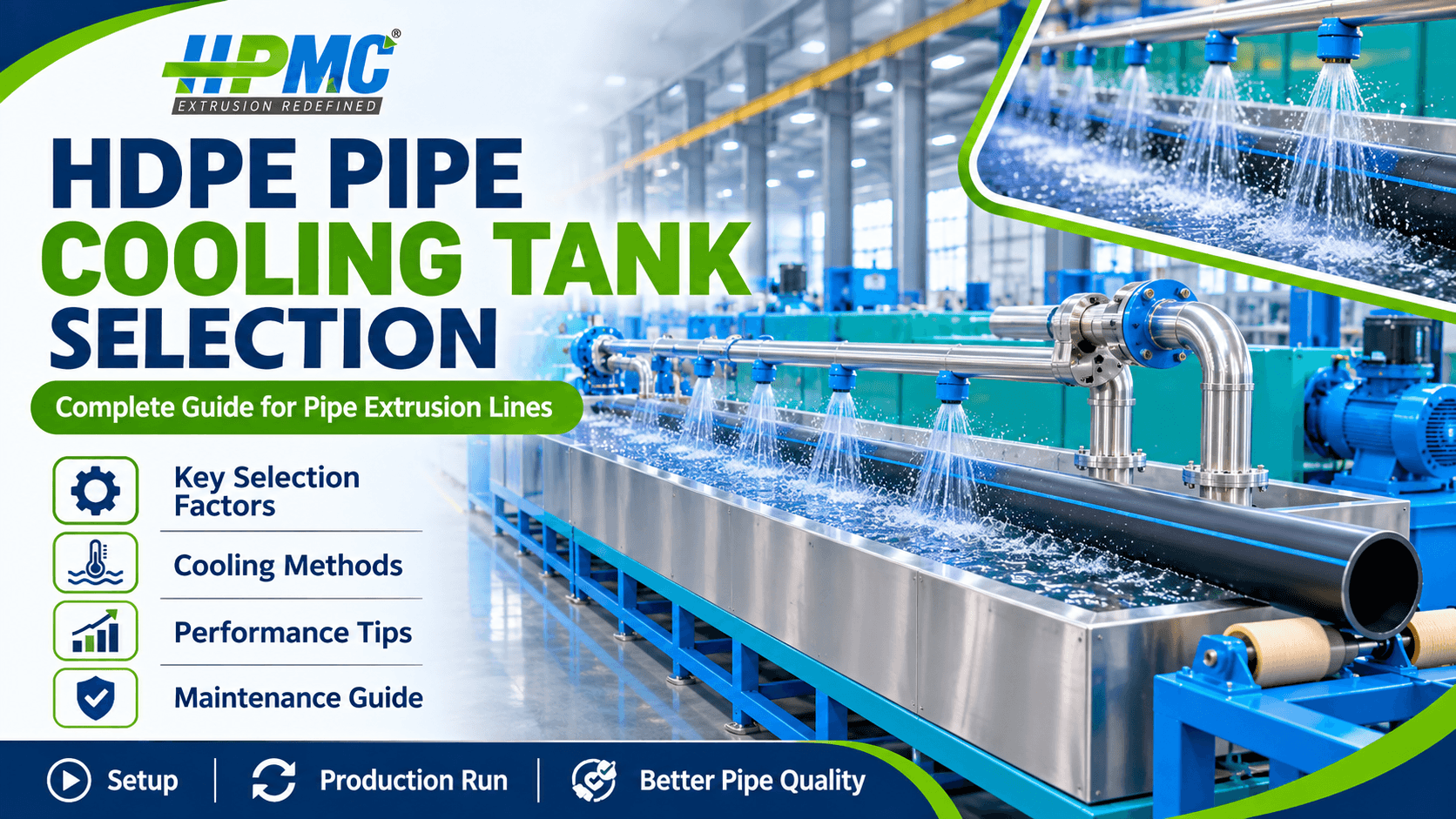
An HDPE Pipe Cooling Tank is designed to remove heat from the extruded pipe through circulating water and controlled spray arrangements. The cooling system must be capable of handling the pipe diameter, wall thickness, extrusion output, and production speed required by the manufacturer.
Selecting an unsuitable cooling tank can create problems such as uneven cooling, pipe deformation, dimensional variation, excessive water temperature, and production speed limitations. These issues can affect finished product quality and increase production adjustments.
However, choosing a cooling tank is not simply a matter of selecting a longer tank or a pump with higher capacity. Manufacturers must evaluate water circulation, spray nozzle positioning, cooling length, tank construction, pipe support, temperature control, and compatibility with the complete extrusion line.
Hindustan Plastics and Machine Corporation (HPMC) provides plastic extrusion machinery solutions for different industrial applications. This guide explains the important technical considerations involved in HDPE pipe cooling tank selection, common cooling problems, maintenance requirements, and the factors manufacturers should evaluate before purchasing equipment.
What Is an HDPE Pipe Cooling Tank?
An HDPE pipe cooling tank is a downstream component of a pipe extrusion line that removes heat from an extruded polyethylene pipe using circulating cooling water.
During extrusion, HDPE granules are melted inside the extruder and pushed through a specially designed die head. The molten material takes the shape of the required pipe as it exits the die.
The newly formed pipe then passes through a sizing arrangement, where its outside diameter and roundness are controlled. After sizing, the pipe moves through one or more cooling sections.
Cooling water absorbs heat from the pipe surface and helps reduce its temperature before the pipe reaches the haul-off and cutting equipment.
A typical HDPE pipe extrusion process follows this sequence:
Raw Material Feeding → Single Screw Extrusion → Die Head → Vacuum Sizing → Water Cooling → Haul-Off → Cutting → Pipe Collection
Each component has a different function. The extruder provides the required melt, the die forms the pipe, the sizing system establishes dimensional accuracy, and the cooling tank helps stabilise the extruded product.
The cooling tank must therefore be selected according to the requirements of the entire production process.
Why Is Cooling Important in HDPE Pipe Manufacturing?
Cooling directly influences the behaviour of HDPE after it leaves the extrusion die. Polyethylene is a thermoplastic material, meaning its physical condition changes with temperature.
The extruded pipe must lose heat in a controlled manner so that it can retain the intended dimensions during subsequent handling.
1. Maintaining Outside Diameter Accuracy
Outside diameter is one of the most important specifications in HDPE pipe manufacturing.
The pipe passes through sizing equipment before entering the cooling section. However, dimensional stability must be maintained as the material continues to cool.
Uneven cooling, improper sizing, and incorrect production settings can contribute to dimensional variation.
A properly designed cooling arrangement helps maintain consistent processing conditions along the production line.
2. Reducing Pipe Deformation
An insufficiently cooled pipe may remain too soft when it reaches the haul-off equipment.
Pulling forces, unsupported pipe weight, or improper roller positioning can contribute to deformation.
Adequate cooling helps the pipe achieve sufficient stability before downstream handling.
3. Supporting Consistent Production Speed
The extrusion line operates through coordinated equipment. The extruder output, cooling capacity, and haul-off speed must be compatible.
If the cooling system cannot remove heat at the required rate, manufacturers may need to reduce production speed to maintain acceptable pipe quality.
Selecting an appropriate cooling tank helps support the intended production requirements.
4. Maintaining Surface Quality
Water distribution and temperature conditions influence the cooling process.
Blocked nozzles, inconsistent spray pressure, and contaminated water can create uneven cooling conditions.
A suitable cooling arrangement helps distribute water around the pipe surface and maintain consistent operation.
5. Supporting Continuous Manufacturing
Industrial HDPE pipe plants are often designed for extended production runs.
The cooling system must maintain stable water circulation and temperature conditions throughout operation.
Properly selected pumps, filtration arrangements, drainage, and water cooling equipment help reduce unnecessary production interruptions.
Types of HDPE Pipe Cooling Systems
Different cooling arrangements can be used in HDPE pipe extrusion depending on pipe dimensions, production capacity, and machinery configuration.
1. Spray Cooling Tank
A spray cooling tank uses water nozzles positioned around the moving pipe. These nozzles distribute cooling water over the external pipe surface.
The water absorbs heat and flows back into the collection or circulation system.
Spray cooling is particularly useful in industrial pipe extrusion arrangements where controlled water distribution is required.
Important features include:
- Multiple spray nozzles.
- Uniform water distribution.
- Suitable pump pressure.
- Controlled water circulation.
- Effective drainage.
- Accessible nozzle cleaning.
- Proper pipe support arrangements.
The number and positioning of nozzles should be determined according to pipe diameter and cooling requirements.
If water is distributed unevenly, certain sections of the pipe may cool faster than others.
2. Immersion Cooling Tank
An immersion cooling tank allows the extruded pipe to pass through a water-filled section.
The pipe remains surrounded by cooling water while travelling through the tank.
This arrangement provides continuous contact between the pipe surface and cooling water.
Important selection considerations include tank length, water temperature, circulation, pipe entry and exit arrangements, and internal support.
The tank should accommodate the intended pipe diameter without creating unnecessary contact or movement.
3. Multi-Stage Cooling System
A multi-stage arrangement uses multiple cooling sections to remove heat progressively.
The first section may provide initial cooling, while subsequent sections reduce the remaining heat before the pipe reaches the haul-off unit.
The number and length of cooling sections depend on the pipe dimensions, production speed, material characteristics, and cooling requirements.
Manufacturers should evaluate the complete cooling process instead of assuming that every pipe size requires the same number of tanks.
Key Factors to Consider When Selecting an HDPE Pipe Cooling Tank
Cooling tank selection requires technical evaluation of the intended production range.
The following factors should be discussed with the machinery manufacturer before finalising the equipment.
1. Pipe Diameter Range
The maximum and minimum pipe diameters determine the physical dimensions and arrangement of the cooling system.
A tank designed for smaller pipes may not provide adequate clearance for larger-diameter products.
Manufacturers should specify:
- Minimum pipe outside diameter.
- Maximum pipe outside diameter.
- Product range.
- Expected production frequency.
- Required pipe handling arrangement.
The tank should accommodate the complete intended product range.
2. Pipe Wall Thickness
Wall thickness is another important consideration.
A thick-walled HDPE pipe generally contains more polymer material per unit length than a thin-walled pipe of the same outside diameter.
This affects the amount of heat that must be removed during cooling.
Manufacturers should share the required pipe wall thickness and SDR range when discussing cooling tank specifications.
The cooling arrangement should be evaluated for the most demanding pipe dimensions within the production range.
3. Production Output and Line Speed
Cooling capacity must match the intended extrusion output.
For example, a line manufacturing thick-walled pipes at a high production rate may require a different cooling arrangement from a line producing smaller pipes at a lower output.
Important production details include:
- Required output in kg/hr.
- Pipe travel speed in metres per minute.
- Maximum intended production rate.
- Pipe diameter.
- Wall thickness.
- Material grade.
The extruder and cooling system must work together without creating a downstream production bottleneck.
4. Cooling Tank Length
Tank length determines the distance over which cooling takes place.
The time available for cooling depends on the effective cooling length and the pipe travel speed.
The basic relationship is:
Cooling Residence Time = Effective Cooling Length ÷ Pipe Travel Speed
For example, consider an illustrative cooling length of 6 metres and a pipe travel speed of 2 metres per minute.
The theoretical residence time would be 3 minutes.
This calculation provides an initial understanding of the available cooling time. It does not establish the actual cooling requirement.
Actual cooling performance also depends on pipe wall thickness, inlet temperature, water temperature, circulation, heat transfer, and the required exit condition.
A longer tank is not automatically better if the water circulation and heat removal capacity are inadequate.
5. Water Temperature
Cooling water temperature influences the rate at which heat moves from the pipe into the water.
During continuous production, the water absorbs heat from the pipe. If the system cannot remove this heat effectively, water temperature may increase.
Higher water temperature can reduce the temperature difference between the pipe and the cooling water.
Manufacturers should evaluate water temperature during actual production instead of relying only on the initial water supply temperature.
A cooling tower or chiller may be incorporated depending on the production requirements and factory conditions.
6. Water Circulation Capacity
Water circulation is essential for maintaining cooling performance.
The pump must supply the required water flow to the cooling tank and spray arrangement.
Important parameters include:
- Pump flow rate in litres per minute.
- Operating pressure.
- Water pipe dimensions.
- Number of spray nozzles.
- Water return arrangement.
- Filtration requirements.
Pump selection should be based on the hydraulic requirements of the complete system.
A higher motor rating alone does not guarantee better cooling. Actual flow rate and pressure at the operating points must be considered.
7. Spray Nozzle Design and Positioning
Spray nozzles distribute water around the pipe circumference.
Their position, spacing, direction, and flow characteristics influence how uniformly water reaches the pipe surface.
Incorrect positioning may leave certain areas with inadequate water contact.
Manufacturers should check whether the nozzle arrangement is suitable for the intended pipe diameter and production conditions.
The nozzles should also be accessible for inspection and cleaning.
8. Tank Material and Construction
Cooling tanks operate in a wet industrial environment.
The tank structure should provide adequate strength, corrosion resistance, and durability.
Stainless steel is commonly used for industrial water-contact components because of its corrosion resistance and cleaning characteristics.
Manufacturers should evaluate:
- Tank material.
- Sheet thickness.
- Welding quality.
- Frame strength.
- Drainage arrangement.
- Pipe entry and exit sections.
- Maintenance accessibility.
A well-constructed tank helps maintain reliable operation over extended production periods.
9. Pipe Support and Roller Arrangement
The pipe must travel through the cooling system with proper alignment.
Support rollers help guide the pipe and reduce unwanted movement during production.
Their arrangement should be suitable for the pipe diameter, weight, and line speed.
Poor roller alignment can create unnecessary contact, vibration, or pulling issues.
This is especially important when manufacturing larger-diameter HDPE pipes.
10. Temperature Monitoring and Automation
Monitoring the cooling process helps operators maintain stable production conditions.
Depending on the machine configuration, useful monitoring features may include:
- Water temperature indicators.
- Water-level monitoring.
- Pump controls.
- Pressure indicators.
- Automatic water circulation.
- Electrical control panel.
- Alarm and safety arrangements.
Automation should be selected according to the actual production requirements and operating complexity.
Understanding Cooling Tank Requirements for Different HDPE Pipe Sizes
Different pipe sizes create different cooling requirements.
A small-diameter pipe generally contains less polymer material per metre than a large-diameter pipe with the same relative wall thickness.
Similarly, a thick-walled pipe may retain more heat than a thinner pipe.
For this reason, manufacturers should not select a cooling tank only by considering the maximum outside diameter.
The following factors should be evaluated together:
ParameterWhy it matters
Outside diameter
Determines tank clearance and water distribution
Wall thickness
Influences the amount of heat to remove
SDR
Helps define the pipe dimensional requirement
Production speed
Determines available cooling time
Extruder output
Establishes the production demand
Water temperature
Influences heat transfer
Pump flow
Supports water circulation
Cooling length
Determines the available cooling distance
A manufacturer producing multiple pipe sizes should evaluate the most demanding production combination before finalising the tank configuration.
Common Cooling Problems in HDPE Pipe Extrusion
Even a properly designed cooling tank requires correct operation and regular monitoring.
The following problems can affect cooling performance.
1. Uneven Pipe Cooling
Uneven cooling can result from blocked nozzles, incorrect nozzle positioning, inconsistent water pressure, or poor circulation.
Operators should inspect water distribution around the pipe and verify that all cooling sections are functioning properly.
2. High Cooling Water Temperature
During continuous production, circulating water absorbs heat from the pipe.
If the cooling tower, chiller, or water circulation arrangement is inadequate, water temperature may increase.
Monitoring water temperature and checking heat rejection capacity can help identify this issue.
3. Pipe Ovality
Ovality refers to a difference between the maximum and minimum outside diameters of a pipe cross-section.
It may be influenced by vacuum sizing conditions, uneven cooling, pipe support, haul-off tension, and other process variables.
Cooling should be examined together with the sizing system rather than treating ovality as a cooling tank problem alone.
4. Pipe Deformation After Cooling
A pipe may deform if it does not achieve sufficient stability before downstream handling.
Operators should evaluate cooling performance, roller alignment, haul-off pressure, and pipe support.
5. Low Production Speed
When the cooling system cannot support the required production output, operators may have to reduce line speed.
The solution may involve adjusting water circulation, correcting nozzle problems, reviewing cooling length, or upgrading the cooling arrangement.
The actual cause should be identified before making equipment changes.
6. Blocked Spray Nozzles
Water impurities and deposits can restrict nozzle openings.
This reduces water flow and creates uneven cooling conditions.
Regular cleaning and appropriate filtration help maintain the cooling system.
Relationship Between the Cooling Tank and Other Extrusion Equipment
The cooling tank is not an independent component. Its performance depends on the complete pipe extrusion arrangement.
Extruder and Die Head
The extruder melts and conveys the HDPE material, while the die head forms the pipe.
Variations in melt temperature, output, or die performance can influence the conditions under which the pipe enters the cooling section.
Vacuum Sizing Tank
The vacuum sizing tank helps establish the required outside diameter and roundness.
It must operate in coordination with the cooling system to maintain dimensional stability.
Haul-Off Unit
The haul-off pulls the pipe through the downstream equipment at a controlled speed.
Its pulling speed must be coordinated with the extruder output and cooling arrangement.
Cutting Machine
The cutting machine separates the continuously produced pipe into the required lengths.
The pipe must be sufficiently stable for accurate downstream cutting and handling.
Manufacturers planning a complete production facility should review the HPMC High Speed HDPE Pipe Plant. Its published equipment information includes the extruder, spiral die head, vacuum sizing tank, cooling system, haul-off, and cutting arrangement.
How to Evaluate an HDPE Pipe Cooling Tank Before Purchasing
Before purchasing a cooling tank, manufacturers should prepare a technical requirement sheet.
The following checklist can help during discussions with an equipment manufacturer.
- Confirm the minimum and maximum pipe diameter.
- Specify the required wall thickness and SDR range.
- Define the target extrusion output in kg/hr.
- Confirm the expected pipe travel speed.
- Identify the required cooling arrangement.
- Discuss the effective cooling length.
- Confirm pump flow rate and operating pressure.
- Evaluate the spray nozzle arrangement.
- Check the water temperature management system.
- Inspect tank material and structural construction.
- Confirm roller support and pipe alignment.
- Review drainage and water filtration.
- Check temperature monitoring and electrical controls.
- Confirm compatibility with the vacuum sizing and haul-off systems.
- Discuss installation, commissioning, and maintenance support.
Manufacturers should also consider future production requirements. If the product range or output is likely to increase, the cooling arrangement should be evaluated for those future requirements.
Cooling Tank Maintenance for Reliable Production
Regular maintenance helps maintain water circulation, cooling consistency, and equipment reliability.
A preventive maintenance schedule should include the following activities.
Water pumps: Inspect operating pressure, flow, vibration, leakage, and unusual noise.
Spray nozzles: Check for blockages, damaged openings, and uneven spray patterns.
Water filters: Clean or replace filters according to water quality and operating conditions.
Tank structure: Inspect welding joints, support frames, corrosion, and drainage.
Rollers: Check alignment, surface condition, free movement, and wear.
Water temperature: Monitor the circulating water temperature during production.
Pipelines: Inspect connections for leakage, blockages, and damaged sections.
Electrical controls: Check sensors, wiring, indicators, and pump control arrangements.
Cooling tower or chiller: Follow the equipment manufacturer's maintenance schedule.
Cleaning frequency depends on operating hours, water quality, and the amount of contamination entering the system.
Maintenance should always be performed according to the manufacturer's instructions and appropriate industrial safety procedures.
Selecting the Right Extrusion Machinery for HDPE Pipe Manufacturing
A cooling tank can perform effectively only when it is correctly matched with the rest of the extrusion line.
The extruder capacity, die design, sizing equipment, cooling arrangement, haul-off speed, and cutting system must be evaluated together.
The screw and barrel design also influence material melting, conveying, and extrusion output. Manufacturers should select the appropriate extrusion technology according to the polymer and product requirements.
For a related polyethylene pipe manufacturing application, businesses can also review the HPMC LLDPE Pipe Plant. The material and machine configuration differ, but it provides another example of how extrusion equipment is configured for pipe manufacturing.
It is also important to understand that different extrusion applications require different machine technologies. For example, a Co-Rotating Twin Screw Extruder is designed for compounding and mixing applications rather than serving as a direct replacement for the conventional single-screw HDPE pipe extrusion system.
For manufacturers evaluating machine specifications, installation, and technical support, HPMC's Frequently Asked Questions section provides additional information about its plastic extrusion machinery and services.
Why Choose HPMC for Plastic Extrusion Machinery?
Hindustan Plastics and Machine Corporation (HPMC) has been serving the plastic extrusion machinery industry since 1972.
The company provides machinery solutions for different plastic processing applications, including HDPE pipe manufacturing, PVC pipe extrusion, compounding, and plastic recycling.
Choosing suitable machinery requires an understanding of material characteristics, production output, product dimensions, downstream equipment, and factory requirements.
Manufacturers should evaluate the complete production line instead of comparing individual machine components in isolation.
HPMC's machinery range is designed for different industrial processing applications, and businesses can discuss their production requirements with the technical team before finalising an equipment configuration.
The company aims to support manufacturers with suitable machinery solutions, technical guidance, and equipment-related assistance.
Conclusion
HDPE Pipe Cooling Tank Selection is an important part of planning a reliable HDPE pipe extrusion line.
Manufacturers should consider pipe diameter, wall thickness, SDR, extrusion output, production speed, cooling length, water temperature, pump capacity, spray nozzle arrangement, tank construction, and pipe support.
An appropriately selected cooling system helps remove heat from the extruded pipe and supports dimensional stability before downstream handling.
However, the cooling tank must work in coordination with the vacuum sizing tank, extruder, die head, haul-off unit, and cutting machine.
Before purchasing equipment, manufacturers should share their actual pipe specifications and production targets with the machinery manufacturer. Technical evaluation and production trials can help establish whether the proposed cooling arrangement is suitable for the intended application.
With proper equipment selection, controlled water circulation, and preventive maintenance, HDPE pipe manufacturers can support consistent production and reliable finished pipe quality.
Contact HPMC
HPMC (Hindustan Plastics and Machinery Corporation)
Address: 5, Category II, DSIDC Industrial Area, Nangloi, Delhi – 110041, India.
Website: https://www.hindustanplastics.com/
Email: info@hindustanplastics.com
Phone: +91 95605 96392
Contact HPMC for information about plastic extrusion machinery and HDPE pipe manufacturing requirements.
Frequently Asked Questions
Find quick answers to the most common questions about this topic.
An HDPE pipe cooling tank is a downstream component of an extrusion line that uses circulating water or spray arrangements to remove heat from the extruded polyethylene pipe and help it achieve dimensional stability.
Cooling reduces the temperature of the extruded pipe after sizing. It helps the pipe become sufficiently stable for downstream handling and supports consistent dimensions and surface quality.
Spray cooling tanks, immersion cooling tanks, and multi-stage cooling arrangements can be used. The appropriate system depends on pipe dimensions, production speed, extrusion output, and the complete line configuration.
Tank length should be evaluated according to pipe diameter, wall thickness, production speed, water temperature, cooling capacity, and required exit conditions. The final configuration should be established through technical evaluation and production trials.
Yes. Thicker pipes generally contain more polymer material per unit length and may require greater heat removal. Wall thickness and SDR should therefore be considered when determining cooling requirements.
Water circulation distributes cooling water through the tank and helps remove heat from the pipe. Suitable pump flow, operating pressure, filtration, and water return arrangements are important for consistent performance.
Yes. A cooling tower can be incorporated into the circulating water system to remove absorbed heat and maintain suitable water temperature during continuous production.
Uneven cooling may result from blocked spray nozzles, incorrect nozzle positioning, inconsistent water pressure, poor circulation, or unsuitable cooling arrangements. The complete water distribution system should be inspected.
Maintenance frequency depends on operating hours, water quality, and factory conditions. Pumps, filters, nozzles, rollers, drainage, and temperature monitoring equipment should be inspected according to the manufacturer's maintenance schedule.
Manufacturers should check pipe diameter, wall thickness, SDR, production capacity, cooling length, pump flow, water temperature, nozzle arrangement, tank construction, automation, and compatibility with the complete extrusion line.