
Introduction
The co-rotating twin screw extruder price in India depends on several factors, including machine specifications, production capacity, screw configuration, motor power and the auxiliary equipment required for a particular application. For manufacturers involved in plastic compounding, masterbatch production, engineering plastics and polymer recycling, selecting the right machine is an important part of planning a production facility.
Different manufacturing processes have different requirements. A machine designed for a particular masterbatch formulation may not be suitable for every engineering plastic or high-filler application. Similarly, choosing a larger machine without assessing actual production requirements can increase the investment unnecessarily.
Therefore, buyers should consider more than the initial purchase cost. Machine performance, material compatibility, operating requirements, maintenance and technical support also deserve attention.
Hindustan Plastics & Machine Corporation (HPMC) offers co-rotating twin screw extrusion solutions for industrial polymer processing and compounding applications. This guide explains how these machines work, which factors affect their cost, the available HPMC models and what buyers should evaluate before requesting a quotation.
What Is a Co-Rotating Twin Screw Extruder?
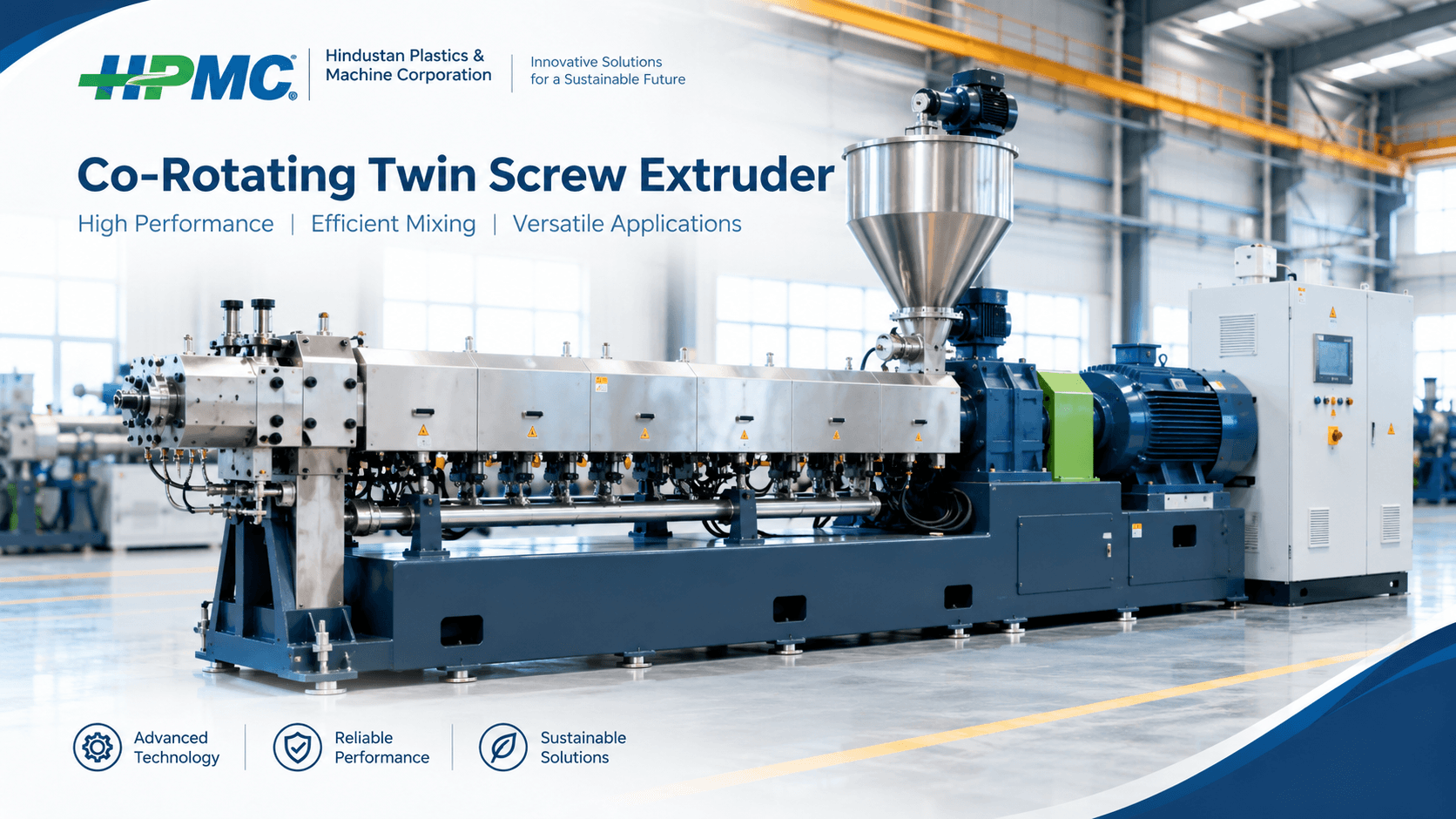
A co-rotating twin screw extruder is a plastic processing machine that uses two screws rotating in the same direction inside a barrel. The machine conveys, melts, mixes and homogenises polymer materials under controlled processing conditions.
Businesses comparing extrusion technologies can also review the differences between a twin screw extruder and a single screw extruder.
This technology is widely used when a manufacturing process requires effective mixing and dispersion of fillers, pigments or additives within a polymer formulation.
Compared with equipment primarily used for straightforward extrusion, a twin screw compounding extruder is particularly useful for applications where material blending and formulation control are important.
Common Applications of Co-Rotating Twin Screw Extruders
These machines are used in several industrial applications, including:
- Colour masterbatch production: Mixing pigments with a polymer carrier to produce concentrated colour formulations.
- Filler masterbatch production: Incorporating fillers such as talc and calcium carbonate into suitable polymer formulations.
- Additive masterbatch: Mixing functional additives into a polymer base.
- Engineering plastics: Processing suitable polymer formulations for industrial applications.
- Glass fibre reinforced compounds: Incorporating reinforcing fibres into compatible polymers.
- Polymer blending: Combining compatible polymers to achieve the required material properties.
- Plastic recycling and reprocessing: Processing suitable recycled polymers according to the formulation and process requirements.
Manufacturers exploring recycling applications can also read this guide to co-rotating twin screw extruders for recycling.
The correct configuration depends on the raw material, required output, filler loading and final product specifications.
Co-Rotating Twin Screw Extruder Price in India: What Determines the Cost?
There is no single price that applies to every co-rotating twin screw extruder. The final quotation depends on the selected model, technical specifications, application requirements and scope of supply.
A machine supplied with additional feeders, specialised dosing systems, vacuum degassing and pelletising equipment will have different requirements from a basic machine configuration.
Key Factors Affecting the Price
How to Get an Accurate Price
To obtain a relevant quotation, share the following information with the manufacturer:
- Type of polymer or raw material
- Intended application
- Required output in kilograms per hour
- Filler, pigment or additive requirements
- Preferred machine configuration, if known
- Required feeding, degassing and pelletising systems
- Installation and commissioning requirements
These details help the manufacturer assess the application and recommend a suitable configuration.
For current pricing, contact HPMC directly for a quotation based on your requirements. The actual cost should be confirmed through a written offer covering the machine specifications and included equipment.
HPMC Co-Rotating Twin Screw Extruder Models and Specifications
HPMC publishes several co-rotating twin screw extruder models for different production requirements. The following table summarises the published specifications for the main models.
Which HPMC Model Should You Consider?
HPMC 20 and HPMC 30: These models may be worth evaluating for applications with lower output requirements. Suitability depends on the formulation and required processing performance.
HPMC 35: Its published output range is 10–80 kg/hr. Discuss the material characteristics and required mixing performance before selecting this configuration.
HPMC 50: With a published output range of 20–150 kg/hr, this model can be considered for suitable small-to-medium production requirements.
HPMC 65: Its published output range is 100–300 kg/hr. Buyers should evaluate the drive configuration, feeding requirements and expected output for their particular formulation.
HPMC 72: This model has a published output range of 300–600 kg/hr and may be suitable for applications requiring higher throughput.
HPMC 92: With a published output range of 600–1,000 kg/hr, this model can be considered for larger production requirements where the formulation and processing conditions support the required output.
These ranges are not interchangeable production guarantees. The recommended model should be selected after assessing the material, process and expected product quality.
For businesses comparing extrusion machinery, HPMC’s co-rotating twin screw extruder range offers a starting point for reviewing available machine configurations.
Seven Important Factors to Consider Before Buying a Twin Screw Extruder
1. Screw Diameter and Machine Configuration
Screw diameter is one of the important specifications when comparing extrusion machinery. However, a larger diameter does not automatically make a machine suitable for every application.
The selection should account for the required output, polymer characteristics, formulation and processing conditions.
Before requesting a quotation, explain your current production requirements and expected future demand. This helps the manufacturer recommend an appropriate machine instead of selecting a model based on size alone.
2. Motor Power and Gearbox Specifications
The drive system supplies the power required to rotate the screws and process the material. Motor power and gearbox specifications must match the formulation, processing demands and required throughput.
Applications involving demanding formulations or high filler loading may require a different drive configuration from simpler compounding processes.
When comparing quotations, check the motor rating, gearbox specifications and suitability of the complete drive system for the intended application.
3. Screw Design and L/D Ratio
The length-to-diameter ratio, commonly known as the L/D ratio, describes the relationship between screw length and screw diameter.
Screw design influences conveying, melting, mixing and material dispersion. Different formulations may require different screw arrangements to achieve the desired processing performance.
Discuss your material formulation and final product requirements with the manufacturer before finalising the screw configuration.
4. Feeding and Dosing Systems
Plastic compounding processes may involve several materials, including polymers, pigments, fillers and additives. Depending on the formulation, the machine may require a main feeder, side feeders or specialised dosing equipment.
The type and number of feeding systems influence the overall machine configuration.
Confirm which feeders are included in the quotation, what materials they are intended to handle and whether any additional equipment is necessary.
5. Vacuum Degassing and Temperature Control
Some formulations require venting or vacuum degassing to help remove moisture, trapped air or volatile substances during processing.
Temperature monitoring and control also help maintain suitable processing conditions for the material being handled.
The exact requirements depend on the formulation and application. Buyers should confirm whether a vent port, vacuum system and additional process controls are needed.
6. Pelletising and Downstream Equipment
An extruder can be supplied as a standalone machine or as part of a complete production line.
Depending on the application, additional equipment may include:
- Die head or strand die
- Cooling arrangements
- Strand pelletiser or another suitable pelletising system
- Conveying equipment
- Product collection systems
- Auxiliary material handling equipment
The final investment depends partly on the equipment included in the supplier's scope of supply.
A quotation covering only the extruder should not be compared directly with an offer that includes feeding, cooling, pelletising and material handling systems.
7. Installation, Warranty and Technical Support
The purchase decision should also account for installation, commissioning, operator training and after-sales support.
Before finalising the order, clarify the warranty coverage, exclusions, recommended spare parts and availability of technical assistance.
These details help buyers understand the support available after the machine is delivered.
How to Compare Twin Screw Extruder Quotations
A detailed written quotation makes it easier to compare machines from different manufacturers.
Technical Specifications
Check the model, screw diameter, L/D ratio, motor power, gearbox details, temperature-control system and expected output for your application.
Scope of Supply
Confirm whether the quotation includes feeders, vacuum systems, pelletising equipment, control panels and other auxiliary components.
Installation and Commissioning
Ask whether installation, commissioning and operator training are included or charged separately.
Warranty and Spare Parts
Review warranty terms, exclusions, spare parts availability and the process for requesting technical assistance.
Delivery and Payment Terms
Check the expected delivery schedule, payment milestones, applicable taxes, transportation arrangements and installation requirements.
Expected Performance
Ask the supplier to explain the expected production capacity and the conditions under which it applies.
A detailed comparison helps ensure that quotations cover similar specifications and equipment instead of relying on the quoted amount alone.
How to Choose the Right Extruder for Your Production Requirements
Follow these steps to evaluate a suitable machine configuration.
Step 1: Define your material. Identify the polymer, fillers, pigments and additives you plan to process.
Step 2: Establish your output target. Determine the required production in kg/hr and consider your operating schedule.
Step 3: Explain your application. Specify whether the machine will be used for colour masterbatch, filler compounding, engineering plastics, polymer blending or recycling.
Step 4: Confirm the technical configuration. Discuss the screw design, drive system, feeding equipment, venting and pelletising requirements.
Step 5: Review the total equipment requirement. Identify the auxiliary systems needed for your production line.
Step 6: Evaluate operating needs. Consider energy consumption, maintenance, operator requirements, spare parts and potential downtime.
Step 7: Confirm technical support. Clarify installation assistance, training, maintenance guidance and after-sales service arrangements.
Following these steps helps businesses choose equipment according to application suitability and operational requirements.
Why the Lowest Quotation May Not Be the Best Choice
A lower initial quotation may cover a different machine capacity, fewer auxiliary systems or a different level of automation. Similarly, a higher quotation does not automatically guarantee better performance.
The important question is whether the proposed configuration meets your actual production requirements.
Before making a decision, compare:
- Machine specifications and material suitability
- Expected output for your formulation
- Included auxiliary equipment
- Energy and maintenance requirements
- Installation and commissioning scope
- Warranty and spare parts availability
- Technical support and training
A complete comparison helps businesses understand what they are paying for and choose a machine that suits their manufacturing process.
Why Consider Hindustan Plastics & Machine Corporation (HPMC)?
Hindustan Plastics & Machine Corporation provides extrusion and plastic processing machinery solutions for industrial applications.
HPMC's published co-rotating twin screw extruder range includes multiple models with different screw diameters, motor ratings, L/D ratios and production capacities. The company's product information also covers polymer compounding, masterbatch production, engineering plastics, reinforced compounds and recycling applications.
When evaluating an HPMC machine, buyers should provide their material details, intended application and required production output. This information helps establish the technical requirements for a suitable configuration.
Businesses looking for suitable machinery can explore HPMC’s co-rotating twin screw extruder range to understand the available machine options.
For applications involving polymer compounding and recycling, HPMC’s co-rotating twin screw extruder solutions can also be considered.
Summary
The co-rotating twin screw extruder price in India depends on the machine model, screw diameter, drive configuration, production capacity, feeding systems, automation and auxiliary equipment.
HPMC's published model specifications provide a useful starting point for comparing machine capacities and technical requirements. However, the most suitable model depends on the material formulation, intended application and required output.
Before purchasing, define your production requirements, compare complete quotations and confirm the scope of supply, installation and technical support.
Rather than selecting a machine on the basis of price alone, evaluate its suitability for your manufacturing process.
Contact HPMC to discuss your application and request a quotation based on your material, target output and equipment requirements.
Contact Hindustan Plastics & Machine Corporation (HPMC)
Address: 5, Category II, DSIDC Industrial Area, Nangloi, Delhi – 110041
Phone: +91 95605 96392
Email: info@hindustanplastics.com
Website: https://www.hindustanplastics.com/
Google Business Profile: https://share.google/lBK4uD53HqY891ynv
For machine specifications, application guidance and quotation enquiries, visit the official website or contact HPMC directly.
Key Factors Affecting the Price — Comparison Table
Factor
Impact on the investment
Machine model and screw diameter
Determines the size and processing capability
Production capacity
Influences the required machine configuration
Motor and gearbox
Must suit the material and processing demands
Screw design and L/D ratio
Depends on mixing and material processing requirements
Feeding and dosing systems
Varies with the formulation and number of materials
Vacuum degassing
Depends on moisture and volatile-removal requirements
Automation and controls
Varies with monitoring and operational needs
Downstream equipment
Includes cooling, pelletising and material handling
Installation and technical support
Depends on the agreed scope of services
HPMC Co-Rotating Twin Screw Extruder Models and Specifications — Comparison Table
Model
Screw diameter
Main motor power
L/D ratio
Published output
HPMC 20
21.7 mm
4 kW
32–40
2–10 kg/hr
HPMC 30
30 mm
11 kW
28–48
5–30 kg/hr
HPMC 35
35.6 mm
11/15 kW
32–48
10–80 kg/hr
HPMC 50
50.5 mm
37/45 kW
32–48
20–150 kg/hr
HPMC 65
62.4 mm
55/75 kW
32–48
100–300 kg/hr
HPMC 72
71.2 mm
90/110 kW
32–48
300–600 kg/hr
HPMC 92
91 mm
220/250 kW
32–40
600–1,000 kg/hr
Frequently Asked Questions
Find quick answers to the most common questions about this topic.
The price depends on the machine model, screw diameter, motor power, production capacity, screw configuration and included equipment. Since these requirements vary by application, contact HPMC for a quotation based on your specifications.
Important factors include screw diameter, L/D ratio, motor power, gearbox configuration, production capacity, feeding and dosing systems, vacuum degassing, automation, downstream equipment and installation requirements.
HPMC publishes output ranges from approximately 2 kg/hr to 1,000 kg/hr across its HPMC 20, 30, 35, 50, 65, 72 and 92 models. Actual capacity depends on the material, formulation, filler loading and processing conditions.
Depending on the machine configuration, applications may include compatible polymers such as PP, PE, ABS, PVC and engineering plastics, as well as masterbatch formulations, reinforced compounds and suitable recycled polymers. Confirm material compatibility with the manufacturer.
A single screw extruder uses one rotating screw and is widely used for conveying, melting and extrusion. A co-rotating twin screw extruder uses two screws rotating in the same direction and is commonly selected for applications requiring intensive mixing, dispersion and compounding.
Not necessarily. The included equipment depends on the supplier's quotation. Confirm whether the die, cooling system, pelletiser, feeders, control panel and other auxiliary components are included or quoted separately.Not necessarily. The included equipment depends on the supplier's quotation. Confirm whether the die, cooling system, pelletiser, feeders, control panel and other auxiliary components are included or quoted separately.
No. The right model depends on the formulation, required output, mixing requirements and operating schedule. A larger machine may increase the investment without providing a corresponding benefit if its capacity is not required.
Share the polymer or material, intended application, target output in kg/hr, filler or additive requirements, preferred configuration and downstream equipment needs. The manufacturer may request additional details to finalise the specification.
Compare machine specifications, expected output, material suitability, included equipment, installation, warranty, spare parts, delivery terms and after-sales support. Ensure that each quotation covers a comparable scope of supply.
can help businesses manage production interruptions and maintain reliInstallation assistance, operator training, maintenance guidance, spare parts and technical troubleshooting able operation.
Contact Hindustan Plastics & Machine Corporation with your material details, application, target output and equipment requirements. Request a written quotation that specifies the machine configuration, included equipment, delivery terms and available technical support.