
Introduction
PVC conduit pipes are used in residential buildings, commercial complexes, factories, and infrastructure projects to provide a protective pathway for electrical wires and cables. Manufacturers need a suitable extrusion line to produce pipes with consistent dimensions, a smooth surface, and specifications that meet the intended application.
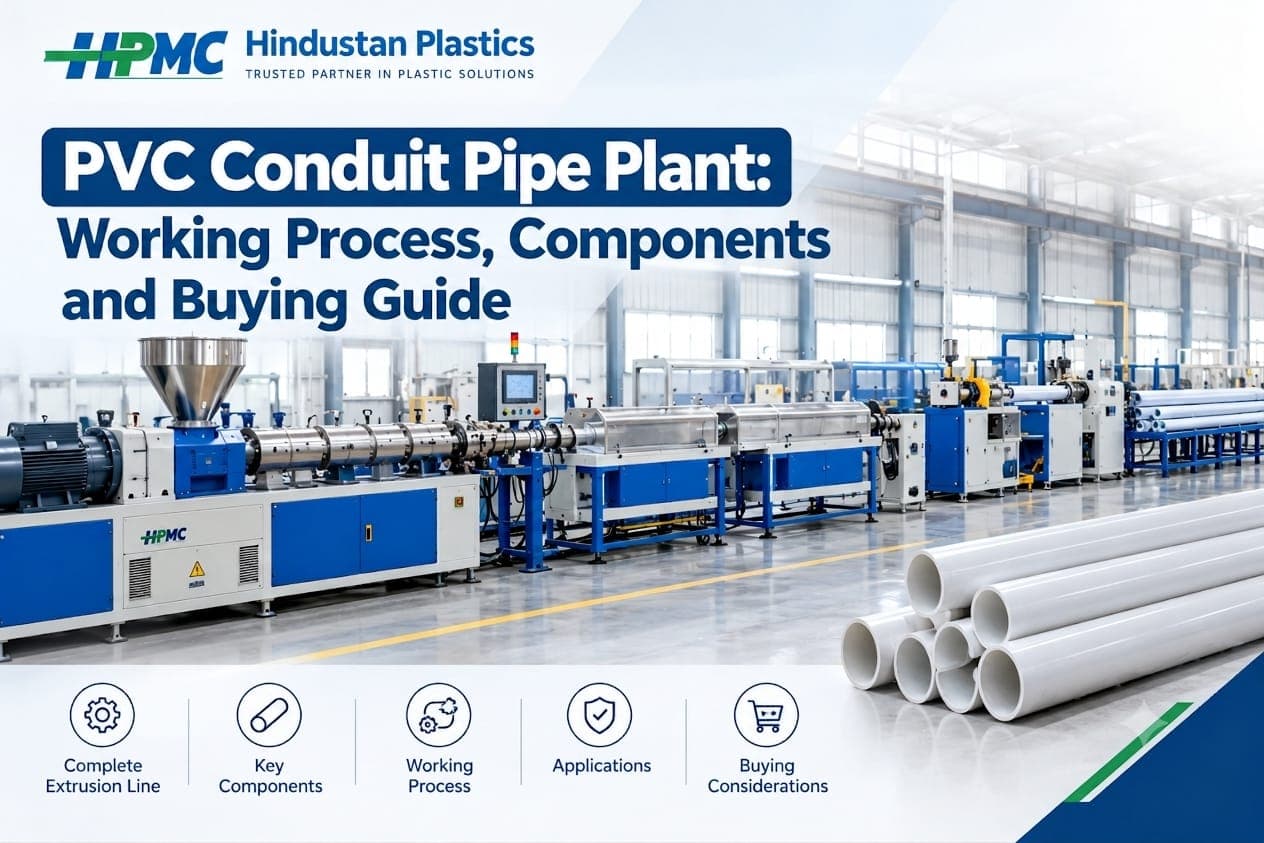
A PVC conduit pipe plant is a manufacturing system that processes rigid PVC compound and forms it into electrical conduit pipes. Depending on the configuration, the line may include a conical twin screw extruder, conduit die, vacuum calibration tank, cooling system, haul-off unit, cutter, and pipe collection equipment.
Choosing the right plant requires consideration of pipe dimensions, expected production output, tooling, automation, operating requirements, and after-sales support.
Hindustan Plastics & Machine Corporation (HPMC) offers machinery for PVC conduit pipe manufacturing. Explore its PVC Conduit Pipe Plant page for product details and available configurations.
This guide explains the working process, key components, production considerations, and factors to evaluate before investing in an electrical conduit pipe extrusion line.
What Is a PVC Conduit Pipe Plant?
A PVC conduit pipe plant is an extrusion system designed to manufacture rigid PVC pipes used for protecting electrical wiring and cables.
The system processes PVC compound through an extruder and shapes it through a die. The pipe then passes through calibration and cooling equipment before being pulled, cut, inspected, and collected.
The exact configuration depends on the required pipe sizes, production capacity, and finished-product specifications.
PVC conduit pipes are commonly used in:
- Residential electrical installations.
- Commercial buildings and offices.
- Industrial facilities and factories.
- Construction and infrastructure projects.
- Suitable cable-routing and electrical ducting applications.
The finished pipe must meet the dimensional and performance requirements applicable to its intended use.
Main Components of a PVC Conduit Pipe Extrusion Line
A complete extrusion line combines several components that work together to manufacture finished pipes.
1. Conical Twin Screw Extruder
The extruder conveys and processes the PVC compound before delivering it to the die. A conical twin screw design uses two screws housed inside a matching barrel.
The machine must be selected according to the PVC formulation, intended pipe dimensions, and required production output.
For more information about the extrusion stage, read HPMC's guide to the conical twin screw extruder for PVC pipe production.
2. Conduit Die Head
The die head forms the processed PVC material into a continuous pipe profile.
The die and associated tooling must match the required pipe diameter and design. Correct setup helps maintain uniform material distribution and consistent dimensions.
3. Vacuum Calibration Tank
The calibration system helps establish the pipe's required outside diameter and shape after it leaves the die.
Its configuration must suit the product specifications and work in coordination with the extrusion and cooling stages.
4. Cooling System
The cooling section removes heat from the newly formed pipe so that it can retain its intended shape.
Consistent cooling conditions help reduce dimensional variation. The appropriate arrangement depends on the pipe dimensions, line speed, and machine configuration.
5. Haul-Off Unit
The haul-off unit pulls the pipe through the production line at a controlled speed.
It must operate in coordination with the extruder. Incorrect speed settings may affect pipe dimensions and production consistency.
6. Cutting Unit
The cutting system divides the continuous pipe into the required lengths.
Depending on the machine design, it may include automatic measurement and synchronisation features to help maintain consistent cut lengths.
7. Belling Machine
A belling machine forms or expands the end of a pipe when the product design requires a socket for joining.
It is an application-dependent component, so manufacturers should confirm whether it is required for their specific conduit product and whether it is included in the proposed line.
8. Stacker and Collection System
The stacker or collection arrangement receives and organises finished pipes after cutting.
Proper handling helps maintain an orderly production area and reduces unnecessary damage to the finished products.
Important: Not every PVC conduit pipe plant contains exactly the same components. Confirm the included equipment, optional units, tooling, and technical specifications before placing an order.
How Does a PVC Conduit Pipe Plant Work?
The manufacturing process involves several stages, from preparing the PVC compound to inspecting the finished pipes.
Step 1: PVC Compound Preparation
PVC resin and the required formulation ingredients are prepared according to the intended application.
Consistent material preparation helps support stable processing and repeatable product quality.
Step 2: Material Feeding
The prepared compound is supplied to the extruder through the feeding arrangement. Consistent feeding helps maintain stable operating conditions.
Step 3: Extrusion and Plasticisation
The extruder conveys and processes the PVC compound under controlled conditions before delivering it to the conduit die.
Operating settings must be appropriate for the material formulation and machine design.
Step 4: Pipe Formation
The processed material passes through the die, which shapes it into a continuous pipe profile.
Step 5: Calibration and Cooling
The pipe moves through the calibration and cooling sections. These stages help establish and maintain the required shape and dimensions.
Step 6: Haul-Off and Cutting
The haul-off unit pulls the pipe through the line, and the cutting system divides it into specified lengths.
The equipment must work in coordination to maintain consistent output.
Step 7: Inspection and Collection
Finished pipes are checked against the required specifications and collected for storage or dispatch. If the product design requires socketed ends, a suitable belling operation may also be included.
Single-Pipe, Two-Pipe and Four-Pipe Conduit Plants
The right production configuration depends on the manufacturer's product range, output targets, and investment requirements.
Single-Pipe Plant
A single-pipe configuration produces one pipe at a time. It may suit manufacturers whose production plans and product range are designed around this arrangement.
Two-Pipe PVC Conduit Plant
A two-pipe system is designed to manufacture two pipes simultaneously using a suitably configured extrusion system.
HPMC provides a dedicated Two-Pipe PVC Conduit Plant for manufacturers evaluating this production arrangement.
Four-Pipe PVC Conduit Plant
A four-pipe system is designed to produce four pipes simultaneously, subject to the selected machine, tooling, and product requirements.
Manufacturers can explore HPMC's Four-Pipe PVC Conduit Plant for its dedicated product information.
Producing multiple pipes simultaneously does not guarantee a particular output or cost saving. Actual performance depends on pipe dimensions, material formulation, tooling, operating conditions, and line configuration.
Applications of PVC Conduit Pipes
PVC conduit pipes are used in various electrical installation environments.
Residential Buildings
Conduit pipes provide a protective route for electrical wires in houses, apartments, and residential developments.
Commercial Buildings
Offices, retail spaces, schools, and other commercial premises use suitable conduit systems to route and protect electrical wiring.
Industrial Facilities
Factories and workshops may use conduit products in electrical installations. The selected pipe must suit the environmental conditions and installation requirements.
Infrastructure Projects
Suitable conduit pipes may be used in cable-routing and ducting applications associated with construction and infrastructure projects.
Cable Protection
The primary purpose of an electrical conduit is to provide a protective pathway for wires and cables. Product selection should follow the requirements of the intended installation.
How to Choose the Right PVC Conduit Pipe Machine
Before purchasing an electrical conduit pipe extrusion line, manufacturers should evaluate the following factors.
1. Required Pipe Sizes
Identify the required pipe diameters, wall thicknesses, and product specifications. Confirm that the proposed machine and tooling can accommodate the intended size range.
2. Production Capacity
Estimate the required output and operating schedule. Ask the manufacturer to clarify the rated capacity and the conditions under which it can be achieved.
3. Production Configuration
Consider whether a single-pipe, two-pipe, or four-pipe arrangement suits your manufacturing plan. Compare the complete system requirements rather than choosing based only on a headline output figure.
4. PVC Formulation
The extruder must be appropriate for the rigid PVC compound being processed. Discuss the formulation and relevant processing requirements with the machinery manufacturer.
5. Downstream Equipment
Confirm whether the quotation includes the die, calibration and cooling equipment, haul-off, cutter, belling machine if required, and collection system.
6. Automation and Controls
Review the control panel, temperature controls, cutting arrangement, and automation features. Consider the operating skills and production process available at your facility.
7. Installation and After-Sales Support
Ask about installation, commissioning, operator training, spare parts, maintenance guidance, and technical support before finalising the purchase.
PVC Conduit Pipe Plant Price in India
The price of a PVC conduit pipe plant depends on the machine configuration and the equipment included in the supply. A single-pipe line and a multi-pipe line may have different tooling, capacity, and automation requirements.
Key cost factors include:
- Extruder model and configuration.
- Required pipe diameter range.
- Single-pipe, two-pipe, or four-pipe production arrangement.
- Die head and tooling.
- Calibration and cooling equipment.
- Haul-off and cutting systems.
- Belling and stacking equipment, where required.
- Control systems and automation.
- Installation, commissioning, and training.
- Transportation, taxes, and commercial terms.
There is no single price that applies to every configuration. A reliable quotation should be based on the required specifications and the complete equipment package.
For current pricing, contact HPMC through its official website and share your required pipe sizes, target output, production arrangement, and downstream equipment requirements.
Maintenance Tips for a PVC Conduit Pipe Plant
Regular maintenance can help maintain stable production and identify equipment issues early.
Inspect the Extruder
Follow the equipment manual for inspecting the gearbox, drive system, heating components, and other relevant parts.
Check the Die and Tooling
Inspect the die and material-contact surfaces for wear, deposits, or damage. Follow the manufacturer's approved cleaning and maintenance procedures.
Maintain Calibration and Cooling Equipment
Check the calibration system, cooling-water arrangement, and associated components according to the recommended maintenance schedule.
Inspect the Haul-Off and Cutter
Check the gripping components, blade condition, and operating synchronisation. Replace worn parts according to the manufacturer's instructions.
Monitor Finished Pipe Quality
Measure finished pipes regularly and inspect their surface condition, cut length, and dimensions against the required specifications.
Maintain Production Records
Record important operating settings, maintenance activities, and quality observations. These records help operators identify recurring problems and track changes in production performance.
Why Consider HPMC for PVC Conduit Pipe Machinery?
Hindustan Plastics & Machine Corporation manufactures plastic extrusion machinery for industrial applications. The company states that it was established in 1972 and serves the plastic processing industry. https://www.hindustanplastics.com/faq
Manufacturers evaluating conduit pipe production equipment can explore HPMC's PVC Conduit Pipe Plant and compare the available options with their manufacturing requirements.
HPMC also lists dedicated two-pipe and four-pipe conduit plant configurations.
Before purchasing, discuss the required pipe specifications, expected output, included equipment, installation arrangements, and maintenance requirements with the manufacturer.
Conclusion
A PVC conduit pipe plant manufactures rigid PVC pipes used to provide a protective pathway for electrical wires and cables. Its performance depends on the coordinated operation of the extruder, die, calibration and cooling systems, haul-off, cutter, and any additional equipment required for the product.
Before investing in an electrical conduit pipe extrusion line, manufacturers should evaluate the pipe size range, production targets, material formulation, tooling, automation, and long-term maintenance needs.
Comparing complete configurations and confirming the included equipment can help businesses make a more informed purchasing decision.
For product information or a quotation based on your requirements, visit HPMC's official website.
Frequently Asked Questions (FAQs)
1. What is a PVC conduit pipe plant?
A PVC conduit pipe plant is an extrusion system that processes rigid PVC compound and forms it into pipes used to protect electrical wires and cables.
2. Which machine is used to manufacture PVC electrical conduit pipes?
A PVC conduit pipe extrusion line commonly uses an extruder, conduit die, calibration and cooling equipment, haul-off, and cutter. Additional components depend on the intended product.
3. Why is a conical twin screw extruder used for PVC conduit pipes?
A conical twin screw extruder is commonly used for rigid PVC processing. Its suitability depends on the formulation, machine design, required output, and pipe specifications.
4. What are the main components of a PVC conduit pipe plant?
The line may include a conical twin screw extruder, conduit die, vacuum calibration tank, cooling system, haul-off, cutter, and collection equipment. A belling machine may be added if required.
5. What are PVC conduit pipes used for?
PVC conduit pipes provide a protective pathway for electrical wiring in residential, commercial, industrial, and suitable infrastructure installations.
6. What is the difference between a two-pipe and four-pipe conduit plant?
A two-pipe plant is designed to produce two pipes simultaneously, while a four-pipe plant is designed to produce four. Actual output depends on the machine configuration, material, tooling, and operating conditions.
7. What factors affect the price of a PVC conduit pipe plant?
The price depends on the extruder model, production configuration, pipe sizes, tooling, automation, downstream equipment, installation requirements, and commercial terms.
8. Can one PVC conduit pipe machine manufacture different pipe sizes?
The available pipe sizes depend on the machine configuration, die tooling, calibration equipment, and manufacturer specifications. Confirm the required size range before purchasing.
9. What is the role of a vacuum calibration tank?
A vacuum calibration tank helps establish the required outside diameter and shape of the extruded pipe. Its setup must match the product specifications and operating conditions.
10. Is a belling machine necessary for PVC conduit pipe production?
A belling machine is needed when the intended pipe design requires a formed or expanded socket at the end. It is not necessary for every conduit pipe product.
11. How can manufacturers maintain PVC conduit pipe quality?
Manufacturers should maintain consistent material preparation, appropriate process settings, proper calibration and cooling, coordinated haul-off and cutting, and regular dimensional inspections.
12. How can I request a quotation for a PVC conduit pipe plant from HPMC?
Visit the official HPMC website or contact the company using the details below. Share your required pipe sizes, expected output, production arrangement, and equipment requirements to help obtain a suitable quotation.
Contact HPMC
Company: Hindustan Plastics & Machine Corporation (HPMC)
Address: 5, Category II, DSIDC Industrial Area, Nangloi, Delhi – 110041, India
Website: https://www.hindustanplastics.com/
Phone: +91 95605 96392
Email: info@hindustanplastics.com
Google Business Profile: https://share.google/lBK4uD53HqY891ynv
Contact HPMC to discuss your PVC conduit pipe manufacturing requirements and request machinery information.
Frequently Asked Questions
Find quick answers to the most common questions about this topic.
A PVC conduit pipe plant is an extrusion system that processes rigid PVC compound and forms it into pipes used to protect electrical wires and cables.
A PVC conduit pipe extrusion line commonly uses an extruder, conduit die, calibration and cooling equipment, haul-off, and cutter. Additional components depend on the intended product.
A conical twin screw extruder is commonly used for rigid PVC processing. Its suitability depends on the formulation, machine design, required output, and pipe specifications.
The line may include a conical twin screw extruder, conduit die, vacuum calibration tank, cooling system, haul-off, cutter, and collection equipment. A belling machine may be added if required.
PVC conduit pipes provide a protective pathway for electrical wiring in residential, commercial, industrial, and suitable infrastructure installations.
A two-pipe plant is designed to produce two pipes simultaneously, while a four-pipe plant is designed to produce four. Actual output depends on the machine configuration, material, tooling, and operating conditions.
The price depends on the extruder model, production configuration, pipe sizes, tooling, automation, downstream equipment, installation requirements, and commercial terms.
The available pipe sizes depend on the machine configuration, die tooling, calibration equipment, and manufacturer specifications. Confirm the required size range before purchasing.
A vacuum calibration tank helps establish the required outside diameter and shape of the extruded pipe. Its setup must match the product specifications and operating conditions.
A belling machine is needed when the intended pipe design requires a formed or expanded socket at the end. It is not necessary for every conduit pipe product.