
Introduction
In HDPE pipe manufacturing, maintaining accurate pipe dimensions is essential for delivering consistent products and meeting customer requirements. Manufacturers generally focus on pipe diameter, wall thickness, surface finish and pressure performance. However, pipe length is another important quality parameter that requires proper monitoring throughout production.
HDPE Pipe Length Measurement Accuracy refers to how closely the actual length of a finished pipe matches its specified length. Maintaining consistent pipe lengths helps manufacturers improve product quality, reduce cutting errors, control material wastage and simplify packaging and transportation.
In a modern HDPE pipe extrusion line, length measurement is generally connected with the haul-off and automatic cutting systems. An encoder or suitable measuring device tracks pipe movement and communicates with the PLC control system. When the preset length is reached, the cutting unit receives a signal to perform the cutting operation.
However, accurate measurement depends on more than the encoder alone. Haul-off movement, calibration, production speed, cooling conditions, measuring equipment and cutting synchronization all influence the final result.
Hindustan Plastics & Machine Corporation (HPMC), based in Delhi, India, manufactures plastic extrusion machinery for different industrial applications. This guide explains how HDPE pipe length measurement works, the components involved, factors affecting accuracy, common production problems and practical methods manufacturers can use to maintain consistent pipe lengths.
What Is HDPE Pipe Length Measurement Accuracy?
HDPE Pipe Length Measurement Accuracy describes the ability of a measurement system to monitor pipe movement and produce finished pipes according to the required length specification.
During continuous extrusion, the pipe travels through different downstream sections before reaching the cutting unit. The measurement system monitors this movement and determines when the pipe reaches the programmed cutting length.
For example, a manufacturer producing HDPE pipes with a specified length of 6 metres needs a reliable measurement and cutting arrangement to maintain consistent finished lengths. The permitted dimensional variation should follow the applicable product standard, customer specification and inspection procedure.
A properly configured measurement system helps manufacturers maintain uniform products and reduce unnecessary differences between individual pipes.
Length measurement is particularly important in production facilities where pipes are manufactured in different sizes and cutting lengths. Consistent measurement also makes product inspection, packaging, inventory management and customer order fulfilment easier.
How Does HDPE Pipe Length Measurement Work?
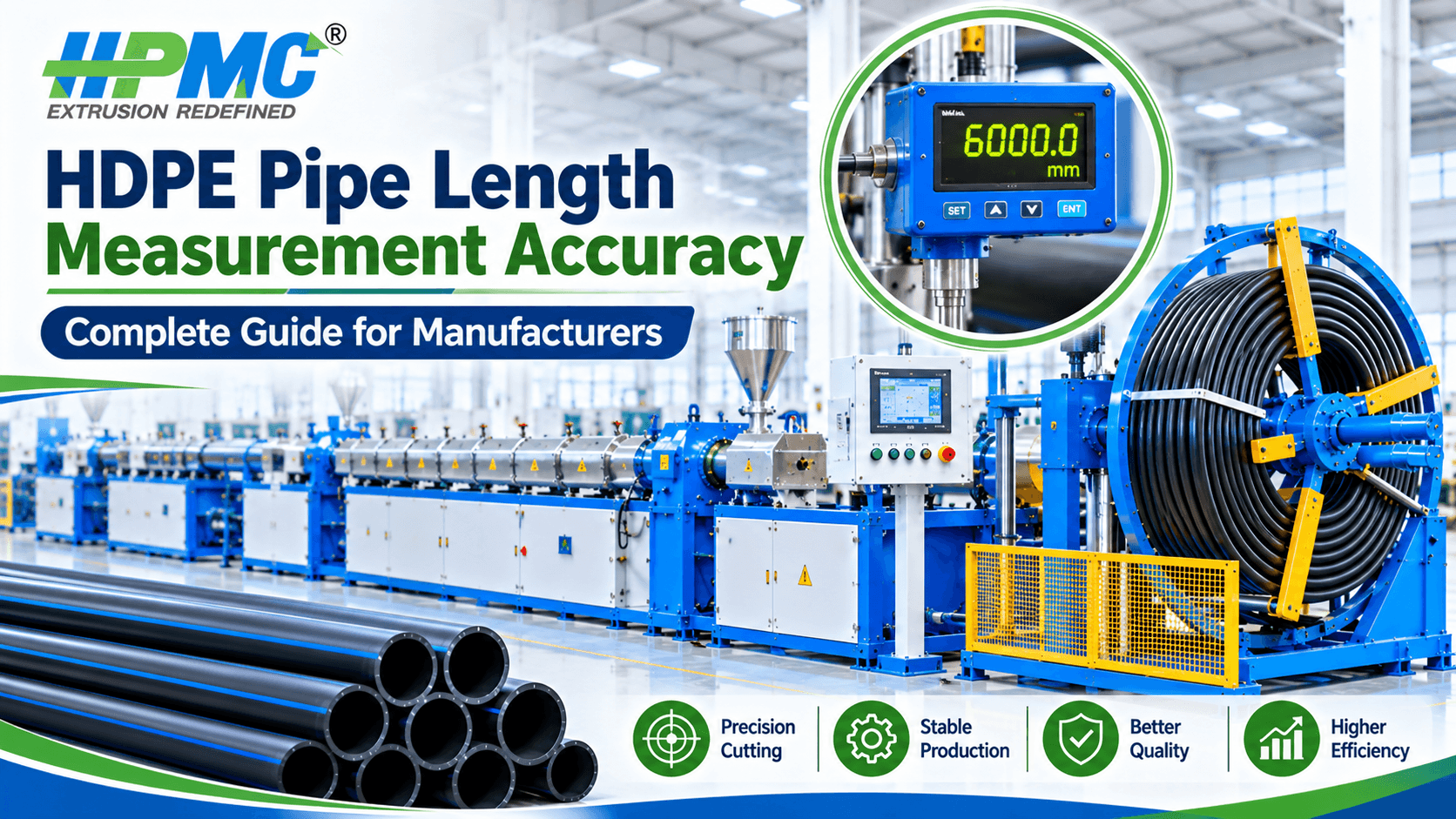
HDPE pipe length measurement takes place during the downstream stage of the extrusion process. The system generally works with the haul-off unit, encoder, PLC control panel and automatic cutting machine. The manufacturing process begins when HDPE raw material enters the extruder. The screw and barrel assembly melts and conveys the polymer towards the die head, where the material takes the required pipe shape.The newly formed pipe then passes through vacuum calibration and cooling sections. These stages help establish and maintain the required pipe dimensions. After cooling, the haul-off unit pulls the pipe through the production line at a controlled speed. The measurement system monitors the movement using an encoder or another suitable measuring device.The encoder sends signals to the PLC control system. The PLC processes these signals and compares the measured movement with the preset cutting length.Once the required length is reached, the control system activates the cutting arrangement. The cutter separates the pipe, and the finished product moves towards inspection, stacking or collection.The complete process depends on proper coordination between the extrusion machine, haul-off, measurement arrangement and cutting equipment.
Important Components Used in HDPE Pipe Length Measurement
Several machine components work together to maintain consistent measurement and cutting performance. Understanding their functions helps manufacturers identify possible problems during production.
Encoder and Measuring System
An encoder is an important component in many automatic pipe length measurement arrangements. It converts mechanical movement into electrical signals that the control system uses to monitor pipe movement.
Depending on the machine configuration, the encoder may be connected to the haul-off drive or a separate measuring wheel.
Its resolution, installation and calibration influence the measurement reading. If the encoder is not configured correctly, the system may record more or less movement than the actual pipe movement.
Regular calibration and inspection help maintain reliable measurement performance.
Haul-Off Unit
The haul-off unit pulls the pipe through the production line at a controlled speed. It generally uses belts or tracks to maintain suitable gripping during continuous operation.
Consistent movement is important because the measurement system must accurately track the pipe as it travels through the line.
Worn gripping pads, unsuitable pressure or incorrect alignment may cause pipe slippage. This can create differences between the recorded movement and actual pipe length.
PLC Control System
The Programmable Logic Controller (PLC) coordinates the measurement and cutting sequence.
It receives information from the encoder and processes the selected length settings. Operators can enter the required cutting length through the control panel, depending on the machine configuration.
Correct programming and reliable communication between the measuring and cutting systems help maintain consistent operation.
Automatic Cutting Unit
The automatic cutting unit separates the pipe when the preset length is reached.
Depending on the extrusion line, the cutting arrangement may use a planetary saw or another suitable cutting mechanism.
The cutting unit must operate in coordination with the moving pipe. Incorrect timing or unsuitable machine settings may result in length variations.
Measuring Wheel and Sensors
Some production lines use a contact measuring wheel to monitor pipe movement, while other systems use non-contact measurement technology.
Contact measuring wheels should be inspected for wear, alignment and slipping. Non-contact sensors require suitable installation and alignment to maintain reliable readings.
The selected measurement arrangement should match the machine configuration and production requirements.
Factors Affecting HDPE Pipe Length Measurement Accuracy
Measurement accuracy can change because of several mechanical, electrical and operating conditions. Manufacturers should understand these factors before making adjustments to their production lines.
Incorrect Encoder Calibration
Incorrect encoder calibration can cause the system to record more or less movement than the pipe actually travels. This may result in repeated cutting errors.
Manufacturers should compare machine readings with physically measured pipe samples and follow the equipment manufacturer's recommended calibration procedure.
Pipe Slippage During Haul-Off
When the pipe slips inside the haul-off tracks, the recorded movement may not match the actual movement.
Worn belts, incorrect gripping pressure and poor alignment are possible reasons for this problem.
Inspecting the gripping arrangement and maintaining suitable operating conditions can help reduce measurement differences.
Unstable Production Speed
Frequent changes in haul-off speed can affect cutting synchronization.
The measurement and cutting systems should respond correctly to normal production speed changes. Proper coordination helps maintain consistent cutting positions throughout the manufacturing process.
Temperature and Cooling Conditions
HDPE is a thermoplastic material, and its dimensions can change during cooling.
A pipe measured immediately after extrusion may show a different length from the same pipe after reaching a stable temperature.
Manufacturers should follow a consistent cooling and inspection procedure when checking finished pipe dimensions.
Measuring Wheel Wear
In contact-based measurement systems, wheel wear can change the relationship between recorded movement and actual movement.
The measuring wheel should be inspected regularly for surface damage, wear and alignment problems.
Cutting System Synchronization
The cutting unit must operate in coordination with the movement of the pipe.
Delayed triggering, incorrect settings or mechanical response problems can result in variations in finished pipe length.
Electrical Signal Problems
Loose connections, damaged cables and electrical interference can affect encoder signals.
Operators should inspect wiring, connections and control-system diagnostics whenever measurement readings become inconsistent.
Different Methods of HDPE Pipe Length Measurement
Manufacturers can use different measurement methods depending on production requirements, machine configuration and automation level.
Encoder-Based Measurement
Encoder-based measurement is widely used in automatic extrusion lines.
The encoder monitors mechanical movement and sends signals to the PLC control system. When the preset length is reached, the controller activates the cutting arrangement.
This method supports continuous measurement and integration with automatic cutting equipment.
Its performance depends on correct calibration, reliable mechanical movement and suitable control settings.
Contact Measuring Wheel
A contact measuring wheel measures pipe movement through physical contact with the pipe surface.
It can be used in suitable production arrangements where the wheel maintains consistent contact.
However, wear, slipping and unsuitable contact pressure can influence measurement results. Regular inspection is necessary to maintain reliable performance.
Non-Contact Laser Measurement
Non-contact measurement systems use optical or laser-based technology to monitor moving material without direct mechanical contact.
These systems can be useful where contact-based measurement introduces wear or slipping.
Correct alignment, installation and operating conditions remain important for reliable measurement.
Manual Length Verification
Manual verification is generally used during finished-product inspection.
A suitable measuring instrument is used to compare the actual pipe length with the specified dimension.
This method helps manufacturers verify automatic measurement results and maintain quality inspection records.
How to Improve HDPE Pipe Length Measurement Accuracy
Maintaining accurate pipe length requires proper machine setup, regular inspection and consistent operating practices.
Calibrate the Encoder: Compare encoder readings with the actual measured length of a finished pipe. Check the measurement settings whenever repeated differences are identified.
Maintain the Haul-Off Unit: Inspect belts, gripping pads and mechanical alignment. Ensure that the pipe moves smoothly without unnecessary slipping or deformation.
Maintain Stable Production Speed: Coordinate the haul-off, measuring system and cutting unit. Avoid unnecessary speed fluctuations during normal production.
Inspect the Cutting Mechanism: Check sensors, switches, cutting movement and mechanical components according to the manufacturer's maintenance recommendations.
Maintain Consistent Cooling: Follow suitable cooling conditions before final pipe inspection. This helps manufacturers compare measurements under consistent conditions.
Train Machine Operators: Operators should understand length settings, encoder readings, control-panel functions and basic troubleshooting procedures.
Maintain Inspection Records: Record finished pipe measurements and compare them with the required specifications. Regular documentation helps identify repeated errors and evaluate corrective actions.
Common HDPE Pipe Length Measurement Problems and Solutions
Measurement problems can occur during continuous manufacturing, but systematic inspection helps identify their possible causes.
Incorrect Pipe Length: Check encoder calibration, measurement scaling and cutting settings.
Different Lengths in the Same Batch: Inspect haul-off movement, gripping conditions and cutting synchronization.
Measurement Changes Over Time: Check measuring wheel wear, mechanical connections and encoder installation.
Cutter Activates Too Early: Verify preset length settings and encoder feedback.
Cutter Activates Too Late: Inspect the control sequence, sensor response and mechanical movement.
Length Changes After Cooling: Follow a consistent cooling and finished-product inspection procedure.
Manufacturers should identify the actual cause before changing machine settings or replacing components. A structured inspection process helps avoid unnecessary adjustments and supports consistent production.
For additional information about common extrusion-related quality problems, manufacturers can read HPMC's Common Pipe Extrusion Defects and Their Causes guide.
How to Select an HDPE Pipe Extrusion Line with Accurate Length Control
Selecting suitable machinery is important for maintaining consistent pipe dimensions and production quality.
Manufacturers should evaluate the complete extrusion line rather than focusing only on the extruder. Important equipment considerations include the haul-off arrangement, encoder system, PLC control panel, automatic cutting mechanism and finished-pipe handling system.
Before purchasing machinery, manufacturers should provide the required pipe diameter range, wall thickness, target pipe lengths, material grade and production capacity.
It is also important to discuss measurement calibration, cutting synchronization, available control settings and maintenance requirements with the machinery supplier.
HPMC's High Speed HDPE Pipe Plant provides information about its HDPE pipe extrusion equipment and downstream production arrangements.
Why Choose HPMC for HDPE Pipe Extrusion Machinery?
Hindustan Plastics & Machine Corporation (HPMC) has been associated with plastic extrusion machinery manufacturing since 1972. Based in Delhi, India, the company provides machinery solutions for different plastic processing applications.
Its HDPE pipe extrusion machinery range includes equipment designed for material processing, pipe formation, vacuum sizing, cooling, haul-off and cutting.
HPMC's published machine information highlights features such as single screw extrusion technology, spiral-type die heads, vacuum sizing tanks, spray cooling systems, haul-off units and planetary cutting arrangements.
The suitable machine configuration depends on the required pipe dimensions, material grade, production capacity and automation requirements.
Manufacturers planning a new production facility or upgrading an existing line can discuss their technical requirements with HPMC.
Maintenance Tips for HDPE Pipe Length Measurement Systems
Regular maintenance helps maintain reliable measurement performance and reduces avoidable production interruptions.
Inspect encoder connections, measuring wheels, sensors and electrical cables according to the manufacturer's maintenance recommendations.
Check the haul-off belts and gripping surfaces for wear. Any slipping or irregular movement should be investigated before it affects the measurement process.
The cutting unit should also be inspected for mechanical wear, alignment and correct operation. Control-panel settings and measurement parameters should be checked whenever repeated length variations occur.
Operators should maintain records of calibration, maintenance activities and finished-product inspection results.
For machine operating instructions and maintenance-related information, manufacturers can refer to HPMC's Machine Manuals and Technical Guides.
HDPE Pipe Length Measurement Quality Control Checklist
A consistent quality control process helps manufacturers monitor finished pipe lengths throughout production.
Before starting production, operators should check the selected cutting length, encoder settings, measuring arrangement and haul-off operation.
During production, finished pipes should be checked at suitable intervals using an appropriate measuring instrument. Measurements should be compared with the applicable product specifications and customer requirements.
Manufacturers should also verify the cutting arrangement after machine adjustments, maintenance activities or changes in production settings.
Important inspection points include:
- Correct preset cutting length.
- Proper encoder calibration.
- Stable haul-off movement.
- Correct measuring wheel alignment.
- Reliable sensor and PLC communication.
- Proper cutting synchronization.
- Consistent cooling conditions.
- Finished pipe length inspection.
- Regular maintenance records.
- Documented corrective actions.
For further guidance on extrusion process optimization and production performance, manufacturers can explore HPMC's Plastic Extrusion Hints.
Conclusion
HDPE Pipe Length Measurement Accuracy is an important part of maintaining consistent quality in polyethylene pipe manufacturing. A reliable measurement arrangement helps manufacturers control finished pipe lengths, reduce cutting errors and improve production consistency.
Encoder calibration, haul-off performance, PLC settings, cutting synchronization and cooling conditions all influence measurement results.
Regular maintenance, operator training and finished-product inspection help identify problems before they affect larger production batches.
When selecting an HDPE pipe extrusion line, manufacturers should evaluate the complete measurement and cutting arrangement according to their production requirements. Proper machinery selection and consistent quality control practices can support reliable pipe manufacturing.
For technical guidance about HDPE pipe extrusion machinery and production requirements, manufacturers can contact Hindustan Plastics & Machine Corporation (HPMC).
Contact Hindustan Plastics & Machine Corporation (HPMC)
Company: Hindustan Plastics & Machine Corporation (HPMC)
Address: 5, Category II, DSIDC Industrial Area, Nangloi, Delhi – 110041, India
Phone: +91 95605 96392
Email: info@hindustanplastics.com
Website: https://www.hindustanplastics.com/
Contact HPMC to discuss HDPE pipe extrusion machinery, automatic cutting systems and production requirements.
Frequently Asked Questions
Find quick answers to the most common questions about this topic.
HDPE Pipe Length Measurement Accuracy refers to how closely the actual measured length of a finished pipe matches its specified length. It helps manufacturers maintain consistent product dimensions.
Pipe length is generally monitored through an encoder or suitable measuring device connected to the production line. The control system uses this information to activate the cutting unit.
An encoder converts mechanical movement into electrical signals. These signals help the PLC monitor pipe movement and determine when the preset cutting length has been reached.
Possible reasons include incorrect encoder calibration, pipe slippage, unstable haul-off movement, cutting synchronization problems and dimensional changes during cooling.
Yes. Measuring wheel wear, slipping, incorrect alignment and unsuitable contact pressure can influence the recorded pipe movement.
Non-contact laser measurement can be suitable for certain production applications. Its selection depends on the required measurement performance, installation conditions and equipment specifications.
Calibration frequency should follow the machine manufacturer's recommendations and factory quality procedures. Additional verification is advisable after maintenance or when measurement errors are identified.
Yes. The haul-off controls pipe movement and may provide measurement feedback to the cutting system. Unstable movement or slippage can affect measurement consistency.
Manufacturers should maintain encoder calibration, inspect haul-off components, synchronize the cutting system and verify finished pipe lengths regularly.
Accurate pipe length helps maintain product specifications, reduce material wastage, improve packaging and support customer requirements.