Introduction
An HDPE pipe extrusion line can produce a continuous length of pipe, but collecting that pipe in an organized and controlled manner is equally important. For manufacturers producing flexible, smaller-diameter HDPE pipes, a suitable coiler helps manage the finished pipe, maintain consistent winding and prepare coils for storage, transportation and installation.
When comparing HDPE pipe coiler options, start with the pipe range you intend to manufacture. Outside diameter, wall thickness, pipe flexibility, required coil dimensions and extrusion line speed all influence the equipment configuration. A coiler suitable for one pipe size may not be appropriate for another, even when both products use the same HDPE material.
HPMC's High Speed HDPE Pipe Plant includes single and double station coiler configurations for different pipe collection requirements. This guide explains how to evaluate those configurations, what to specify before requesting a quotation and how to compare coiling equipment using your actual production requirements.
What Is an HDPE Pipe Coiler?
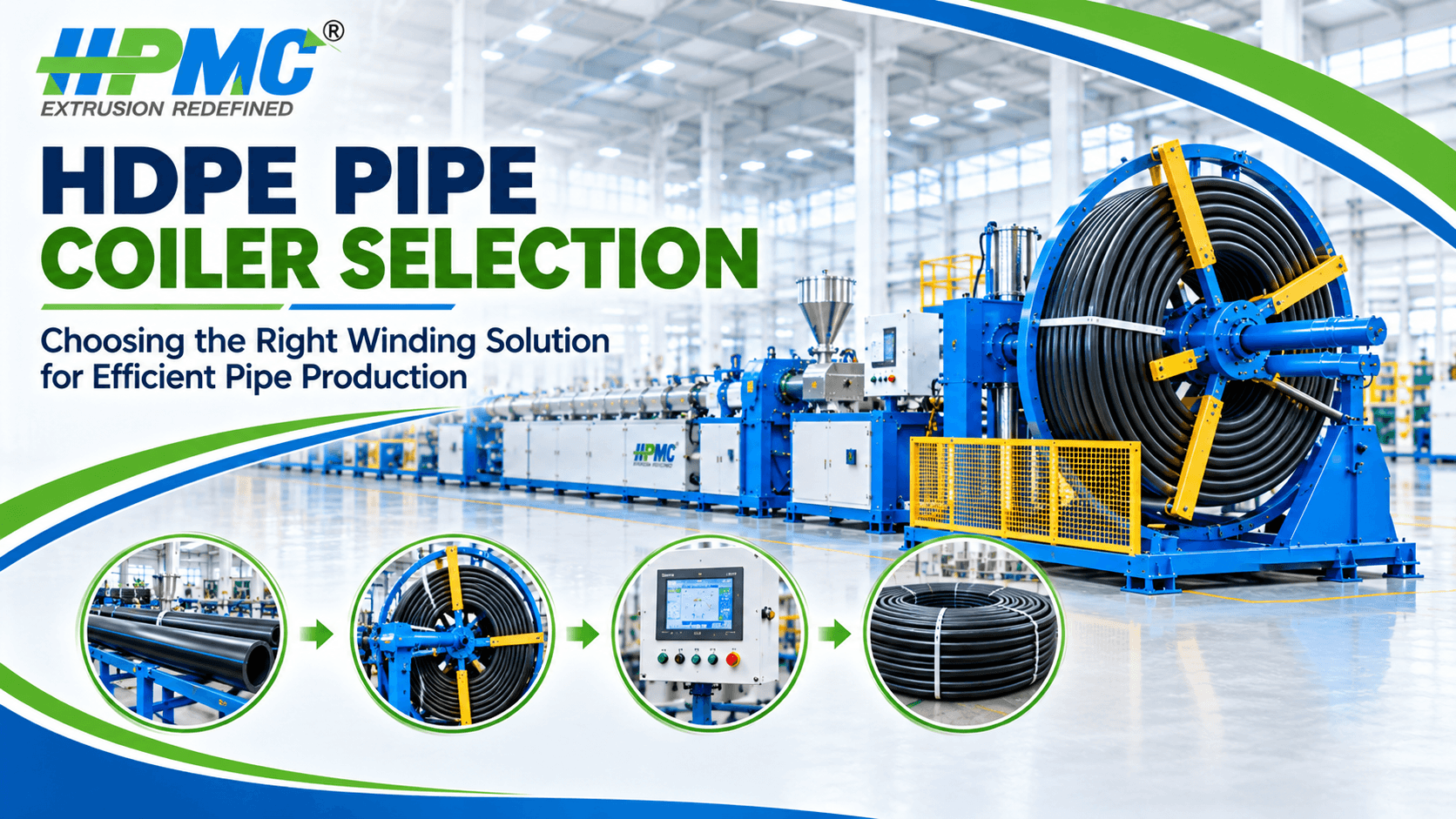
An HDPE pipe coiler is a downstream machine used to collect flexible HDPE pipes into circular coils after extrusion and cooling. It receives the finished pipe from the production line and winds it around a suitable winding arrangement.
The coiler is generally positioned after the haul-off section when the pipe size and production arrangement are suitable for winding. Its design may include a rotating winding structure, pipe guiding arrangement, drive motor, speed control, traverse mechanism and coil handling system.
The equipment configuration depends on the pipe diameter, wall thickness, coil dimensions, production speed and required level of automation. Some machines use a single winding station, while others have two stations to support coil changeover.
A coiler should not be selected only because it can physically accommodate the pipe. It must also handle the pipe without creating excessive bending, deformation or unstable winding.
How Does an HDPE Pipe Coiler Work?
An HDPE pipe coiler works as part of the complete extrusion process. The pipe is formed by the extruder, sized and cooled before being pulled through the downstream equipment and delivered to the winding section.
1. Pipe Formation and Cooling
The HDPE material passes through the extrusion die to form a continuous pipe. Vacuum sizing and cooling systems help establish the required outside diameter and stabilize the pipe before it reaches the coiler.
2. Pipe Feeding and Guiding
The cooled pipe moves towards the winding station through a suitable guiding arrangement. Proper positioning helps the pipe enter the coiler smoothly and reduces unnecessary bending.
3. Controlled Winding
The winding mechanism collects the incoming pipe in a circular arrangement. The winding speed must be coordinated with the extrusion line so that the coiler does not pull the pipe excessively or allow uncontrolled slack.
4. Coil Formation
The pipe is distributed across the winding width according to the machine design. Suitable winding arrangements help maintain an organized coil and make finished product handling easier.
5. Coil Removal
After the required coil length or dimensions are reached, the winding operation is completed. The finished coil is secured and removed using the arrangement provided with the machine.
The actual winding and unloading procedure depends on the selected coiler configuration.
Different Types of HDPE Pipe Coilers
The two common configurations offered in HDPE pipe extrusion plants are single station and double station coilers. The right option depends on pipe dimensions, production speed and coil changeover requirements.
Single Station HDPE Pipe Coiler
A single station coiler uses one winding position to collect the finished pipe. It is generally considered for production applications where one coil is wound and removed before the next winding cycle begins.
Its main considerations include winding capacity, coil dimensions, pipe guiding and finished coil removal. HPMC publishes a single station coiler configuration for pipes up to 110 mm, subject to the applicable machine configuration.
Double Station HDPE Pipe Coiler
A double station coiler has two winding positions. This arrangement can help manage coil changeovers by allowing the next winding position to be prepared while the completed coil is handled, depending on the machine design.
It can be useful where production continuity and frequent coil changes are important. HPMC publishes a double station coiler configuration for pipes up to 63 mm.
The published diameter limits should be treated as configuration-specific information. Buyers should confirm the exact pipe range, coil dimensions and operating conditions with HPMC before finalizing an order.
Important Factors to Consider During HDPE Pipe Coiler Selection
Selecting the correct coiler requires more than checking its maximum pipe diameter. Manufacturers should prepare a complete product specification before comparing equipment.
1. Pipe Outside Diameter
The outside diameter is one of the first details to check. A coiler designed for a smaller pipe range may not accommodate a larger pipe or provide the required winding arrangement.
List every pipe diameter you intend to manufacture and identify the sizes that account for most of your production. Ask the supplier to confirm the supported range for the proposed coiler.
2. Pipe Wall Thickness
Wall thickness affects the flexibility and handling characteristics of an HDPE pipe. Pipes with the same outside diameter can behave differently during winding when their wall thicknesses vary.
Provide the pipe diameter, wall thickness and SDR range when requesting a quotation. This helps the manufacturer evaluate whether the proposed winding arrangement is suitable for the actual product.
3. Minimum Coil Inside Diameter
The minimum coil inside diameter is important because excessive bending can cause deformation or kinking. The acceptable bending conditions depend on pipe dimensions, material properties, temperature and product requirements.
Do not select the winding diameter based on available factory space alone. Ask the pipe material supplier and machinery manufacturer to confirm suitable winding limits for your intended pipe range.
4. Coil Outside Diameter and Width
Finished coil dimensions influence storage, transportation and installation. Before purchasing a coiler, decide the required coil inside diameter, outside diameter and width.
Also consider the length of pipe required in each coil and the available space for finished coil handling. A suitable configuration should support the intended packaging and transportation arrangement.
5. Production Line Speed
The coiler must handle the pipe output of the extrusion line without becoming a downstream bottleneck. Its operating speed and winding arrangement should be compatible with the upstream haul-off system.
For production planning, manufacturers should compare actual line output with the required pipe length and coil completion time. HPMC's guide to HDPE Pipe Extrusion Line Output Calculation explains the production factors that influence extrusion capacity.
6. Winding Tension
Winding tension affects how the pipe is collected. Excessive tension can place unnecessary stress on the pipe, while insufficient control may result in loose or irregular coils.
Ask the supplier how winding speed and pipe movement are controlled. The final operating settings should be established according to the pipe specifications and machine manufacturer's instructions.
7. Traverse and Pipe Guiding Arrangement
The traverse mechanism distributes the pipe across the winding width. Its movement should suit the required coil dimensions and pipe diameter.
Check how the pipe enters the winding area, how the layers are distributed and whether the arrangement prevents unnecessary twisting or overlapping.
8. Motor and Speed Control
The drive system controls the winding movement. Evaluate the motor configuration, speed adjustment, control panel and synchronization with the extrusion line.
A variable-frequency drive may be used where specified to adjust motor speed. However, the complete drive arrangement should be evaluated according to actual production requirements rather than selecting components based on specifications alone.
9. Automation and Coil Changeover
Automation requirements depend on production volume and operator handling needs. A single station arrangement may be sufficient for some manufacturing operations, while a double station configuration may help manage frequent coil changes.
Ask which functions are automatic and which require operator intervention. Confirm the winding, stopping, coil removal and changeover procedures before purchasing.
10. Safety and Maintenance Access
Rotating winding equipment requires suitable protective guards, emergency stops and safe operator access. Finished coils should also be handled using an appropriate lifting and unloading arrangement.
Check the location of moving components, maintenance access and the manufacturer's recommended inspection schedule before approving the machine layout.
Single Station vs Double Station HDPE Pipe Coiler
The choice between these configurations should be based on the production process rather than the number of winding stations alone.
A single station coiler may suit manufacturers with a suitable pipe range and manageable coil removal requirements. It provides one winding position and a straightforward operating arrangement.
A double station coiler may be more suitable where coil changeovers occur frequently and production interruptions need to be managed. Its advantage depends on how the winding and unloading operations are designed.
Before selecting either option, compare the supported pipe diameter, coil dimensions, winding speed, unloading method and operator requirements. Ask for a demonstration using a representative pipe size wherever possible.
How to Integrate a Coiler with an HDPE Pipe Extrusion Line
A coiler should be planned as part of the complete production line. The extruder, die head, vacuum sizing tank, cooling system, haul-off and winding equipment must operate in coordination.
Line Speed Synchronization
The winding arrangement should be compatible with the speed of the upstream equipment. Sudden differences between haul-off and coiler movement may affect pipe handling.
Pipe Alignment
The pipe should travel towards the coiler without unnecessary bending or contact with sharp edges. The installation layout should provide sufficient space for smooth pipe movement.
Electrical and Control Compatibility
Confirm the electrical supply, motor requirements, control arrangement and speed adjustment features. Discuss how the coiler will coordinate with the existing extrusion line controls.
Factory Layout
Plan the position of the coiler, operator access, finished coil removal and storage area before installation. This helps avoid handling difficulties after the machinery is installed.
Common Mistakes to Avoid When Selecting an HDPE Pipe Coiler
Selecting Only by Maximum Pipe Diameter: Diameter alone does not establish suitability. Wall thickness, pipe flexibility, coil dimensions and winding conditions must also be considered.
Ignoring Coil Dimensions: A machine may handle the pipe but fail to produce the required finished coil size. Confirm inside diameter, outside diameter and width before ordering.
Overlooking Production Speed: If the coiler cannot handle the extrusion output, it may interrupt the production process. Compare the complete line requirements.
Choosing Automation Without a Production Need: Additional automation should solve a real handling or production problem. Evaluate its benefits against the investment and maintenance requirements.
Not Checking Safety Arrangements: Protective guards, emergency stops and safe coil removal are essential considerations during machine selection and installation.
How to Choose the Right HDPE Pipe Coiler Manufacturer
The supplier should understand both pipe extrusion and downstream winding requirements. Before comparing quotations, share the same technical information with every manufacturer.
Provide the pipe diameter range, wall thickness, SDR, material grade, required coil dimensions, production speed and expected coil length. Also ask for the equipment layout, motor details, control features and included accessories.
Review the manufacturer's experience with extrusion machinery and its ability to provide installation guidance, commissioning and operator support. HPMC's HDPE Pipe Machine Manufacturers Guide provides further points to consider when comparing machinery suppliers.
Ask whether the quoted coiler is included in the complete extrusion line or supplied separately. Confirm which components, electrical connections and handling arrangements are included in the final offer.
Why Choose HPMC for HDPE Pipe Coiling Solutions?
Hindustan Plastics & Machine Corporation (HPMC) has been associated with plastic extrusion machinery manufacturing since 1972. Its published HDPE pipe plant configuration includes single and double station coiler options for different pipe collection requirements.
The published configuration lists double station coiling for pipes up to 63 mm and single station coiling for pipes up to 110 mm. The suitable option depends on the required pipe dimensions and machine configuration.
Manufacturers planning a new HDPE pipe extrusion line should discuss their complete product range, target output and finished coil requirements before selecting equipment. For installation, commissioning and on-site assistance, HPMC provides Field Services covering technical inspections, maintenance and performance support.
Conclusion
HDPE Pipe Coiler Selection is an important part of planning a flexible pipe manufacturing line. The right equipment should match the pipe diameter, wall thickness, coil dimensions, extrusion speed and required winding arrangement.
Manufacturers should compare single and double station configurations, evaluate winding control and consider how finished coils will be removed, stored and transported. A suitable coiler should work smoothly with the upstream extrusion equipment and support the intended production process.
Rather than choosing a machine based only on price or maximum diameter, prepare a complete pipe specification and confirm the proposed configuration with the manufacturer. This makes equipment comparison more practical and helps avoid problems after installation.
Contact HPMC
HPMC (Hindustan Plastics & Machine Corporation).
Share your required pipe diameter, wall thickness, SDR, target coil dimensions and production speed with HPMC to discuss a suitable HDPE pipe coiler configuration.
Address: 5, Category II, DSIDC Industrial Area, Nangloi, Delhi – 110041, India.
Phone: +91 95605 96392.
Email: info@hindustanplastics.com.
Website: https://www.hindustanplastics.com/
Frequently Asked Questions
Find quick answers to the most common questions about this topic.
An HDPE pipe coiler is a downstream machine used to wind flexible HDPE pipes into circular coils after extrusion and cooling. It helps organize finished pipes for storage, transportation and installation.
The common configurations include single station and double station coilers. The appropriate type depends on pipe dimensions, production speed, coil requirements and changeover needs.
Consider outside diameter, wall thickness, SDR, pipe flexibility, minimum coil inside diameter, coil outside diameter, width, production speed and automation requirements.
A single station coiler has one winding position. A double station coiler has two winding positions and may help manage coil changeovers, depending on the machine design.
HPMC publishes a single station coiler configuration for pipes up to 110 mm and a double station configuration for pipes up to 63 mm. Confirm the exact machine configuration before ordering.
Coil inside diameter determines the bending conditions during winding. An unsuitable diameter may cause excessive bending, deformation or kinking.
It may handle multiple sizes if the winding arrangement, guiding system, drive and machine configuration support the required product range. Confirm compatibility with the manufacturer.
The coiler must work in coordination with the extrusion line. Incorrect speed coordination may cause excessive pulling force, loose winding or interruptions in pipe collection.
Not necessarily. Automation is useful when it addresses production handling, coil changeover or operator requirements. The investment should be evaluated against actual production needs.
Provide pipe outside diameter, wall thickness, SDR, material grade, required coil dimensions, pipe length per coil, extrusion line speed, preferred coiler type and factory handling requirements.