
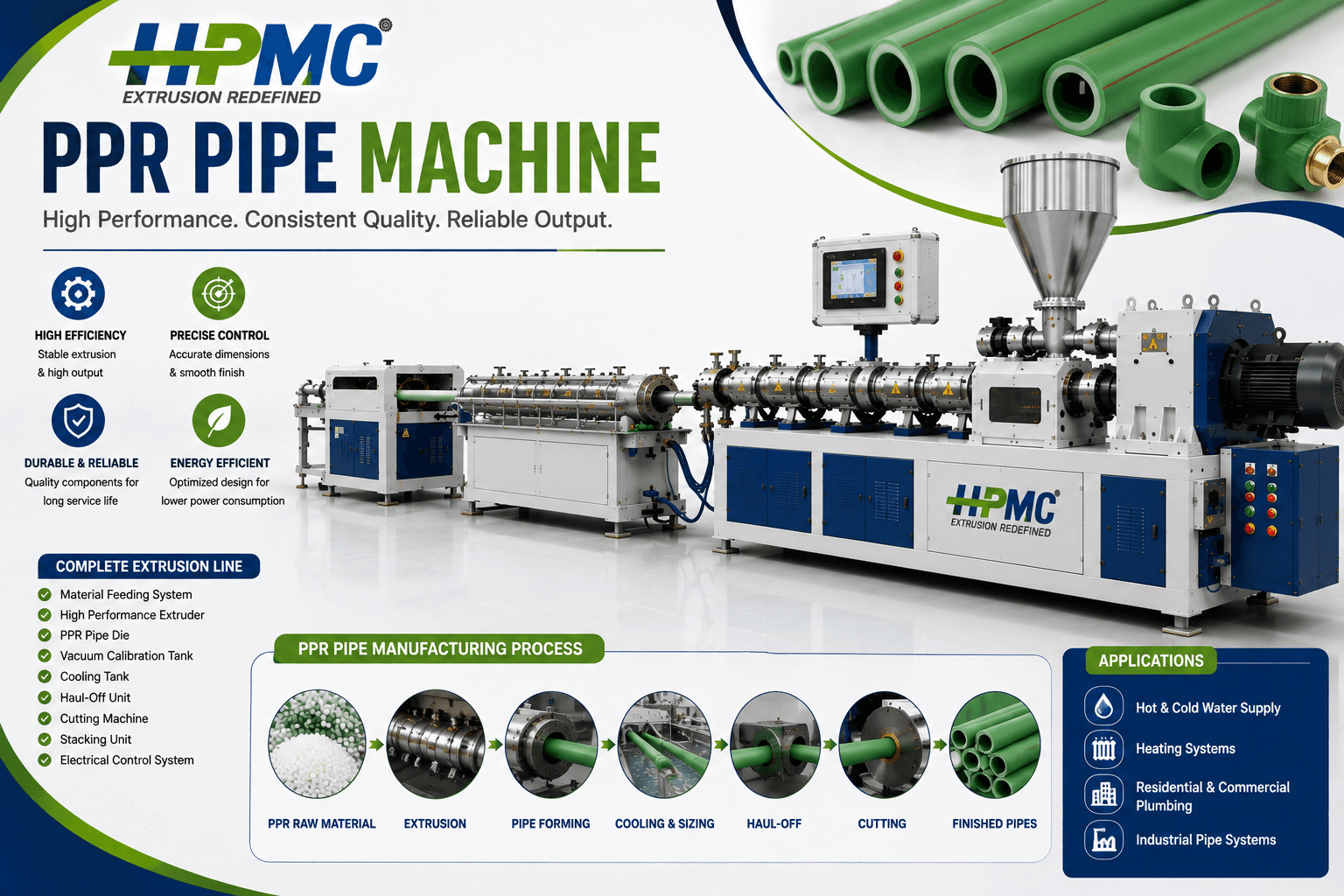
PPR pipes are widely used in plumbing, water distribution, heating systems, and other building applications because of their durability, corrosion resistance, and suitability for hot and cold water systems. As demand for reliable plastic piping solutions continues to increase, manufacturers require efficient machinery capable of producing pipes with consistent dimensions and quality.
A PPR Pipe Machine is an extrusion-based production system used to manufacture PPR pipes from polypropylene random copolymer material. The machine continuously melts, forms, cools, sizes, and cuts the polymer into finished pipes.
For businesses planning to establish or expand PPR pipe manufacturing, selecting the right PPR Pipe Extrusion Machine is an important investment decision. The machine configuration should match the required pipe diameter, wall thickness, production capacity, material formulation, and level of automation.
This guide explains how a PPR pipe machine works, its major components, applications, benefits, and the factors to consider when selecting a suitable machine manufacturer.
What is a PPR Pipe Machine?
A PPR Pipe Machine is a plastic extrusion system specifically designed for manufacturing pipes from PPR material.
PPR, or polypropylene random copolymer, is commonly used for plumbing and fluid transportation applications. During manufacturing, PPR material is processed through an extruder and continuously formed into a pipe using a specially designed die.
A complete PPR Pipe Extrusion Line can include:
- Material feeding system
- Extruder
- Screw and barrel
- PPR pipe extrusion die
- Vacuum calibration tank
- Cooling tank
- Haul-off unit
- Cutting machine
- Stacking or collection unit
- Electrical control system
Additional equipment may be included depending on the production requirements and pipe specifications.
How Does a PPR Pipe Extrusion Machine Work?
The PPR pipe manufacturing process begins with feeding the required raw material into the extrusion system.
The material enters the extruder, where controlled heating and mechanical action melt and homogenize the polymer.
The molten PPR material is then pushed through a specially designed pipe die. The die determines the basic shape of the pipe.
After leaving the die, the hot pipe enters the vacuum calibration section. Vacuum sizing helps establish the required outside diameter and maintain dimensional consistency.
The pipe then passes through cooling tanks, where controlled cooling solidifies the material.
A haul-off system continuously pulls the pipe through the production line at a controlled speed.
Finally, the pipe is cut into the required lengths and transferred to the stacking or collection section.
The finished PPR pipes can then undergo quality inspection, marking, packaging, and dispatch.
Major Components of a PPR Pipe Machine
Understanding the main components of a PPR Pipe Making Machine can help manufacturers compare different systems.
Extruder
The extruder is the core processing unit of the line. It melts and conveys the PPR material toward the extrusion die.
The screw and barrel configuration should be selected according to the material and required production capacity.
PPR Pipe Die
The die forms the molten polymer into the required pipe shape and dimensions.
Different pipe sizes generally require suitable tooling configurations.
Vacuum Calibration Tank
The calibration system helps maintain the required pipe diameter and shape immediately after extrusion.
Accurate calibration is important for producing pipes with consistent dimensions.
Cooling Tank
Cooling tanks remove heat from the extruded pipe and help stabilize its dimensions.
Haul-Off Unit
The haul-off continuously pulls the pipe through the line.
Consistent pulling speed helps maintain production stability and dimensional consistency.
Cutting Unit
The cutting system cuts the continuously extruded pipe into predetermined lengths.
Stacking System
The finished pipes can be automatically or manually transferred to a collection or stacking area.
Control Panel
A modern control system allows operators to monitor and adjust important production parameters such as temperature, extrusion speed, haul-off speed, and cutting length.
What PPR Pipes Can Be Manufactured?
A properly configured PPR Pipe Extrusion Line can be used to manufacture different pipe sizes and specifications.
The exact product range depends on the extruder, die sets, calibration equipment, cooling system, and downstream configuration.
Manufacturers may produce PPR pipes for applications such as:
- Cold water distribution
- Hot water distribution
- Plumbing systems
- Building water supply
- Heating systems
- Residential applications
- Commercial buildings
- Industrial fluid transportation
Pipe dimensions and pressure classifications should be selected according to the intended application and applicable standards.
Benefits of PPR Pipe Manufacturing
Investing in a properly configured PPR pipe production line can provide several benefits to manufacturers.
Consistent Pipe Dimensions
Controlled extrusion, calibration, cooling, and haul-off help maintain consistent pipe dimensions throughout production.
Continuous Production
Extrusion technology allows PPR pipes to be produced continuously rather than individually moulded.
Production Flexibility
With appropriate tooling, a production line can support different pipe sizes and specifications.
Efficient Material Processing
A suitable extruder provides controlled melting and conveying of PPR material.
Automated Operation
Modern production lines can incorporate automated temperature control, haul-off control, cutting, and other functions to reduce manual intervention.
Suitable for Multiple Applications
PPR pipes can be manufactured for plumbing, water distribution, heating, and other suitable applications.
How to Choose the Right PPR Pipe Machine
Choosing a PPR Pipe Machine Manufacturer requires more than comparing machine prices. The complete production requirement should be evaluated before selecting equipment.
Determine Pipe Sizes
First identify the pipe diameters and wall thicknesses you plan to manufacture.
This helps determine the appropriate extrusion die, calibration system, haul-off, and downstream equipment.
Define Production Capacity
Calculate the required production output in kilograms per hour or metres per hour.
The extruder size, motor capacity, cooling system, and downstream equipment should be appropriately matched to the required output.
Evaluate Extruder Configuration
The screw and barrel should be suitable for processing PPR material and the desired production rate.
Discuss your material formulation and output requirements with the manufacturer before finalizing the extrusion system.
Check Tooling Quality
The extrusion die and calibration tooling play an important role in pipe quality.
Choose a manufacturer capable of supplying suitable tooling for the pipe sizes you intend to produce.
Consider Cooling Capacity
Proper cooling is essential for stabilizing the pipe after extrusion.
The cooling system should be appropriately sized according to pipe diameter, production speed, and material characteristics.
Evaluate Automation
PLC-based controls can simplify operation and allow operators to monitor important production parameters.
Automation can also help maintain consistency between production runs.
Consider Energy Efficiency
Energy consumption affects the long-term operating cost of a PPR pipe production line.
Consider the efficiency of the extrusion drive, heating system, cooling system, and other major components.
Evaluate After-Sales Support
Installation, commissioning, operator training, spare parts, maintenance assistance, and technical support should be considered before purchasing the machine.
PPR Pipe Machine vs Other Plastic Pipe Machines
Different plastic pipe materials require different extrusion configurations.
For example, PPR pipe production is different from PVC, CPVC, HDPE, and SWR pipe extrusion.
PVC and CPVC processing may require specific screw designs and temperature-control arrangements, while HDPE pipe production uses extrusion systems designed around polyethylene processing characteristics.
Similarly, pipe diameter, wall thickness, material formulation, and production standards can influence the machine configuration.
Businesses planning to manufacture multiple types of plastic pipes should discuss their complete product range with the machinery manufacturer before selecting the extrusion equipment.
You can also explore related machinery such as HDPE Pipe Machine, CPVC Pipe Machine, PVC Pipe Machine, and SWR Pipe Machine.
PPR Pipe Machine Production Line Setup
A typical PPR pipe production process can be represented as:
Raw Material Feeding → Extrusion → Pipe Die → Vacuum Calibration → Cooling → Haul-Off → Cutting → Stacking
Each stage has a specific role in producing consistent pipe.
The raw material must be properly prepared and fed into the extruder.
The extrusion system melts and homogenizes the polymer.
The die forms the pipe.
Vacuum calibration establishes the required dimensions.
Cooling stabilizes the product.
The haul-off maintains controlled movement through the line.
Finally, cutting and stacking prepare the pipes for handling and packaging.
The exact production line configuration depends on the pipe specifications and required production capacity.
Common Applications of PPR Pipes
PPR pipes are commonly used in applications involving suitable hot and cold water transportation.
These may include:
- Residential plumbing
- Commercial plumbing
- Hot water systems
- Cold water systems
- Building water distribution
- Heating installations
- Industrial water applications
The pipe specifications should be selected according to the intended operating conditions and relevant technical requirements.
Maintenance of a PPR Pipe Machine
Regular maintenance is important for maintaining consistent production and reducing unexpected downtime.
Manufacturers should establish a maintenance schedule covering major components such as:
- Extruder screw and barrel
- Gearbox
- Heating zones
- Cooling system
- Vacuum system
- Haul-off rollers
- Cutting mechanism
- Electrical controls
- Pipe dies
- Calibration tooling
Regular inspection can help identify wear or operational problems before they affect production.
Operators should also follow the machine manufacturer's maintenance and operating recommendations.
Why Choose HPMC for PPR Pipe Machinery?
HPMC provides plastic extrusion machinery for different pipe, profile, recycling, compounding, and polymer processing applications.
Our extrusion solutions can be configured according to pipe dimensions, material requirements, production capacity, tooling requirements, downstream equipment, and desired automation level.
Businesses looking for a PPR Pipe Machine can discuss their pipe specifications, production requirements, and manufacturing objectives with HPMC to determine a suitable extrusion line configuration.
The focus is on appropriate extrusion technology, reliable machine components, controlled processing, and technical support for long-term production requirements.
Conclusion
A PPR Pipe Machine is an essential investment for manufacturers planning to produce PPR pipes for plumbing, water distribution, heating, and other suitable applications.
A properly designed PPR Pipe Extrusion Line combines controlled extrusion, accurate tooling, vacuum calibration, cooling, haul-off, cutting, and stacking to produce pipes with consistent dimensions and reliable production performance.
Before purchasing a PPR pipe production machine, manufacturers should define their pipe sizes, wall thicknesses, production capacity, material formulation, automation requirements, and future expansion plans.
It is equally important to select an experienced PPR Pipe Machine Manufacturer capable of providing suitable machinery, tooling, installation, commissioning, spare parts, and technical support.
With the right machine configuration and production process, manufacturers can establish an efficient PPR pipe manufacturing operation designed around their specific product requirements.
Frequently Asked Questions
Find quick answers to the most common questions about this topic.
A PPR Pipe Machine is an extrusion-based production system used to manufacture pipes from polypropylene random copolymer material.
A PPR Pipe Extrusion Line is a complete production system that can include an extruder, pipe die, vacuum calibration tank, cooling system, haul-off, cutting unit, and stacking equipment.
PPR pipes are manufactured using polypropylene random copolymer material, with the specific formulation depending on the intended product and application.
A suitable production line can manufacture different pipe sizes using appropriate extrusion dies and calibration tooling, depending on the machine configuration.
Consider the manufacturer's experience, extrusion technology, machine capacity, tooling capabilities, automation, machine components, customization options, energy efficiency, installation support, spare parts, and after-sales service.
PPR and PVC require different processing conditions and machine configurations. The screw design, extrusion temperature, tooling, and downstream equipment should be selected according to the specific polymer being processed.