
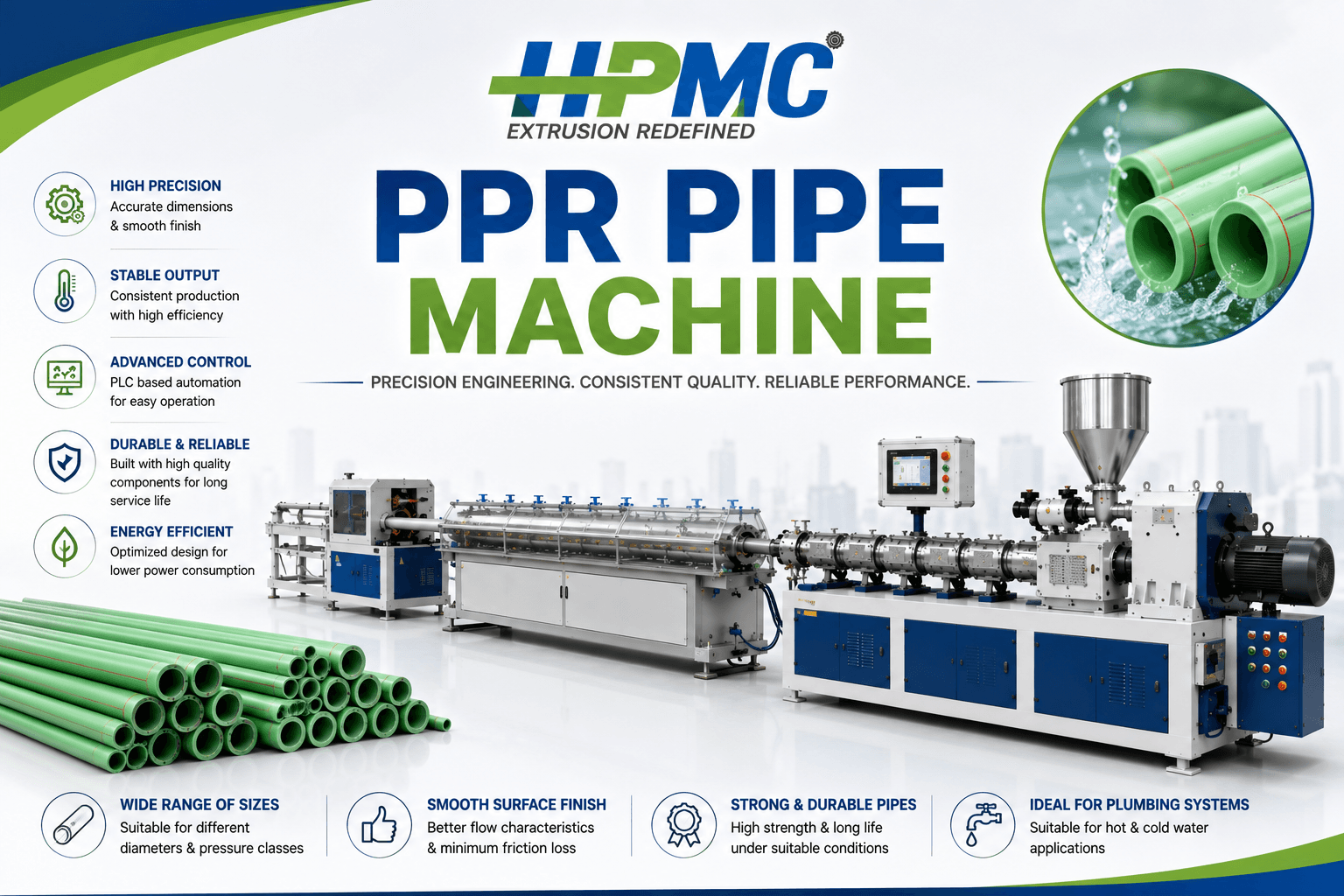
PPR pipes have become an important choice for modern plumbing and water distribution systems. Made from Polypropylene Random Copolymer, PPR pipes are used in residential, commercial, and industrial applications where reliable fluid transportation and long-term performance are required.
As demand for efficient piping systems continues to increase, manufacturers need reliable machinery capable of producing PPR pipes with consistent dimensions, smooth surfaces, and stable quality.
A properly designed PPR Pipe Machine provides the extrusion technology required to convert PPR raw material into finished pipes. From material feeding and extrusion to calibration, cooling, hauling, and cutting, every stage of the production line contributes to the final product quality.
For businesses looking for PPR Pipe Machine Manufacturers, selecting the right machinery supplier requires careful consideration of production capacity, extrusion technology, tooling, automation, machine components, energy efficiency, and technical support.
What is a PPR Pipe Machine?
A PPR Pipe Machine is an extrusion-based manufacturing system used to produce PPR pipes in different diameters, wall thicknesses, and pressure classes.
The machine processes PPR material through controlled heating and extrusion before forming it into the required pipe shape using a specially designed die.
A typical PPR Pipe Extrusion Line may include:
- Raw material feeding system
- Extruder
- Screw and barrel
- PPR pipe die
- Vacuum calibration tank
- Cooling tank
- Haul-off unit
- Cutting machine
- Stacking system
- Electrical control panel
The exact configuration depends on the required pipe size, production capacity, material formulation, and level of automation.
How Does a PPR Pipe Extrusion Line Work?
The PPR pipe manufacturing process begins with feeding the prepared PPR material into the extrusion system.
Inside the extruder, the material is heated and plasticized under controlled processing conditions. The processed material is then continuously pushed through a specially designed pipe die.
The die determines the initial shape and dimensions of the pipe.
After leaving the die, the pipe enters a vacuum calibration tank. The calibration system helps maintain the required outer diameter and dimensional accuracy.
The pipe then passes through cooling tanks where its temperature is gradually reduced and the pipe structure is stabilized.
A haul-off machine continuously pulls the pipe through the production line at a controlled speed. Finally, the pipe is cut into predetermined lengths and transferred to the stacking system.
The finished PPR pipes can then undergo quality inspection, marking, packaging, and dispatch.
Why Are PPR Pipes Used in Plumbing Applications?
PPR pipes are widely used for water distribution because of their combination of durability and processing characteristics.
Some important properties include:
- Corrosion resistance
- Smooth internal surface
- Lightweight construction
- Low maintenance
- Resistance to many chemicals
- Long service life under suitable conditions
- Heat-fusion joining capability
- Suitable for hot and cold water applications
These properties have contributed to the adoption of PPR piping systems in various plumbing and fluid transportation applications.
Key Features of a High-Quality PPR Pipe Machine
When evaluating PPR Pipe Machine Manufacturers, manufacturers should assess the complete extrusion line rather than focusing only on the main extruder.
Efficient Extrusion System
The extruder should provide stable material conveying, melting, and plasticization. Proper screw and barrel design can contribute to consistent extrusion output.
Precise Temperature Control
Stable temperature control is essential for maintaining consistent material processing. Different heating zones should be monitored and controlled appropriately throughout the extrusion process.
Accurate Pipe Tooling
The pipe die is responsible for forming the required pipe geometry. High-quality tooling can help achieve consistent dimensions and surface finish.
Effective Vacuum Calibration
Calibration plays an important role in maintaining pipe diameter and dimensional accuracy immediately after the material leaves the die.
Efficient Cooling System
Proper cooling helps stabilize the pipe and maintain its dimensions during continuous production.
Stable Haul-Off
The haul-off unit should provide consistent pulling speed. Variations in haul-off speed can affect pipe dimensions and wall thickness.
Automated Cutting
Automatic cutting systems help produce pipes in consistent lengths while reducing manual intervention.
PLC-Based Controls
Modern PLC-based control systems allow operators to monitor and adjust production parameters such as temperature, extrusion speed, haul-off speed, and cutting length.
How to Choose PPR Pipe Machine Manufacturers
Selecting a suitable machinery manufacturer requires evaluation of both technical and commercial factors.
Check Manufacturing Experience
Choose a manufacturer with experience in plastic pipe extrusion machinery. Knowledge of polymer processing and pipe production can help ensure the machine is configured appropriately for PPR.
Determine Required Production Capacity
Your production target should determine the extruder size, motor capacity, cooling system, haul-off configuration, and other components.
Before purchasing, calculate the expected daily and monthly production requirements.
Consider Pipe Size Range
Determine the range of PPR pipe diameters you intend to manufacture. Confirm that the proposed extrusion system can accommodate those sizes with appropriate dies and calibration equipment.
Evaluate Machine Components
Ask about the specifications and quality of major components such as the extruder, gearbox, screw, barrel, heating system, die, vacuum calibration unit, cooling tanks, haul-off, and cutting machine.
Consider Automation
Automated temperature control, speed monitoring, cutting, and production controls can improve consistency and reduce dependence on manual operation.
Evaluate After-Sales Support
Installation, commissioning, operator training, troubleshooting, maintenance support, and spare parts availability are important considerations when purchasing industrial extrusion equipment.
Reliable technical support can help minimize production downtime.
Applications of PPR Pipe Manufacturing Machines
PPR pipes are used across several plumbing and fluid transportation applications.
Common applications include:
- Residential plumbing
- Commercial plumbing
- Hot water distribution
- Cold water distribution
- Industrial water systems
- Building water supply
- Heating systems
- Fluid transportation
- Institutional plumbing projects
The exact application depends on the pipe specification, formulation, dimensions, and applicable product standards.
Benefits of Investing in a Modern PPR Pipe Machine
A properly configured PPR Pipe Machine can provide several benefits to manufacturers.
Consistent Pipe Quality
Controlled extrusion, calibration, and cooling help manufacturers maintain uniform pipe dimensions and surface finish.
Higher Production Efficiency
Continuous extrusion enables manufacturers to produce pipes at a consistent rate with reduced manual handling.
Reduced Material Waste
Stable processing and accurate tooling can help reduce defective production and improve material utilization.
Flexible Production
With suitable dies and calibration systems, manufacturers can produce PPR pipes in different sizes.
Better Process Control
Automated systems allow operators to monitor key production parameters and make adjustments when required.
Long-Term Reliability
Quality components and appropriate machine design can help reduce unexpected downtime and maintenance requirements.
Important Factors Before Setting Up a PPR Pipe Production Line
Starting a PPR pipe manufacturing operation requires more than purchasing an extruder.
Manufacturers should consider:
- Required production capacity
- Pipe diameter range
- Wall thickness requirements
- Raw material availability
- Extrusion technology
- Factory space
- Electrical requirements
- Cooling water requirements
- Tooling requirements
- Quality control systems
- Packaging requirements
- Operator training
- Maintenance and spare parts
Discussing these requirements with an experienced machinery manufacturer before purchasing equipment can help avoid unnecessary modifications after installation.
PPR Pipe Machine and Other Plastic Pipe Machinery
PPR pipe production is one application of plastic pipe extrusion technology. Similar extrusion principles are used for manufacturing other thermoplastic pipes, although each material may require specific processing conditions, tooling, and machine configurations.
Businesses planning to manufacture multiple pipe types should communicate their complete product requirements to the machinery manufacturer.
Depending on the materials and product specifications, an appropriate extrusion setup may provide greater flexibility across different production requirements.
You can also explore the PVC Pipe Machine and CPVC Pipe Machine categories for other plastic pipe extrusion applications.
Why Choose HPMC for PPR Pipe Machinery?
HPMC provides plastic extrusion machinery for different pipe, profile, compounding, recycling, and WPC applications.
Our extrusion solutions can be configured according to product specifications, production capacity, material requirements, and desired automation level.
Businesses looking for PPR Pipe Machine Manufacturers can discuss their required pipe sizes, production capacity, material specifications, and plant requirements with HPMC to determine a suitable machine configuration.
The focus is on appropriate extrusion technology, reliable machine components, process control, and technical support for long-term manufacturing requirements.
Conclusion
Choosing the right PPR Pipe Machine Manufacturers is an important decision for businesses planning to enter or expand PPR pipe production. A properly configured extrusion line can help manufacturers achieve consistent dimensions, stable production, efficient material processing, and reliable finished-pipe quality.
Before purchasing a PPR Pipe Machine, evaluate your pipe specifications, production targets, material requirements, tooling needs, automation level, factory infrastructure, and future expansion plans.
The machinery manufacturer should also be able to provide installation, commissioning, operator training, technical assistance, and spare parts support.
For businesses planning to establish a PPR pipe manufacturing facility, selecting an experienced extrusion machinery partner can provide the technical expertise and production solution required for efficient long-term operation.
Frequently Asked Questions
Find quick answers to the most common questions about this topic.
A PPR Pipe Machine is an extrusion-based production system used to manufacture PPR pipes in different diameters, wall thicknesses, and specifications.
A typical line includes an extruder, PPR pipe die, vacuum calibration tank, cooling system, haul-off machine, cutting unit, stacking system, and control panel.
Yes. With suitable dies and calibration equipment, a PPR pipe extrusion line can be configured to produce different pipe diameters and specifications.
Calibration helps maintain the required pipe diameter and dimensional accuracy after the material exits the extrusion die.
Consider manufacturing experience, extrusion technology, production capacity, pipe size range, tooling capabilities, machine component quality, automation, customization options, and after-sales technical support.