
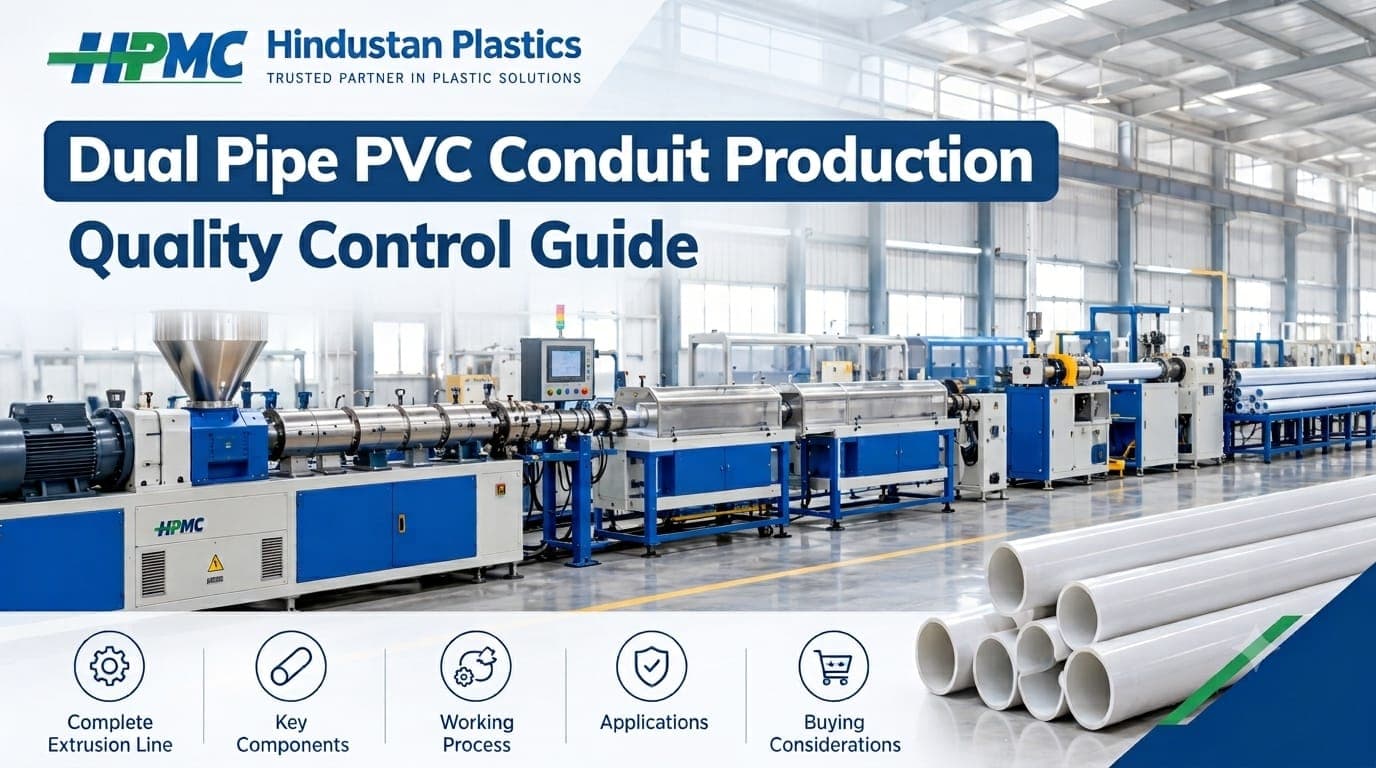
Introduction
Manufacturers looking to increase PVC electrical conduit pipe production need machinery that supports consistent output, accurate sizing, and an efficient manufacturing process. A Four Pipe PVC Conduit Pipe Plant is designed to extrude four pipes simultaneously, making it a suitable option for manufacturers targeting high-volume production.
Hindustan Plastics & Machine Corporation (HPMC), based in Delhi NCR, India, offers a four-pipe PVC conduit pipe plant designed for industrial pipe manufacturing applications. The production line combines extrusion, multi-strand pipe forming, vacuum calibration, haul-off, cutting, and stacking equipment to support continuous manufacturing.
By producing four pipes in parallel, this type of setup can help manufacturers improve production efficiency and distribute operating resources across multiple pipe strands. Actual output and cost per metre depend on pipe dimensions, material formulation, machine configuration, operating conditions, and production efficiency.
In this guide, we will cover how a four-pipe PVC conduit pipe plant works, its main components, productivity benefits, applications, and the factors manufacturers should consider before purchasing one.
What Is a Four-Pipe PVC Conduit Pipe Plant?
A Four-Pipe PVC Conduit Pipe Plant is an extrusion-based manufacturing system designed to produce four PVC conduit pipes simultaneously.
Unlike a single-strand line, which forms one pipe at a time, a four-strand configuration uses a multi-strand die and compatible downstream equipment to process four pipes in parallel.
The system typically includes:
- A conical twin screw extruder.
- A four-strand extrusion die.
- A vacuum calibration tank.
- A multi-strand haul-off unit.
- Cutting equipment.
- Pipe stacking and handling arrangements.
- An electrical control system.
The configuration is intended for manufacturers that require high-volume PVC electrical conduit production. The exact pipe sizes, output capacity, and operating specifications should be confirmed with the manufacturer according to the intended application.
For an overview of related equipment, visit HPMC's PVC Conduit Pipe Plant product page.
How Does a Four-Pipe PVC Conduit Pipe Plant Work?
The production process involves several coordinated stages. Each stage contributes to the formation, sizing, cooling, and handling of the finished pipes.
1. Raw Material Preparation
PVC resin and the required additives are prepared according to the pipe formulation and manufacturing specifications.
Material preparation is important because variations in formulation or material handling can affect processing stability and the quality of the finished conduit pipes.
Manufacturers should follow suitable storage, mixing, and material-handling procedures before feeding the material into the extrusion line.
2. Extrusion Through a Conical Twin Screw Extruder
The prepared material enters the conical twin screw extruder, where it is conveyed and processed under controlled temperature and operating conditions.
The screw system supports material movement, mixing, and melt preparation before the material reaches the die.
The extruder should be configured according to the PVC formulation, intended pipe dimensions, and required production output. Temperature settings and screw speed must be suitable for the material and equipment.
3. Four-Strand Die and Pipe Formation
After extrusion, the processed PVC material passes through a four-strand die designed to form four pipes simultaneously.
The die distributes material into the four pipe-forming channels. Its design is important for maintaining consistent flow and producing pipes that meet the required dimensional specifications.
The die and extrusion system must be properly matched to the intended pipe size and production conditions.
4. Vacuum Calibration and Cooling
After leaving the die, the pipes enter the vacuum calibration tank.
Vacuum calibration helps maintain the intended outer dimensions and shape while the pipes cool. Suitable cooling conditions support dimensional consistency and help the pipes retain their required form.
For a four-strand line, the calibration arrangement must accommodate all four pipes under appropriate operating conditions.
5. Multi-Strand Haul-Off
The haul-off unit pulls the four pipes through the downstream equipment at a controlled speed.
Consistent pulling is important for coordinating the pipe movement with the extrusion process. The haul-off arrangement should be suitable for the number of strands and the dimensions of the pipes being manufactured.
6. Cutting to the Required Length
Once the pipes reach the required length, the cutting equipment separates them into individual sections.
The cutting arrangement must coordinate with the line speed and the required product length. Proper synchronisation helps support consistent finished lengths and efficient material handling.
7. Pipe Stacking and Handling
After cutting, the pipes are transferred to the stacking or handling section.
Organised stacking supports easier collection, inspection, storage, and dispatch. Manufacturers should also establish suitable handling procedures to prevent damage to the finished pipes.
Key Components of a Four-Pipe PVC Conduit Pipe Production Line
Each component plays a specific role in the overall manufacturing process.
Conical Twin Screw Extruder
The extruder processes the PVC material before it enters the pipe-forming die. Its configuration and operating settings influence material processing and production stability.
The appropriate extruder should be selected according to the formulation, required output, and intended pipe specifications.
Four-Strand Die
The four-strand die is a key component that allows four pipes to be produced simultaneously.
Its design must support the required pipe dimensions and suitable material distribution across all four strands.
Vacuum Calibration Tank
The vacuum calibration tank supports pipe sizing and cooling after the material leaves the die.
Correct calibration and cooling conditions help maintain the specified pipe dimensions and shape.
Multi-Strand Haul-Off Unit
The haul-off system pulls the pipes through the line. Its arrangement should support the simultaneous movement of all four pipes at the required production speed.
Cutting System
The cutting unit separates the continuously extruded pipes into specified lengths. The cutting method and operating sequence depend on the equipment configuration and production requirements.
Stacking Equipment
Stacking equipment helps collect and organise the finished pipes after cutting. Suitable handling arrangements support a more organised production workflow.
Electrical Control System
The control system allows operators to monitor and adjust relevant machine settings according to the equipment design.
These may include temperature, screw speed, haul-off speed, and cutting operations. Operators should follow the manufacturer's instructions when setting or adjusting production parameters.
Benefits of a Four-Pipe PVC Conduit Pipe Plant
A four-strand production line offers several potential advantages for manufacturers with high-volume production requirements.
1. Simultaneous Production of Four Pipes
The main benefit is the ability to produce four pipes in parallel rather than processing only one pipe strand.
This configuration can help manufacturers increase the number of pipes produced during a production run, depending on pipe size, line speed, operating conditions, and production efficiency.
2. Improved Production Productivity
Producing multiple pipes simultaneously can support higher production productivity when the extrusion, calibration, haul-off, and cutting systems are properly coordinated.
Actual production output should be evaluated against the manufacturer's specified capacity and the pipe dimensions required.
3. Potential Reduction in Cost per Metre
A multi-strand line may help distribute certain operating costs across a greater volume of production.
However, the actual cost per metre depends on material consumption, energy use, labour, scrap, maintenance, pipe dimensions, and the line's operating efficiency. Manufacturers should compare actual production data before assuming a particular level of savings.
4. Coordinated Production and Handling
A properly configured line brings together extrusion, calibration, haul-off, cutting, and stacking operations.
Coordinated equipment can support an organised manufacturing workflow and reduce unnecessary handling between production stages.
5. Suitable for High-Volume Manufacturing
A four-pipe configuration may be suitable for manufacturers with established demand for PVC electrical conduit pipes.
Before choosing this setup, businesses should assess their production targets, available floor space, utility requirements, material supply, and downstream handling capacity.
Four-Pipe vs. Single-Pipe PVC Conduit Production
The primary difference between these configurations is the number of pipes produced simultaneously.
FactorSingle-Pipe LineFour-Pipe Line
Pipe strands
One
Four
Production arrangement
Single-strand extrusion
Multi-strand extrusion
Die configuration
Single-pipe die
Four-strand die
Downstream equipment
Designed for one pipe
Designed to handle four pipes
Production planning
Suitable for the intended single-strand output
Intended for higher-volume multi-strand production
Space and installation
Depends on the machine configuration
Requires space and utilities suitable for the complete line
Cost per metre
Depends on actual operating costs
May benefit from higher output, subject to actual operating costs
A four-pipe line does not automatically produce four times the saleable output of a single-pipe line in every application. Actual performance depends on the pipe dimensions, extrusion capacity, line speed, changeovers, downtime, and quality requirements.
Manufacturers should compare the expected saleable output and total operating costs before making an investment decision.
For more information about the general production setup, explore HPMC's PVC Pipe Extrusion Line guide.
Applications of a Four-Pipe PVC Conduit Pipe Plant
PVC conduit pipes are commonly used in electrical installations to provide a route for electrical wiring and suitable mechanical protection.
A four-pipe production line can support the manufacture of conduit pipes for different projects, provided the equipment and tooling are configured for the required specifications.
Residential Construction
PVC electrical conduits are used in residential buildings for routing wiring through suitable electrical installations.
Commercial Buildings
Offices, shops, educational facilities, and other commercial buildings may require PVC conduit pipes for electrical wiring systems.
Industrial Facilities
Industrial projects may use conduit systems to organise and protect wiring, subject to the requirements of the installation.
Infrastructure and Construction Projects
Construction contractors and electrical suppliers may require conduit pipes in different sizes and specifications for suitable projects.
The intended application determines the relevant pipe dimensions, product specifications, and quality requirements. Manufacturers should verify that their finished products meet the applicable standards and customer requirements.
Factors to Consider Before Buying a Four-Pipe PVC Conduit Plant
Selecting the right machine requires more than comparing the number of pipe strands.
1. Required Pipe Sizes
Identify the pipe diameters, wall thicknesses, and lengths that your business intends to manufacture.
Confirm which sizes the proposed machine can support and whether different sizes require separate dies or tooling changes.
2. Production Capacity
Discuss the expected output for your specific pipe dimensions and material formulation.
Ask the manufacturer for application-specific capacity details instead of relying only on a general maximum-output claim.
3. Extruder Configuration
Confirm that the conical twin screw extruder is suitable for the intended PVC formulation and production requirements.
Relevant considerations include the processing system, drive configuration, temperature controls, and compatibility with the four-strand die.
4. Calibration and Cooling System
Check whether the calibration tank and cooling arrangement are suitable for all four pipes at the required production speed.
The cooling system should be evaluated according to the pipe dimensions and manufacturing conditions.
5. Haul-Off and Cutting Arrangement
The haul-off and cutting equipment should be designed to handle four pipes in parallel.
Discuss speed coordination, cutting accuracy, and finished pipe handling with the supplier.
6. Power Consumption and Utilities
Ask for the machine's electrical requirements and relevant utility specifications.
Actual energy consumption per kilogram or per metre depends on the operating conditions, pipe specifications, equipment efficiency, and production performance.
7. Installation and Floor Space
Check the space required for the complete line, including the extruder, calibration tank, haul-off, cutters, stackers, and access for maintenance.
Also confirm installation requirements, water supply arrangements, and other utilities.
8. Maintenance and Technical Support
Discuss preventive maintenance, recommended spare parts, operating instructions, operator training, and available technical support.
A maintenance plan can help manufacturers manage equipment condition and production interruptions.
9. Total Investment
The total project cost may include the main machine, dies, installation, utilities, spare parts, and other required equipment.
Request a detailed quotation that specifies what is included and what may require additional investment.
Common Production Challenges and Quality Checks
Even a high-capacity production line requires appropriate process control and regular inspection.
Production issueAreas to investigate
Variations in pipe diameter
Die setup, vacuum calibration, cooling, and haul-off speed
Uneven wall thickness
Material distribution, die condition, and process settings
Surface irregularities
Material quality, formulation, die condition, and processing parameters
Differences between pipe strands
Die distribution, calibration conditions, and strand alignment
Inconsistent pipe length
Cutting synchronisation and line-speed settings
Pipe deformation after extrusion
Cooling, calibration, handling, and material characteristics
These are general troubleshooting areas rather than confirmed diagnoses. The cause of any specific defect should be identified through inspection and the equipment manufacturer's recommendations.
Recommended Quality-Control Practices
Manufacturers can establish a quality-control routine that includes:
- Checking raw material and formulation consistency.
- Monitoring important machine operating parameters.
- Measuring pipe diameter and wall thickness.
- Inspecting the surface and overall pipe shape.
- Checking finished pipe length.
- Comparing the quality of all four strands.
- Recording defects and production interruptions.
- Following the recommended machine maintenance schedule.
Checking all four strands is particularly important because the pipes are produced simultaneously but may still require individual inspection.
Why Consider HPMC for a Four-Pipe PVC Conduit Pipe Plant?
Hindustan Plastics & Machine Corporation (HPMC) is an Indian machinery manufacturer established in 1972, according to the company information supplied for this product.
The company offers a four-pipe PVC conduit pipe plant designed for high-volume electrical conduit production. The described configuration includes a conical twin screw extruder, four-strand die, vacuum calibration tank, multi-strand haul-off, cutters, and stackers.
Manufacturers evaluating this equipment should discuss their required pipe sizes, production targets, tooling needs, installation requirements, and operating conditions with HPMC before finalising the machine.
You can review the HPMC Four-Pipe PVC Conduit Pipe Plant for available product information.
Conclusion
A Four-Pipe PVC Conduit Pipe Plant is designed to produce four electrical conduit pipes simultaneously, making it a potential option for manufacturers targeting high-volume production.
Its main components include a conical twin screw extruder, four-strand die, vacuum calibration tank, multi-strand haul-off, cutting equipment, and stackers. When correctly configured and operated, the line can support coordinated production and may improve productivity for suitable manufacturing requirements.
However, the actual output, energy consumption, labour requirements, and cost per metre depend on the machine configuration, pipe specifications, material formulation, operating conditions, and production efficiency.
Before purchasing, manufacturers should evaluate the complete production line, confirm application-specific capacity, and request detailed technical specifications and pricing from the supplier.
For businesses planning to expand their PVC conduit production, HPMC's four-pipe plant is an option worth discussing according to the intended production requirements.
Frequently Asked Questions
Find quick answers to the most common questions about this topic.
It is a PVC pipe extrusion system designed to produce four conduit pipes simultaneously using a four-strand die and compatible downstream equipment.
The PVC material is processed in the extruder, shaped through a four-strand die, calibrated and cooled, pulled through the line, cut to the required length, and stacked.
The supplied product description specifies a conical twin screw extruder. The detailed machine specifications should be confirmed with HPMC.
The four-strand die forms four pipes simultaneously. Its design supports the intended pipe dimensions and material distribution.
Vacuum calibration helps maintain the pipe's required shape and outer dimensions while it cools.
It may help distribute some operating costs over a higher production volume. Actual savings depend on energy use, labour, material consumption, scrap, maintenance, and production efficiency.
No. The number of strands alone does not determine the actual output. Extruder capacity, pipe dimensions, line speed, downtime, and quality requirements also matter.
The supplied description lists a conical twin screw extruder, four-strand die, vacuum calibration tank, multi-strand haul-off, cutters, and stackers. Confirm the final included components in the quotation.
Manufacturers should check pipe diameter, wall thickness, length, surface finish, and shape. They should also compare results across all four strands.
Consider pipe dimensions, required capacity, extruder configuration, tooling, cooling, haul-off, cutting, utilities, installation space, maintenance, and total project cost.
Not necessarily. It is primarily worth evaluating for manufacturers whose demand, product specifications, space, and operating requirements justify multi-strand production.