
Introduction
Installing a PVC pipe extrusion line is an important investment for any plastic pipe manufacturing business. However, purchasing machinery and completing its physical installation are only the first steps. Before starting regular production, manufacturers must ensure that every machine, utility connection, control system and safety arrangement is properly checked. This is where a PVC Pipe Line Commissioning Checklist becomes essential. Commissioning is the process of inspecting, testing and preparing an extrusion line before it enters regular production. It helps manufacturers identify installation issues, verify machine functions, establish suitable processing conditions and confirm that the production line can manufacture PVC pipes according to the required specifications.
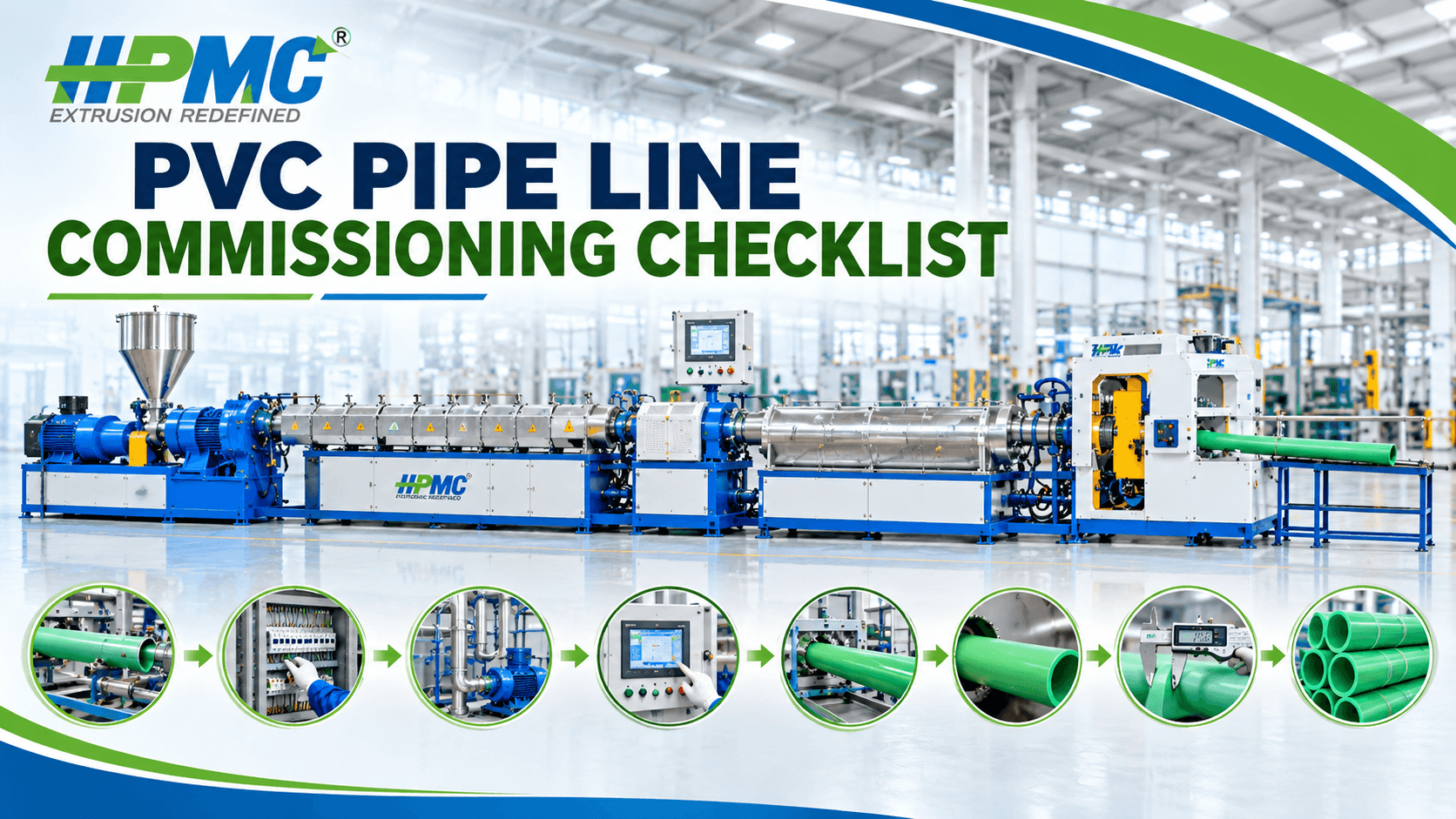
A typical PVC pipe extrusion line includes a conical twin screw extruder, pipe die head, vacuum calibration tank, cooling tanks, haul-off unit, cutting machine and supporting equipment. Every section must operate in coordination to achieve stable production.
Even a small installation or alignment issue can affect pipe dimensions, surface quality, production speed and machine performance.
Hindustan Plastics and Machinery Corporation (HPMC) has been serving the plastic processing machinery industry since 1972. The company provides extrusion machinery and technical support solutions for manufacturers planning new production facilities or upgrading existing plants.
In this guide, we will explain the complete PVC pipe line commissioning process, important pre-installation checks, electrical and mechanical inspections, machine startup procedures, quality control requirements and common commissioning mistakes.
What Is PVC Pipe Line Commissioning?
PVC pipe line commissioning refers to the systematic inspection, testing and startup preparation of a complete PVC pipe manufacturing line.
The process begins after machinery installation and utility connections are completed. Engineers and technicians inspect individual machine components, verify electrical connections, check safety systems and test the operation of different production sections.
The purpose is to ensure that the complete extrusion line is ready for controlled production.
Commissioning generally includes:
- Mechanical installation inspection.
- Machine alignment and leveling.
- Electrical connection verification.
- Cooling water and utility checks.
- Extruder and auxiliary equipment inspection.
- Safety system verification.
- Temperature controller testing.
- Trial production.
- Pipe dimension and quality inspection.
- Operator training and documentation.
The exact commissioning procedure depends on the machine configuration, project scope and manufacturer's operating instructions.
Why Is a PVC Pipe Line Commissioning Checklist Important?
A commissioning checklist provides a structured method for checking equipment before production begins.
Without proper inspection, manufacturers may experience unexpected machine problems, production interruptions and unnecessary material wastage.
1. Ensures Proper Machine Installation
A PVC pipe extrusion line contains several connected machines. Proper installation and alignment help ensure that the pipe travels smoothly through the production process.
2. Helps Identify Electrical Problems
Electrical inspection helps identify loose connections, incorrect wiring, grounding issues and problems with control panels before regular operation.
3. Supports Stable Production
Testing the extruder, vacuum calibration system, cooling tanks and haul-off unit helps establish a coordinated production process.
4. Improves Workplace Safety
Safety inspections help verify emergency stops, protective guards, electrical protection and other machine safety arrangements.
5. Reduces Unplanned Downtime
Identifying installation problems before production can help prevent avoidable interruptions after the plant becomes operational.
6. Helps Maintain Pipe Quality
A properly commissioned line provides a better foundation for maintaining consistent pipe diameter, wall thickness, surface finish and cutting length.
Complete PVC Pipe Line Commissioning Checklist
The following checklist covers the major inspection stages that manufacturers should consider before starting a PVC pipe extrusion line.
1. Pre-Installation Site Inspection
Before installing the machinery, inspect the factory area and confirm that the installation site is suitable for the complete production line.
Important checks include:
- Confirm that sufficient factory floor space is available.
- Check the foundation and floor condition.
- Review the approved machine layout.
- Ensure sufficient space for maintenance and machine operation.
- Check access for material handling and finished pipe collection.
- Verify ventilation arrangements.
- Confirm that electrical and water supply connections are available.
- Check drainage and cooling water arrangements.
- Ensure suitable lighting throughout the production area.
The machine layout should allow convenient access to the extruder, die head, calibration tanks, haul-off unit and cutting equipment. Manufacturers should follow the installation drawings supplied by the machinery manufacturer rather than making unapproved layout changes.
2. Mechanical Installation and Alignment
Mechanical alignment is one of the most important stages of PVC pipe line commissioning.
The extruder, die head, vacuum calibration tank, cooling tanks, haul-off and cutting equipment must be installed according to the approved production line layout.
Inspect the following:
- Check the position of every machine.
- Verify that equipment is properly leveled.
- Inspect machine foundation and mounting arrangements.
- Check connecting bolts and fasteners.
- Verify the alignment between the extruder and die head.
- Check the alignment of calibration and cooling tanks.
- Ensure that the haul-off is positioned correctly.
- Verify the cutting machine position.
- Inspect mechanical connections and moving components.
- Confirm that maintenance access is available.
The production line centerline should be checked so that the pipe can move through the equipment without unnecessary bending or mechanical interference.
Any adjustment should be performed by trained installation personnel.
3. Electrical System Inspection
Before energizing the extrusion line, the electrical system should be inspected by qualified electrical technicians.
Electrical checks should include:
- Verify the incoming power supply.
- Check voltage and frequency against machine requirements.
- Inspect electrical panel connections.
- Verify protective earthing.
- Check motor wiring.
- Inspect overload protection.
- Verify circuit breakers and protection devices.
- Inspect cable connections.
- Check control panel indicators.
- Test emergency stop circuits.
- Verify safety interlocks.
The electrical supply must match the specifications provided by the machine manufacturer.
Never operate equipment with damaged cables, exposed electrical connections or defective protective systems.
4. Extruder Inspection
The extruder is the main processing machine in a PVC pipe extrusion line. It processes the PVC compound and supplies the material to the die head for pipe formation.
Before startup, inspect:
- Screw and barrel installation.
- Gearbox condition.
- Lubrication arrangements.
- Main motor connections.
- Hopper and feeding system.
- Heating elements.
- Temperature sensors.
- Cooling arrangements.
- Control panel operation.
- Drive system and protective guards.
For rigid PVC pipe manufacturing, conical twin screw extruders are commonly used because their configuration is suitable for processing PVC compounds. The selected extruder should match the intended pipe specifications, material formulation and production requirements.
5. Die Head and Tooling Inspection
The die head determines the shape of the extruded pipe. Incorrect tooling installation or adjustment may affect material distribution, pipe diameter and wall thickness.
Check the following:
- Confirm that the correct die head is installed.
- Inspect die surfaces for contamination.
- Check the condition of the mandrel.
- Verify tooling assembly.
- Confirm that die components are securely fitted.
- Check heating connections where applicable.
- Verify temperature sensors.
- Confirm that the selected tooling matches the required pipe size.
The die head should be installed and adjusted according to the manufacturer's instructions.
6. Vacuum Calibration Tank Inspection
The vacuum calibration tank helps establish the required outside diameter of the newly extruded pipe.
Proper calibration is important for maintaining dimensional consistency.
Important checks include:
- Inspect the vacuum tank structure.
- Check water supply connections.
- Inspect vacuum pump connections.
- Verify vacuum pipeline condition.
- Check sealing arrangements.
- Inspect calibration sleeves.
- Verify water circulation.
- Check vacuum gauges and control instruments.
- Inspect tank alignment with the die head.
The calibration system should be tested according to the equipment manufacturer's procedure before production begins.
7. Cooling System Inspection
The cooling system helps the extruded PVC pipe solidify and maintain its required shape.
Insufficient or inconsistent cooling may affect dimensional stability and limit production performance.
Inspect:
- Cooling water supply.
- Water circulation pumps.
- Water tank condition.
- Spray nozzles.
- Water filters.
- Drainage arrangements.
- Water temperature monitoring.
- Pipeline connections.
- Leakage points.
Ensure that the cooling system has sufficient capacity for the intended pipe specifications and production speed.
8. Haul-Off Unit Inspection
The haul-off unit pulls the pipe through the downstream equipment at a controlled speed.
Its operation must be coordinated with the extruder output.
Before startup:
- Inspect belts or caterpillar tracks.
- Check the drive motor.
- Verify speed control.
- Inspect gripping surfaces.
- Check alignment.
- Verify control panel operation.
- Inspect mechanical connections.
- Confirm that the unit can operate smoothly.
Incorrect haul-off operation can affect pipe dimensions and production stability.
9. Cutting Machine Inspection
The cutting machine divides the continuously extruded pipe into the required lengths.
Check the following:
- Inspect the cutting blade.
- Check the cutting motor.
- Verify machine guarding.
- Inspect the pipe support arrangement.
- Check length measurement systems.
- Verify cutting controls.
- Inspect dust extraction arrangements where applicable.
- Confirm that the cutter is aligned with the production line.
The cutting system should be tested using the approved operating procedure before regular production.
PVC Pipe Line Startup and Trial Run Checklist
Once the mechanical, electrical and utility inspections are completed, the next stage is controlled machine startup. The initial startup should follow the machine manufacturer's operating manual and approved process instructions.
Step 1: Verify Machine Readiness
Confirm that all equipment is installed and that the required inspections have been completed.
Check the availability of raw materials, tooling and supporting equipment.
Step 2: Switch On Supporting Utilities
Start the required cooling water, compressed air and other utility systems according to the equipment instructions. Confirm that the required flow and operating conditions are available.
Step 3: Activate Temperature Controllers
Set the barrel and die heating systems according to the approved PVC compound processing recommendations.
Allow the machine to reach the specified processing conditions. Avoid using one universal temperature setting for every PVC formulation.
Step 4: Test Individual Motors
Check motor rotation and operating condition using the manufacturer's approved procedure. Verify the main extruder motor, pumps, haul-off and cutting equipment.
Do not run the screw at high speed without material unless the manufacturer specifically permits the test.
Step 5: Begin Controlled Material Feeding
Introduce the approved PVC compound according to the machine startup instructions.
Monitor feeding stability and extrusion conditions.
Step 6: Observe Pipe Formation
Check the material flow through the die head and observe the initial pipe formation.
Inspect the pipe surface and verify that the material is moving smoothly into the calibration system.
Step 7: Check Calibration and Cooling
Observe the pipe as it enters the vacuum calibration and cooling sections. Check dimensional stability, water circulation and calibration performance.
Step 8: Synchronize the Haul-Off
Coordinate the haul-off speed with the extrusion output.
Make controlled adjustments according to the manufacturer's operating procedure.
Step 9: Test the Cutting System
Verify the cutting operation and inspect the finished pipe length.
Check that the pipe is collected and handled properly.
Step 10: Record Trial Production Results
Document the operating parameters, pipe dimensions, production stability and inspection results.
Any deviation should be investigated before regular production is approved.
Quality Control Checks During PVC Pipe Line Commissioning
Commissioning should not finish with a successful machine startup alone.
Manufacturers must also confirm that the extrusion line can produce pipes meeting the agreed specifications.
1. Outside Diameter
Measure the pipe outside diameter using suitable calibrated instruments.
Compare the readings with the applicable product specification.
2. Wall Thickness
Check wall thickness at appropriate positions around the pipe circumference.
This helps identify uneven material distribution.
3. Pipe Ovality
Inspect pipe roundness and verify that the finished pipe maintains the required shape.
4. Surface Finish
Check the internal and external pipe surfaces for visible defects such as roughness, scratches, bubbles and other irregularities.
5. Cutting Length
Measure the finished pipe lengths and verify that the cutting system operates within the agreed requirements.
6. Product Testing
Carry out the required product tests according to the relevant pipe standard, customer specification and intended application.
For pressure pipes, this may include applicable hydrostatic testing and other required quality evaluations.
7. Production Consistency
Observe the line during a suitable trial period to assess whether the production process remains stable.
The final acceptance criteria should be agreed upon before commissioning begins.
Common PVC Pipe Line Commissioning Mistakes
Several installation and startup mistakes can create problems during production.
Incorrect Machine Alignment
Poor alignment between the extruder, calibration tank, haul-off and cutter can affect pipe movement.
Solution: Verify the complete production line alignment before startup.
Ignoring Electrical Safety
Starting machinery without checking grounding, protection devices and emergency stops can create serious safety risks.
Solution: Complete electrical and safety inspections with qualified personnel.
Incorrect Temperature Settings
Using unsuitable processing temperatures can affect PVC material processing and product quality.
Solution: Follow the approved material processing recommendations and machine instructions.
Poor Cooling Water Management
Insufficient water circulation can affect pipe cooling and dimensional stability.
Solution: Inspect pumps, pipelines, filters and cooling arrangements before production.
Skipping Trial Production
Moving directly into regular production without controlled testing can allow installation problems to go unnoticed.
Solution: Conduct trial production and document the inspection results.
Inadequate Operator Training
Untrained operators may make unsuitable adjustments or overlook important safety procedures.
Solution: Provide proper machine operation, maintenance and troubleshooting training.
Why Professional Commissioning Support Matters
PVC pipe extrusion machinery contains multiple interconnected mechanical, electrical and process-control systems.
Professional commissioning support helps ensure that the equipment is installed and tested according to the approved project requirements.
A machinery manufacturer can assist with:
- Installation guidance.
- Machine alignment.
- Electrical and control system inspection.
- Initial startup assistance.
- Process parameter setup.
- Trial production.
- Operator training.
- Troubleshooting guidance.
- Maintenance instructions.
HPMC provides installation and commissioning support for plastic extrusion machinery. Manufacturers can explore the company's installation and commissioning support through HPMC FAQs.
For additional information about available support, manufacturers can also review HPMC's technical assistance services.
How to Prepare a PVC Pipe Line Commissioning Report
A commissioning report provides a record of the installation and startup activities.
It helps manufacturers track equipment inspection results, identify pending issues and document final machine acceptance.
A useful report should include:
Project Information
- Company name.
- Factory location.
- Machine model.
- Equipment serial number.
- Installation date.
- Commissioning date.
Mechanical Inspection
- Machine alignment status.
- Foundation inspection.
- Die head installation.
- Cooling tank inspection.
- Haul-off and cutter inspection.
Electrical Inspection
- Power supply verification.
- Grounding status.
- Motor testing.
- Control panel inspection.
- Emergency stop verification.
Trial Production
- PVC compound details.
- Pipe size.
- Wall thickness.
- Extrusion conditions.
- Calibration performance.
- Cooling performance.
- Finished pipe inspection.
Final Acceptance
- Pending issues.
- Corrective actions.
- Operator training status.
- Maintenance recommendations.
- Final commissioning approval.
The report should be reviewed and signed by the responsible technical representatives according to the agreed project acceptance procedure.
Why Choose HPMC for PVC Pipe Extrusion Machinery?
Hindustan Plastics and Machinery Corporation (HPMC) is an established manufacturer of plastic processing and extrusion machinery based in Delhi, India.
With experience dating back to 1972, HPMC serves manufacturers looking for equipment suited to different plastic processing applications.
When planning a PVC pipe manufacturing project, customers can discuss their requirements, including pipe dimensions, production capacity, extrusion configuration and complete line setup.
HPMC's technical resources also include field services and machine manuals, which can help customers access relevant equipment support information.
Before finalising a machinery order, manufacturers should clarify installation responsibilities, commissioning scope, operator training, spare parts and maintenance requirements.
A properly planned installation and commissioning process helps establish a reliable foundation for long-term manufacturing operations.
Conclusion
A PVC Pipe Line Commissioning Checklist is an essential part of preparing a new extrusion plant for regular manufacturing.
From site inspection and mechanical alignment to electrical verification, extruder testing, cooling system inspection and trial production, every stage contributes to the overall performance of the production line.
Manufacturers should never consider machine installation complete until the required inspections, safety checks and agreed production acceptance tests have been carried out.
A structured commissioning process helps identify potential problems early, supports stable machine operation and provides a foundation for consistent PVC pipe quality.
Hindustan Plastics and Machinery Corporation brings experience in the plastic processing machinery industry dating back to 1972. Manufacturers planning a new PVC pipe extrusion project can contact HPMC to discuss machinery requirements, installation arrangements and technical support.
Contact HPMC
Company: Hindustan Plastics and Machinery Corporation (HPMC)
Address: 5, Category II, DSIDC Industrial Area, Nangloi, Delhi – 110041, India.
Phone: +91 95605 96392
Email: info@hindustanplastics.com
Website: https://www.hindustanplastics.com/
Contact HPMC to discuss your PVC pipe extrusion machinery and commissioning requirements.
Frequently Asked Questions
Find quick answers to the most common questions about this topic.
It is a structured list of inspections and tests performed before starting a PVC pipe extrusion line. It covers mechanical installation, electrical systems, utilities, machine safety, trial production and quality checks.
Commissioning helps verify that all machine components are installed correctly and operate according to the agreed project requirements. It also helps identify potential problems before regular production.
The main equipment includes the extruder, die head, vacuum calibration tank, cooling tanks, haul-off unit, cutting machine, electrical control panel and supporting utility systems.
The duration depends on the production line configuration, installation readiness, utility connections, machine complexity and trial production requirements. The machinery manufacturer should provide a project-specific schedule.
Inspect the electrical supply, grounding, lubrication, machine alignment, cooling water, safety guards, emergency stops, heating elements and other components according to the machine manual.
Proper alignment helps the pipe move smoothly through the die, calibration tank, cooling section, haul-off and cutting equipment. Poor alignment may affect production stability and pipe quality.
Common checks include outside diameter, wall thickness, ovality, surface finish, cutting length and other product-specific tests required by the applicable standards.
Yes. Operators should understand machine operation, process controls, safety procedures, maintenance requirements and basic troubleshooting before handling regular production.
HPMC states that it provides installation and commissioning services for PVC pipe plants and other plastic processing machinery. Customers can discuss the specific scope with the company.
Important documents include installation inspection reports, electrical test records, machine operating parameters, trial production results, quality inspection reports, operator training records and final acceptance documentation.