
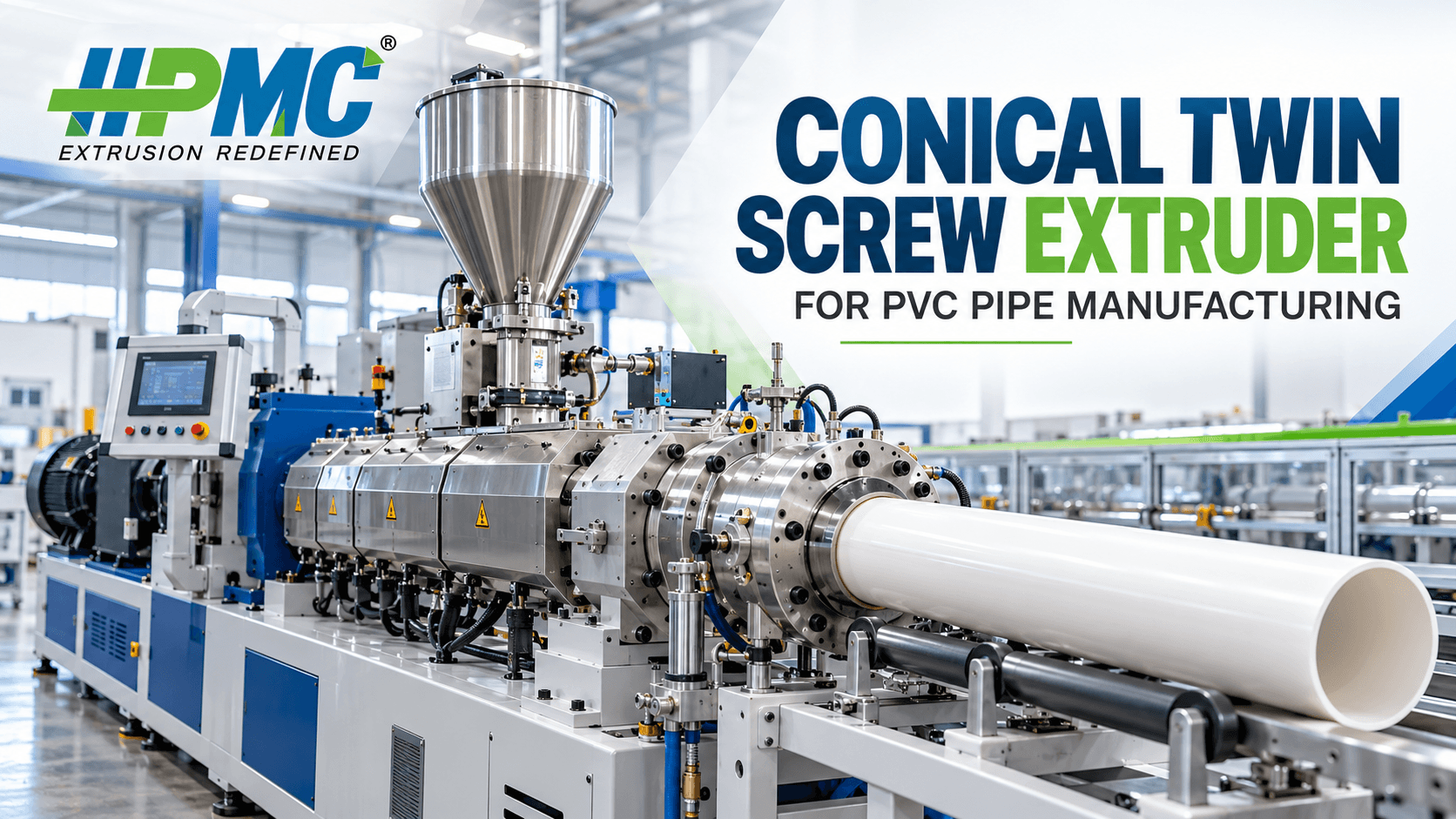
PVC pipes are widely used in plumbing, drainage, irrigation, electrical conduit systems, infrastructure, and industrial applications. Manufacturing these pipes requires suitable extrusion equipment that can process PVC compounds and deliver consistent output according to the intended pipe application.
A Conical Twin Screw Extruder for PVC Pipe is designed to process PVC material using two conical screws rotating within a specially designed barrel. This configuration is commonly used in rigid PVC processing because it can provide material conveying, mixing, and processing under controlled conditions.
For businesses planning to establish or upgrade a PVC pipe manufacturing facility, choosing the right Conical Twin Screw Extruder is an important investment decision. The selection should consider the PVC formulation, required pipe specifications, production targets, downstream equipment, and overall plant requirements.
HPMC provides plastic processing and extrusion machinery solutions for businesses looking to develop or improve their PVC pipe manufacturing operations.
What Is a Conical Twin Screw Extruder for PVC Pipe?
A Conical Twin Screw Extruder for PVC Pipe is an extrusion machine that uses two conical screws positioned inside a matching barrel to process PVC material before it passes through a pipe-forming die.
The screws are conical because their diameter changes along their length. This arrangement supports the conveying, compression, mixing, and processing of PVC compounds as the material moves through the extruder.
The machine is generally used as part of a PVC pipe extrusion line rather than as a standalone pipe-making system.
A complete production line may include:
- PVC material feeding and dosing equipment
- Conical twin screw extruder
- Pipe extrusion die
- Vacuum calibration tank
- Cooling tank or system
- Pipe haul-off unit
- Cutting machine
- Pipe stacking or collection equipment
The configuration depends on the pipe material, dimensions, application, and production requirements.
Why Is a Conical Twin Screw Extruder Used for PVC Pipe Manufacturing?
PVC processing requires appropriate control of heat, shear, material flow, and formulation. The extrusion machine must process the compound while supporting the required output and product quality.
A Conical Twin Screw Extruder for PVC Pipe can offer several advantages when correctly selected and operated.
1. Suitable for Rigid PVC Processing
Conical twin screw extruders are commonly used for processing rigid PVC compounds, including formulations used in UPVC pipe production.
2. Material Conveying and Mixing
The twin-screw configuration helps convey and mix the PVC compound as it moves through the barrel.
3. Controlled Processing
The extruder must be matched to the PVC formulation and process settings to support stable production.
4. Integration with Pipe Extrusion Lines
The machine can be integrated with the die, calibration, cooling, haul-off, and cutting equipment required to manufacture finished pipes.
5. Support for Continuous Production
When correctly configured and maintained, the extrusion system can support continuous pipe manufacturing according to the production plan and material requirements.
How Does a Conical Twin Screw Extruder for PVC Pipe Work?
The working process involves feeding the PVC compound into the extruder, processing it through the twin screws, and delivering the material to the pipe-forming die.
Step 1: PVC Compound Feeding
The prepared PVC compound is supplied to the extruder through the feeding system.
The formulation may contain PVC resin and other ingredients selected according to the intended pipe application and product requirements.
Step 2: Conveying and Mixing
The two conical screws convey the material along the barrel while promoting mixing and material distribution.
Step 3: Heating and Plasticization
Heat supplied by the processing system, together with mechanical energy from the screws, helps process the PVC compound into a suitable extrusion state.
The operating conditions must be appropriate for the specific PVC formulation to avoid material degradation and processing instability.
Step 4: Melt Conveying
The processed material moves toward the extruder outlet and enters the pipe-forming die.
Step 5: Pipe Formation
The die shapes the material into a continuous pipe profile.
Step 6: Calibration and Cooling
The pipe passes through calibration and cooling equipment to help achieve the required dimensions and maintain its shape.
Step 7: Haul-Off and Cutting
The haul-off unit pulls the pipe through the production line at a controlled speed. The cutting unit then cuts it to the required length.
The final product is collected or stacked for inspection and further handling.
Main Components of a Conical Twin Screw Extruder
Understanding the main components helps buyers evaluate a Conical Twin Screw Extruder Machine before purchasing it.
1. Feeding System
The feeding system supplies the prepared PVC compound to the extrusion barrel.
2. Conical Twin Screws
The two conical screws convey, mix, and process the PVC compound as it travels through the machine.
3. Barrel
The barrel houses the screws and provides the processing channel for the material.
4. Heating and Temperature Control System
This system manages the barrel's thermal conditions according to the PVC formulation and operating requirements.
5. Drive System
The drive system supplies the mechanical power needed to rotate the screws.
6. Gearbox
The gearbox transmits and manages drive power according to the machine design.
7. Control Panel
The control system allows operators to monitor and adjust relevant machine settings.
8. Extrusion Die
The die shapes the processed PVC material into the required pipe profile. It is a downstream component of the extrusion system.
Important: The extruder and the complete pipe extrusion line perform different functions. Buyers should confirm which components are included in the quoted supply.
Applications of a Conical Twin Screw Extruder for PVC Pipe
A Conical Twin Screw Extruder for PVC Pipe can be used in rigid PVC pipe manufacturing applications, depending on the machine configuration and the intended formulation.
UPVC Pipe Manufacturing
The extruder can be used in production lines designed for unplasticized PVC pipes.
Plumbing and Water Supply Pipes
Appropriately configured lines can manufacture PVC pipes for applications where the product specification permits their use.
Drainage and Sewerage Pipes
Rigid PVC extrusion systems can be used to produce pipes for suitable drainage and sewerage applications.
Electrical Conduit Pipes
PVC pipe extrusion lines can manufacture conduit pipes used to protect electrical wiring.
Agricultural Irrigation Pipes
Suitable PVC formulations and line configurations can be used for certain irrigation pipe applications.
Industrial PVC Pipe Production
Manufacturers can select extrusion equipment according to the intended pipe application, product specifications, and production requirements.
The final pipe properties depend on the material formulation, die design, calibration, cooling, and process control - not only on the extruder.
Benefits of a Conical Twin Screw Extruder for PVC Pipe
Selecting a suitable extruder can support the overall performance of a PVC pipe production line.
Suitable Processing Configuration
The conical twin screw design is widely associated with rigid PVC processing applications.
Effective Material Conveying
The screws move the PVC compound through the barrel toward the extrusion die.
Mixing and Processing
The machine supports material mixing and processing before pipe formation.
Production Line Integration
The extruder can operate as part of a complete system that includes pipe forming, calibration, cooling, pulling, and cutting.
Application-Based Configuration
The machine can be selected according to the PVC formulation and the pipe product being manufactured.
Support for Manufacturing Operations
A suitable extrusion setup can help manufacturers establish a consistent production workflow when the equipment and process parameters are properly matched.
Actual output, energy use, product quality, and operating performance depend on the complete line configuration and operating conditions.
Conical Twin Screw Extruder vs Parallel Twin Screw Extruder
Conical and parallel twin screw extruders differ in screw geometry and are selected according to processing requirements.
A Conical Twin Screw Extruder has screws whose diameters change along their length. It is commonly used in rigid PVC processing applications.
A Parallel Twin Screw Extruder uses screws with a more uniform diameter along the working length. Its suitability depends on the machine design and the material-processing application.
When evaluating the two options, buyers should consider:
- PVC formulation
- Required processing characteristics
- Production targets
- Screw and barrel design
- Available downstream equipment
- Maintenance and spare-parts requirements
- Total operating cost
Neither configuration is automatically best for every application. The appropriate choice depends on the product and processing requirements.
How to Choose the Right Conical Twin Screw Extruder for PVC Pipe
Before purchasing a Conical Twin Screw Extruder for PVC Pipe, evaluate the following factors.
1. Define the Pipe Application
Identify whether the line will manufacture UPVC pipes, drainage pipes, conduit pipes, irrigation pipes, or another PVC pipe product.
2. Confirm Pipe Specifications
Define the required pipe diameter range, wall thickness, length, and applicable product standards.
These requirements influence the extruder and downstream line configuration.
3. Evaluate the PVC Formulation
The machine should be suitable for the compound being processed. Discuss the formulation and its processing requirements with the manufacturer.
4. Establish Production Targets
Estimate the required production output based on the product mix and manufacturing schedule. Request verified output information for the intended application.
5. Review Screw and Barrel Design
Ask the manufacturer how the screw and barrel configuration is suited to the intended PVC compound and production requirements.
6. Check Temperature and Process Controls
Review the control system and how it supports stable processing conditions for the selected formulation.
7. Assess the Complete Extrusion Line
Confirm the compatibility of the extruder with the die, calibration system, cooling tanks, haul-off unit, and cutting equipment.
8. Consider Installation and Utilities
Review the installation area, electrical requirements, cooling-water arrangements, material handling, and other site requirements.
9. Evaluate Maintenance and Technical Support
Ask about routine maintenance, spare parts, operator training, troubleshooting, and service support.
10. Compare Total Cost of Ownership
Consider purchase price alongside energy consumption, maintenance, downtime, spare parts, production requirements, and the expected operating life of the equipment.
Complete PVC Pipe Extrusion Line Configuration
A Conical Twin Screw Extruder for PVC Pipe is one part of a complete pipe production system.
A typical manufacturing sequence is:
PVC Compound Preparation → Feeding → Conical Twin Screw Extrusion → Pipe Die → Vacuum Calibration → Cooling → Haul-Off → Cutting → Pipe Collection
Each stage contributes to the final product.
- Compound preparation: Ensures the formulation is suitable for the intended pipe.
- Extrusion: Processes and conveys the PVC compound.
- Die: Forms the pipe profile.
- Calibration: Helps establish the required dimensions.
- Cooling: Helps the pipe retain its shape.
- Haul-off: Controls pipe movement through the line.
- Cutting: Produces the required pipe lengths.
- Inspection: Verifies that the finished product meets the manufacturer's quality requirements and applicable specifications.
The complete line should be selected as a coordinated system rather than treating the extruder as the only factor affecting production.
Common Factors Affecting PVC Pipe Extrusion Quality
The performance of a PVC pipe extrusion line depends on several interconnected factors.
PVC Compound Quality
Variations in formulation and material preparation can affect processing behaviour and finished pipe properties.
Processing Conditions
Temperature, screw speed, material feed, and other settings must be appropriate for the formulation and equipment.
Die Design
The die must be suitable for the required pipe dimensions and material flow.
Calibration and Cooling
Incorrect calibration or cooling conditions can affect pipe dimensions and shape.
Haul-Off Speed
The haul-off system must be coordinated with extrusion output to maintain consistent pipe dimensions.
Equipment Maintenance
Wear, contamination, or incorrect machine settings can affect production stability.
A complete process review is recommended when troubleshooting dimensional variation, surface defects, or inconsistent output.
Maintenance of a Conical Twin Screw Extruder
Preventive maintenance helps support reliable operation and can reduce avoidable production interruptions.
Recommended maintenance practices include:
- Inspecting screws and barrel according to the manufacturer's guidance
- Checking gearbox condition and lubrication
- Monitoring drive-system performance
- Inspecting heating and temperature-control components
- Checking electrical connections and control equipment
- Cleaning material-contact areas using approved procedures
- Inspecting the extrusion die and downstream equipment
- Following the prescribed startup and shutdown procedures
- Keeping records of maintenance and operating issues
Maintenance intervals should be determined by the equipment manual, operating hours, material conditions, and manufacturer recommendations.
Why Choose HPMC for PVC Pipe Extrusion Machinery?
HPMC provides plastic processing and extrusion machinery solutions for businesses involved in PVC pipe manufacturing and related applications.
When selecting a Conical Twin Screw Extruder for PVC Pipe, buyers should assess the intended pipe product, PVC formulation, production targets, required line components, and installation requirements.
HPMC can help businesses evaluate their extrusion application and identify a suitable equipment configuration based on their manufacturing needs.
Before finalizing a purchase, discuss the required pipe specifications, expected output, included equipment, commissioning arrangements, maintenance requirements, and technical support with the supplier.
Conclusion
A Conical Twin Screw Extruder for PVC Pipe is an important component in rigid PVC pipe manufacturing. Its role is to process the PVC compound and deliver it to the pipe-forming die as part of a coordinated extrusion line.
Choosing the right machine requires evaluating the pipe application, PVC formulation, product specifications, production targets, screw and barrel configuration, downstream equipment, and long-term operating requirements.
For businesses planning to establish or upgrade a PVC pipe manufacturing facility, HPMC can help assess the application and identify a suitable plastic extrusion machinery solution.
Frequently Asked Questions
Find quick answers to the most common questions about this topic.
It is an extrusion machine that uses two conical screws to convey and process PVC compound before sending it through a die to form a pipe.
It is commonly used for rigid PVC processing because its screw configuration supports material conveying, mixing, and controlled processing when correctly matched to the formulation.
Yes. A suitably configured conical twin screw extruder can be used in a UPVC pipe extrusion line. The complete line must match the intended pipe specifications and production requirements.
No. A complete production line typically also requires a pipe die, calibration and cooling equipment, haul-off, cutting equipment, and suitable material preparation systems.
Important factors include PVC formulation, pipe dimensions, production targets, screw and barrel design, control systems, downstream equipment, installation requirements, and maintenance support.
The main difference is screw geometry. Conical screws change in diameter along their length, whereas parallel screws maintain a more uniform diameter. The right configuration depends on the application and machine design.
The range of pipe sizes depends on the extruder's processing capabilities and the compatible dies and downstream equipment. Confirm the intended size range with the manufacturer before purchasing.
Evaluate application knowledge, machine configuration, documented performance, line integration, installation support, spare-parts availability, and after-sales service.