
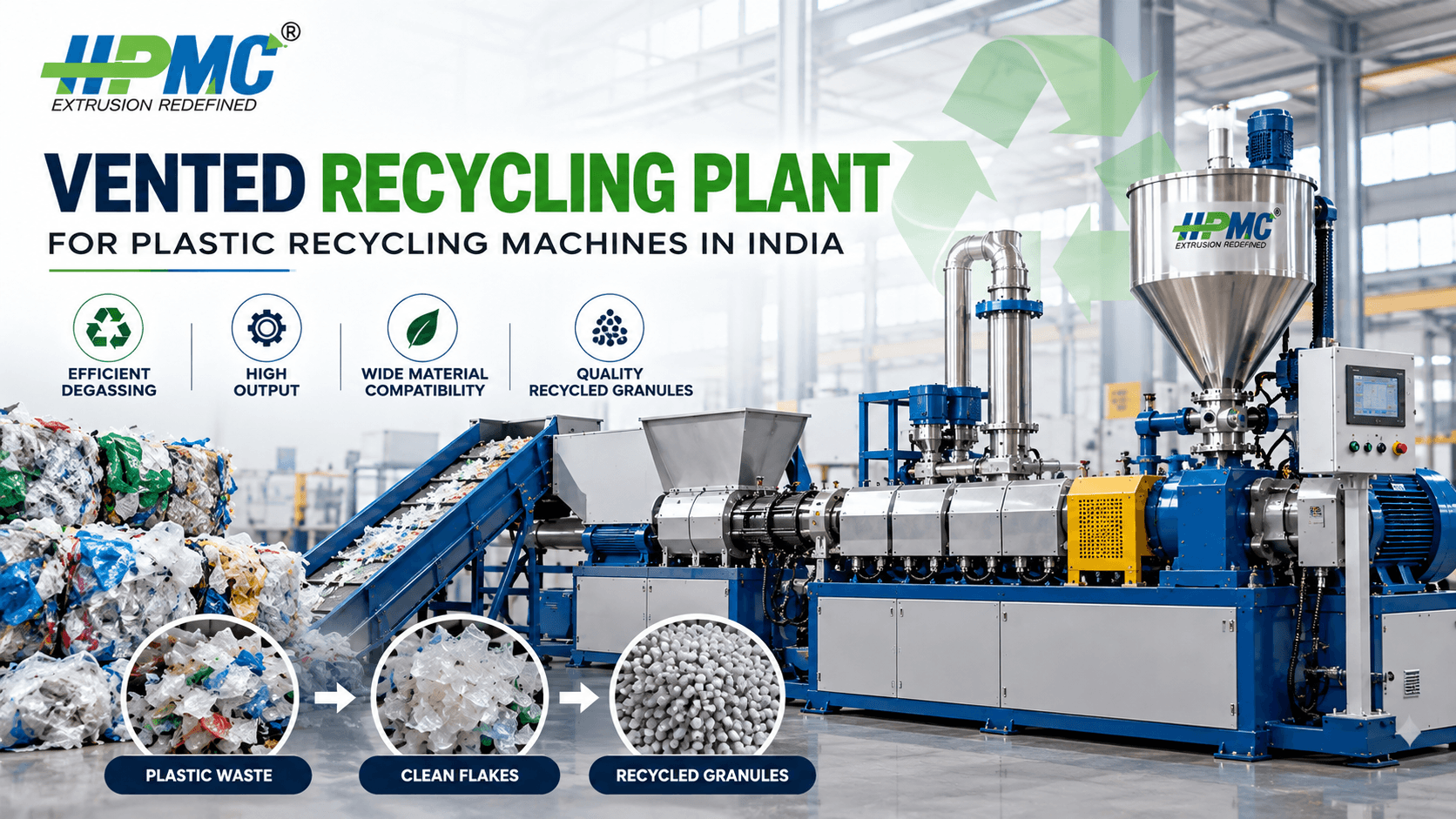
Plastic recycling plays an important role in converting suitable plastic waste into reusable raw material. However, waste plastic can contain moisture, trapped air, printing-related volatiles and other substances that may affect extrusion stability and the quality of recycled granules.
A Vented Recycling Plant is designed to address certain degassing and devolatilization requirements during plastic extrusion. Its vented extruder provides a section through which moisture, gases and some volatile substances can escape from the polymer melt during processing. Depending on the feedstock and application, a vacuum system may also be incorporated to support degassing.
Hindustan Plastics & Machine Corporation (HPMC), based in Nangloi, Delhi, manufactures plastic extrusion and recycling machinery for industrial applications. Its vented extrusion systems are designed for processing suitable virgin and reclaimed polymers, helping recyclers produce material for reuse in downstream manufacturing.
Businesses planning to establish or upgrade a recycling facility can explore HPMC's Vented Recycling Plant for product details, available models and quotation enquiries.
What Is a Vented Recycling Plant?
A Vented Recycling Plant is a plastic recycling extrusion system equipped with a specially designed venting section. It processes suitable plastic waste into reusable recycled material while allowing certain gases, moisture and volatile components to escape during extrusion.
In a typical recycling process, prepared plastic waste enters the extruder and is heated and processed by the screw. As the polymer reaches the venting section, unwanted gases and volatile substances may be removed. The molten polymer then passes through a filtration system and pelletizing arrangement to produce reusable granules.
A typical plant may include:
- Feeding system
- Vented extruder with screw and barrel
- Heating and temperature control system
- Venting section and vacuum arrangement, where applicable
- Hydraulic screen changer or melt filtration system
- Die head
- Strand or die-face pelletizing system
- Cooling arrangement
- Granule collection system
- Optional compactor for suitable lightweight feedstock
- Electrical control panel
The actual configuration depends on the type of plastic, moisture content, contamination level, required output and desired granule quality.
For model-specific details, visit the official HPMC Vented Recycling Plant page.
How Does a Vented Recycling Plant Work?
The process generally includes plastic preparation, extrusion, degassing, filtration, pelletizing, cooling and granule collection.
Step 1: Plastic Waste Preparation
Plastic waste is sorted according to polymer type and suitability for recycling. Depending on the feedstock, it may require shredding, washing, drying or other preprocessing.
Removing unsuitable materials before extrusion helps protect the equipment and improve the consistency of the recycled output.
Step 2: Feeding the Material
Prepared plastic flakes, regrind or other suitable feedstock are supplied to the extruder through the feeding system.
Lightweight films and loose materials may require a suitable feeding or compaction arrangement to maintain a stable feed rate.
Step 3: Melting and Plasticization
Inside the barrel, controlled heating and mechanical action from the screw soften and melt the plastic. The operating conditions depend on the polymer and feedstock characteristics.
Step 4: Venting and Degassing
As the polymer moves through the venting section, moisture, trapped air and certain volatile substances can escape from the melt. Vacuum-assisted degassing may be used where appropriate.
Venting effectiveness depends on material preparation, polymer characteristics, screw design, vent configuration and process settings.
Step 5: Melt Filtration
The molten polymer passes through a screen changer or other filtration arrangement. This helps remove solid contaminants that remain in the melt.
A screen changer cannot remove every type of contamination, so effective sorting and preprocessing remain important.
Step 6: Extrusion and Pelletizing
The filtered melt passes through the die and enters the selected pelletizing system. Depending on the configuration, the material may be cut into granules using a strand or die-face arrangement.
Step 7: Cooling and Collection
The granules are cooled and collected. Additional drying or screening may be included where required by the plant design.
Step 8: Quality Inspection
The recycled granules are checked against the manufacturer's requirements for appearance, consistency and intended downstream use.
Why Is Venting Important in Plastic Recycling?
Plastic waste can contain moisture, trapped air and volatile substances that may cause processing difficulties if they remain in the molten polymer.
Depending on the feedstock, insufficient degassing may contribute to bubbles, voids, surface defects, unstable extrusion and inconsistent pellet quality.
A vented extruder creates an opportunity to remove some of these unwanted substances during processing.
Moisture Removal
The venting section can help remove moisture released from the polymer during extrusion. However, heavily wet feedstock may still require washing and drying or a dedicated wet recycling process.
Removal of Trapped Air
Air entrained in the feed material may escape through the venting system, helping improve processing stability.
Volatile Removal
Printing residues, residual substances and other volatile components may be released during heating. The suitability and effectiveness of venting depend on the material and process configuration.
Improved Melt Processing
Appropriate degassing and filtration can help produce a more consistent melt for pelletizing.
Important: A vented recycling plant does not automatically make heavily contaminated or mixed plastic waste suitable for high-quality recycling. Feedstock preparation, polymer compatibility, filtration and process control remain essential.
Which Plastic Materials Can Be Processed in a Vented Recycling Plant?
HPMC's official product information identifies a range of polymers that may be processed using its vented extruders, subject to the machine configuration and material requirements.
1. Polypropylene (PP)
PP scrap from suitable industrial products, packaging and other sources may be reprocessed into granules for compatible manufacturing applications.
2. High-Density Polyethylene (HDPE)
Suitable HDPE scrap, including selected rigid products and industrial waste, can be processed according to the feedstock and plant specifications.
3. Low-Density Polyethylene (LDPE)
LDPE waste from suitable packaging and film applications can be reprocessed into reusable material.
4. Linear Low-Density Polyethylene (LLDPE)
Selected LLDPE film and industrial scrap can be processed when the feedstock and machine configuration are appropriate.
5. High-Impact Polystyrene (HIPS) and Polystyrene (PS)
Suitable HIPS and PS scrap can be processed into recycled granules for compatible applications.
6. ABS
Selected ABS waste from industrial products and components may be reprocessed using an appropriately configured recycling system.
7. Engineering Plastics
HPMC identifies materials such as PMMA, PC and PA among the polymers suitable for certain vented extrusion configurations. Their processing conditions, moisture requirements and handling procedures can differ considerably.
For the full product range and model details, see the HPMC Vented Recycling Plant.
Technical Specifications of HPMC Vented Recycling Plant
HPMC publishes multiple vented extruder models with different screw diameters, motor ratings and production capacities.
The following figures are taken from the official product information. Actual output depends on the polymer, feedstock condition, formulation and operating conditions.
- Extruder 90: Approximately 80–100 kg/hr; 90 mm screw diameter; 22.5 kW main motor.
- Extruder 100: Approximately 125–150 kg/hr; 100 mm screw diameter; 30 kW main motor.
- Extruder 110: Approximately 150–175 or 200–225 kg/hr, depending on configuration; 110 mm screw diameter; 37 or 55 kW main motor.
- Extruder 120: Approximately 200–220 or 250–300 kg/hr, depending on configuration; 120 mm screw diameter; 55 or 75 kW main motor.
- Extruder 130: Approximately 300–350 kg/hr; 130 mm screw diameter; 75 kW main motor.
- Extruder 140: Approximately 350–400 kg/hr; 140 mm screw diameter; 90 kW main motor.
- Extruder 150: Approximately 400–500 kg/hr; 150 mm screw diameter; 110 kW main motor.
The product information also lists hydraulic screen changers and model-dependent heating zones.
These capacities are not guaranteed outputs for every plastic. Ask HPMC to confirm the appropriate model and expected production rate for your specific material.
Main Components of a Vented Recycling Plant
Vented Extruder
The extruder melts and conveys the plastic while supporting degassing through its venting section.
Screw and Barrel
The screw and barrel determine how the material is conveyed and processed. Their design must be suited to the polymer and intended output.
Venting System
The venting section provides an outlet for gases and volatile components. Vacuum assistance may be included depending on the machine configuration.
Hydraulic Screen Changer
The screen changer allows filtration of the molten polymer. Its configuration and screen arrangement should match the contamination profile and production requirements.
Die Head
The die delivers the filtered polymer melt to the selected pelletizing system.
Pelletizing System
The pelletizing arrangement converts the melt into reusable granules. The method should suit the polymer and required pellet characteristics.
Cooling System
The cooling system helps bring the extruded material or pellets to a suitable temperature for handling.
Optional Compactor
A compactor may help feed lightweight film or loose plastic waste into the extruder. It is not required for every material and should be selected according to the feedstock.
Control Panel
The control system allows operators to monitor and adjust relevant process settings.
Before purchasing, confirm which components are included in the quoted plant and which are optional.
Applications of a Vented Recycling Plant
Plastic Film Recycling
Suitable LDPE and LLDPE film waste can be processed after the necessary sorting and preparation.
For materials with high moisture content, compare a vented extrusion system with HPMC's Wet Recycling Extrusion Line, which is designed for processing suitable wet plastic flakes.
PP Scrap Recycling
Suitable polypropylene waste from industrial products and packaging can be processed into granules for compatible manufacturing applications.
HDPE Recycling
Selected HDPE waste can be recycled into reusable material for products whose specifications allow the use of recycled polymer.
Post-Industrial Plastic Waste
Clean or appropriately prepared production scrap may be reprocessed to recover material for suitable reuse.
Printed Film and Packaging Scrap
Venting may help remove certain volatile substances released during processing of suitable printed film waste. Results depend on the printing system, ink residues, feedstock preparation and equipment configuration.
Selected Engineering Plastic Scrap
Some engineering plastics can be processed using a suitable vented extruder. Each polymer requires a review of material compatibility, moisture control, temperature settings and product requirements.
Vented Recycling Plant Price in India
The price of a Vented Recycling Plant depends on the model, required output, extrusion system, filtration arrangement, pelletizing method, feeding equipment and overall scope of supply.
HPMC's official Vented Recycling Plant page provides technical information and a route to request a quotation, but it does not publish one universal price for all configurations.
For preliminary budgeting, third-party listings show the following examples for HPMC recycling equipment:
- Approximately ₹19.6 lakh for a listed vented-type recycling configuration of around 100 kg/hr.
- Approximately ₹52 lakh for a listed vented extruder configuration with a stated production capacity of up to 500 kg/hr.
These are indicative third-party prices for particular configurations, not a confirmed current quotation from HPMC. They should not be treated as a fixed price range for every vented recycling plant. <Cite refs={["turn238423search8","turn238423search10"]}/>
The final price may vary based on:
- Required production capacity
- Polymer type and feedstock condition
- Screw and barrel configuration
- Venting and vacuum requirements
- Hydraulic screen changer
- Strand or die-face pelletizing system
- Optional compactor and feeding arrangement
- Cooling and collection equipment
- Automation and control systems
- Installation, commissioning, transport and taxes
How to get an accurate quote: Share the polymer type, form of scrap, moisture level, contamination profile, target output in kg/hr and desired pelletizing arrangement with HPMC. This will help the team recommend an appropriate configuration and provide a project-specific quotation.
How to Choose the Right Vented Recycling Plant
1. Identify the Plastic Type
Determine whether you will process PP, HDPE, LDPE, LLDPE, HIPS, ABS or another polymer. Avoid assuming that one configuration is suitable for every plastic.
2. Assess Feedstock Condition
Describe whether the input is film, flakes, regrind, rigid scrap or mixed waste. Include details about moisture, printing, contamination and bulk density.
3. Establish the Required Capacity
Estimate the desired output in kg/hr and consider expected operating hours and production demand.
4. Review Degassing Requirements
Discuss the type and level of moisture or volatile substances present. Confirm whether standard venting or vacuum-assisted degassing is appropriate.
5. Select the Filtration System
The screen changer should match the feedstock's contamination profile and the required melt quality.
6. Choose the Pelletizing Method
Review the available pelletizing options and select one that suits the material and intended downstream process.
7. Evaluate Feeding and Compaction
Lightweight film may need a special feeding arrangement or compactor. Rigid regrind may have different feeding requirements.
8. Check Utilities and Power Requirements
Confirm the connected electrical load, operating requirements, cooling arrangement and installation space with the manufacturer.
9. Review Maintenance and Service Support
Ask about screen changes, screw and barrel maintenance, spare parts, operator training and commissioning.
10. Compare Total Project Cost
Compare the complete scope of supply, including auxiliary equipment, installation, taxes, transport, energy requirements and maintenance.
Vented Recycling Plant vs Wet Recycling Extrusion Line
A vented recycling plant and a wet recycling extrusion line serve different processing needs.
A vented recycling plant uses a venting section to help remove moisture, air and volatile components during extrusion. It can be suitable for feedstock that has been prepared to meet the machine's input requirements.
A wet recycling extrusion line is designed for processing suitable plastic flakes with high moisture content. Depending on the system design, it may reduce the need for a separate agglomerator and handle wet feedstock more directly.
The right choice depends on the material, moisture level, washing process, required output, plant layout and final product specifications.
If your feedstock contains substantial residual moisture after washing, review HPMC's Wet Recycling Extrusion Line alongside the Vented Recycling Plant.
Vented Recycling Plant vs Two-Stage Recycling Plant
A vented recycling plant uses a vented extrusion system to support degassing during material processing.
A two-stage recycling plant uses two extrusion stages in its process configuration. Depending on the design, this can provide additional processing and filtration arrangements for suitable materials.
The appropriate system depends on the feedstock, contamination, material characteristics, production target and recycled granule requirements.
Explore HPMC's Two Stage Recycling Plant if you are comparing recycling configurations.
How to Improve Recycled Plastic Granule Quality
The final quality of recycled granules depends on more than the vented extruder alone.
Sort the Feedstock
Separate incompatible polymers and remove materials that could affect processing or product performance.
Prepare the Material Properly
Shredding, washing and drying may be necessary depending on the source and condition of the waste.
Use Appropriate Degassing
Match the venting and vacuum arrangement to the moisture and volatile content of the feedstock.
Maintain Effective Filtration
Choose a screen arrangement suited to the contamination profile and replace or clean screens according to the manufacturer's instructions.
Control Process Parameters
Temperature, screw speed, feed rate and other operating settings should be adjusted according to the polymer and machine configuration.
Inspect the Final Granules
Check the recycled material for consistency, contamination and the properties required for its intended application.
Follow Preventive Maintenance
Routine inspection of the screw, barrel, vent, screen changer and pelletizing system can help identify issues before they affect production.
Why Consider HPMC for a Vented Recycling Plant?
Hindustan Plastics & Machine Corporation (HPMC) manufactures plastic extrusion and recycling machinery and has operated in the industry since 1972.
Businesses looking for a Vented Recycling Plant Manufacturer in India can explore HPMC's product range and compare the available equipment according to their feedstock and production requirements.
Relevant HPMC resources include:
- Vented Recycling Plant — vented extrusion machinery and model specifications.
- Wet Recycling Extrusion Line — for suitable high-moisture plastic flakes.
- Two Stage Recycling Plant — an alternative recycling system configuration.
- Recycling Plant with Compactor — for suitable plastic waste and feeding requirements.
- HPMC Official Website — explore the wider range of plastic processing machinery.
Before finalising a purchase, discuss the feedstock type, moisture content, target output, filtration needs, pelletizing arrangement and installation requirements with HPMC.
Conclusion
A Vented Recycling Plant is designed to help plastic recyclers process suitable waste materials while removing moisture, trapped air and certain volatile components during extrusion. When matched to the feedstock and operating requirements, the vented extrusion process can support more stable processing and the production of reusable recycled plastic granules.
Choosing the right machine requires evaluating the polymer type, feedstock preparation, moisture level, production capacity, venting system, melt filtration, pelletizing arrangement, utilities and total project cost. A vented extruder should be selected as part of a complete recycling process, rather than as a substitute for proper sorting, washing or drying when those steps are necessary.
Hindustan Plastics & Machine Corporation (HPMC) offers vented extrusion machinery for suitable plastic recycling applications. Visit the HPMC Vented Recycling Plant product page to review available models and contact the team for a quotation based on your specific recycling requirements.
Contact HPMC
Company: Hindustan Plastics & Machine Corporation (HPMC)
Address: 5, Category II, DSIDC Industrial Area, Nangloi, Delhi – 110041, India
Website: https://www.hindustanplastics.com/
Product Page: Vented Recycling Plant
Google Business Profile: https://share.google/lBK4uD53HqY891ynv
Phone: +91 95605 96392
Email: info@hindustanplastics.com
Frequently Asked Questions
Find quick answers to the most common questions about this topic.
A Vented Recycling Plant is a plastic recycling extrusion system with a venting section that helps remove moisture, trapped air and certain volatile substances during processing.
Depending on the machine configuration, suitable materials may include PP, HDPE, LDPE, LLDPE, HIPS, PS, ABS, PMMA, PC, PA and other polymers. Confirm compatibility with the manufacturer before purchasing.
The price depends on the capacity and configuration. Third-party listings for particular HPMC recycling systems show examples of approximately ₹19.6 lakh and ₹52 lakh for different configurations. These are indicative listings, not confirmed current quotations. Contact HPMC for a project-specific price.
HPMC's official product page lists models with approximate capacities from 80–100 kg/hr to 400–500 kg/hr. Actual output depends on the material, feedstock condition and selected configuration.
Venting allows moisture, air and certain volatile components to escape from the polymer melt. This can help reduce gas-related defects and support more stable extrusion, depending on the feedstock and process conditions.
It can process suitable printed film waste when the material and equipment are compatible. The effectiveness of volatile removal depends on the printing residues, feedstock preparation, venting arrangement and operating conditions.
No. Venting can remove certain substances during extrusion, but it does not replace sorting, washing or drying when those steps are required by the feedstock. Heavily wet material may need a dedicated wet recycling process.
A hydraulic screen changer filters solid contaminants from the molten polymer. The correct screen arrangement depends on the contamination level and required melt quality.
A vented plant focuses on degassing during extrusion. A wet recycling line is designed to process suitable high-moisture plastic flakes. The correct option depends on the input material and the complete process design.
No. A compactor may help feed lightweight films or loose material, but it is not necessary for every feedstock. The requirement depends on the material's bulk density and feeding behaviour.
Consider polymer type, feedstock condition, moisture, contamination, target output, screw design, venting, filtration, pelletizing, utilities, maintenance and after-sales support.
Visit the HPMC Vented Recycling Plant page, call +91 95605 96392, or email info@hindustanplastics.com. Provide your plastic type, feedstock condition, required capacity and desired output to help the team recommend a suitable configuration.