
Introduction
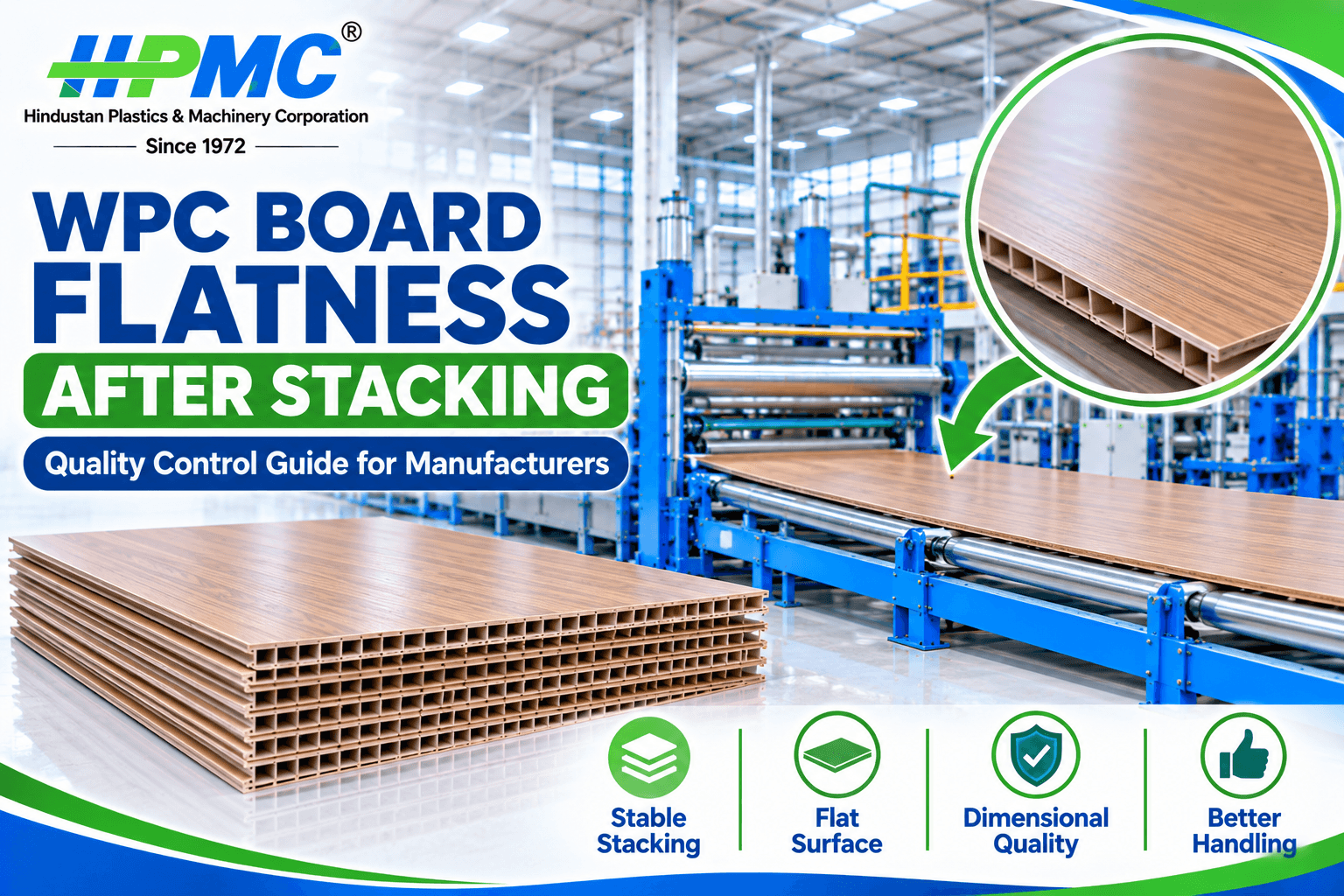
Maintaining proper board flatness is an important part of WPC (Wood Plastic Composite) board manufacturing. Manufacturers expect every finished board to maintain its required thickness, shape and surface quality during production, handling and storage. However, sometimes WPC boards develop bending, uneven surfaces or deformation after they are stacked. This issue is commonly associated with WPC Board Flatness After Stacking and can affect product quality, storage efficiency and customer satisfaction.
WPC boards are manufactured using a combination of thermoplastic materials, wood flour or wood fibre and processing additives. After extrusion, the hot board passes through calibration, cooling, haul-off and cutting sections before reaching the stacking area. Each stage has an important role in maintaining the final board dimensions.
Even when a board looks flat immediately after cutting, it may develop curvature or surface unevenness after being stacked for several hours. Uneven cooling, internal material stress, improper stacking arrangements, inconsistent thickness and unsuitable handling practices can contribute to this problem.
For manufacturers, understanding the causes of board deformation is important for maintaining consistent production quality. This guide explains why WPC boards lose flatness after stacking, which production factors influence the problem and how manufacturers can improve board stability.
What Is WPC Board Flatness After Stacking?
WPC Board Flatness After Stacking refers to the ability of finished WPC boards to maintain a reasonably flat and stable shape after they are placed together for storage, handling or transportation.
A properly manufactured WPC board should maintain its specified dimensions without developing excessive bending, twisting, bowing or surface deformation under normal storage conditions.
Flatness is an important quality characteristic because WPC boards are commonly used in furniture, cabinets, partitions, decorative panels and interior applications. Uneven boards can create difficulties during cutting, lamination, installation and further processing.
Board flatness depends on several connected factors, including material formulation, extrusion conditions, cooling performance, cutting accuracy and stacking practices.
Why Is Board Flatness Important in WPC Manufacturing?
Flatness is not only an appearance-related requirement. It also affects the usability and processing performance of finished WPC boards.
1. Better Product Appearance
Flat boards provide a more consistent appearance and are easier to inspect before dispatch. Bending and twisting can reduce the perceived quality of the finished product.
2. Improved Furniture Manufacturing
Furniture manufacturers require boards with stable dimensions for cutting, drilling, edge finishing and assembly. Uneven boards may create difficulties during these operations.
3. Easier Lamination and Surface Finishing
A reasonably flat surface supports more consistent contact during decorative lamination and finishing processes. Excessive curvature may create processing difficulties.
4. Better Storage and Handling
Flat boards are easier to arrange in organised stacks. Uneven products may create unstable piles and require additional handling.
5. Reduced Material Rejection
Maintaining board flatness helps reduce avoidable quality problems and the possibility of rejected products.
Common Causes of WPC Board Flatness Problems After Stacking
1. Uneven Cooling During Production
Uneven cooling is one of the important factors that manufacturers should investigate when WPC boards develop deformation.
After extrusion, the board remains hot and needs to pass through a suitable calibration and cooling arrangement. If different areas of the board cool at different rates, internal stresses may develop.
These stresses can become more noticeable after cutting and stacking.
How to improve it: Maintain consistent cooling conditions across the board width and thickness. Inspect the cooling equipment and check whether the cooling arrangement matches the board dimensions and production speed.
2. Improper Stacking Arrangement
The stacking method directly affects how finished boards are stored.
If boards are placed unevenly, unsupported sections may experience additional bending. Different board lengths, uneven surfaces and incorrectly positioned support points can also affect stack stability.
How to improve it: Use a level stacking surface and arrange boards carefully. Keep the support points properly aligned and avoid uneven loading.
3. Inconsistent Board Thickness
Thickness variation can affect how boards sit against each other during stacking.
When some sections are thicker than others, the boards may not form a uniform stack. This can contribute to uneven support and deformation.
How to improve it: Regularly inspect board thickness at different positions. Check die setup, material flow and calibration conditions if repeated variations are observed.
4. High Internal Material Stress
WPC boards may retain internal stresses due to material formulation, processing conditions and cooling behaviour.
When the board temperature changes after production, these stresses may contribute to dimensional changes or bending.
How to improve it: Review the material formulation, processing temperature and cooling conditions. Allow boards to stabilise under suitable storage conditions before further processing.
5. Excessive Stacking Pressure
Excessive pressure from heavy stacks can contribute to deformation, particularly when boards are insufficiently supported or have not stabilised after extrusion.
How to improve it: Establish suitable stacking limits according to board thickness, material properties and storage conditions. Avoid applying unnecessary weight to freshly produced boards.
6. Improper Board Handling
Rough handling during transfer from the cutting section to the stacking area can cause bending, edge damage and uneven positioning.
How to improve it: Use suitable handling equipment and train operators to transfer boards without unnecessary impact or bending.
How Cooling Conditions Affect WPC Board Flatness
Cooling plays an important role in determining the dimensional stability of WPC boards.
After the molten material exits the extrusion die, it enters the calibration and cooling section. During this stage, the material gradually loses heat and develops its final dimensions.
If cooling is insufficient or uneven, the board may experience dimensional changes after leaving the production line.
Manufacturers should pay attention to:
- Consistency of cooling across the board width.
- Cooling conditions according to board thickness.
- Stability of production speed.
- Calibration equipment condition.
- Proper board support during cooling.
- Material temperature before downstream handling.
Cooling should be controlled according to the specific material formulation and machine configuration. Increasing cooling intensity without understanding the cause of deformation may create additional problems.
Role of the WPC Board Extrusion Line in Maintaining Flatness
A WPC board extrusion line is a complete production system in which different machine sections work together to produce boards with the required dimensions and surface quality.
The extrusion process begins with material preparation and feeding. The extruder processes the mixture and supplies it to the board die. The die creates the required board shape, while calibration and cooling equipment help establish dimensional stability.
The haul-off system moves the board through the downstream section, and the cutting machine produces the required lengths. Finally, the boards are transferred to the stacking area.
If one section operates inconsistently, the final product may develop quality variations.
Manufacturers planning a new production facility can explore the WPC Board Plant Manufacturing Process to understand the different stages involved in WPC board production.
Common Signs of WPC Board Deformation After Stacking
1. Edge Bending
The edges of the board may curve upward or downward while the centre remains relatively flat. This may be associated with uneven cooling, material stress or support conditions.
2. Centre Bending
The middle section of the board may become curved when the product is not adequately supported or experiences uneven temperature changes.
3. Twisting
Twisting occurs when different corners or sections of a board are not aligned on the same plane. Material variation, uneven cooling and handling conditions may contribute to this issue.
4. Surface Unevenness
The board may show visible irregularities or changes in surface level after stacking. Roller contact, material flow and calibration conditions should be inspected.
5. Uneven Stack Formation
When boards do not sit properly on each other, gaps and unstable sections may become visible. This can indicate dimensional variation or improper stacking practices.
How to Improve WPC Board Flatness After Stacking
1. Maintain Consistent Raw Material Quality
Raw material consistency is essential for stable extrusion processing. Variations in wood flour moisture, particle size, polymer quality and additive proportions can influence material behaviour.
Manufacturers should follow a controlled formulation and maintain consistent raw material preparation practices.
2. Optimise Extrusion Temperature
Temperature settings should be selected according to the material formulation and equipment manufacturer's recommendations.
Incorrect processing temperatures may affect material flow, fusion and the stability of the finished board.
3. Improve Calibration Conditions
The calibration system helps control the board dimensions after it exits the die.
Manufacturers should inspect calibration surfaces, cooling arrangements and alignment to ensure that the equipment is suitable for the required board specifications.
4. Maintain Stable Haul-Off Speed
The haul-off unit should pull the board consistently through the production line.
Improper coordination between extrusion output and haul-off speed may contribute to dimensional variation and internal stress.
5. Check Cutting Accuracy
Cutting should be performed after the board has passed through the required cooling and stabilisation stages.
Proper cutting alignment and support can help prevent unnecessary mechanical stress during downstream processing.
6. Use Proper Stacking Equipment
The stacking arrangement should support the boards evenly. Suitable racks, support surfaces and handling equipment can help reduce bending during storage.
7. Allow Suitable Cooling and Stabilisation
Boards should not be stacked under unsuitable conditions immediately after production. The required cooling and stabilisation time depends on board thickness, formulation, production conditions and machine configuration.
WPC Board Stacking Best Practices for Manufacturers
Correct stacking practices are important for maintaining finished-product quality.
Manufacturers should follow these practices:
- Stack boards on a clean and level surface.
- Keep support points properly aligned.
- Maintain consistent board orientation.
- Avoid excessive stacking height and pressure.
- Separate damaged boards from finished-quality products.
- Avoid placing boards on uneven flooring.
- Protect finished boards from unsuitable environmental conditions.
- Use suitable lifting and transfer equipment.
- Inspect board flatness before and after storage.
- Maintain records of recurring quality problems.
These practices help improve storage organisation and reduce avoidable handling-related deformation.
Quality Inspection Methods for WPC Board Flatness
Regular inspection helps manufacturers identify flatness problems before the products are dispatched.
Visual Inspection
Inspect boards from different angles to identify visible bending, twisting, uneven edges and surface irregularities.
Straightedge Inspection
A suitable straightedge can help identify gaps or deviations along the board surface. Measurements should follow a consistent inspection procedure.
Surface-Level Inspection
A suitable flat reference surface can be used to assess whether the board rests evenly or shows visible curvature.
Thickness Measurement
Measure the board thickness at several points across its width and length. Record the results to identify repeated variations.
Before-and-After Stacking Inspection
Compare board condition immediately after production with its condition after a defined storage period. This helps manufacturers understand whether deformation develops during storage.
The inspection method and acceptance limits should be established according to the product specification and applicable quality requirements.
How to Choose the Right WPC Board Manufacturing Machine
Selecting suitable machinery is important for achieving consistent WPC board quality.
Manufacturers should consider the complete production line instead of focusing only on the extruder.
Important factors include:
- Board Dimensions: Confirm the required width, thickness and product design.
- Material Compatibility: Discuss the intended polymer, wood flour and additive formulation.
- Extrusion Capacity: Select a machine according to the expected production requirements.
- Calibration System: Review the calibration arrangement and dimensional control features.
- Cooling System: Check whether the cooling configuration suits the board dimensions and production speed.
- Haul-Off Equipment: Ensure stable downstream board movement.
- Cutting System: Review cutting accuracy and board handling arrangements.
- Technical Support: Confirm installation, commissioning, operator training and maintenance support.
Manufacturers can review the HPMC WPC Board Plant to learn more about available WPC extrusion machinery and production configurations.
Difference Between WPC Board Flatness and WPC Profile Dimensional Stability
WPC boards and WPC profiles are manufactured using extrusion technology, but their quality requirements are different.
WPC boards are flat products, so their thickness, width, surface quality and flatness are important characteristics.
WPC profiles have specific cross-sectional shapes. Their quality depends on profile dimensions, geometry, calibration, cooling and dimensional stability.
A production line designed for boards may not be suitable for manufacturing every type of profile. The machinery should match the intended product.
Businesses interested in producing shaped WPC products can also explore the HPMC WPC Profile Plant.
Maintenance Tips to Prevent WPC Board Flatness Problems
Regular machine maintenance helps reduce process variations that may influence finished-board quality.
Manufacturers should:
- Inspect extrusion equipment regularly.
- Check the condition of the board die.
- Clean calibration surfaces.
- Inspect cooling-system performance.
- Check haul-off alignment and movement.
- Inspect cutting equipment and blades.
- Maintain stacking equipment.
- Monitor bearings and mechanical components.
- Follow recommended lubrication schedules.
- Maintain production and quality inspection records.
Maintenance activities should be performed according to the equipment manufacturer's instructions and suitable industrial safety procedures.
Conclusion
WPC Board Flatness After Stacking is an important quality consideration for manufacturers producing WPC boards for furniture, interior decoration and construction applications. Board deformation may develop because of uneven cooling, internal material stress, inconsistent thickness, improper handling or unsuitable stacking conditions.
Maintaining flatness requires attention to the complete manufacturing process, starting from raw material preparation and extrusion to calibration, cooling, cutting and final storage.
Manufacturers should regularly inspect finished boards, maintain suitable cooling conditions and follow consistent stacking practices. Selecting appropriate extrusion machinery and maintaining stable operating conditions can also help improve overall product quality.
A systematic approach to production and quality control helps manufacturers reduce avoidable defects, improve finished-board consistency and maintain reliable manufacturing operations.
Contact Hindustan Plastics and Machinery Corporation (HPMC)
Hindustan Plastics and Machinery Corporation (HPMC) provides plastic extrusion machinery solutions for different industrial manufacturing applications. Businesses planning a WPC board manufacturing facility or looking to upgrade their existing production setup can contact HPMC to discuss suitable machinery configurations and technical requirements.
Company: Hindustan Plastics and Machinery Corporation (HPMC)
Address: 5, Category II, DSIDC Industrial Area, Nangloi, Delhi – 110041, India
Phone: +91 95605 96392
Email: info@hindustanplastics.com
Website: https://www.hindustanplastics.com/
Request a Quote: https://www.hindustanplastics.com/get-in-touch
Google Business Profile: https://share.google/lBK4uD53HqY891ynv
When contacting HPMC, share your required board width, thickness, material formulation, expected production capacity, cooling requirements and current manufacturing challenges.
Contact HPMC today to discuss your WPC board extrusion machinery requirements and find a suitable manufacturing solution for your business.
Frequently Asked Questions
Find quick answers to the most common questions about this topic.
WPC Board Flatness After Stacking refers to the ability of finished WPC boards to maintain a flat and stable shape after being arranged together for storage or transportation.
WPC boards may bend because of uneven cooling, internal material stress, inconsistent thickness, excessive stacking pressure or improper support during storage.
Uneven cooling can create temperature differences and internal stresses within the board, which may contribute to bending or dimensional changes.
Yes. Uneven support, excessive weight and incorrect board positioning can contribute to deformation during storage.
Manufacturers should maintain consistent cooling, suitable processing conditions, proper calibration, accurate cutting and organised stacking practices.
Yes. Thickness and dimensional consistency influence board support and stability during stacking. Significant variations may create uneven contact between boards.
Boards should be placed on a clean, level surface with suitable support points. Stacking height and loading conditions should match the board specifications.
The extruder, board die, calibration unit, cooling system, haul-off, cutting machine and stacking equipment can all influence finished-board quality.
They can use visual inspection, straightedge checks, suitable flat reference surfaces and dimensional measurements according to their quality inspection procedure.
Suitable machinery helps maintain consistent material processing, board shaping, calibration, cooling and downstream handling, supporting better dimensional stability and finished-product quality.