
Introduction
Wood Plastic Composite (WPC) boards are used in furniture manufacturing, interior design, partitions, cabinets and several construction applications. They combine wood-based materials with thermoplastics to create composite boards that can be processed into different sizes, thicknesses and surface finishes.
For manufacturers planning to enter this segment, selecting the right WPC Board Plant is an important step. The production line must be suitable for the intended material formulation, board dimensions, output requirements and finishing standards.
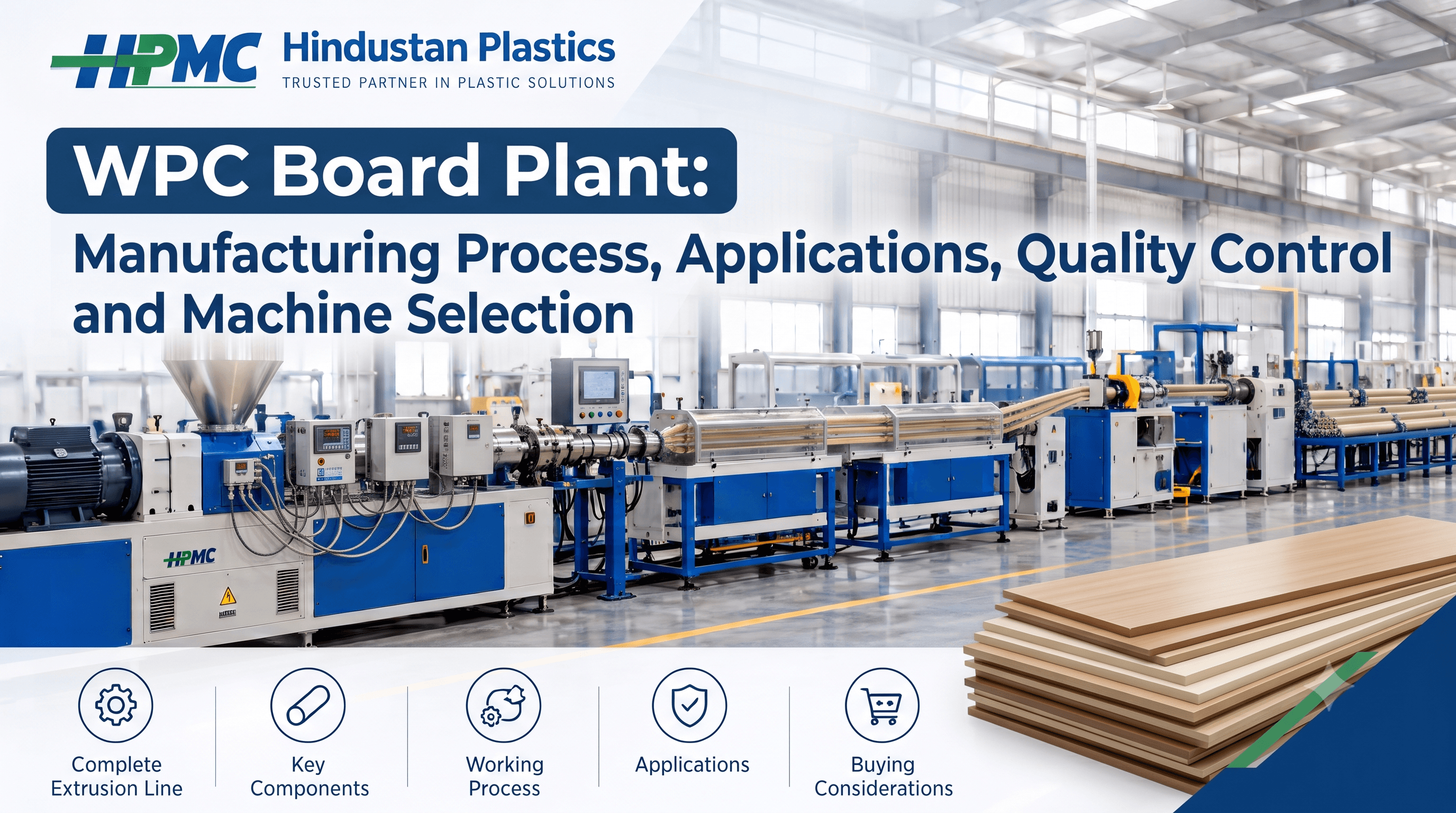
A WPC board extrusion line generally includes a material feeding system, extruder, board die, calibration and cooling equipment, haul-off unit, cutting system and stacking arrangement. Each section contributes to the quality and consistency of the finished board.
This guide explains how a WPC board production line works, which factors influence board quality, where WPC boards are used and what manufacturers should consider before purchasing equipment.
What Is a WPC Board Plant?
A WPC Board Plant is an extrusion-based manufacturing system designed to produce boards or sheets from a suitable combination of thermoplastic material, wood flour or wood fibre, and processing additives.
Depending on the formulation and machine configuration, the plant can be designed for different board dimensions, densities, thicknesses and surface requirements.
The final application determines the production requirements. For example, a board intended for furniture or cabinetry may require a different surface finish and thickness tolerance from a board intended for partitions or decorative interior panels.
Manufacturers should therefore define the intended end product before selecting the extrusion line.
How Does a WPC Board Manufacturing Process Work?
WPC board production involves several connected stages. The exact arrangement depends on the raw materials, product design and equipment configuration.
1. Raw Material Preparation
The first stage involves preparing the required raw materials. These may include wood flour or wood fibre, a suitable thermoplastic resin, mineral fillers, stabilisers, lubricants, pigments and other formulation-specific additives.
The material proportions influence processing behaviour and finished-board properties. Raw material moisture, particle consistency and the accuracy of weighing can also affect production stability.
Before production begins, manufacturers should establish a repeatable material preparation procedure.
2. Mixing and Feeding
The prepared ingredients are mixed to distribute the components as uniformly as possible. The mixture is then supplied to the extrusion system through an appropriate feeding arrangement.
Inconsistent feeding can lead to fluctuations in material flow, which may affect board thickness, density and surface appearance. Stable feeding is therefore an important part of maintaining consistent production.
3. Extrusion and Plasticisation
The extruder transports, heats and processes the material before pushing it through the board die.
Depending on the formulation and machine design, the extruder may use a conical twin-screw or another suitable screw configuration. The selection should be based on the material being processed, required output and board specifications.
Temperature, screw speed and material residence time need to be controlled according to the formulation. Excessive heat or unsuitable processing conditions may affect the material and the quality of the final board.
4. Board Die and Shaping
The die shapes the processed material into a continuous board with the required width and profile.
Die design and setup influence material distribution across the board. Incorrect alignment or an unsuitable die configuration can contribute to uneven thickness, edge variations or inconsistent surface quality.
The die should be selected according to the intended board dimensions and production requirements.
5. Calibration and Cooling
After leaving the die, the board passes through calibration and cooling equipment. This stage helps establish the required dimensions and stabilise the board as it cools.
Inadequate or uneven cooling may cause warping, dimensional variation or surface defects. The cooling arrangement must therefore be compatible with the board thickness, line speed and material formulation.
6. Haul-Off, Cutting and Stacking
The haul-off unit pulls the board through the downstream equipment at a controlled speed. The cutting system then cuts the continuous board into the required lengths.
The board is inspected and stacked for subsequent handling, finishing or packaging. Consistent haul-off speed and accurate cutting help reduce dimensional variation and improve finished-product consistency.
Main Components of a WPC Board Extrusion Line
A production line should be evaluated as a complete system rather than by considering the extruder alone.
Extruder
The extruder processes the material and supplies it to the die. Screw design, motor capacity, temperature control and material compatibility are important selection factors.
Board Die
The die forms the material into the required board shape and width. Its design should suit the product specification and material flow characteristics.
Calibration and Cooling Unit
This section helps maintain the board's dimensions while reducing its temperature. Its configuration affects dimensional stability and the overall production process.
Haul-Off Unit
The haul-off system moves the board through the production line. Stable pulling speed helps maintain consistent downstream processing.
Cutting System
The cutter produces boards of the specified length. The required cutting arrangement depends on board dimensions, production speed and handling needs.
Stacking and Handling Equipment
The stacking section organises the finished boards for inspection, storage or further processing. Suitable handling practices help protect board edges and surfaces.
Applications of WPC Boards
WPC boards are used in various applications, depending on their formulation, density, mechanical properties and surface finish.
Furniture and Cabinetry
WPC boards may be used in selected furniture components, cabinet structures and interior panels. Suitability depends on the board's load requirements, fastening performance and finishing compatibility.
Kitchen Cabinets and Wardrobes
Boards can be considered for kitchen cabinetry, wardrobe components and storage systems where moisture exposure is a design consideration. However, actual performance depends on the specific formulation, edge treatment, joints and installation conditions.
Doors and Interior Partitions
WPC board products may be used for selected door components, partition panels and interior applications. Manufacturers should match the board specification to the intended structural and finishing requirements.
Wall Panels and Decorative Interiors
Depending on the product design, WPC boards can be processed into wall cladding, decorative panels and other interior elements.
Signage and Display Applications
Suitable boards may be used for signs, display panels and selected commercial interior installations. Surface finish, rigidity and compatibility with printing or lamination should be evaluated before choosing a formulation.
WPC Board Plant vs WPC Profile Plant
Although both systems use extrusion technology, board and profile production have different output requirements.
A WPC Board Plant is designed around flat products, where board width, thickness, density and surface quality are important. A profile extrusion line is designed to produce continuous shapes with a specific cross-section, such as frames, trims and decorative profiles.
For businesses planning to manufacture door frames or other shaped components rather than flat boards, HPMC also provides a dedicated WPC Profile Plant.
The equipment should be selected according to the product geometry rather than assuming that a board line and a profile line are interchangeable.
How to Maintain Consistent WPC Board Quality
Consistent board quality depends on the combined performance of material preparation, extrusion, calibration, cooling and downstream handling.
Control Raw Material Consistency
Use a documented formulation and consistent material preparation procedures. Changes in moisture, particle size or additive proportions can affect processing behaviour and finished-board properties.
Monitor Processing Temperatures
Set temperature zones according to the material formulation and equipment manufacturer's guidance. Record operating conditions during stable production to make it easier to identify deviations.
Check Board Thickness and Width
Measure board dimensions at regular intervals. Monitoring several points across the width can help identify uneven thickness or edge variations before a large quantity of material is affected.
Inspect Surface Finish
Look for visible defects such as roughness, streaks, bubbles, marks or uneven colouring. Their causes can differ, so adjustments should be made only after checking the material and relevant process conditions.
Maintain Calibration and Cooling Equipment
Keep calibration surfaces and cooling arrangements clean and in suitable working condition. Follow the manufacturer's maintenance schedule for moving parts, temperature controls and cooling systems.
Check Cutting Accuracy
Inspect finished board lengths and edges. Accurate cutting and appropriate handling help maintain product consistency during storage and dispatch.
Common WPC Board Production Problems and Their Possible Causes
Production issuePossible contributing factors
Uneven board thickness
Die setup, material distribution or calibration issues
Rough surface
Formulation, processing temperature or die condition
Board warping
Uneven cooling, material variation or downstream handling
Inconsistent density
Feeding variation, formulation changes or processing instability
Uneven colour
Pigment distribution or inconsistent mixing
Incorrect board length
Cutting setup or haul-off synchronisation
These are possible causes rather than definitive diagnoses. Manufacturers should inspect the material, machine settings and equipment condition before making adjustments.
How to Choose the Right WPC Board Machine Manufacturer in India
Selecting a machine manufacturer requires more than comparing the quoted price. The equipment should match the intended product and the manufacturer's production requirements.
1. Define Your Product Specifications
Decide the required board width, thickness, length, density and surface finish. Also identify whether the production plan involves solid boards, foam boards or another specific product type.
2. Confirm Material Compatibility
Discuss the intended resin, wood-based filler and additive formulation with the equipment supplier. Not every machine configuration is suitable for every material combination.
3. Evaluate the Complete Production Line
Review the extruder, die, calibration, cooling, haul-off and cutting arrangement together. The capacity of downstream equipment should be compatible with the intended production speed.
4. Review Production Capacity Carefully
Ask the manufacturer to clarify the expected output for your particular material formulation and product dimensions. Actual production depends on several variables, so a general capacity figure should not be treated as a guaranteed output for every product.
5. Ask About Installation and Technical Support
Clarify installation requirements, operator training, spare parts availability, maintenance schedules and after-sales support before finalising the purchase.
6. Compare Total Operating Requirements
Consider energy consumption, labour, raw materials, maintenance, tooling and other operating costs. A suitable machine is one that meets your production goals and quality requirements within your planned operating budget.
Manufacturers evaluating other extrusion equipment can also review HPMC's Twin Screw Extruder information to understand the role of screw configuration in extrusion applications.
Why Consider HPMC for a WPC Board Plant?
HPMC (Hindustan Plastics and Machine Corporation) is a Delhi-based plastic extrusion machinery manufacturer with a history dating back to 1972.
Businesses evaluating a WPC board production line should discuss their required board dimensions, material formulation, target output and finishing expectations with the manufacturer before selecting a configuration.
You can explore the HPMC WPC Board Plant page for available product information and contact the company to discuss your specific manufacturing requirements.
For businesses comparing different product categories, HPMC also offers information about its WPC Board Plant and related extrusion equipment.
The final equipment selection should be based on the intended application, production targets, machine configuration and technical requirements confirmed with the supplier.
Conclusion
A WPC Board Plant combines material preparation, extrusion, die shaping, calibration, cooling and cutting to produce boards for selected furniture, construction and interior applications.
The quality of the finished product depends on the consistency of the raw materials, suitable machine configuration, stable processing conditions and regular quality checks. Before investing in a WPC Foam Board Machine or another board extrusion system, manufacturers should define their product specifications and verify that the complete production line can meet their requirements.
Choosing equipment according to the intended application can help establish a more consistent and manageable manufacturing process.
For details about WPC board extrusion equipment, contact HPMC to discuss your production requirements.
Contact HPMC
HPMC (Hindustan Plastics and Machine Corporation)
- Address: 5, Category II, DSIDC Industrial Area, Nangloi, Delhi – 110041, India
- Website: https://www.hindustanplastics.com/
- Phone: +91 95605 96392
- Email: info@hindustanplastics.com
- Google Business Profile: https://share.google/lBK4uD53HqY891ynv
Frequently Asked Questions
Find quick answers to the most common questions about this topic.
A WPC Board Plant is an extrusion system used to manufacture wood-plastic composite boards from a suitable combination of thermoplastics, wood-based material and additives.
A WPC Foam Board Machine is equipment configured to manufacture foamed wood-plastic composite boards. The machine and formulation must be suitable for the required foam structure, density, dimensions and surface finish.
Depending on the formulation, materials may include PVC, PE or PP, wood flour or wood fibre, mineral fillers, stabilisers, lubricants, pigments and other processing additives.
A WPC board extrusion line mixes and processes raw materials in an extruder, shapes them through a board die, then cools and calibrates the board. Finally, the board is cut to the required length and stacked for inspection.
Depending on their properties, WPC boards may be used in furniture components, cabinets, wardrobes, partitions, decorative panels, wall cladding and selected signage applications.
A board plant produces flat boards or sheets, while a profile plant produces continuous products with a defined cross-sectional shape, such as door frames and decorative profiles.
Raw material consistency, formulation, extrusion conditions, die setup, calibration, cooling and downstream handling can all affect the finished board.
Possible causes include uneven material flow, die setup problems, calibration issues or fluctuations in processing conditions. The cause should be identified through inspection.
Review product dimensions, formulation compatibility, expected output, complete line configuration, energy requirements, maintenance needs and technical support.
No. Foam board production requires a suitable machine configuration and formulation. Buyers should confirm the equipment's intended application with the manufacturer.