
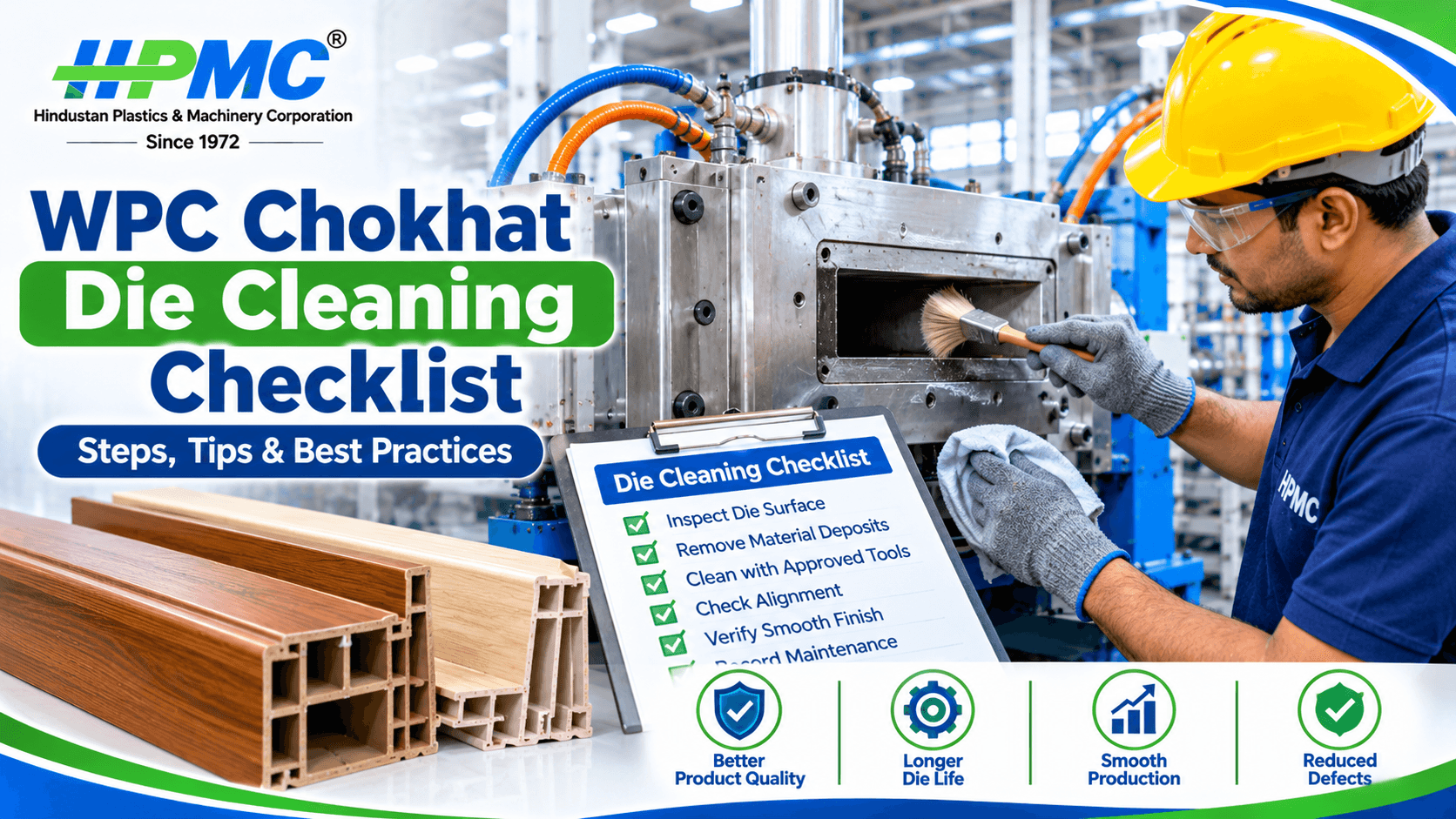
Introduction
WPC (Wood Plastic Composite) chokhat manufacturing requires proper machine maintenance, accurate processing and consistent production conditions. The extrusion die is one of the most important components of a WPC chokhat production line because it determines the final shape, dimensions and surface appearance of the product. During continuous production, material deposits, dust, carbonised particles and processing residues may accumulate inside the die. These deposits can affect material flow and finished-product quality. This is why following a proper WPC Chokhat Die Cleaning Checklist is essential for manufacturers.
A clean extrusion die helps maintain consistent material distribution, reduces the possibility of surface defects and supports stable production. If die cleaning is ignored, manufacturers may experience uneven chokhat dimensions, rough surfaces, material blockage and frequent production interruptions.
WPC chokhat products are commonly used in door frames, window frames, interior applications and construction projects. Customers expect consistent dimensions, attractive finishes and reliable product quality. Regular die inspection and cleaning help manufacturers maintain these requirements.
In this guide, we explain the importance of WPC chokhat die cleaning, the complete cleaning checklist, common die problems, maintenance practices and ways to improve extrusion performance.
What Is WPC Chokhat Die Cleaning?
WPC chokhat die cleaning is the process of removing accumulated material, dust, carbon deposits and other residues from the extrusion die used in WPC door frame manufacturing.
During extrusion, a mixture of thermoplastic material, wood flour and processing additives passes through the machine and enters the die. The die shapes the processed material into the required chokhat profile.
Over time, processing residues may accumulate around the die opening, flow channels and other internal surfaces. If these deposits are not removed properly, they may interfere with material flow and affect the final product.
Die cleaning involves inspection, safe removal of residues, checking the die surfaces and verifying that the equipment is ready for the next production run.
Why Is WPC Chokhat Die Cleaning Important?
Regular die cleaning is important for maintaining extrusion performance and finished-product consistency.
1. Maintains Consistent Material Flow
Material deposits inside the die can disturb the flow of the WPC mixture. Cleaning helps maintain suitable flow conditions and reduces the possibility of partial blockage.
2. Improves Surface Quality
Deposits and carbonised material can create unwanted marks on the finished chokhat profile. Proper die cleaning helps reduce these surface-related problems.
3. Reduces Production Interruptions
Heavy material accumulation may require additional cleaning and troubleshooting. A planned maintenance routine helps reduce unexpected interruptions.
4. Supports Dimensional Accuracy
A clean and properly maintained die helps maintain consistent material distribution through the profile opening. This supports dimensional control when combined with correct calibration and cooling.
5. Helps Extend Die Service Life
Removing deposits using suitable cleaning methods and tools helps prevent unnecessary damage during maintenance.
6. Improves Production Consistency
Regular inspection and cleaning help manufacturers maintain more predictable machine performance across different production runs.
Complete WPC Chokhat Die Cleaning Checklist
Manufacturers should follow a systematic cleaning procedure rather than cleaning only when visible defects appear.
1. Prepare the Machine for Cleaning
Before starting maintenance, ensure that the machine is shut down according to the manufacturer's procedure. Isolate electrical and other relevant energy sources and follow the required lockout and safety procedures.
The die should be handled only after it reaches a safe temperature for the specified cleaning method.
Checklist:
- Stop the production process safely.
- Isolate relevant energy sources.
- Follow the manufacturer's shutdown procedure.
- Allow the equipment to reach a safe working condition.
- Wear suitable protective equipment.
- Prepare approved cleaning tools.
2. Inspect the Extrusion Die
Before cleaning, inspect the die to identify accumulated material and visible damage.
Pay attention to:
- Material deposits around the die opening.
- Carbonised material and processing residue.
- Scratches on die surfaces.
- Signs of corrosion.
- Damaged or loose components.
- Uneven material accumulation.
Record any unusual conditions before beginning the cleaning process.
3. Remove Material Deposits
Remove accumulated material using cleaning tools approved for the specific die material and construction.
Avoid using unsuitable metal objects or excessive force because they may scratch or damage precision surfaces.
The cleaning method should follow the equipment manufacturer's recommendations. Abrasive methods and unapproved chemicals should be avoided.
4. Clean the Die Flow Channels
Flow channels are important because they guide the processed WPC material towards the die opening.
Material accumulation in these areas can disturb flow distribution and contribute to uneven profile formation.
Inspect accessible flow channels and remove residues using approved cleaning methods. For internal areas that require disassembly, follow the manufacturer's maintenance instructions.
5. Inspect the Die Opening
The die opening determines the shape of the WPC chokhat profile. Any damage, residue or unevenness in this area may affect the finished product.
Check for:
- Deposits around the opening.
- Scratches and surface damage.
- Uneven edges.
- Material blockage.
- Visible wear.
The opening should be clean and free from unwanted deposits before production resumes.
6. Clean and Inspect Related Components
Die maintenance should also include an inspection of associated components.
Depending on the machine configuration, inspect die fasteners, heating elements, temperature sensors, connecting components and mounting surfaces.
Do not disturb electrical connections or heating components unless the work is authorised and covered by the relevant maintenance procedure.
7. Reassemble the Die Correctly
After cleaning and inspection, reassemble the die according to the manufacturer's instructions.
Ensure that components are correctly positioned and fasteners are secured using the specified procedures. Incorrect assembly may cause material leakage, alignment issues or uneven profile formation.
8. Verify Die Alignment
Die alignment is important for producing consistent WPC chokhat profiles.
After reassembly, check the die position and its relationship with the calibration equipment. Confirm that all relevant mounting and alignment requirements are satisfied.
9. Perform a Controlled Production Trial
Before returning to full production, conduct a controlled trial according to the machine manufacturer's operating procedure.
Observe the material flow, profile shape, surface finish and dimensional consistency.
If unusual marks, uneven flow or other defects appear, stop and investigate the cause instead of continuing production with an unresolved problem.
10. Record Cleaning and Maintenance Activities
Maintain a cleaning record for every scheduled maintenance activity.
The record should include the cleaning date, machine identification, die condition, cleaning work performed, components inspected and any issues requiring further attention.
These records help manufacturers identify recurring problems and plan preventive maintenance.
Common Problems Caused by Poor WPC Chokhat Die Maintenance
1. Uneven Chokhat Surface
Material deposits around the die opening can create irregular flow conditions. This may result in visible surface inconsistencies.
Solution: Inspect the die opening and clean accumulated residues using approved methods.
2. Black Spots on WPC Profiles
Black spots may be associated with carbonised material, degraded polymer or contamination in the processing system.
Solution: Inspect the die and other material-contact areas. Also review material quality, processing conditions and cleaning procedures.
3. Uneven Profile Dimensions
Incorrect die assembly, material flow variation or calibration problems may affect profile dimensions.
Solution: Check die alignment, material feeding, extrusion conditions and calibration equipment.
4. Material Blockage
Accumulated processing residues can restrict material movement through the die.
Solution: Stop the machine safely and investigate the blockage using the manufacturer's approved maintenance procedure.
5. Rough Surface Finish
Damaged die surfaces, material deposits or unsuitable processing conditions may contribute to roughness.
Solution: Inspect die surfaces and material flow conditions. Repair or replace damaged components when necessary.
6. Frequent Production Downtime
Unplanned die cleaning and repeated blockages can increase production interruptions.
Solution: Introduce scheduled inspections and preventive cleaning based on production hours, material formulation and actual equipment conditions.
Best Practices for Maintaining WPC Chokhat Extrusion Dies
Use Approved Cleaning Tools
Use cleaning brushes, tools and materials recommended for the die construction. Avoid sharp objects that can damage precision surfaces.
Follow a Scheduled Maintenance Plan
Do not wait until product defects appear. Establish a cleaning schedule based on machine usage and the manufacturer's recommendations.
Monitor Material Quality
Contaminated raw materials can contribute to deposits inside the extrusion system. Maintain proper material storage, preparation and handling practices.
Maintain Suitable Processing Conditions
Incorrect processing conditions may contribute to material degradation and residue accumulation. Follow the recommended temperature and operating settings for the formulation.
Inspect Die Components Regularly
Check for signs of wear, corrosion, damage and loose components during maintenance.
Train Machine Operators
Operators should understand the shutdown procedure, inspection requirements and warning signs of die-related problems.
How Die Cleaning Affects WPC Chokhat Product Quality
The condition of the extrusion die has a direct relationship with the quality of the manufactured profile.
A properly maintained die supports consistent material flow and helps maintain the intended profile geometry. It also reduces the possibility of deposits affecting the surface appearance.
However, die cleaning alone cannot correct every quality problem. Material formulation, feeding, extrusion temperature, calibration, cooling and haul-off conditions also influence the final product.
Manufacturers should therefore evaluate the entire production line when investigating recurring quality defects.
Businesses planning a new manufacturing facility can explore the WPC Profile Plant to understand the machinery requirements for producing different WPC profile applications.
Role of the WPC Extrusion Machine in Die Performance
The extrusion machine and die work together to produce the required WPC chokhat profile.
The extruder processes the material mixture and supplies it to the die under suitable operating conditions. The die shapes the material, while downstream calibration and cooling equipment help establish the required dimensions and stability.
The performance of the die depends on the consistency of material feeding, extrusion conditions and equipment maintenance.
For manufacturers interested in complete production arrangements, the HPMC WPC Board Plant provides information about WPC extrusion machinery and related manufacturing applications.
How Often Should WPC Chokhat Dies Be Cleaned?
There is no single cleaning interval suitable for every WPC extrusion line.
Cleaning frequency depends on material formulation, production hours, operating conditions, die design and the amount of residue generated during manufacturing.
Manufacturers should follow the machine manufacturer's maintenance schedule and monitor the actual condition of the die.
A cleaning inspection may be required:
- During scheduled machine maintenance.
- When visible material deposits appear.
- When surface defects develop repeatedly.
- When material flow becomes inconsistent.
- After processing a formulation that requires additional cleaning.
- Before changing to another product specification, where required.
The objective should be to prevent excessive residue accumulation without unnecessary disassembly or damage to the die.
Benefits of a Proper WPC Chokhat Die Cleaning Routine
A systematic cleaning routine offers several advantages:
- More consistent material flow.
- Reduced risk of material blockage.
- Better surface appearance.
- Improved dimensional consistency.
- Reduced unplanned maintenance.
- Easier identification of die wear.
- Better production planning.
- Improved equipment maintenance records.
The actual benefits depend on the condition of the machine and the quality of the maintenance process.
Conclusion
A proper WPC Chokhat Die Cleaning Checklist is essential for manufacturers who want to maintain reliable extrusion performance and consistent product quality. Material deposits, carbonised residues and die surface damage can affect material flow, profile appearance and production stability.
Regular inspection, approved cleaning methods, correct reassembly and controlled production trials help maintain the condition of the extrusion die. Manufacturers should also pay attention to raw material quality, temperature settings, calibration and cooling because these factors work together to determine the final product quality.
By following a planned preventive maintenance routine, WPC chokhat manufacturers can reduce avoidable production problems, improve maintenance planning and support consistent manufacturing operations.
Contact Hindustan Plastics and Machinery Corporation (HPMC)
Hindustan Plastics and Machinery Corporation (HPMC) provides plastic extrusion machinery solutions for WPC, PVC profiles, pipes, compounding and recycling applications. Manufacturers planning a new WPC chokhat production facility or looking to improve their existing extrusion setup can contact HPMC to discuss suitable machinery configurations and technical requirements.
Company: Hindustan Plastics and Machinery Corporation (HPMC)
Address: 5, Category II, DSIDC Industrial Area, Nangloi, Delhi – 110041, India
Phone: +91 95605 96392
Email: info@hindustanplastics.com
Website: https://www.hindustanplastics.com/
Request a Quote: https://www.hindustanplastics.com/get-in-touch
Google Business Profile: https://share.google/lBK4uD53HqY891ynv
When contacting HPMC, share your WPC chokhat profile design, required dimensions, raw material formulation, expected production capacity and existing machine configuration.
Contact HPMC today to discuss your WPC extrusion machinery requirements and explore suitable manufacturing solutions for your business.
Frequently Asked Questions
Find quick answers to the most common questions about this topic.
WPC chokhat die cleaning is the process of removing accumulated material, carbon deposits and processing residues from the extrusion die used to manufacture WPC door frames.
Regular cleaning helps maintain suitable material flow, reduce deposits, support consistent profile quality and prevent avoidable production interruptions.
Deposits may develop because of processing conditions, material formulation, contamination, prolonged production and material degradation.
Only cleaning tools and materials approved by the machine or die manufacturer should be used. Unsuitable abrasive tools may damage precision surfaces.
Yes. Carbonised material and accumulated residues may contribute to black spots, although material degradation and contamination elsewhere in the processing system should also be investigated.
Cleaning frequency depends on production hours, material formulation, operating conditions and the manufacturer's maintenance recommendations.
Yes. Excessive force, unsuitable chemicals and abrasive tools can scratch or damage die surfaces and affect profile quality.
Proper cleaning can reduce defects caused by material deposits and contamination. However, surface quality also depends on formulation, extrusion, calibration and cooling conditions.
Manufacturers should inspect the die opening, flow channels, surface condition, alignment, mounting components and other relevant parts before restarting production.
A checklist helps operators follow consistent maintenance steps, identify potential problems, maintain records and reduce the possibility of unexpected production interruptions.