
Introduction
Wood Plastic Composite (WPC) door frames, commonly known as WPC chokhat in India, are used in residential and commercial construction as an alternative to conventional timber frames. These products combine a thermoplastic material with wood flour, wood fibre, or other suitable plant-based fillers to create profiles for doors, windows, and related applications.
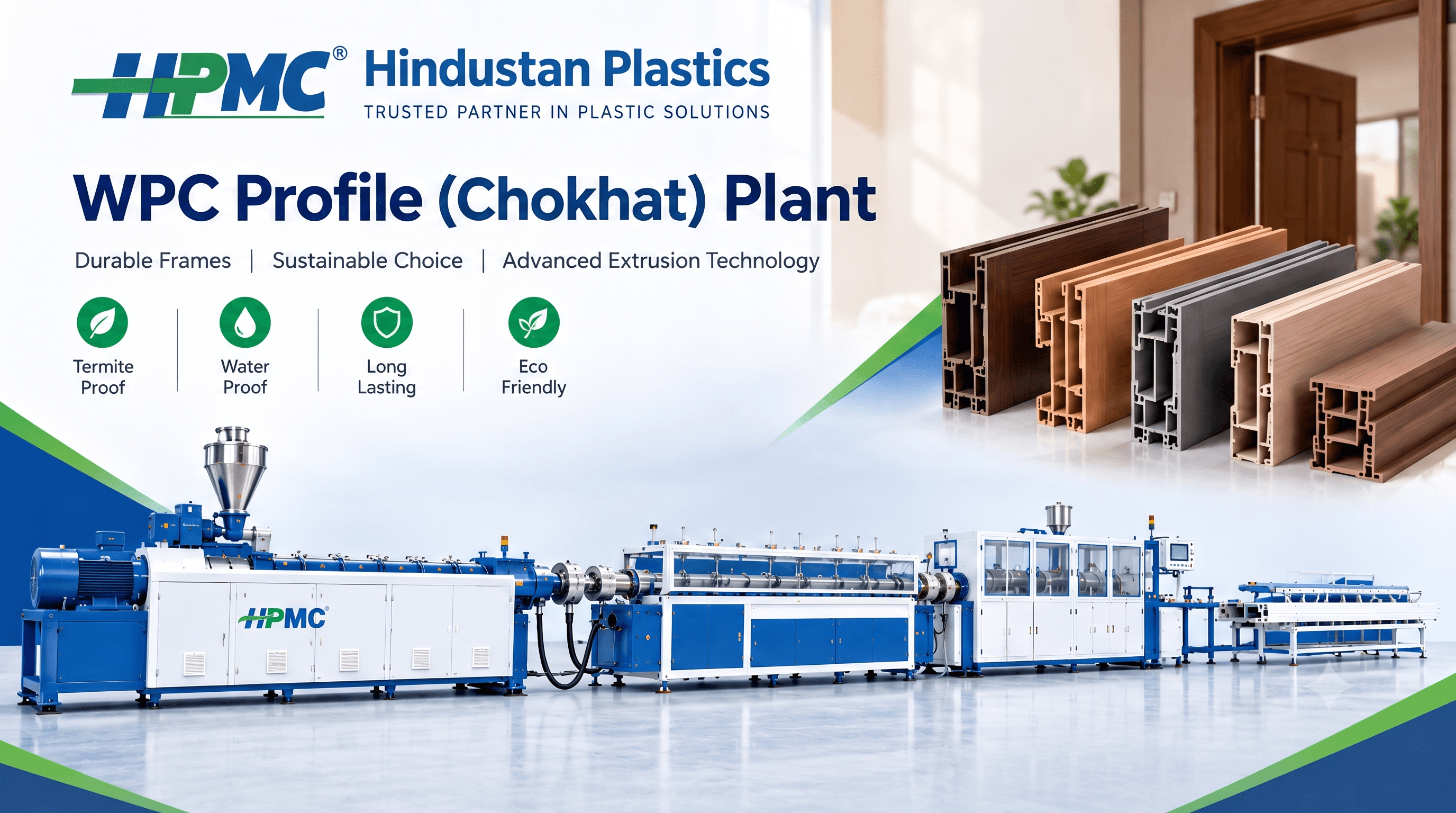
A WPC Profile (Chokhat) Plant is designed to process the selected composite formulation and convert it into continuous profiles using extrusion technology. The production setup may include a twin screw extruder, profile mould, calibration system, haul-off, cutting unit, and stacking arrangement.
For manufacturers planning to produce WPC door frames, the choice of raw materials, feeding arrangement, extrusion conditions, mould design, and calibration process can influence the final product's dimensions, strength, and surface finish.
This guide explains the important considerations involved in WPC chokhat manufacturing, from material preparation to finished-frame inspection.
What Is a WPC Profile (Chokhat) Plant?
A WPC profile plant is an extrusion-based production system used to manufacture continuous wood-plastic composite sections. When configured for chokhat production, it produces profiles intended for door frames and related construction applications.
The composite formulation generally combines a suitable thermoplastic with wood-based filler and processing additives. Depending on the formulation, the polymer may be PVC, PE, or PP. The correct material system must be selected according to the intended application and compatible machine configuration.
A typical WPC chokhat production line may include:
- Material feeding and conveying equipment
- A suitable extrusion system
- A profile mould or die
- Calibration and cooling equipment
- A haul-off unit
- A cutting system
- A stacking or collection arrangement
The exact configuration depends on the required frame dimensions, profile design, formulation, output target, and production method.
Why Is WPC Used for Door Frames?
WPC is used in construction because it combines a polymer matrix with wood-based filler. The resulting properties depend on the formulation, manufacturing process, profile design, and quality of the finished product.
1. Resistance to Moisture
WPC products can offer improved moisture resistance compared with untreated timber, depending on the polymer, filler content, additives, and product construction. However, resistance to water absorption should be verified for the specific product.
2. Resistance to Termites
WPC does not provide the same cellulose-based food source as natural timber, which can make it less susceptible to termite attack. Actual performance depends on the formulation and other materials used in the finished frame.
3. Reduced Dependence on Natural Timber
WPC manufacturing can use suitable wood flour, wood fibre, or rice husk powder as part of the composite formulation. This can provide an alternative material option for selected construction applications.
4. Consistent Profile Design
Extrusion allows manufacturers to produce continuous profiles using a designed mould. With suitable tooling and process control, the line can produce repeatable cross-sectional shapes.
5. Different Surface and Profile Options
Depending on the formulation, mould design, and finishing method, manufacturers can produce profiles for different door-frame designs and architectural requirements.
These benefits should be evaluated against the technical specifications of the actual WPC product rather than assumed for every formulation.
Raw Materials Used in WPC Chokhat Manufacturing
The material formulation is one of the most important decisions in WPC production. Different ingredients affect processing behaviour, finished strength, surface appearance, and dimensional stability.
Thermoplastic Material
The polymer forms the matrix that binds the composite ingredients. PVC, PE, and PP are used in different WPC applications, but the formulation and extrusion equipment must be compatible with the selected polymer.
Wood Flour or Wood Fibre
Wood-based filler contributes to the composite structure and influences density, processing behaviour, and finished-product characteristics. Particle size and consistency should be suitable for the formulation.
Rice Husk Powder
Rice husk powder can be used as a plant-based filler in selected WPC formulations. Its suitability depends on the material specifications, preparation, and processing requirements.
Processing Additives
Depending on the formulation, manufacturers may use stabilisers, lubricants, coupling agents, pigments, and other additives. Each ingredient should be selected according to the polymer system and intended product performance.
Material Preparation
The raw materials should be prepared according to the approved formulation. Moisture, particle-size variation, inconsistent blending, and contamination may affect extrusion stability and finished-profile quality.
Manufacturers should confirm the required material specifications and preparation procedures with their formulation or machinery supplier.
How Does a WPC Chokhat Plant Work?
The production process involves several connected stages. The exact arrangement varies according to the WPC formulation and the machine configuration.
Step 1: Material Preparation
The polymer, wood-based filler, and required additives are prepared according to the selected formulation. Consistent ingredient quality helps support repeatable processing.
Where drying or other material conditioning is required, it should be carried out according to the material supplier's recommendations.
Step 2: Feeding the Composite Blend
The prepared material is supplied to the extruder through the feeding arrangement.
WPC blends can differ in bulk density and flow characteristics because of the combination of polymer and plant-based filler. The feeding system should therefore be suitable for the selected blend and intended production rate.
Step 3: Extrusion and Material Processing
The extruder conveys and processes the material under controlled operating conditions. Depending on the machine design, the screws provide conveying, mixing, and plasticisation before the material reaches the profile mould.
Temperature settings, screw speed, feeding consistency, and formulation must be coordinated. Unsuitable conditions may affect surface finish, material stability, or the consistency of the finished profile.
Step 4: Profile Formation Through the Mould
The processed composite passes through a specially designed mould or die that establishes the required cross-sectional shape.
For a door-frame profile, the tooling should be designed according to the dimensions, wall sections, internal geometry, and other features required by the product drawing.
Step 5: Calibration and Cooling
After leaving the mould, the profile passes through the calibration and cooling section. This stage helps the material stabilise and retain the intended shape and dimensions.
The calibration tooling and cooling arrangement must match the profile geometry and production conditions.
Step 6: Haul-Off
The haul-off pulls the profile through the downstream equipment at a controlled speed. Pulling speed must be coordinated with extrusion output and cooling to help maintain dimensional consistency.
Step 7: Cutting and Stacking
The continuous profile is cut to the required length and collected for inspection, handling, and storage.
Cutting accuracy, profile support, and careful handling help prevent damage during the final production stages.
Why Feeding and Venting Matter in WPC Processing
WPC blends contain both thermoplastic material and plant-based fillers. Their flow behaviour may differ from that of a formulation containing only polymer.
The feeding and venting arrangement should therefore be evaluated as part of the complete extrusion system.
Feeding Consistency
Inconsistent material supply can affect the stability of extrusion. The feeding system should suit the bulk density, particle characteristics, and flow behaviour of the selected composite blend.
Material Conditioning
Moisture and other material variations can affect processing. Material preparation should follow the requirements of the selected formulation.
Venting Requirements
Depending on the formulation and machine design, venting may help remove volatile components from the processing system. The need for venting and the appropriate configuration should be established with the machinery manufacturer.
Coordination With the Extruder
Feeding, screw configuration, temperature control, and venting should be assessed together. A change in one part of the process may affect the behaviour of the material elsewhere in the line.
Manufacturers should confirm the appropriate configuration for their intended PVC-based or other WPC formulation before purchasing equipment.
Choosing the Right Mould for WPC Door Frames
The mould determines the profile's cross-sectional geometry and is an important part of the production setup.
Before selecting or designing a mould, manufacturers should consider the following factors.
- Frame dimensions: The required width, depth, and cross-sectional measurements should be defined in a technical drawing.
- Internal geometry: Chambers, ribs, grooves, and other features influence tooling design and material flow.
- Wall thickness: The design should suit the intended application and the material's processing characteristics.
- Material formulation: Tooling requirements may vary with the polymer system and filler composition.
- Calibration compatibility: The mould and calibration equipment must work together to maintain the required profile dimensions.
- Product range: Manufacturers planning multiple frame designs should discuss tooling requirements and changeover arrangements.
A mould should be evaluated as part of the complete extrusion setup rather than as an independent component.
Maintaining WPC Chokhat Quality During Production
Finished-frame quality depends on the raw materials, extrusion process, tooling, calibration, cooling, and handling practices.
Dimensional Consistency
The frame profile should be checked against the approved drawing. Variations may be associated with material supply, mould conditions, calibration, cooling, or haul-off speed.
Surface Finish
Surface appearance can be influenced by material consistency, formulation, processing conditions, mould condition, and cooling. Any corrective adjustment should be based on the observed problem.
Profile Shape
The profile should retain the intended shape after cooling. Warping or deformation may require checking the calibration arrangement, cooling conditions, alignment, and pulling speed.
Material Consistency
Differences in filler characteristics, polymer quality, additives, or material preparation can affect extrusion behaviour and finished-product properties.
Cutting Accuracy
Finished lengths should be checked against the required specifications. Suitable cutting settings and careful handling help reduce damage and unnecessary rejection.
Manufacturers should establish inspection criteria according to the product's technical requirements and intended application.
Common WPC Profile Production Problems and Possible Causes
Production issueAreas to investigate
Uneven profile dimensions
Mould condition, calibration, cooling, haul-off speed, and material consistency
Rough or inconsistent surface
Formulation, material preparation, mould condition, and processing settings
Profile warping
Cooling uniformity, calibration, alignment, and pulling speed
Unstable extrusion output
Feeding consistency, formulation, and machine operating conditions
Inconsistent finished-product properties
Raw material variation, blending, process control, and product design
These are possible causes rather than definitive diagnoses. Operators should review the complete process and follow the machine manufacturer's operating instructions before making adjustments.
How to Select a WPC Profile (Chokhat) Plant
Before investing in machinery, manufacturers should define the intended product and production requirements.
1. Define the Product
Prepare drawings or samples of the door-frame profiles you intend to manufacture. Include dimensions, wall sections, internal features, and required finished lengths.
2. Confirm the Material Formulation
Identify whether the intended blend uses PVC, PE, PP, or another suitable polymer system, along with the required wood-based filler and additives.
3. Evaluate Feeding and Venting
Discuss the flow characteristics and preparation requirements of the intended WPC blend. Confirm whether the proposed feeding and venting arrangements are suitable.
4. Review the Extrusion Configuration
The extruder should be selected according to the formulation, profile dimensions, expected output, and process requirements.
5. Check Mould and Calibration Compatibility
Ask about mould design, calibration tooling, product changeovers, and the support available for developing new profiles.
6. Confirm Downstream Equipment
The haul-off, cutting unit, cooling arrangement, and stacking system should suit the profile and intended production conditions.
7. Discuss Installation and Technical Support
Clarify installation requirements, commissioning, operator training, maintenance procedures, spare parts, and after-sales assistance before finalising the purchase.
Businesses can also explore HPMC's WPC Profile Plant to review the product information and discuss the intended profile application with the company.
WPC Profile Plant vs WPC Board Plant
WPC profile and board production serve different product requirements, even when both use wood-plastic composite materials.
A profile plant is configured for continuous sections with a particular cross-sectional geometry, such as door frames, window frames, and decorative profiles. A board plant is intended for producing board or panel-shaped products.
The mould, downstream equipment, product dimensions, and production requirements can differ between these applications. Manufacturers should confirm that the selected equipment is suitable for the product they intend to make.
For businesses planning to manufacture sheet or panel products, HPMC also provides information about its WPC Board Plant.
Maintenance Practices for a WPC Chokhat Production Line
Routine maintenance supports reliable operation and helps identify wear before it affects production.
Recommended areas for inspection include:
- Feeding and material-conveying equipment
- Screws, barrel, and relevant extrusion components
- Drive and gearbox systems
- Heating and temperature-control equipment
- Mould and calibration tooling
- Cooling and venting arrangements, where applicable
- Haul-off belts or rollers
- Cutting equipment
- Electrical controls and safety systems
The mould and calibration equipment should be maintained according to the manufacturer's instructions because their condition can affect profile shape and dimensions.
Maintenance schedules should reflect machine usage, material characteristics, and the equipment supplier's recommendations.
Conclusion
A WPC Profile (Chokhat) Plant is designed to manufacture wood-plastic composite profiles for door frames and other suitable construction applications. The finished product depends on the compatibility of the polymer and filler formulation, feeding system, extrusion equipment, mould, calibration, cooling, haul-off, and cutting arrangements.
Manufacturers planning a WPC chokhat production line should begin with clear profile drawings, defined material requirements, and realistic production targets. Evaluating feeding and venting needs, tooling compatibility, quality checks, and technical support can help them select an appropriate machine configuration.
A well-planned production setup and consistent process control are important for producing WPC profiles that meet the intended dimensional and application requirements.
Contact HPMC
Hindustan Plastics & Machine Corporation (HPMC)
Address: 5, Category II, DSIDC Industrial Area, Nangloi, Delhi – 110041, India
Website: https://www.hindustanplastics.com/
Phone: +91 95605 96392
Email: info@hindustanplastics.com
Google Business Profile: https://share.google/lBK4uD53HqY891ynv
Contact HPMC to discuss your WPC chokhat manufacturing requirements and request information about a suitable extrusion plant.
Frequently Asked Questions
Find quick answers to the most common questions about this topic.
It is an extrusion production line designed to manufacture wood-plastic composite profiles, including door-frame sections, using a suitable extruder, mould, calibration system, and downstream equipment.
WPC chokhat is made using a thermoplastic material combined with wood flour, wood fibre, rice husk powder, or other suitable fillers and processing additives, depending on the formulation.
Some WPC extrusion systems are designed for PVC-based blends with wood-based fillers. Compatibility depends on the machine configuration and the specific formulation.
The mould forms the composite material into the required cross-sectional shape. Its design should match the profile drawing and intended dimensions.
Calibration helps the extruded profile retain the intended shape and dimensions while it cools and stabilises.
The haul-off pulls the profile through the downstream equipment at a controlled speed. It must be coordinated with extrusion output and cooling.
WPC products can offer moisture resistance, but performance depends on the formulation, profile construction, processing quality, and installation. Product-specific performance should be verified rather than assuming complete waterproofing.
WPC can be less susceptible to termite attack than natural timber because it contains polymer and other non-cellulosic materials. Actual performance depends on the product formulation and construction.
Possible factors include inconsistent material feeding, mould condition, calibration, cooling, haul-off speed, and variations in the raw material formulation.
Consider the profile design, material formulation, production target, extruder configuration, feeding and venting, mould, calibration, cooling, cutting system, installation, and technical support.