
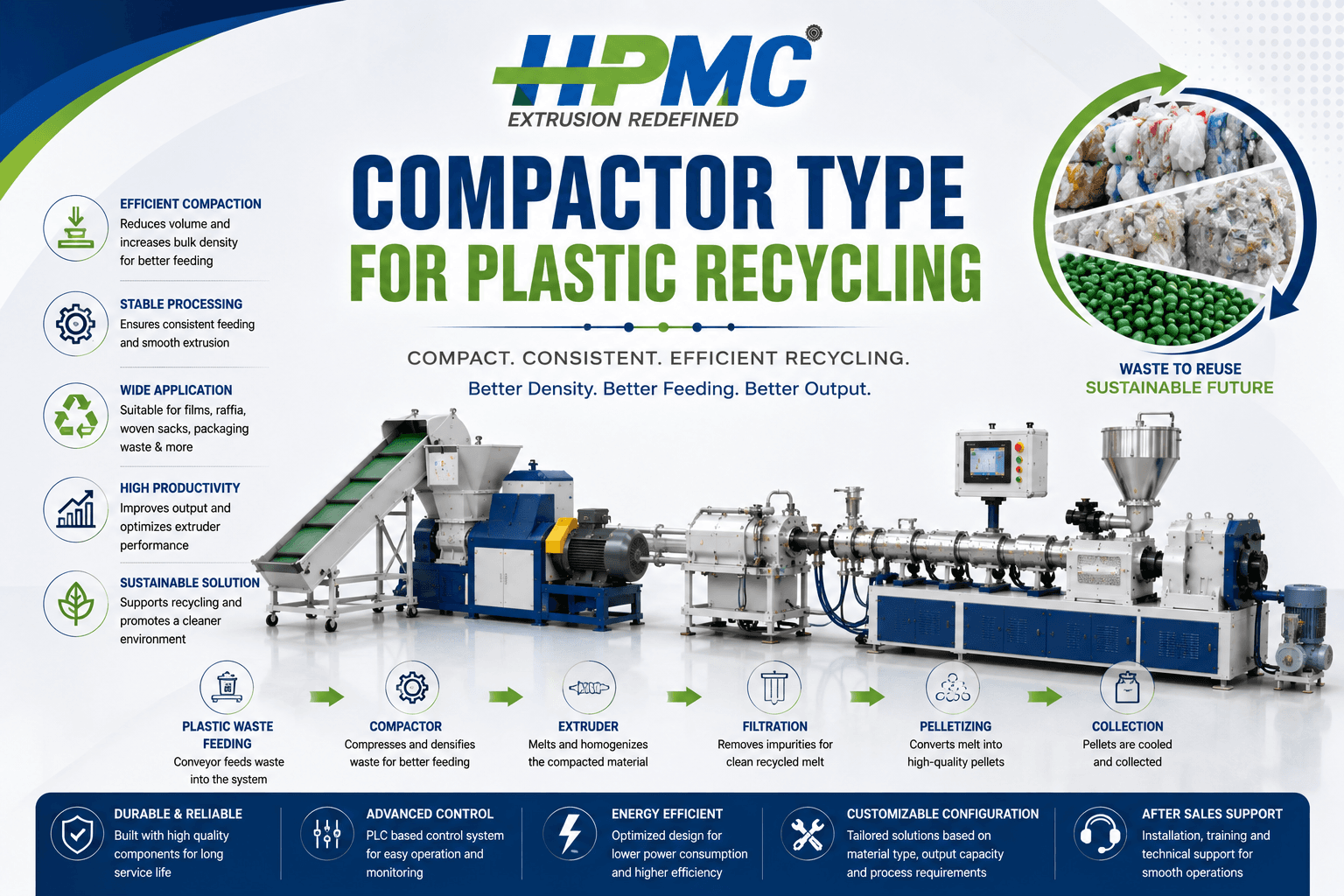
Plastic recycling has become an important part of modern plastic processing as manufacturers increasingly look for efficient ways to recover and reuse plastic waste. However, different types of plastic waste have different feeding, handling, and processing characteristics. Film, raffia, woven materials, lightweight plastics, and other low-density waste can be difficult to process efficiently using conventional recycling systems.
This is where a Compactor Type for Plastic Recycling system can provide an effective solution. A compactor helps reduce the volume of lightweight plastic materials, improve feeding consistency, and prepare the material for further extrusion and reprocessing.
For businesses looking for a Compactor Type for Plastic Recycling in Delhi, understanding the machine's working process, applications, configuration, and important selection factors can help in choosing the right recycling equipment.
What is a Compactor Type Recycling Machine?
A Compactor Type Recycling Machine is designed to process lightweight and bulky plastic waste before or during extrusion recycling.
Plastic films and similar materials have a low bulk density and can be difficult to feed consistently into a conventional extruder. A compactor uses mechanical action to collect, compress, agglomerate, and densify the material, making it easier to feed into the recycling extruder.
Depending on the system configuration, the compactor may be integrated with a recycling extruder to create a continuous plastic recycling line.
A typical system can include:
- Plastic waste feeding system
- Conveyor
- Metal detection or separation system
- Compactor
- Extruder
- Melt filtration system
- Die head
- Pelletizing system
- Cooling system
- Pellet collection system
- Electrical control panel
The exact configuration depends on the type of plastic waste, required output, material contamination, and desired final product.
Why is a Compactor Used in Plastic Recycling?
Lightweight plastic waste can create feeding challenges because it occupies a large volume relative to its weight.
For example, plastic films can bridge inside a hopper or fail to enter the extruder consistently. This can lead to unstable feeding, fluctuating output, and inefficient production.
A compactor helps increase the bulk density of the material before it reaches the extrusion stage.
Important benefits can include:
- Improved material feeding
- Higher bulk density
- Better feeding consistency
- Improved utilization of extruder capacity
- Reduced material volume
- Better handling of lightweight plastic waste
- More stable recycling operations
This makes compactor-based recycling systems particularly useful for specific categories of plastic waste.
How Does a Compactor Type Plastic Recycling Machine Work?
The process generally begins with feeding plastic waste into the system.
The incoming material may consist of plastic films, woven sacks, raffia, packaging waste, or other lightweight thermoplastic materials, depending on the machine configuration.
The material enters the compactor where mechanical action reduces its bulk volume and increases its apparent density. The process also helps prepare the material for continuous feeding into the extrusion system.
The compacted material is then transferred to the extruder.
Inside the extruder, controlled heating and mechanical action melt and homogenize the plastic. The molten material passes through a filtration system to remove remaining contaminants before being converted into recycled pellets or another suitable form.
The final recycled material can then be used as a raw material in suitable plastic manufacturing applications.
What Types of Plastic Waste Can Be Processed?
The suitability of a compactor recycling system depends on the machine configuration and the characteristics of the material.
Common applications can include:
- Plastic films
- Packaging films
- Agricultural films
- Woven plastic sacks
- Raffia waste
- Lightweight plastic waste
- Post-industrial film waste
- Selected post-consumer plastic waste
Material preparation is important before feeding waste into the recycling line. Excessive contamination, moisture, or unsuitable materials can affect the recycling process and finished pellet quality.
Key Features to Look for in a Compactor Type Recycling Machine
When evaluating Compactor Type for Plastic Recycling equipment, manufacturers should consider the complete system rather than looking only at the compactor.
Efficient Compaction
The compactor should be capable of handling lightweight plastic waste and preparing it for stable extrusion feeding.
Consistent Material Feeding
Stable feeding is important for maintaining consistent extruder output. A properly designed compactor can help reduce feeding fluctuations associated with low-density materials.
Suitable Extruder Configuration
The recycling extruder should match the type of plastic being processed, required production capacity, and desired output quality.
Effective Melt Filtration
Contaminants can remain in recycled plastic even after initial sorting and cleaning. A suitable filtration system can help remove unwanted particles from the molten polymer.
Temperature Control
Controlled temperature zones are essential for stable plastic melting and processing.
Automation
PLC-based controls can help operators monitor important parameters such as temperature, feeding rate, extrusion speed, and other operating conditions.
Durable Components
The compactor, extruder, gearbox, screw, barrel, filtration system, and other components should be selected according to the material and expected production conditions.
How to Choose a Compactor Type for Plastic Recycling
Selecting the right recycling machine requires understanding your material and production requirements.
Identify the Plastic Material
Start by identifying the type of plastic waste you intend to process. Different polymers require different processing conditions.
For example, a system designed for certain polyethylene films may require a different configuration from one intended for other plastic materials.
Evaluate Material Condition
Consider whether the waste is clean, washed, dried, printed, contaminated, or mixed with other materials.
The material condition can influence the required washing, drying, filtration, and extrusion configuration.
Determine Production Capacity
Estimate the required hourly output before selecting the machine. The compactor and extruder should be appropriately sized for your production targets.
Consider Filtration Requirements
If the input material contains contaminants, filtration becomes an important part of the recycling line.
Discuss the expected contamination level with the manufacturer to determine the appropriate filtration arrangement.
Evaluate Energy Consumption
Energy efficiency is an important consideration in plastic recycling. Compare motor efficiency, heating requirements, compactor operation, and overall line performance.
Check Automation and Controls
Automated controls can simplify operation and help maintain stable process parameters during continuous production.
Consider After-Sales Support
Installation, commissioning, operator training, spare parts, maintenance, and troubleshooting support are important when investing in recycling machinery.
Applications of Compactor Type Recycling Machines
Compactor-based plastic recycling systems can be used in several recycling and reprocessing operations.
Common applications include:
- Film recycling
- Waste plastic recycling
- Packaging waste recycling
- Agricultural film recycling
- Woven sack recycling
- Raffia recycling
- Post-industrial plastic recycling
- Plastic reprocessing
The exact application depends on the material type and machine configuration.
Benefits of Investing in a Compactor Recycling System
A properly designed compactor recycling line can provide several operational benefits.
Improved Feeding of Lightweight Materials
Compaction can make low-density materials easier to feed into the extruder.
Better Production Stability
More consistent feeding can help maintain stable extrusion output.
Efficient Handling of Bulky Waste
Compaction reduces the volume of lightweight plastic waste, making it easier to handle and process.
Reduced Manual Intervention
An integrated recycling line can automate several stages of the material preparation and extrusion process.
Improved Material Utilization
Efficient processing and controlled extrusion can help manufacturers recover usable material from selected plastic waste streams.
Support for Circular Plastic Processing
Recycling systems allow suitable plastic waste to be converted into reusable material, reducing dependence on virgin polymer for certain applications.
Compactor Recycling Machine vs Conventional Plastic Recycling
Conventional recycling systems may encounter difficulties when processing lightweight and bulky materials because of their low bulk density.
A compactor-based system addresses this feeding challenge by increasing the apparent density of the material before extrusion.
However, not every recycling application requires a compactor. The right solution depends on the type of waste, material density, contamination level, moisture content, required output, and recycling process.
This is why manufacturers should discuss their actual material samples and production requirements with the machine supplier before selecting a recycling system.
Compactor Type for Plastic Recycling in Delhi
Businesses searching for Compactor Type for Plastic Recycling in Delhi should evaluate local machine manufacturers based on their technical capabilities and ability to provide complete recycling solutions.
Important factors include machine configuration, production capacity, component quality, customization, installation support, and availability of spare parts.
Choosing a manufacturer that understands plastic recycling applications can make the installation and commissioning process more efficient.
Why Choose HPMC for Plastic Recycling Machinery?
HPMC provides plastic extrusion and recycling machinery for different plastic processing applications.
Our solutions can be configured according to the type of plastic waste, required production capacity, material characteristics, filtration requirements, and desired automation level.
Businesses looking for a Compactor Type for Plastic Recycling can discuss their material, production requirements, and recycling objectives with HPMC to determine a suitable machine configuration.
The focus is on appropriate recycling technology, reliable machine components, controlled processing, and technical support for long-term operation.
Conclusion
A Compactor Type for Plastic Recycling can be an important solution for processing lightweight and low-density plastic waste that can be difficult to feed into conventional recycling extruders. By reducing bulk volume and improving material feeding characteristics, a compactor can support more stable and efficient recycling operations.
Before investing in a compactor-based recycling line, manufacturers should carefully evaluate the type of plastic waste, contamination level, moisture content, required production capacity, filtration requirements, extrusion technology, and automation.
For businesses searching for a Compactor Type for Plastic Recycling in Delhi, choosing an experienced machinery manufacturer that can understand the complete recycling process can help ensure the equipment is properly configured for the intended application.
Frequently Asked Questions
Find quick answers to the most common questions about this topic.
A compactor is used to reduce the bulk volume and increase the apparent density of lightweight plastic waste, making it easier to feed into a recycling extruder.
Compactor systems are commonly used for suitable lightweight materials such as plastic films, woven sacks, raffia, packaging films, and selected post-industrial plastic waste.
No. The need for a compactor depends on the type, density, form, and feeding characteristics of the plastic waste being processed.
Consider the plastic material, waste condition, moisture and contamination levels, required production capacity, compactor configuration, extruder size, filtration system, automation, energy consumption, and after-sales support.
Yes. Depending on the application, a compactor can be integrated with an extrusion and pelletizing system to create a continuous recycling line.