
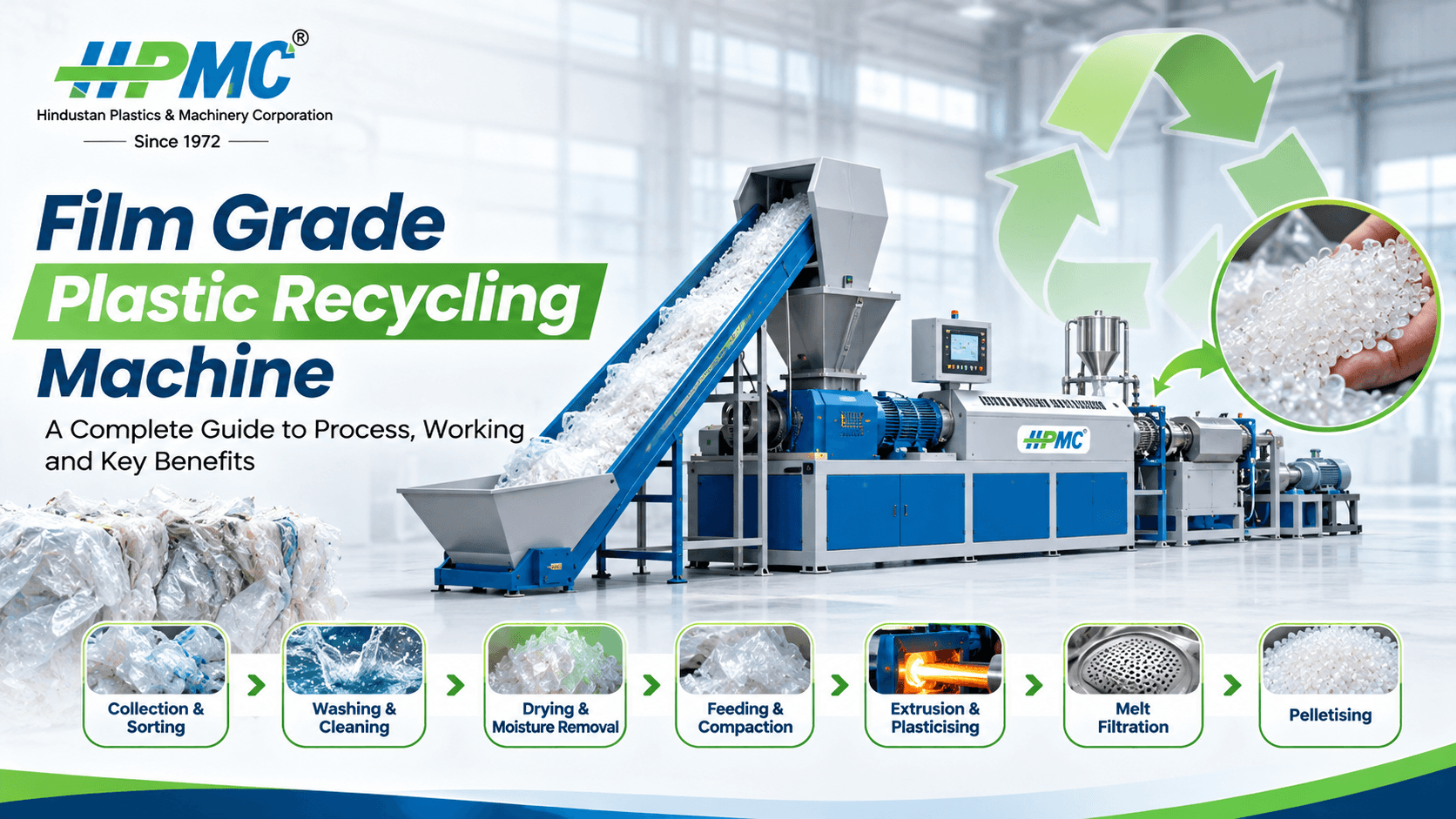
Plastic films are widely used in packaging, agriculture, shopping bags, industrial wrapping, liners and several other applications. Their extensive use creates a continuous demand for effective recycling solutions that can process suitable plastic film waste and convert it into reusable raw material.
A Film Grade Plastic Recycling Machine is designed to process compatible plastic film waste and convert it into recycled plastic granules. The recycling process generally involves material preparation, feeding, melting, filtration and pelletising. Depending on the quality of incoming waste and the required recycled output, the production line may also include washing, drying, compacting and advanced filtration systems.
Hindustan Plastics and Machinery Corporation (HPMC), based in Delhi, India, manufactures plastic processing and recycling extrusion machinery. With experience dating back to 1972, HPMC provides machinery solutions for manufacturers and recyclers looking to process plastic waste and improve material recovery.
For businesses planning to establish or expand a plastic recycling facility, a properly configured Film Grade Plastic Recycling Plant can support the conversion of suitable plastic film waste into reusable recycled material.
What Is a Film Grade Plastic Recycling Machine?
A Film Grade Plastic Recycling Machine is an industrial recycling system used to process compatible plastic film waste and convert it into reusable plastic granules.
Plastic film waste can come from different sources, including:
- LDPE packaging films
- LLDPE stretch films
- HDPE film waste
- Industrial wrapping films
- Agricultural films
- Plastic carry bags
- Packaging production scrap
- Selected post-industrial film waste
The exact material compatibility depends on the polymer type, contamination level, moisture content and machine configuration.
Unlike rigid plastic waste, film materials are lightweight, flexible and can be difficult to feed consistently into conventional extrusion systems. Their low bulk density and tendency to form loose bundles make material preparation and feeding particularly important.
A suitable recycling line addresses these challenges through an appropriate feeding arrangement, material compaction or agglomeration where required, controlled extrusion and effective melt filtration.
The final recycled granules can be used in compatible plastic manufacturing applications, subject to the recycled material's quality and intended end use.
How Does a Film Grade Plastic Recycling Plant Work?
A plastic film recycling line generally operates through several connected stages. The exact process depends on whether the incoming material is clean production scrap, contaminated post-consumer film or washed plastic waste.
1. Collection and Material Sorting
The process begins with collecting and sorting plastic film waste.
Different plastic materials should be separated according to polymer type and recycling requirements. Mixing incompatible plastics can affect melt quality and the properties of the recycled output.
Sorting may include separating:
- LDPE films
- LLDPE films
- HDPE films
- Printed and unprinted films
- Coloured and natural films
- Different polymer grades
- Materials containing non-plastic contaminants
Proper sorting helps improve the consistency of the recycled material.
2. Washing and Cleaning
When the incoming film waste contains dirt, dust, labels, food residue or other contamination, washing may be required before extrusion.
A suitable washing system helps remove unwanted substances from the plastic surface. The washing process should be selected according to the contamination level and the type of film being processed.
Clean industrial production scrap may require a different preparation process from heavily contaminated post-consumer film.
3. Drying and Moisture Removal
After washing, plastic films need appropriate drying before entering the extrusion process.
Excess moisture can cause processing problems, including steam formation, bubbles and variations in the recycled material.
The drying arrangement should match the incoming material's moisture level and the requirements of the extrusion system.
4. Feeding and Material Compaction
Plastic films have low bulk density and can be difficult to feed continuously into a conventional extruder.
Depending on the machine configuration, a compactor or agglomeration system may be used to prepare the material for extrusion.
This stage helps manage the feeding characteristics of loose film waste and supports a more consistent material supply to the extruder.
5. Plasticising and Extrusion
The prepared film material enters the recycling extruder, where it is heated, melted and conveyed through the screw and barrel system.
The extruder must be suitable for the polymer type and incoming material characteristics. Controlled processing helps maintain stable melt delivery and supports consistent recycling operations.
For film recycling applications, appropriate screw design, feeding arrangements and temperature settings are important because different film grades can behave differently during extrusion.
6. Degassing and Venting
Depending on the material condition and extrusion system, degassing may be used to remove moisture vapour and volatile substances from the molten plastic.
Vented recycling systems can be useful when processing materials that require additional devolatilisation.
The effectiveness of degassing depends on the incoming material, moisture content, contamination and machine configuration.
7. Melt Filtration
The molten plastic passes through a filtration system to remove remaining solid contaminants.
Melt filtration helps improve the cleanliness of the recycled material and protects downstream equipment.
The filter selection depends on the contamination level, polymer type, production requirements and desired recycled output quality.
For applications requiring continuous filtration, manufacturers can also explore HPMC's Self Cleaning Laser Filter.
8. Pelletising
After filtration, the molten polymer is converted into small recycled granules through a suitable pelletising system.
The pelletising method depends on the machine configuration and the material being processed.
The granules are then cooled and prepared for collection, storage and further use.
9. Final Quality Inspection
The recycled granules should be checked for relevant quality parameters, such as:
- Appearance and colour consistency
- Contamination levels
- Moisture content
- Melt flow characteristics
- Bulk density
- Processing suitability
- Mechanical properties, where required
Quality requirements depend on the intended application of the recycled material.
Key Features of a Film Grade Plastic Recycling Machine
A film recycling system should be configured according to the type of waste, material condition and required output quality.
Suitable Feeding Arrangement for Plastic Films
Plastic film waste is lightweight and flexible, which can make consistent feeding difficult.
An appropriate feeding and material preparation arrangement helps manage the low bulk density of film materials and supports stable extrusion.
High-Efficiency Recycling Extruder
The recycling extruder melts and conveys the prepared plastic material through a controlled process.
The screw and barrel configuration should be selected according to the polymer type, material condition and required production output.
Compactor or Agglomeration System
A compactor or agglomeration arrangement may be used to prepare loose film waste before extrusion.
This can help improve feeding consistency and material handling, particularly when processing lightweight film scrap.
Degassing and Venting System
A vented extrusion system can help remove moisture vapour and volatile substances from the molten polymer.
The need for venting depends on the incoming material's condition and the required output quality.
Melt Filtration System
Filtration helps remove solid contaminants from the molten plastic before pelletising.
The appropriate filtration arrangement depends on the level and type of contamination present in the feedstock.
Pelletising System
The pelletising section converts filtered molten plastic into granules that can be collected and used in compatible manufacturing processes.
Controlled Processing
Temperature, screw speed, feeding and filtration conditions need to be coordinated to support stable production.
The available control and automation features depend on the selected machine configuration.
Technical Assistance and Installation
HPMC provides machinery-related technical support and installation services. The exact scope should be discussed according to the customer's recycling project and selected equipment.
Types of Plastic Film Waste That Can Be Recycled
A Film Grade Plastic Recycling Machine may be configured for different types of compatible plastic film materials.
1. LDPE Film Waste
Low-density polyethylene (LDPE) films are commonly used in packaging, liners, bags and protective wrapping.
Suitable LDPE film waste can be processed into recycled granules for compatible plastic manufacturing applications.
2. LLDPE Stretch Film
Linear low-density polyethylene (LLDPE) stretch films are widely used for pallet wrapping, industrial packaging and load protection.
Clean production scrap and suitable recovered stretch films can be recycled using appropriately configured equipment.
3. HDPE Film Waste
High-density polyethylene (HDPE) films are used in bags, packaging and several industrial applications.
HDPE film recycling requires processing conditions and machine configuration suitable for the selected material grade.
4. Agricultural Plastic Films
Agricultural films are used in applications such as crop protection, greenhouse covering and soil management.
Used agricultural films may contain soil, moisture and other contaminants. They generally require suitable sorting, washing and drying before extrusion.
5. Industrial Packaging Films
Industrial packaging films are used for wrapping, protection and transportation of goods.
Manufacturing scrap from these applications can be a suitable recycling feedstock when the polymer type and material condition are compatible with the recycling system.
6. Post-Industrial Film Scrap
Plastic film manufacturers generate edge trims, rejected films and other production waste.
This material can often be recovered through a suitable recycling process, subject to polymer compatibility and contamination levels.
Benefits of Investing in a Film Grade Plastic Recycling Plant
A suitable plastic film recycling system can help businesses recover valuable material and establish an organised recycling operation.
Recovery of Reusable Plastic Material
Plastic film waste can be processed into recycled granules that may be used in compatible manufacturing applications.
The usable recycled output depends on the incoming material quality and the recycling process.
Better Management of Production Scrap
Film manufacturers and packaging units often generate rejected material and production scrap.
A recycling line can help recover suitable waste and return it to an appropriate material utilisation process.
Improved Material Handling
A suitable feeding and compaction arrangement can help manage lightweight plastic films and improve the consistency of material feeding.
Controlled Melt Processing
A properly configured extruder supports controlled melting and material conveyance.
Suitable process settings help maintain consistent production and improve the repeatability of recycling operations.
Improved Recycled Material Cleanliness
An appropriate melt filtration system helps remove solid contaminants from the molten polymer.
The final material quality also depends on sorting, washing, drying and the condition of the incoming waste.
Support for Circular Material Use
Recycling compatible plastic films helps recover material that may otherwise be discarded. Recycled granules can be used in suitable products where their properties meet the required specifications.
Flexible Recycling Applications
Depending on the machine configuration, a film recycling line can process different compatible PE film materials.
Manufacturers should confirm the supported polymer grades and feedstock conditions before purchasing equipment.
How to Choose the Right Film Recycling Machine
Selecting the right Film Grade Plastic Recycling Machine requires an understanding of the material, production target and final recycled product requirements.
1. Identify the Plastic Material
Determine whether the incoming film waste consists of LDPE, LLDPE, HDPE or a combination of materials.
Different polymers have different processing characteristics. Material compatibility should be confirmed before finalising the machine configuration.
2. Evaluate the Condition of Film Waste
Check whether the feedstock is clean production scrap or contaminated post-consumer material.
Important factors include:
- Dirt and dust content
- Moisture level
- Printing ink and labels
- Sand and other solid contaminants
- Mixed polymer content
- Presence of non-plastic materials
These factors influence the need for washing, drying, compaction and filtration.
3. Define the Required Production Capacity
Estimate the quantity of film waste to be processed per hour or per shift.
The machine should be selected according to the actual feedstock and required output. Production capacity can vary significantly with material type, moisture, contamination and machine configuration.
4. Review the Feeding and Compaction System
Because plastic films have low bulk density, the feeding arrangement is an important part of the recycling line.
Discuss whether a compactor or agglomeration system is required for your specific material.
5. Select the Appropriate Extruder
The extruder should be suitable for the polymer grade, feedstock condition and desired output.
Consider screw configuration, heating zones, motor capacity, degassing requirements and operating conditions.
6. Evaluate Degassing Requirements
If the incoming film contains moisture or volatile substances, a suitable venting arrangement may be required.
The choice of vented or non-vented extrusion equipment should be based on the feedstock condition and desired recycled material quality.
7. Choose the Right Filtration System
The filtration system should match the contamination level and the quality requirements of the final granules.
For heavily contaminated materials, filtration capacity and cleaning arrangements become particularly important.
8. Consider Pelletising Requirements
The pelletising arrangement should be compatible with the polymer and required granule characteristics.
Discuss the desired pellet size, production method and downstream handling requirements with the machinery manufacturer.
9. Confirm Installation and Technical Support
Before purchasing, clarify installation, commissioning, operator training, maintenance guidance and spare parts requirements.
You can explore HPMC's technical assistance services, field services and machine manuals.
Film Grade Plastic Recycling Machine Price in India
The price of a Film Grade Plastic Recycling Machine depends on the type of plastic film being processed and the required production configuration.
Important factors influencing the quotation include:
- Type of plastic film, such as LDPE, LLDPE or HDPE.
- Required processing capacity.
- Condition and contamination level of the incoming waste.
- Washing and drying requirements.
- Feeding and compaction arrangement.
- Extruder size and screw configuration.
- Degassing and venting requirements.
- Melt filtration system.
- Pelletising arrangement.
- Automation and control features.
- Installation, commissioning and training requirements.
A recycling line designed for clean industrial film scrap may require a different configuration from one intended for contaminated post-consumer agricultural films.
For an accurate quotation, manufacturers should share the material type, feedstock condition, expected hourly input and desired recycled output with HPMC.
Why Choose HPMC for Plastic Film Recycling Machinery?
Hindustan Plastics and Machinery Corporation has been serving the plastic processing machinery industry since 1972.
HPMC provides recycling and extrusion machinery solutions for businesses looking to process plastic waste and recover reusable material.
Key considerations include:
- Industry experience: Serving the plastic machinery industry since 1972.
- Recycling machinery solutions: Equipment options for different plastic recycling applications.
- Application-based configuration: Machinery selection according to material type and processing requirements.
- Filtration solutions: Access to relevant filtration equipment for plastic recycling applications.
- Installation support: Turnkey installation and technical service, subject to the agreed project scope.
- Technical assistance: Support resources for machinery operation and maintenance.
Explore HPMC's official website to learn more about its plastic recycling and extrusion machinery.
Related HPMC Recycling Machines and Resources
If you are planning a plastic recycling facility, the following HPMC products and resources may also be useful:
- Two Stage Recycling Plant — for recycling applications requiring a two-stage extrusion arrangement.
- Vented Recycling Plant — for recycling processes where degassing and venting are required.
- Recycling Plant with Compactor — for applications involving lightweight plastic waste and material compaction.
- Wet Recycling Extrusion Line — for suitable recycling applications involving wet material processing.
- Self Cleaning Laser Filter — for melt filtration requirements in plastic recycling.
- Corotating Twin Screw Extruder — for relevant compounding and recycling applications.
- Spare Parts — for machinery spare parts information.
- Technical Assistance — for technical support information.
- Extrusion Hints — for additional extrusion guidance.
- Troubleshooting Resources — for troubleshooting information.
The suitability of each machine depends on the feedstock and intended recycling process. Contact HPMC to discuss the appropriate configuration for your material.
Conclusion
A Film Grade Plastic Recycling Machine helps manufacturers and recycling businesses process suitable plastic film waste into reusable recycled granules. The right system should be selected according to the polymer type, contamination level, moisture content, production capacity and quality requirements of the final material.
A well-planned recycling line may include material preparation, compaction, extrusion, degassing, melt filtration and pelletising. Each stage contributes to the overall performance and consistency of the recycling process.
Hindustan Plastics and Machinery Corporation has served the plastic machinery industry since 1972 and offers recycling extrusion machinery and technical support services. Contact HPMC to discuss your film recycling requirements and request a machine quotation.
Contact Hindustan Plastics and Machinery Corporation (HPMC)
Company: Hindustan Plastics and Machinery Corporation (HPMC)
Address: 5, Category II, DSIDC Industrial Area, Nangloi, Delhi – 110041, India
Phone: +91 95605 96392
Email: info@hindustanplastics.com
Website: https://www.hindustanplastics.com/
Request a Quote: Contact HPMC
Google Business Profile: View HPMC on Google
When contacting HPMC, share the type of plastic film, contamination level, moisture condition, expected processing capacity and desired recycled output to discuss a suitable machine configuration.
Frequently Asked Questions
Find quick answers to the most common questions about this topic.
A Film Grade Plastic Recycling Machine is used to process compatible plastic film waste and convert it into reusable recycled granules through material preparation, extrusion, filtration and pelletising.
Depending on the machine configuration, suitable materials may include LDPE, LLDPE and HDPE films. The compatibility of mixed or contaminated materials should be confirmed before processing.
Yes. Suitable LDPE and LLDPE film waste can be processed into recycled granules using an appropriately configured recycling line. Material sorting and feedstock quality are important for consistent output.
Plastic films have low bulk density and can be difficult to feed into an extruder. A compactor or agglomeration system can help prepare loose film material and support more consistent feeding.
Degassing helps remove moisture vapour and certain volatile substances from molten plastic during extrusion. Its effectiveness depends on the feedstock condition and the recycling machine configuration.
Melt filtration removes solid contaminants from molten plastic before pelletising. It helps improve the cleanliness of recycled material and protects downstream equipment.
Suitable agricultural films can be recycled, but they may require sorting, washing and drying before extrusion because they can contain soil, moisture and other contaminants. The recycling line must be designed for the actual feedstock condition.
Output depends on the extruder configuration, polymer type, film thickness, contamination, moisture content, feeding arrangement, filtration system and operating conditions.
The price depends on processing capacity, material type, feedstock condition, washing requirements, extruder configuration, filtration and pelletising equipment. Contact HPMC for a quotation based on your requirements.
Visit the HPMC contact page, call +91 95605 96392 or email info@hindustanplastics.com. Share your film material details and production requirements to discuss a suitable recycling solution.