Introduction
A PVC conduit dual pipe extrusion line produces two conduit pipes at the same time from one extrusion system. For manufacturers running repeat orders, the arrangement can increase production within a single line. Its value depends on whether both outlets can produce acceptable pipes at the required dimensions, finish and cut length throughout a normal shift.
A demonstration can look productive when two pipes are moving through the line. The more useful measure is how many of those pipes pass inspection. If one outlet repeatedly produces uneven walls or stops during cutting, the total material processed may look good while the number of saleable lengths falls.
This guide explains how twin pipe extrusion works, what to check at each stage and how to compare configurations using your own formulation, conduit sizes and production targets.
What Is a PVC Conduit Dual Pipe Extrusion Line?
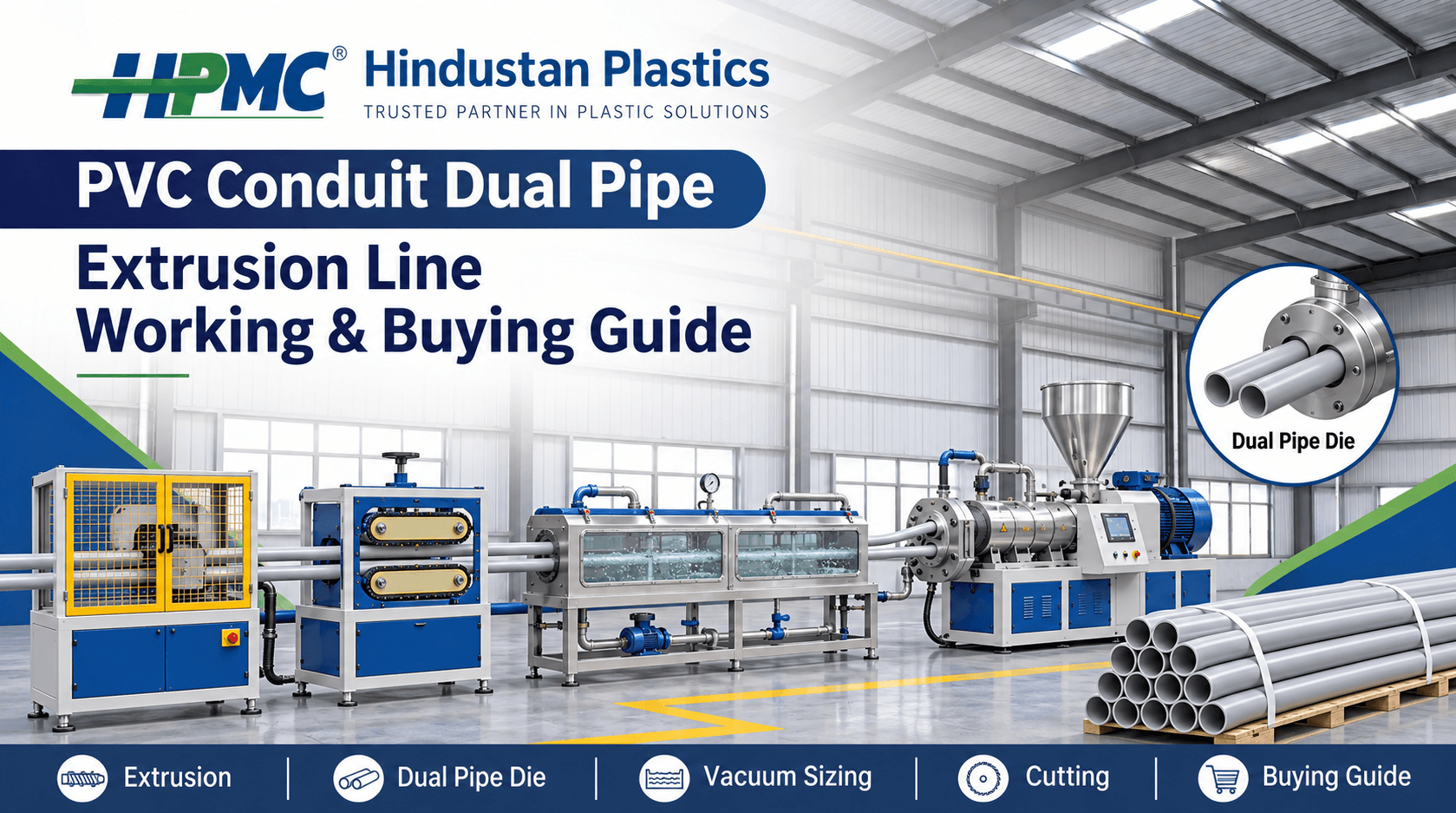
A dual pipe extrusion line feeds processed PVC compound into a die head designed to form two pipes. Each pipe follows a path through sizing, cooling, haul-off and cutting. The layout and controls depend on the equipment configuration and tooling.
HPMC’s Two Pipe PVC Conduit Plant uses a conical twin screw extruder, dual pipe die head, vacuum sizing, haul-off and cutting equipment. When reviewing a proposal, ask which parts are shared between the two paths and which can be adjusted separately. This helps you understand how the operator can respond if only one pipe goes out of specification.
Buyers should start with a list of finished products. Include the outside diameter, wall thickness, length and applicable inspection requirements for each conduit. Ask which size combinations the supplier will support, whether each combination requires different tooling and what happens to the second outlet during a changeover.
How Does a Dual Pipe Extrusion Line Work?
1. Prepare and Feed the PVC Compound
The first step is to supply the extruder with a consistent PVC formulation. Discuss the proposed compound, any permitted variation in the ingredients and how it will be prepared and fed. If you already run a formulation in production, ask the supplier to test that material under the agreed conditions.
Record the compound batch during each trial. If the results change when a new batch is introduced, that record makes it easier to compare the material and the process settings. This is particularly useful when one pipe path starts showing a problem after a period of stable production.
2. Process the Compound in the Extruder
The extruder conveys and plasticises the material before delivering it to the die head. Consistent material delivery matters because changes at the extruder can affect both pipe paths. Ask what operating information the machine records and how operators can identify whether a problem began upstream or at one of the outlets.
When you compare proposals, ask the supplier to state the assumptions behind the quoted output. A figure based on one conduit size and formulation may differ from what you obtain with another size or wall thickness. Request results for the products that matter most to your orders.
3. Form Two Pipes in the Dual Pipe Die Head
The die head divides the material into two paths and forms a pipe at each outlet. During the trial, collect a sample from both paths at the same time. Measure the wall at several points around each pipe and record the results separately. A combined average can hide an issue on one outlet.
Ask how the die will be configured for the specified pipe sizes and whether the two outputs must match for your proposed tooling. If you want to produce two different sizes together, supply both drawings and request written confirmation for that combination. Ask to see the proposed combination running during the trial.
4. Size and Cool Both Pipes
Vacuum sizing helps bring the pipe to its specified outside dimensions, while cooling helps it retain its shape. Check the pipes after cooling using the same measurement method on both paths. Record where the samples were taken and check whether either pipe develops visible deformation during handling.
If one path consistently gives a different result, compare the samples with the supplier. Ask how the proposed line lets operators observe the sizing and cooling conditions for each pipe. This becomes important when one path requires investigation while the other remains within specification.
5. Pull, Cut and Collect Finished Lengths
The haul-off moves the pipes through the line at a controlled rate. The cutting equipment then produces the specified lengths. Inspect cut ends for squareness, roughness and visible damage. Keep samples from each path so the results can be traced to the equipment that produced them.
Ask how both pipes will be collected and kept separate during inspection. A simple way to label samples is to use the outlet position and time of collection. That helps the team follow one path through the trial, even when both finished pipes look alike.
Single Pipe, Dual Pipe and Four Pipe Lines
The number of outlets affects the production layout, tooling and the work needed to monitor finished output. Match the configuration to your usual order sizes, the range you intend to run and the support your team can provide across a shift.
- Single pipe line. Evaluate a single path if your production plan involves frequent product changes or runs that are easier to schedule one size at a time. HPMC’s PVC Conduit Pipe Plant is a starting point for reviewing a single-output configuration.
- Dual pipe line. Compare a two-output configuration when your orders can use both pipe paths consistently. Check the exact size combinations, tooling changes and quality controls needed for each path.
- Four pipe line. Consider whether recurring orders can keep four paths productive and whether downstream handling and inspection can keep up. Review HPMC’s Four Pipe PVC Conduit Plant when assessing this configuration.
Compare the options using the same product mix and working hours. The right configuration is the one that fits the orders you expect to manufacture and lets your team inspect and handle the output consistently.
What to Inspect During a Dual Pipe Line Trial
Start with your conduit drawings, a representative compound and written acceptance criteria. Agree on how long the line will run and what must be measured. Include checks required by the applicable product specification. The following checks give the trial team a record it can compare across the two paths.
- Outside diameter. Measure cooled samples from both paths at the agreed points. Record readings by path so that a difference can be traced.
- Wall thickness. Measure several points around the circumference. Compare the thinnest and thickest readings with your product requirements.
- Roundness. Check the cooled pipes using the method agreed for the trial. Repeat the measurement if deformation appears after cutting or handling.
- Surface finish. Look for marks, roughness and colour variation. Record whether an issue occurs on one path or both.
- Cut length and ends. Check finished length and inspect the ends for squareness, burrs or damage before stacking.
- Repeatability. Collect labelled samples at the start, middle and end of the agreed production period. Use the same acceptance criteria for every sample.
Keep approved samples for commissioning. If the supplier runs only the easiest conduit size, ask for an additional trial on a size or wall specification that is critical to your production plan.
How to Compare Saleable Output
Ask the supplier to report both material processed and accepted conduit lengths. Kilograms per hour can help compare extrusion performance, while accepted lengths per hour tell you how much usable product the complete line delivers. Record results for each path before combining them.
For example, suppose a one-hour trial produces 180 lengths from the first path and 170 from the second. If 10 lengths from the first path and 20 from the second fail inspection, the combined saleable result is 320 lengths for that hour. Keeping the counts separate shows that the second path had more rejects and gives the team a specific result to investigate.
Ask whether the time recorded includes stops, adjustments and startup. If the supplier reports a stable period only, request the elapsed time as well. This lets you compare the demonstration with a normal shift, where operators may spend part of the day changing sizes, clearing material or returning to an approved setup.
How to Plan Production Across Both Outlets
Build a weekly schedule using the orders you actually expect to run. Start with the conduit sizes that account for most of your volume, then list smaller orders and the tooling changes they require. If two sizes are to be produced together, check whether the order quantities match closely enough to use both outlets for the planned run.
For example, suppose you need 900 lengths of one size and 300 of another. A trial that produces both sizes at similar rates tells you how the line performs while both orders are active. It also raises a scheduling question. Once the smaller order is complete, ask whether the proposed setup can continue with one outlet, change to another approved combination or requires a different run plan.
Include cutting, inspection and packing in the schedule. If the team can form more conduit than it can check and stack, the downstream workload will limit what is ready to dispatch at the end of the shift. Include changeover time as well.
Common Dual Pipe Extrusion Issues
The location of a defect provides a starting point for investigation. If both pipes change at the same time, check what changed in the material or shared process. If only one pipe changes, compare its tooling and downstream path with the other. Use the observations to guide the next check with the supplier.
- Uneven wall thickness on one path. Compare the sample measurements, tooling setup and material distribution at that outlet.
- Diameter changes after cooling. Review the sizing and cooling conditions, the measurement method and the point at which the pipe was inspected.
- Surface marks on both pipes. Compare the material batch and shared operating conditions before investigating each path separately.
- Cut lengths vary on one path. Review the relevant haul-off, length measurement and cutter setup.
- Frequent rejects after a size change. Record how long each path takes to produce acceptable samples after the tooling change.
For more examples of process symptoms and what to inspect, see HPMC’s guide to common PVC pipe extrusion defects.
How to Choose the Right PVC Conduit Dual Pipe Extrusion Line
1. List the Sizes You Plan to Sell
Separate your highest-volume conduits from sizes you make occasionally. Ask suppliers to quote tooling for the first production range and identify which additional sizes can be added later. This gives you a clearer view of launch costs and changeover requirements.
2. Compare the Complete Equipment Scope
Ask for an itemised quote covering the extruder, dual die head, sizing and cooling equipment, haul-off, cutter, controls and tooling for each approved size. List any equipment you want to reuse and ask the supplier to confirm how it will fit into the line. Include the same product specifications in every enquiry.
3. Check the Factory Layout and Utilities
Request a layout showing machine dimensions, material feeding, access for service and space for cut lengths. Confirm the quoted electrical and water requirements and ask what utilities you need to provide. Consider how operators will move approved pipes to packing and separate rejected material during a shift.
4. Agree on Changeover Expectations
Ask which tools must be changed and how the line is brought back to acceptable quality. During a demonstration, record the time from the last acceptable length of the previous size to the first acceptable length of the next size. This gives you a more useful planning figure when you switch products frequently.
5. Confirm Commissioning and Operator Support
Agree on who supplies the trial compound, which sizes will be demonstrated and what results will be recorded before acceptance. Ask what operator training covers and how your team can obtain help during the first production runs. HPMC describes its installation and troubleshooting support under Technical Assistance.
What Affects the Price of a Dual Pipe Extrusion Line?
The price depends on the line configuration, conduit size range, number of tooling sets, controls and commissioning scope. A proposal for one pair of pipe sizes can differ from a proposal that includes several combinations and additional downstream equipment. Ask the supplier to identify what is included and which items are optional.
Before comparing prices, request the following details.
- Tooling. Confirm which dies and sizing tools are included and whether the price covers both paths for each agreed size.
- Downstream equipment. Check the scope of sizing, cooling, haul-off, cutting and pipe collection.
- Trial conditions. Confirm the sample material, test duration and criteria for accepting finished pipes.
- Installation. Clarify site preparation, utility connections, training and commissioning responsibilities.
- Support. Ask which wear components are included initially and how replacements are ordered.
A written comparison is easier to use when each supplier quotes against the same drawings, materials and output requirements. Ask for clarification on any missing item before comparing the total cost of getting the line ready for production.
Conclusion
A PVC conduit dual pipe extrusion line can make two pipes at once, but buying decisions should be based on acceptable output from both paths. Start with your drawings and usual order sizes, then run a representative trial. Measure each pipe path separately, check the finished lengths and confirm which tooling and support the quotation includes.
Contact HPMC
HPMC (Hindustan Plastics and Machinery Corporation).
Share your conduit drawings, size combinations, formulation and target output with HPMC to discuss tooling, line configuration and the scope of a machine trial.
Address: 5, Category II, DSIDC Industrial Area, Nangloi, Delhi – 110041, India.
Phone: +91 95605 96392.
Email: info@hindustanplastics.com.
Frequently Asked Questions
Find quick answers to the most common questions about this topic.
It is an extrusion system that forms two PVC conduit pipes at the same time through a dual pipe die head, with downstream equipment for sizing, cooling, pulling and cutting.
Some configurations support selected size combinations. Give the supplier both pipe drawings and confirm the tooling and downstream setup for that specific combination.
It directs the processed compound into two paths and forms a pipe at each outlet. Both paths should be checked separately during a production trial.
Vacuum sizing helps the formed pipe reach its intended outside dimensions. Check the cooled pipe against the agreed dimensional requirements.
Collect labelled samples from both paths and measure several points around each pipe. Compare the results with the product specification and record the readings separately.
Extruder output measures material processed over time. Saleable output counts finished pipes that pass inspection, after accounting for rejects and waste.
Confirm the tooling required, the adjustments involved and how long it takes both paths to produce acceptable pipes again. Keep labelled samples after the change.
Compare both if your order volumes can keep multiple paths in regular use. Evaluate tooling, changeover time, inspection workload and accepted output for your product mix.
Price depends on equipment scope, supported size combinations, tooling, controls and commissioning requirements. Request an itemised quote based on your product drawings.
Send the conduit drawings, required size combinations, material details, target accepted output and factory layout. Include any trial or product acceptance requirements.