
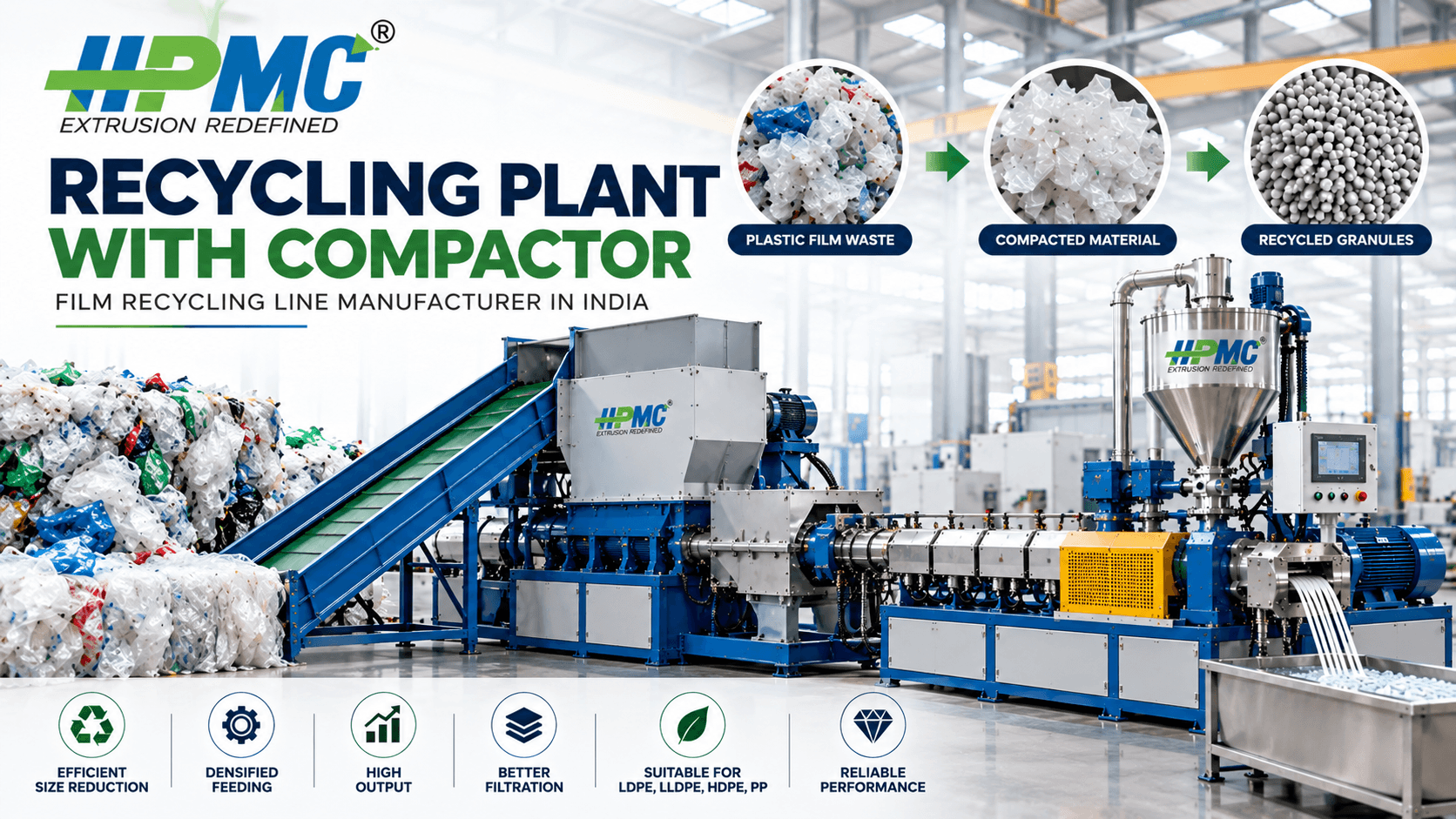
Plastic film recycling has become an important part of modern plastic waste management and resource recovery. However, recycling lightweight materials such as LDPE film, LLDPE stretch film, HDPE film and woven plastic sacks can present operational challenges. These materials may be bulky, flexible and difficult to feed consistently into a conventional plastic recycling extruder.
A Recycling Plant with Compactor addresses this challenge by integrating a compactor with an extrusion and pelletizing system. The compactor cuts and densifies lightweight plastic material before feeding it into the extruder, helping maintain a more consistent material supply and supporting efficient recycling operations.
Hindustan Plastics & Machine Corporation (HPMC) manufactures recycling plants with compactor systems for businesses looking to process plastic waste into reusable granules. With its experience in plastic processing machinery since 1972, HPMC provides machinery solutions for different recycling applications and production requirements.
Explore the official HPMC Recycling Plant with Compactor to learn more about its configurations and applications.
What Is a Recycling Plant with Compactor?
A Recycling Plant with Compactor is an integrated plastic recycling extrusion system designed to process suitable plastic waste, particularly lightweight materials that are difficult to feed directly into an extruder.
Unlike a conventional recycling line that may require separate agglomeration or densification equipment, a compactor-based system combines material cutting, densification and feeding within the recycling process. The prepared material enters the extruder, where it is melted and processed before filtration and pelletizing.
The resulting recycled plastic granules can be used as raw material in suitable plastic manufacturing applications, depending on the polymer type, material quality and intended end product.
A typical system may include:
- Feeding conveyor
- Integrated compactor
- Extruder with screw and barrel assembly
- Heating and temperature-control system
- Hydraulic screen changer or melt filtration system
- Pelletizing equipment
- Cooling and granule-handling equipment
- Electrical control panel
The exact configuration depends on the selected model, material characteristics and production requirements.
How Does a Compactor Type Plastic Recycling Machine Work?
The recycling process involves several coordinated stages.
1. Plastic Waste Feeding
Plastic film, woven sacks, raffia or other compatible waste materials are supplied to the machine through the feeding system. The feedstock should be sorted and prepared according to the machine's processing requirements.
2. Cutting and Size Reduction
Inside the compactor, rotating blades cut the lightweight plastic material into smaller pieces. This helps manage bulky film and flexible waste before extrusion.
3. Densification and Feeding
The compactor reduces the bulkiness of the material and prepares it for controlled feeding into the extruder. Depending on the feedstock and operating conditions, frictional heat may also help condition the material.
This integrated process can reduce the need for a separate pre-agglomeration stage for suitable feedstocks.
4. Plastic Melting and Extrusion
The prepared material enters the extruder, where the screw conveys, melts and homogenises the plastic under controlled processing conditions.
Stable feeding is important because irregular material supply can affect output consistency and machine operation.
5. Melt Filtration
The molten plastic passes through an appropriate filtration system to remove solid contaminants. Filtration performance depends on the screen arrangement, contaminant type, mesh selection and material condition.
Proper sorting and washing remain important when the feedstock contains significant dirt or other impurities.
6. Pelletizing and Cooling
The filtered melt is converted into plastic pellets or granules through the selected pelletizing arrangement. The pellets are then cooled, separated or dried as required by the system configuration.
These recycled granules can be supplied to downstream manufacturing processes that accept the recovered material.
Key Features of HPMC's Recycling Plant with Compactor
Integrated Compactor System
The compactor cuts and densifies suitable lightweight plastic waste before extrusion. This helps improve material handling and supports a more consistent feeding process.
Designed for Lightweight Plastic Materials
Film and woven plastic waste can be challenging to feed because of their low bulk density. A compactor-based line is designed to manage suitable materials more effectively.
Multiple Production Configurations
HPMC lists compactor-based recycling plant configurations with production capacities of approximately 200 kg/hr, 300 kg/hr and 400 kg/hr. Actual output depends on the polymer, feedstock condition, machine settings and operating conditions.
Extrusion and Melt Filtration
The extrusion system melts and processes the material, while the screen changer helps remove solid contaminants from the melt. The filtration arrangement should be selected according to the expected contamination level and recycled product requirements.
Integrated Pelletizing
The line can be configured with pelletizing and downstream handling equipment to produce reusable recycled plastic granules.
Industrial Applications
The system can support plastic recycling businesses, packaging manufacturers and industrial units that generate or process compatible plastic scrap.
Important: Machine specifications and included components may vary by model. Confirm the final configuration with HPMC before making a purchasing decision.
Technical Specifications of HPMC's Recycling Plant with Compactor
HPMC's official product page lists the following model-level information:
- Extruder 100: Approximately 200 kg/hr production capacity; 100 mm screw diameter; 45 kW main motor; 55 kW compactor motor.
- Extruder 110: Approximately 300 kg/hr production capacity; 110 mm screw diameter; 75 kW main motor; 55 kW compactor motor.
- Extruder 120: Approximately 400 kg/hr production capacity; 120 mm screw diameter; 100 kW main motor; 75 kW compactor motor.
- Screw L/D ratio: Listed as 33:1 for the Extruder 100 and 110 models, and 30:1 for the Extruder 120 model.
- Feeding conveyor: Magnetic-frame conveyor configurations are listed, with motor ratings varying by model.
These figures are based on HPMC's published product specifications. Actual throughput can vary with the material being processed and the selected machine configuration. Confirm electrical requirements, filtration options, pelletizing arrangements and expected production output with the manufacturer.
For the latest model details, visit the official Recycling Plant with Compactor product page.
Which Plastic Materials Can Be Processed?
The appropriate feedstock depends on the polymer, material form, contamination level and machine configuration.
LDPE Film
LDPE film is commonly found in packaging waste, carry bags and flexible plastic applications. A compactor-based recycling line can help manage suitable LDPE film by densifying it before extrusion.
LLDPE Film
LLDPE stretch film and packaging film are lightweight materials that can be difficult to feed consistently. An integrated compactor can help prepare compatible LLDPE film for extrusion.
HDPE Film
Suitable HDPE film waste can be processed into recycled granules for applications that accept the recovered material. The required operating conditions depend on the polymer grade and feedstock quality.
PP Film and Woven Sacks
Polypropylene packaging film, woven sacks and raffia may be suitable for appropriately configured recycling equipment. Material segregation is important because PP and PE have different processing characteristics.
Selected Engineering Plastics
HPMC also lists ABS, polycarbonate and other engineering plastics among the materials its compactor-based recycling plants can process. Compatibility must be confirmed for the specific polymer grade and required output.
Feedstock preparation matters: Printed, laminated, wet or heavily contaminated film may require additional sorting, washing, drying or specialised processing. A compactor is not a substitute for every preprocessing requirement.
Applications of a Film Recycling Line
A Recycling Plant with Compactor can be considered for several industrial applications.
- Plastic packaging recycling: Processing compatible flexible packaging waste into reusable granules.
- Agricultural film recycling: Recycling suitable agricultural film after the necessary cleaning and preparation.
- Woven sack recycling: Processing compatible PP woven bags and raffia.
- Industrial plastic scrap recovery: Recovering reusable material from production rejects and suitable manufacturing waste.
- Plastic recycling facilities: Supporting commercial recycling operations that handle lightweight plastic waste.
- Packaging manufacturing: Helping convert compatible production scrap into material for approved reuse applications.
The final use of recycled granules depends on their polymer composition, contamination, mechanical properties and the requirements of the downstream manufacturing process.
Benefits of a Recycling Plant with Compactor
1. More Consistent Material Feeding
Densifying lightweight film before extrusion can help reduce feeding irregularities and support more stable machine operation.
2. Reduced Need for Separate Pre-Agglomeration
For suitable materials, the integrated compactor can eliminate the need for a separate pre-agglomeration step. This may simplify the production layout and reduce material-handling stages.
3. Efficient Handling of Bulky Plastic Waste
Plastic film and woven sacks occupy significant space relative to their weight. Compaction helps prepare these materials for processing.
4. Production Capacity Options
The availability of different model configurations allows buyers to evaluate a plant according to their required output, feedstock availability and investment plans.
5. Integrated Recycling Process
Combining compaction, extrusion, filtration and pelletizing can help streamline the recycling workflow and reduce the need to coordinate multiple standalone machines.
6. Potential Operating Cost Savings
More stable feeding and fewer processing stages may contribute to operating efficiencies. However, actual energy consumption and savings depend on the feedstock, machine settings, production rate and plant configuration. Buyers should compare the complete line's power consumption and operating costs before purchasing.
Recycling Plant with Compactor vs. Conventional Recycling Plant
A conventional recycling line may rely on a separate agglomerator or other preparation equipment when processing lightweight film. A compactor-based recycling plant integrates material preparation with the feeding process.
A compactor-based system may be suitable when:
- The primary feedstock includes lightweight film or woven plastic waste.
- Feeding consistency is a major operational concern.
- The buyer wants to reduce the number of separate material-preparation stages.
- The production target matches an available compactor-based model.
A conventional or alternative recycling system may be suitable when:
- The feedstock is already dense and feeds consistently.
- The material requires a different processing arrangement.
- Specialised washing, drying, degassing or multi-stage filtration is needed.
For material that contains substantial moisture or requires additional degassing, compare the compactor-based line with HPMC's Vented Recycling Plant. If the application involves processing wet plastic flakes, also review the Wet Recycling Extrusion Line.
The best option should be selected according to the actual feedstock and required recycled product quality rather than the machine name alone.
How to Choose the Right Plastic Recycling Machine
Before purchasing a Recycling Plant with Compactor, evaluate the following factors.
Type of Plastic Waste
Identify whether the primary feedstock is LDPE film, LLDPE film, HDPE film, PP woven sacks or a mixed stream. Different polymers should be assessed for compatibility before processing together.
Required Production Capacity
Estimate the quantity of plastic waste available per hour and the target production rate. HPMC lists configurations around 200, 300 and 400 kg/hr, but the achievable output should be confirmed for your material.
Moisture and Contamination
Determine whether the material requires washing, drying or additional degassing. The presence of dirt, paper, labels, sand or other contaminants can affect filtration and pellet quality.
Pellet Quality Requirements
Consider the end use of the recycled granules. Applications with stricter quality requirements may need more intensive sorting, melt filtration or other processing stages.
Energy and Operating Requirements
Ask for the complete installed power load, expected energy consumption under your operating conditions, labour requirements and maintenance schedule. Do not compare machines using motor ratings alone.
Installation and After-Sales Support
Confirm the scope of installation, commissioning, operator training, spare parts availability and technical support before finalising the order.
Why Choose HPMC for a Recycling Plant with Compactor?
Hindustan Plastics & Machine Corporation manufactures plastic processing and recycling machinery from its facility in Nangloi, Delhi.
Reasons to consider HPMC include:
- Experience in plastic processing machinery manufacturing since 1972.
- Compactor-based recycling plant configurations for different production requirements.
- Machinery solutions for suitable LDPE, LLDPE, HDPE, PP and selected engineering-plastic applications.
- Product options covering recycling extrusion, filtration and pelletizing.
- Technical consultation to help buyers evaluate machine configuration and feedstock compatibility.
Businesses should share their material samples or specifications, desired output and final application with HPMC to help determine a suitable machine configuration.
Explore HPMC's complete range of plastic extrusion and recycling machinery.
Related HPMC Products and Resources
If you are comparing plastic recycling systems, the following pages may help:
- Recycling Plant with Compactor — compactor-based recycling for suitable lightweight and other compatible plastic waste.
- Vented Recycling Plant — extrusion systems designed for degassing and devolatilization.
- Two Stage Recycling Plant — a two-stage extrusion option for suitable recycling applications.
- Wet Recycling Extrusion Line — designed for applications involving wet plastic flakes and film.
- HPMC Frequently Asked Questions — additional information about HPMC machinery and applications.
Recycling Plant with Compactor Price in India
The price of a Recycling Plant with Compactor depends on several factors, including:
- Required production capacity.
- Compactor size and motor configuration.
- Extruder specifications and screw design.
- Hydraulic screen changer and filtration requirements.
- Pelletizing and cooling arrangements.
- Automation and control-panel configuration.
- Material-handling equipment.
- Installation, commissioning and other project requirements.
A machine configured for approximately 200 kg/hr may have different equipment and power requirements from a 300 kg/hr or 400 kg/hr system. For this reason, a single generic price may not accurately represent the investment required.
HPMC does not publish a confirmed current price on the product page. Contact the manufacturer for a configuration-specific quotation, including the machine scope, electrical requirements, delivery terms, installation and after-sales support.
Conclusion
A Recycling Plant with Compactor can be an effective solution for businesses looking to process suitable lightweight plastic waste, including LDPE film, LLDPE film, HDPE film and compatible woven sacks. By integrating compaction, extrusion, melt filtration and pelletizing, the system can simplify material handling and support consistent recycling operations.
Hindustan Plastics & Machine Corporation (HPMC) offers compactor-based recycling plant configurations for different production requirements. Selecting the right model requires an assessment of the feedstock, contamination level, expected output, pellet quality and operating costs.
If you are planning to establish or upgrade a plastic film recycling line, contact HPMC to discuss your requirements and request a customised quotation.
Contact Hindustan Plastics & Machine Corporation (HPMC)
Company: Hindustan Plastics & Machine Corporation (HPMC)
Address: 5, Category II, DSIDC Industrial Area, Nangloi, Delhi – 110041, India
Phone: +91 95605 96392
Email: info@hindustanplastics.com
Website: https://www.hindustanplastics.com/
Google Business Profile: https://share.google/lBK4uD53HqY891ynv
Product Page: https://www.hindustanplastics.com/recycling-plant-with-compactor
Contact HPMC to discuss suitable materials, production capacity, machine configuration and pricing for your recycling project.
Frequently Asked Questions
Find quick answers to the most common questions about this topic.
A Recycling Plant with Compactor is a plastic recycling system that cuts and densifies suitable plastic waste before feeding it into an extruder. The line can include extrusion, melt filtration and pelletizing equipment to produce reusable plastic granules.
Depending on the configuration, the plant can process LDPE, LLDPE, HDPE, PP, ABS, polycarbonate and other compatible plastics. Material compatibility should be confirmed with the manufacturer.
Yes. A suitably configured plant can process compatible LDPE film waste. The feedstock may require sorting, washing or drying depending on its condition.
The compactor cuts and densifies lightweight plastic materials to improve feeding into the extruder. For suitable feedstocks, it can reduce the need for a separate pre-agglomeration stage.
HPMC's official product page lists compactor-based configurations of approximately 200 kg/hr, 300 kg/hr and 400 kg/hr. Actual production depends on the material, operating conditions and machine configuration.
HPMC describes its compactor-based recycling plant as an integrated recycling system. The exact pelletizing and cooling arrangement should be confirmed in the quotation for the selected model.
Compatible PP woven sacks and raffia can be considered for processing, subject to material preparation and machine configuration. Confirm the intended feedstock with HPMC before ordering.
No. Compaction helps with material size reduction, densification and feeding; it does not replace washing when the plastic waste contains dirt or other contaminants. Washing and drying requirements depend on the feedstock.
The price depends on production capacity, motor configuration, filtration, pelletizing, automation and installation requirements. Contact HPMC for a current quotation based on your application.
You can contact Hindustan Plastics & Machine Corporation (HPMC), based in Nangloi, Delhi, through its official product page, call +91 95605 96392 or email info@hindustanplastics.com.