
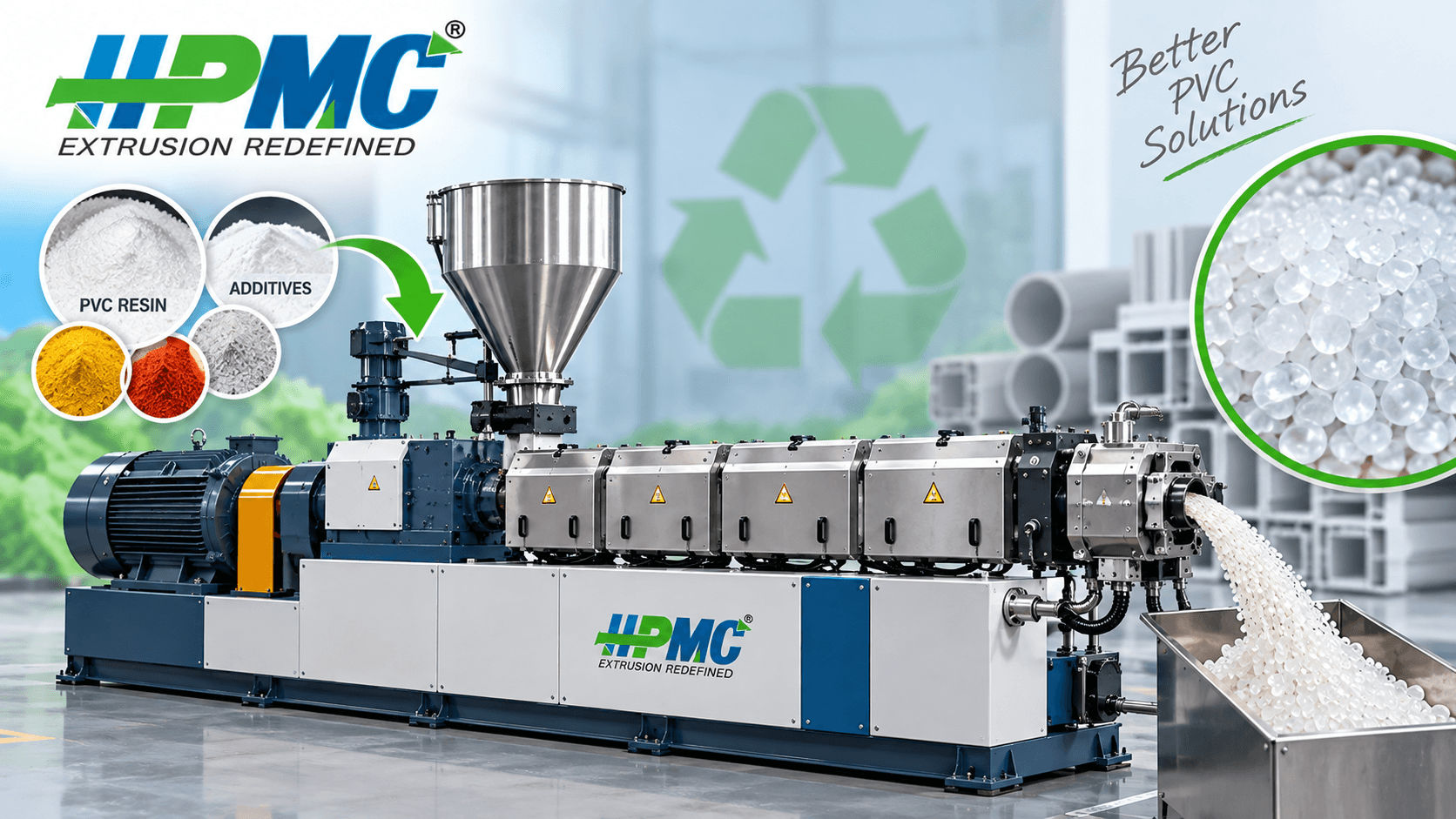
PVC compounding is an important stage in the production of PVC materials used for pipes, profiles, cables, sheets, flooring, tubing, and other applications. Before PVC compound can be converted into finished products, different ingredients need to be combined and processed into a consistent material.
A Single Screw Extruder for PVC Compounding can be used in suitable PVC processing applications to melt, mix, homogenize, and continuously process PVC-based formulations.
The performance of the extrusion system depends on factors such as the PVC formulation, additives, processing conditions, screw design, temperature control, feeding system, and required output.
For manufacturers planning to establish or upgrade a PVC compounding operation, selecting the right extruder is important. The machine should be matched with the formulation, material characteristics, processing requirements, and intended application.
This guide explains what a Single Screw Extruder for PVC Compounding is, how it works, its components, applications, benefits, and the factors manufacturers should consider before purchasing a PVC compounding extrusion system.
What is a Single Screw Extruder for PVC Compounding?
A Single Screw Extruder for PVC Compounding is an extrusion machine that uses a rotating screw inside a heated barrel to convey and process PVC-based material continuously.
During processing, PVC resin and other formulation ingredients are prepared according to the required compound and introduced into the extrusion system.
The screw transports the material through different sections of the barrel while heat and mechanical energy support melting, mixing, homogenization, and material transport.
The resulting PVC compound can then be shaped or pelletized according to the downstream application.
A single screw extrusion system may be selected for applications where its processing characteristics, material formulation, output requirements, and process design are suitable.
Why is PVC Compounding Important?
PVC products generally require more than PVC resin alone.
A PVC formulation can include different additives and processing ingredients selected according to the required properties of the final product.
Depending on the application, the formulation may involve:
- PVC resin
- Stabilizers
- Plasticizers
- Lubricants
- Fillers
- Pigments
- Processing aids
- Impact modifiers
- Other formulation-specific additives
Proper compounding helps distribute these ingredients throughout the material.
Consistent mixing and homogenization are important because variations in the formulation can affect the processing behaviour and properties of the final PVC product.
A suitable PVC Compound Machine therefore plays an important role in preparing material for downstream manufacturing.
How Does a Single Screw Extruder for PVC Compounding Work?
The basic operation begins with preparing the PVC formulation.
The materials are introduced into the feeding system and transported into the heated barrel.
Inside the barrel, the rotating screw conveys the material through the extrusion zones.
A simplified process is:
PVC Formulation → Feeding → Conveying → Heating → Melting/Plasticization → Mixing → Homogenization → Extrusion → Cooling/Pelletizing
The exact processing conditions depend on the formulation and machine configuration.
Step 1: Material Preparation
PVC resin and additives are prepared according to the required formulation.
Proper material preparation helps maintain consistency during extrusion.
Step 2: Feeding
The prepared material is introduced into the extruder through the feeding system.
Consistent feeding is important for stable processing.
Step 3: Conveying
The rotating screw transports the material through the barrel.
As the material moves forward, it is subjected to heat and mechanical action.
Step 4: Plasticization
Heat and mechanical energy help soften and process the PVC formulation.
The required processing conditions depend on the specific PVC formulation.
Step 5: Mixing and Homogenization
The screw design and processing conditions help distribute the formulation components through the material.
The objective is to achieve a consistent compound suitable for the intended application.
Step 6: Extrusion
The processed PVC compound moves toward the die or downstream discharge arrangement.
Depending on the system, the output may be cooled and pelletized for further use.
Major Components of a Single Screw PVC Compounding Extruder
Feeding System
The feeding system introduces the PVC formulation into the extruder.
A stable and controlled feed helps support consistent material processing.
Screw
The screw is one of the most important components of a single screw extruder.
Its geometry influences conveying, melting, mixing, residence time, and overall processing behaviour.
The screw should therefore be selected according to the PVC formulation and application.
Barrel
The barrel surrounds the screw and provides the processing chamber.
It may contain different heating and cooling zones to control processing conditions.
Heating and Cooling System
Temperature control is important during PVC processing.
The heating system supports material processing, while cooling can help manage temperatures in areas where required.
Die or Discharge System
The die or discharge arrangement determines how the processed material exits the extruder.
Its configuration depends on whether the output is intended for pelletizing, direct extrusion, or another downstream process.
Drive System
The drive system provides the power required to rotate the screw.
Motor and drive selection should be matched to the processing requirements.
Control System
The control system allows operators to monitor and adjust important process parameters.
Temperature, screw speed, feeding, and other operating conditions can be managed according to the machine configuration.
Pelletizing or Cooling System
When the PVC compound is produced in granule form, suitable cooling and pelletizing equipment can be integrated downstream.
The exact configuration depends on the required product form.
Applications of Single Screw Extruder for PVC Compounding
A Single Screw Extruder for PVC Compounding can be considered for suitable PVC formulations and processing applications.
PVC Pipe Compounds
PVC compounds used in pipe manufacturing can require controlled formulation and consistent processing before extrusion into pipes.
PVC Profile Compounds
Suitable PVC compounds can be prepared for profiles used in construction and other applications.
PVC Cable Compounds
Certain PVC formulations used for cable-related applications can be processed through appropriately configured compounding systems.
PVC Sheet Compounds
PVC sheet manufacturing may require specific formulations that can be processed through suitable extrusion equipment.
PVC Tubing Applications
Flexible or rigid PVC tubing applications can use different formulations depending on the required product characteristics.
PVC Granule Production
A suitable extrusion system can be integrated with downstream pelletizing equipment to produce PVC granules for further processing.
Benefits of a Single Screw Extruder for PVC Compounding
A properly selected Single Screw Extruder for PVC Compounding can provide several advantages.
Continuous Processing
Extrusion allows the PVC formulation to be processed continuously rather than through separate batch operations.
Controlled Material Processing
The extrusion system provides controlled conveying, heating, plasticization, and discharge.
Suitable for Specific PVC Formulations
Single screw extrusion can be suitable for certain PVC compound formulations when the screw and process configuration are appropriately selected.
Consistent Output
A stable feeding and extrusion process can support consistent material output.
Flexible Downstream Integration
The extruder can be connected with cooling, pelletizing, screening, storage, or other downstream equipment according to the application.
Production Efficiency
Continuous extrusion can support efficient material processing for suitable production requirements.
Process Control
Temperature, screw speed, feeding, and other parameters can be controlled according to the machine configuration and formulation.
Single Screw Extruder vs Twin Screw Extruder for PVC Compounding
Both single screw and twin screw extruders are used in polymer processing, but their processing characteristics differ.
A twin screw extruder can provide strong distributive and dispersive mixing capabilities and is widely used for demanding compounding applications.
A single screw extruder has a simpler screw configuration and can be suitable for applications where the formulation and required mixing characteristics can be achieved with a single screw system.
The choice depends on:
- PVC formulation
- Additive loading
- Required mixing intensity
- Material characteristics
- Production requirements
- Desired output
- Downstream application
- Process design
Manufacturers should evaluate the actual formulation and required compound quality before deciding between single screw and twin screw technology.
How to Choose a Single Screw Extruder for PVC Compounding
Selecting the right machine requires evaluation of both the formulation and the complete production process.
Understand the PVC Formulation
Identify the PVC resin, fillers, plasticizers, stabilizers, pigments, lubricants, and other ingredients being processed.
The formulation directly influences the required extrusion conditions.
Define the Required Output
Determine the desired production rate for the PVC compound.
The extrusion system should be appropriately matched to the production requirement.
Select the Appropriate Screw Design
Screw geometry is important for conveying, melting, mixing, and homogenization.
The screw should be selected according to the specific PVC formulation and processing objective.
Evaluate Temperature Control
PVC requires controlled processing conditions.
The heating and cooling system should provide suitable control across the processing zones.
Consider Feeding Requirements
Consistent feeding contributes to stable extrusion.
The feeding system should be compatible with the physical characteristics of the PVC formulation.
Consider the Final Product Form
Determine whether the processed PVC will be directly extruded or converted into granules.
This affects the downstream equipment required.
Evaluate Automation
Suitable automation can help operators monitor important parameters and maintain repeatable processing conditions.
Consider Maintenance
Before purchasing, evaluate access to wear components, screw and barrel maintenance, spare parts, cleaning requirements, and technical support.
Evaluate Complete Line Integration
The extruder should be considered as part of the complete production process rather than as an isolated machine.
Cooling, pelletizing, screening, storage, and material handling equipment may be required depending on the application.
Single Screw Extruder for PVC Compound Production
When used for compound production, the extruder can be integrated with downstream equipment to convert processed PVC into usable granules.
A typical process may look like:
PVC Resin + Additives → Premixing → Feeding → Single Screw Extrusion → Homogenization → Die → Cooling → Pelletizing → Screening → PVC Granules
The exact process depends on the formulation and production requirements.
The quality of the final compound is influenced by raw material preparation, formulation consistency, feeding, extrusion conditions, cooling, and pelletizing.
Factors Affecting PVC Compounding Performance
Several factors can influence the performance of a PVC compounding extrusion system.
Raw Material Quality
Consistent raw materials can help maintain formulation stability.
Formulation Accuracy
Variations in ingredient ratios can affect the final compound.
Screw Design
The screw geometry influences conveying, melting, mixing, and homogenization.
Temperature Control
Stable temperature control is important for controlled PVC processing.
Feeding Consistency
Irregular feeding can influence output and processing stability.
Residence Time
Material residence time inside the extruder can influence processing behaviour and should be considered during machine selection and process development.
Cooling
Appropriate cooling can help maintain controlled processing conditions.
Maintenance of a Single Screw Extruder for PVC Compounding
Regular maintenance is important for reliable operation and consistent processing.
Important areas to inspect include:
- Screw
- Barrel
- Die
- Feed system
- Heating zones
- Cooling system
- Motor
- Gearbox
- Bearings
- Temperature controls
- Electrical system
- Pelletizing equipment
The screw and barrel should be inspected for wear according to operating conditions.
The feeding system should be kept clean and checked for material buildup.
Heating and cooling systems should be maintained to ensure proper temperature control.
The gearbox, bearings, and drive system should be inspected according to the manufacturer's recommended maintenance schedule.
Why Choose HPMC for PVC Compounding Machinery?
HPMC provides machinery solutions for plastic extrusion, PVC processing, compounding, recycling, reprocessing, and related polymer applications.
A Single Screw Extruder for PVC Compounding can be selected according to the PVC formulation, required mixing characteristics, production requirements, screw design, temperature control, feeding requirements, and downstream application.
Businesses looking for a PVC Compounding Machine can discuss their formulation and production requirements with HPMC to determine a suitable extrusion configuration.
The complete process should be evaluated, including material preparation, feeding, extrusion, cooling, pelletizing, storage, and downstream PVC manufacturing.
Conclusion
A Single Screw Extruder for PVC Compounding can be an effective solution for suitable PVC formulations that require continuous conveying, heating, plasticization, mixing, homogenization, and extrusion.
The performance of the system depends on several factors, including PVC formulation, screw design, feeding consistency, temperature control, production requirements, and downstream processing.
Manufacturers should carefully evaluate their material formulation and required compound characteristics before selecting an extrusion machine.
It is also important to consider complete line integration, maintenance requirements, spare parts availability, automation, technical support, and after-sales service.
For businesses planning to manufacture or process PVC compounds, selecting a properly configured Single Screw Extruder for PVC Compounding can support controlled material processing and integration into a complete PVC compounding and extrusion workflow.
Frequently Asked Questions
Find quick answers to the most common questions about this topic.
A Single Screw Extruder for PVC Compounding is an extrusion machine that uses a rotating screw and controlled heating to process suitable PVC formulations into a homogeneous compound.
Yes, a single screw extruder can be used for suitable PVC compounding applications when the formulation, screw design, processing conditions, and required mixing characteristics are appropriate.
PVC formulations may contain PVC resin along with stabilizers, plasticizers, fillers, lubricants, pigments, processing aids, and other application-specific ingredients.
Twin screw extruders generally provide greater mixing flexibility and are widely used for demanding compounding applications. Single screw extruders can be suitable for formulations where the required processing and mixing performance can be achieved with a single screw configuration.
Yes. A suitable single screw extrusion system can be connected with cooling and pelletizing equipment to produce PVC granules for further processing.
Consider the PVC formulation, additive loading, required mixing characteristics, production output, screw design, temperature control, feeding system, final product form, automation, maintenance, and downstream equipment.
Yes. Controlled processing temperatures are important for stable PVC extrusion. The required conditions depend on the formulation and machine configuration.
Yes. The extruder can be integrated with feeding, cooling, pelletizing, screening, storage, and other downstream equipment according to the required process.