
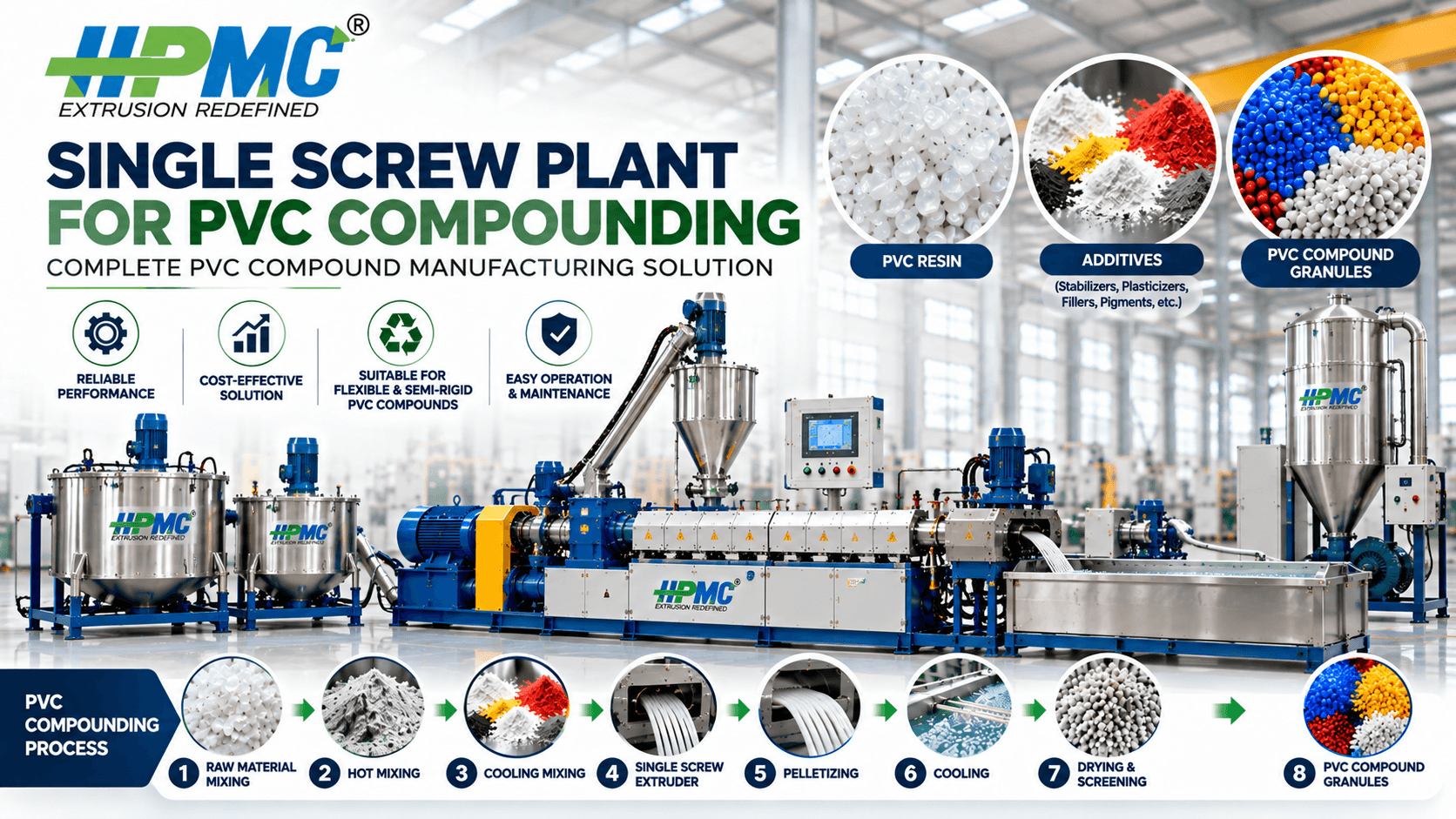
PVC is an important raw material across several manufacturing industries, including footwear, cable production, hoses, profiles, and moulded components. Before PVC can be converted into finished products, it may need to be blended with stabilizers, lubricants, plasticizers, fillers, pigments, and other additives according to the intended application.
This process is known as PVC compounding. It helps manufacturers prepare a formulation with the processing characteristics and performance properties required for a particular product.
A Single Screw Plant for PVC Compounding is designed to process suitable PVC formulations into compounds or granules for downstream manufacturing. Depending on the plant configuration, the production line can combine material mixing, extrusion, pelletizing, cooling, and drying.
Hindustan Plastics & Machine Corporation (HPMC), a plastic processing machinery manufacturer based in Delhi, India, offers a Single Screw Plant for PVC Compounding for manufacturers evaluating PVC compounding equipment.
In this guide, we explain how a single screw PVC compounding plant works, its main components, applications, benefits, and the factors manufacturers should evaluate before purchasing a machine.
What Is a Single Screw Plant for PVC Compounding?
A Single Screw Plant for PVC Compounding is a production system that uses a single screw extruder to process an appropriately prepared PVC formulation into a compound suitable for further manufacturing.
The screw conveys and processes the material inside the heated barrel. The processed compound then passes through the relevant discharge and pelletizing arrangement. Depending on the plant design, the pellets or granules are cooled, dried, screened, and collected.
A typical single screw PVC compounding line may include:
- Material mixing equipment
- Grooved-feed single screw extruder
- Heating and temperature control systems
- Extrusion die or discharge arrangement
- Pelletizing unit
- Cooling system
- Drying equipment
- Material collection and handling arrangements
The final equipment configuration depends on the PVC formulation, compound type, required pellet dimensions, target output, and production workflow.
Manufacturers comparing different compounding technologies can also review HPMC's Conical Twin Screw Plant for PVC Compounding to understand an alternative extrusion arrangement for suitable PVC applications.
What Is PVC Compounding?
PVC compounding is the process of combining PVC resin with selected additives to produce a material formulation suited to a particular manufacturing application.
The ingredients vary according to whether the finished product requires a rigid, semi-rigid, or flexible compound.
Common ingredients include:
- PVC resin: The primary polymer used in the formulation.
- Plasticizers: Used in suitable flexible PVC formulations to modify flexibility and processing characteristics.
- Heat stabilizers: Help control heat-related degradation during processing.
- Lubricants: Support processing and influence material flow.
- Fillers: Such as calcium carbonate, where appropriate for the intended formulation.
- Pigments: Used to achieve the required colour.
- Impact modifiers: Added when specific impact properties are required.
- Processing aids: Used to improve selected processing characteristics.
The exact formulation depends on the product, customer requirements, processing conditions, and applicable product standards.
For example, a flexible PVC footwear compound may require a different formulation from a semi-rigid PVC profile compound or a cable insulation compound.
Manufacturers focused on cable-grade formulations can also explore HPMC's Soft Cable Grade PVC Compounding Plant.
How Does a Single Screw PVC Compounding Plant Work?
The production process typically involves material preparation, extrusion, pelletizing, cooling, and collection. The exact sequence depends on the machine configuration and compound requirements.
1. Raw Material Preparation
PVC resin and the required additives are measured according to the approved formulation.
Accurate weighing is important because variations in ingredient proportions can affect the processing behaviour and properties of the finished compound.
Material quality, storage conditions, and consistent preparation also influence production results.
2. Mixing the PVC Formulation
The ingredients are mixed to distribute the additives and prepare a consistent blend for extrusion.
Depending on the formulation and plant arrangement, the mixing stage may use suitable high-speed mixing equipment or another appropriate preparation system.
Mixing temperature, duration, and sequence should be selected according to the material formulation and process requirements.
3. Feeding the Extruder
The prepared blend is fed into the single screw extruder. A grooved-feed arrangement supports material intake and conveying when properly matched to the formulation and machine design.
Consistent feeding helps maintain stable processing conditions and predictable output.
4. Single Screw Extrusion
Inside the heated barrel, the rotating screw conveys and processes the PVC formulation. Temperature control, screw design, screw speed, feed consistency, and residence time all influence the material's processing behaviour.
The extruder must be selected for the intended PVC formulation and the required compound output.
5. Compound Discharge and Pelletizing
The processed material passes through the relevant die or discharge arrangement and is converted into pellets or granules using the specified pelletizing system.
The pelletizing method should be appropriate for the compound's characteristics and the required pellet dimensions.
6. Cooling
The newly formed pellets are cooled as required by the selected system. Suitable cooling helps prepare the material for subsequent handling and storage.
Cooling conditions should be matched to the compound formulation and pelletizing method.
7. Drying and Collection
Depending on the process, the pellets may pass through a drying stage before collection.
The finished material can then be inspected, packed, and transferred to storage or downstream manufacturing.
The final process arrangement should be confirmed with HPMC according to the required PVC compound and plant configuration.
Key Features of a Single Screw Plant for PVC Compounding
The performance of a PVC compounding plant depends on its extruder, material preparation system, pelletizing equipment, and overall process configuration.
1. Single Screw Extruder
The single screw extruder is the main processing component. It conveys and processes the prepared PVC formulation under controlled operating conditions.
The machine should be selected according to the formulation, required output, and intended compound properties.
2. Grooved-Feed Design
A grooved-feed barrel arrangement can support material intake and conveying when the screw, barrel, feed conditions, and formulation are appropriately matched.
The actual feeding performance depends on material characteristics and the machine design.
3. Material Mixing System
Mixing equipment helps distribute additives through the PVC formulation before extrusion.
The mixer should be appropriate for the batch size and intended production rate. Consistent material preparation is important for stable downstream processing.
4. Pelletizing Equipment
The pelletizer converts the processed compound into granules suitable for handling and subsequent manufacturing.
The cutting arrangement and process settings should be selected according to the compound type, required pellet size, and production requirements.
5. Cooling and Drying Arrangements
Cooling and drying equipment prepares the finished compound for collection and storage.
The exact arrangement depends on the pelletizing method, material properties, and final product requirements.
6. Straightforward Operating Arrangement
A single screw system may be suitable for manufacturers looking for a comparatively straightforward extrusion configuration for an appropriate PVC formulation.
Actual ease of operation and maintenance depends on the machine design, automation level, material handling system, and operator training.
7. Configuration Based on Production Needs
Manufacturers should specify their compound type, required output, pellet dimensions, and operating schedule when discussing a machine with HPMC.
Visit HPMC's Single Screw PVC Compounding Plant page for product information and to enquire about the available configuration.
Applications of a Single Screw PVC Compounding Plant
A suitably configured single screw compounding plant can serve manufacturers producing different types of PVC compounds. The equipment and formulation must be appropriate for the intended end product.
1. Flexible PVC Footwear
Flexible PVC compounds are used in suitable footwear products, including certain soles, slippers, and related components.
The formulation may require plasticizers, stabilizers, pigments, and other additives to achieve the required flexibility, colour, and processing behaviour.
Manufacturers should confirm that the selected plant is suitable for their footwear formulation and production target.
2. PVC Hose Manufacturing
Flexible and semi-rigid PVC formulations are used in suitable hose products.
The compound formulation depends on the intended hose application, including flexibility, durability, and operating conditions.
A consistent compounding process helps manufacturers maintain control over material preparation before hose extrusion.
3. PVC Cable Compounds
PVC compounds are used in suitable electrical cable insulation and sheathing applications.
Cable-grade formulations have specific electrical, mechanical, thermal, and processing requirements. Manufacturers should select equipment and material formulations accordingly.
HPMC's Soft Cable Grade PVC Compounding Plant is a relevant alternative to review when evaluating dedicated cable-compounding machinery.
4. Semi-Rigid PVC Profiles
PVC compounds are used in suitable profiles for construction, building components, and other industrial products.
Manufacturers producing profiles can also explore HPMC's Twin Screw Plant for PVC Profile for related downstream extrusion machinery.
5. PVC Moulded Goods
Suitable PVC formulations can be used for moulded products, fittings, and industrial components.
The compound must meet the requirements of the intended moulding process and finished product.
6. Other Flexible and Semi-Rigid PVC Products
PVC compounds may also be used in selected sheets, accessories, and other manufactured products.
The appropriate machine configuration depends on the formulation, production rate, pellet quality requirements, and downstream processing method.
Benefits of a Single Screw Plant for PVC Compounding
A single screw compounding plant may offer several practical benefits when selected and configured for the intended PVC formulation.
1. Potentially Economical Equipment Configuration
A single screw system may be worth considering for manufacturers seeking a suitable compounding solution without investing in a more complex extrusion arrangement.
The overall value depends on the machine price, required auxiliary equipment, output, maintenance, and production utilisation.
2. Support for Flexible and Semi-Rigid Compounds
A suitably configured plant can process appropriate flexible and semi-rigid PVC formulations.
However, not every machine configuration is suitable for every PVC compound. Material compatibility should be confirmed before purchase.
3. Consistent Material Processing
Controlled feeding, extrusion, and temperature management can support repeatable processing conditions.
Final compound quality still depends on raw material consistency, formulation accuracy, equipment design, and operating procedures.
4. Granule Production for Downstream Manufacturing
The pelletizing arrangement converts the processed compound into granules that can be handled, stored, and supplied to subsequent manufacturing operations.
The required pellet dimensions and quality should be specified before selecting the system.
5. Potentially Straightforward Maintenance
A single screw extruder may offer a practical maintenance arrangement for suitable applications.
Actual maintenance requirements depend on screw and barrel design, material formulation, operating conditions, wear, and the manufacturer's maintenance recommendations.
6. Suitable for Different Production Requirements
Single screw compounding machinery may be considered by small and medium-sized compounders when its output and processing capabilities match their production needs.
Buyers should confirm the realistic production capacity for their specific formulation rather than selecting a machine based only on a general output claim.
7. Integration into an Existing Manufacturing Process
A compounding plant can help manufacturers prepare PVC compounds for their own downstream operations, depending on their production strategy.
Before purchasing equipment, compare in-house compounding with buying ready-made compound. Include raw materials, power, labour, maintenance, quality testing, storage, and equipment utilisation in the cost calculation.
Single Screw vs Conical Twin Screw Plant for PVC Compounding
Both single screw and conical twin screw systems may be used in suitable PVC processing applications. Their suitability depends on the formulation, output requirements, and machine configuration.
Single Screw PVC Compounding Plant
A single screw system may be considered when the formulation, processing requirements, and target output are compatible with its design.
Potential considerations include:
- Initial equipment investment
- Intended production capacity
- Material feeding characteristics
- Processing requirements
- Pelletizing and auxiliary equipment
- Maintenance and operating costs
Conical Twin Screw PVC Compounding Plant
A conical twin screw system is commonly associated with rigid PVC processing and selected PVC compounding applications.
It may be appropriate when the formulation and required process are compatible with the equipment's design and operating capabilities.
Explore HPMC's Conical Twin Screw Plant for PVC Compounding to review the related product range.
Which Plant Should You Choose?
Before deciding, compare:
- Whether the formulation is flexible, semi-rigid, or rigid PVC
- Required compound output per hour
- Additive and filler loading
- Material feeding and processing behaviour
- Required pellet size and quality
- Total equipment investment
- Energy and maintenance costs
- Expected operating hours and production utilisation
Neither system is universally better. The correct choice is the machine that meets your formulation, quality, capacity, and commercial requirements.
How to Choose the Right Single Screw PVC Compounding Machine
Selecting a compounding plant requires evaluating the complete production process rather than focusing only on the extruder.
1. Define Your PVC Compound Type
Identify whether you intend to produce flexible PVC, semi-rigid PVC, cable compounds, footwear compounds, hose compounds, or another formulation.
The compound type affects the material preparation, feeding, processing, and pelletizing requirements.
2. Determine Your Required Output
Calculate the expected finished compound output per hour and per production shift.
Share these requirements with HPMC and request realistic output estimates for your formulation and intended operating conditions.
3. Confirm Material Compatibility
Discuss the PVC resin, plasticizers, stabilizers, fillers, and other additives used in your formulation.
Confirm that the proposed screw, barrel, feeding arrangement, temperature controls, and pelletizing system are appropriate for the material.
4. Evaluate the Mixing System
Check whether the proposed mixer can handle the required batch size and supply the extruder at the necessary rate.
Mixing and extrusion capacity should be coordinated to support an efficient production workflow.
5. Select the Right Pelletizing Arrangement
Specify the required pellet dimensions, cutting method, cooling arrangement, and handling requirements.
The pelletizing system should be suitable for the compound's characteristics and intended downstream use.
6. Compare Total Operating Costs
Consider the equipment price alongside power consumption, labour, maintenance, spare parts, material wastage, and quality control.
Request technical information from the manufacturer rather than relying on broad claims about low power consumption or operating costs.
7. Check Technical Support and Spare Parts
Before purchasing, discuss installation, commissioning, operator training, maintenance schedules, and spare parts availability.
HPMC provides product information through its official website. Contact the company to confirm the support available for the proposed machine model.
Single Screw Plant for PVC Compounding Price in India
The price of a Single Screw Plant for PVC Compounding depends on the machine specification and the complete scope of supply.
Factors that may influence the quotation include:
- Extruder model and required output
- Mixer configuration and capacity
- Grooved-feed design and screw-barrel specifications
- Pelletizing equipment
- Cooling and drying arrangements
- Automation and control requirements
- Auxiliary equipment and material handling
- Installation and commissioning requirements
There is no single price that applies to every plant configuration. Manufacturers should request a current quotation based on their intended compound, production target, and required equipment.
To help HPMC prepare a suitable proposal, provide details about your PVC formulation, finished product application, target output, pellet requirements, and available factory utilities.
Visit HPMC's Contact and Quotation Page to submit an enquiry.
Why Choose Hindustan Plastics & Machine Corporation (HPMC)?
Hindustan Plastics & Machine Corporation is an Indian manufacturer of plastic extrusion and recycling machinery with experience dating back to 1972.
Manufacturers evaluating PVC compounding equipment can explore HPMC's Single Screw Plant for PVC Compounding and discuss their production requirements with the company.
Related HPMC equipment includes:
- Conical Twin Screw Plant for PVC Compounding
- Soft Cable Grade PVC Compounding Plant
- Twin Screw Plant for PVC Profile
- Twin Screw Plant for PVC Trunking
- Twin Screw Plant for CPVC Pipe
Each machine serves a particular processing application. Confirm the formulation compatibility, available capacity, and complete machine configuration with HPMC before placing an order.
Related HPMC Products and Resources
Explore these internal resources for additional information about PVC compounding and plastic extrusion machinery:
- Single Screw Plant for PVC Compounding: Main product page for the single screw compounding plant.
- Conical Twin Screw Plant for PVC Compounding: Related conical twin screw compounding equipment.
- Soft Cable Grade PVC Compounding Plant: Equipment for suitable cable-grade PVC compounds.
- Twin Screw Plant for PVC Profile: Machinery for PVC profile extrusion.
- Twin Screw Plant for PVC Trunking: Machinery for PVC trunking production.
- Twin Screw Plant for CPVC Pipe: Equipment for compatible CPVC pipe manufacturing applications.
- Frequently Asked Questions: General information about HPMC and its machinery.
- Machine Manuals: Available machine documentation.
- Spare Parts: Information about machine spare parts.
- Contact HPMC: Submit product enquiries and request a quotation.
These internal links help readers explore related machinery while keeping the single screw PVC compounding plant as the primary topic of the article.
Conclusion
A Single Screw Plant for PVC Compounding can be a practical option for manufacturers looking to process suitable PVC formulations into compounds and granules for footwear, hoses, cables, profiles, and moulded products.
The right plant depends on the material formulation, required output, feeding arrangement, extrusion conditions, pelletizing system, and total operating costs. Buyers should evaluate the complete configuration and obtain realistic production estimates before making an investment.
Hindustan Plastics & Machine Corporation (HPMC), an Indian plastic processing machinery manufacturer since 1972, offers a Single Screw Plant for PVC Compounding.
Contact HPMC to discuss your PVC formulation, production targets, machine requirements, and quotation.
Contact HPMC
Hindustan Plastics & Machine Corporation (HPMC)
- Address: 5, Category II, DSIDC Industrial Area, Nangloi, Delhi – 110041, India
- Phone: +91 95605 96392
- Email: info@hindustanplastics.com
- Website: https://www.hindustanplastics.com/
- Single Screw PVC Compounding Plant: View Product Details
- Google Business Profile: View HPMC on Google
- Request a Quote: Contact HPMC
Contact HPMC with your intended PVC compound, target production capacity, and equipment requirements to discuss a suitable plant configuration.
Frequently Asked Questions
Find quick answers to the most common questions about this topic.
It is a processing system that uses a single screw extruder to process a suitable PVC formulation into compound or granules for downstream manufacturing. Depending on the configuration, the line can include mixing, extrusion, pelletizing, cooling, and drying equipment.
Suitable PVC compounds may be used in footwear, hoses, cables, profiles, moulded goods, and other products. The plant configuration and formulation must match the intended application.
A suitably configured single screw plant may process flexible PVC formulations. Compatibility depends on the plasticizer content, formulation, feeding behaviour, processing conditions, and machine design. Confirm suitability with the manufacturer.
A grooved-feed arrangement can support material intake and conveying under appropriate operating conditions. Actual performance depends on the formulation, feed properties, screw design, and machine configuration.
Depending on the configuration, a line may include a mixer, grooved-feed single screw extruder, pelletizer, cooling system, drying equipment, and material collection arrangements. Confirm the exact scope with HPMC.
The two systems use different screw configurations and may suit different formulations and processing requirements. The appropriate option depends on the PVC compound, production target, material feeding characteristics, and overall plant design.
Output depends on the machine configuration, PVC formulation, additives and fillers, feeding consistency, operating settings, pelletizing system, and required compound quality.
It may be suitable when the machine's processing capability and output match the manufacturer's production requirements. Buyers should compare the complete plant cost and expected output before selecting a model.
The price depends on the extruder specification, required capacity, mixer, pelletizing equipment, cooling and drying systems, automation, auxiliary equipment, and installation requirements. Contact HPMC for a current quotation.
Visit the Single Screw Plant for PVC Compounding page or contact HPMC at +91 95605 96392 or info@hindustanplastics.com. Share your formulation, target output, and required equipment configuration.