
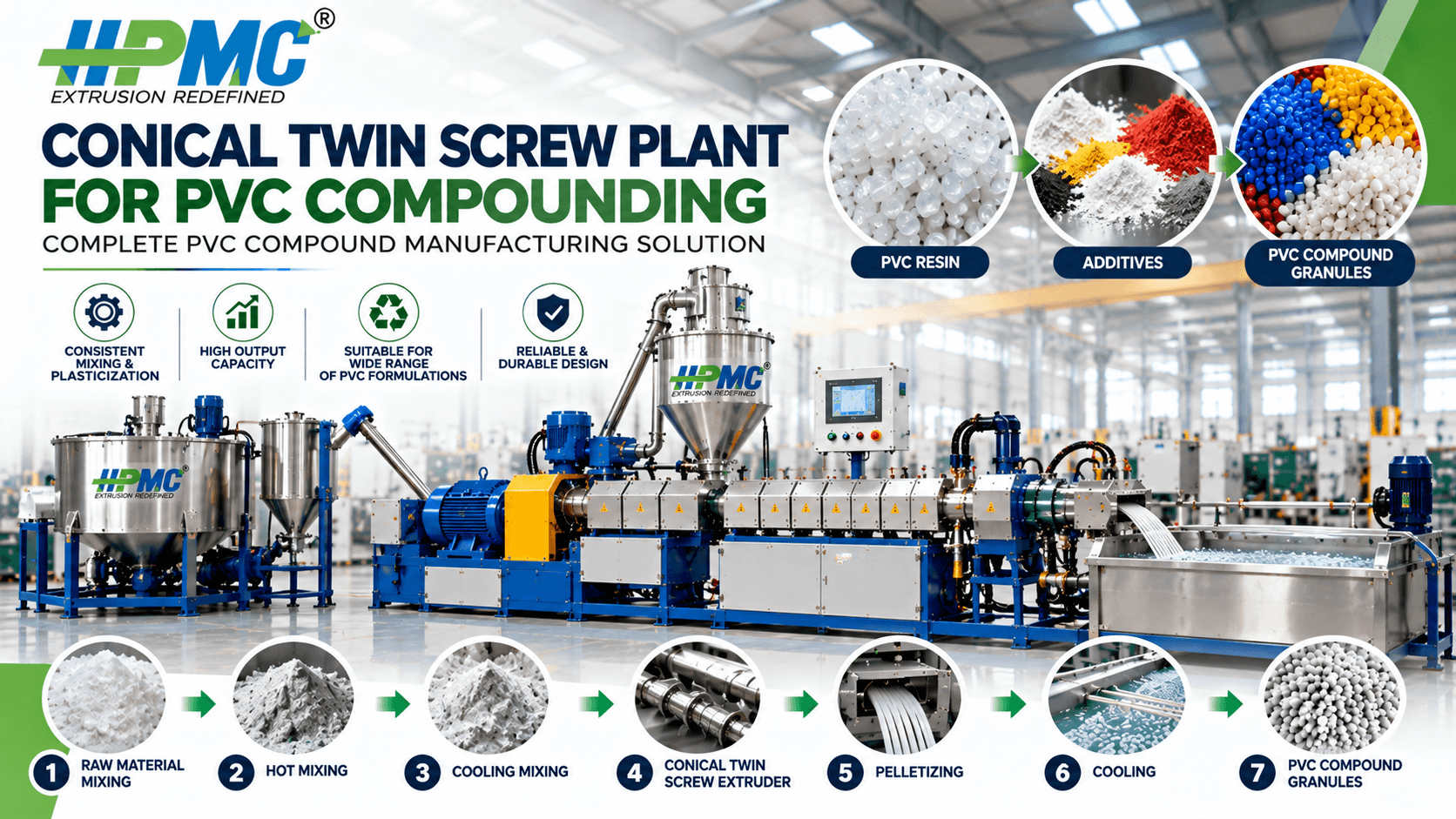
PVC is widely used in construction, electrical products, plumbing, profiles, fittings, and several other industrial applications. However, PVC resin generally needs to be combined with carefully selected additives, stabilizers, lubricants, fillers, pigments, and processing aids before it can be converted into finished products.
This process is known as PVC compounding. It helps manufacturers prepare material formulations with properties suited to their intended applications.
A Conical Twin Screw Plant for PVC Compounding is designed to process PVC formulations under controlled conditions, supporting material mixing, plasticization, and consistent compound production. Depending on the selected system, the process can include dry blending, extrusion, pelletizing, cooling, and screening.
Hindustan Plastics & Machine Corporation (HPMC), an Indian plastic processing machinery manufacturer since 1972, offers dedicated Twin Screw Extruders for PVC Compounding. Manufacturers can explore the available models and discuss the appropriate configuration for their material formulation and production targets.
This guide explains how a PVC compounding plant works, its key components, benefits, applications, available models, and the factors to consider before purchasing a machine.
What Is a Conical Twin Screw Plant for PVC Compounding?
A Conical Twin Screw Plant for PVC Compounding is an industrial processing system designed to combine and process PVC-based formulations into a consistent compound suitable for downstream manufacturing.
The system uses a twin screw extruder to convey, mix, and process the formulation. Depending on the complete plant configuration, the processed compound may then be converted into pellets or granules for storage, transportation, or use in another production process.
A typical PVC compounding setup may include:
- High-speed hot mixer
- Cooling mixer
- Material feeding and transfer equipment
- Conical twin screw compounding extruder
- Extrusion die and pelletizing equipment
- Cooling system
- Screening or sieving equipment
- Material collection and handling arrangements
The exact configuration depends on the required formulation, pellet shape, production capacity, and intended application.
Manufacturers comparing compounding technologies can also review HPMC's Single Screw Plant for PVC Compounding to understand how different machine arrangements may suit different manufacturing requirements.
What Is PVC Compounding?
PVC compounding is the process of blending PVC resin with other ingredients to obtain a formulation with the required processing and end-use properties.
Depending on the product, a PVC compound may contain:
- PVC resin: The principal polymer in the formulation.
- Heat stabilizers: Help control heat-related degradation during processing.
- Lubricants: Assist processing and influence material flow.
- Fillers: Such as calcium carbonate, where suitable for the intended formulation.
- Pigments: Used to achieve the required colour.
- Impact modifiers: Incorporated when required to achieve suitable impact performance.
- Processing aids: Help achieve the desired processing characteristics.
- Plasticizers: Used in suitable flexible PVC formulations.
The formulation depends on whether the compound is intended for rigid pipes, profiles, fittings, cable insulation, flexible products, or another application.
For example, rigid PVC compounds and flexible cable-grade PVC compounds have different formulation requirements. Manufacturers should select the equipment and process settings according to the specific formulation.
For cable-related applications, HPMC also offers a Soft Cable Grade PVC Compounding Plant, which can be explored separately when evaluating machinery for cable compound production.
How Does a PVC Compounding Plant Work?
PVC compounding involves multiple stages that work together to achieve the required material consistency and production output.
1. Raw Material Preparation
PVC resin and the required additives are measured according to the approved formulation.
Accurate weighing and consistent ingredient quality are important because variations in formulation can affect processing behaviour and final compound properties.
2. Hot Mixing
The ingredients may be processed in a high-speed hot mixer to distribute the additives and prepare a suitable dry blend.
Mixing conditions must be selected according to the formulation and the manufacturer's process requirements. Excessive heat or inappropriate mixing conditions can negatively affect material quality.
3. Cooling and Blend Stabilisation
After hot mixing, the material may be transferred to a cooling mixer. Cooling helps bring the blend to an appropriate temperature for subsequent handling and processing.
The hot and cool mixer arrangement should be matched to the required batch size and production workflow.
4. Material Feeding
The prepared blend is fed into the extruder at a controlled rate. Consistent feeding helps maintain stable processing conditions and supports predictable output.
Feeding equipment and material handling arrangements depend on the physical properties of the formulation and the selected plant design.
5. Twin Screw Extrusion and Compounding
Inside the extruder, the screws convey and process the formulation. Heat and mechanical energy support the processing of the material under controlled conditions.
Appropriate screw design, temperature settings, screw speed, and residence time are important for achieving the desired compound quality.
Explore HPMC's PVC Compounding Extruders for information about available machine models and listed output capacities.
6. Pelletizing or Granule Formation
The processed compound is converted into pellets or granules using the pelletizing arrangement specified for the plant.
The selected cutting system, die design, and process settings influence pellet dimensions and consistency. Hot-cut pelletizing is one possible arrangement, depending on the machine configuration.
7. Cooling and Sieving
The pellets are cooled as required and passed through screening or sieving equipment to separate material according to the specified size range.
This stage helps prepare the compound for collection, storage, and downstream manufacturing.
8. Collection and Quality Inspection
The finished material is collected and checked against the relevant quality requirements.
Inspection may include pellet appearance, consistency, formulation verification, and application-specific testing.
The final process sequence and equipment depend on the selected PVC compounding system.
Key Features of HPMC's PVC Compounding Extruder
HPMC's official PVC Compounding product page lists three conical twin screw compounding models: HPMC 51/105, HPMC 65/132, and HPMC 80/156.
1. Multiple Machine Models
The available models allow manufacturers to compare equipment according to production requirements.
Selecting a model should involve evaluating the material formulation, required output, operating conditions, and complete plant configuration rather than choosing solely by model size.
2. Controlled Material Processing
Twin screw compounding equipment is used to convey and process PVC formulations while supporting mixing and material consistency.
Actual compound quality depends on the formulation, feeding accuracy, screw configuration, temperature profile, and operating conditions.
3. Integration with Material Preparation
A compounding line can be configured with suitable material preparation equipment, including hot and cool mixing systems where required.
The mixer capacity and extruder throughput should be coordinated to support a consistent production workflow.
4. Pellet Production
The compounding process can be configured to produce pellets or granules for downstream use.
The pelletizing arrangement should be selected according to the compound properties, required pellet dimensions, and handling requirements.
5. Application-Specific Configuration
Different PVC products require different formulations and processing conditions. A plant intended for rigid pipe compounds may not automatically be the best configuration for flexible cable-grade compounds.
Discuss the intended material and application with HPMC before finalising the equipment.
HPMC PVC Compounding Plant Models and Output Capacity
HPMC's official PVC Compounding Extruder product page lists three conical twin screw compounding models with different processing capacities.
1. HPMC 51/105
- Maximum plasticizing capacity: 180 kg/hr
- Maximum output: 150 kg/hr
- Selection consideration: May be considered by manufacturers with comparatively lower production requirements, subject to the formulation and required output.
2. HPMC 65/132
- Maximum plasticizing capacity: 275 kg/hr
- Maximum output: 250 kg/hr
- Selection consideration: May be considered by manufacturers requiring greater output than the HPMC 51/105 model.
3. HPMC 80/156
- Maximum plasticizing capacity: 400 kg/hr
- Maximum output: 350 kg/hr
- Selection consideration: May be considered by manufacturers evaluating higher-capacity PVC compounding operations.
Important: These maximum capacity figures are published on HPMC's official product page. They should not be treated as guaranteed output under every operating condition. Actual production depends on the PVC formulation, additive and filler loading, processing settings, and complete plant configuration. Confirm the expected output for your formulation directly with HPMC.
How to Choose the Right Model
When comparing these models, consider:
- Required finished compound output per hour
- Formulation and additive requirements
- Filler loading and material characteristics
- Required pellet dimensions and quality
- Mixer and material feeding capacity
- Expected daily operating hours
- Planned production expansion
- Power requirements and operating costs
For a manufacturer with a defined production target, HPMC can help identify a suitable model and the supporting equipment required for the intended process.
Benefits of a Conical Twin Screw Plant for PVC Compounding
A suitably configured PVC compounding plant can support consistent material preparation and efficient manufacturing operations.
1. Consistent Compound Quality
Controlled feeding, mixing, and extrusion can help manufacturers achieve consistent material distribution and processing.
The final result still depends on raw material quality, formulation accuracy, equipment selection, and process control.
2. Efficient Additive Distribution
Compounding equipment helps distribute stabilizers, lubricants, fillers, pigments, and other formulation ingredients through the PVC compound.
Appropriate mixing and extrusion conditions are important for achieving the required uniformity.
3. Production of PVC Pellets
A configured pelletizing system can convert the processed compound into manageable granules for storage, handling, and downstream manufacturing.
Pellet quality should be evaluated according to the intended application and customer specifications.
4. Support for Multiple PVC Applications
PVC compounding equipment can support formulations intended for pipes, fittings, profiles, cables, and other products, provided the selected machine and formulation are appropriate for the application.
Manufacturers producing rigid profiles can also explore HPMC's Twin Screw Plant for PVC Profile.
5. Production Capacity Options
HPMC lists multiple compounding models with different maximum output capacities. This gives buyers a basis for discussing equipment selection against their production requirements.
The suitable model should be determined using realistic output targets and formulation-specific operating conditions.
6. Integration into a Manufacturing Workflow
A compounding plant can help manufacturers prepare material in-house for subsequent processing, depending on their production strategy.
Before making an investment, compare the cost of in-house compounding with purchasing ready-made compound, taking into account raw materials, energy, labour, quality control, maintenance, and production utilisation.
7. Potential Operating Efficiency
The right equipment configuration can support efficient material processing and production planning.
Actual energy use and cost per kilogram depend on the machine model, formulation, operating settings, production rate, and plant utilisation. Request configuration-specific data before making energy-efficiency comparisons.
Applications of PVC Compounding Plants
PVC compounding machinery serves manufacturers that need formulations with specific processing and end-product characteristics.
1. PVC Pipe Manufacturing
PVC compounds are used in suitable pipe applications, including plumbing, drainage, and other piping systems.
Manufacturers producing pipes can explore HPMC's Conical Twin Screw Extruder and Twin Screw Plant for CPVC Pipe for related extrusion equipment. CPVC pipe production is a separate application and requires compatible materials and machinery.
2. PVC Profiles
PVC compounds are used to manufacture profiles for building, construction, and other industrial purposes.
HPMC's Twin Screw Plant for PVC Profile is relevant for manufacturers researching profile extrusion machinery.
3. PVC Fittings and Moulded Components
Suitable PVC compounds can be processed into fittings and other moulded products. The formulation must meet the requirements of the intended product and manufacturing process.
4. PVC Cable Compounds
Flexible and rigid PVC formulations are used in suitable cable insulation and sheathing applications.
For manufacturers specifically focused on cable-grade PVC formulations, HPMC's Soft Cable Grade PVC Compounding Plant is a relevant product to review.
5. PVC Trunking and Electrical Products
PVC compounds can be used in electrical trunking, conduits, and related products when the formulation meets the applicable requirements.
Explore HPMC's Twin Screw Plant for PVC Trunking for related machinery.
6. Other Industrial PVC Applications
PVC compounds are also used in suitable sheets, flooring, flexible products, and other industrial components. The machine, formulation, and process must be matched to the intended end product.
Conical Twin Screw vs Co-Rotating Twin Screw Extruder for Compounding
Manufacturers should select the extrusion technology according to the polymer formulation and process requirements.
Conical Twin Screw Extruder
Conical twin screw extruders are widely used for rigid PVC processing and suitable PVC compounding applications. They may be considered when the production process, formulation, and output requirements are compatible with the machine design.
Co-Rotating Twin Screw Extruder
Co-rotating twin screw extruders are used across a broader range of polymer compounding applications, including masterbatch, engineering plastics, and certain highly filled or reinforced formulations.
HPMC's Co-Rotating Twin Screw Extruder for Compounding and Recycling provides information about a separate range of compounding equipment.
Which One Should You Choose?
Consider the following factors:
- Type of polymer and formulation
- Filler and additive loading
- Required mixing and dispersion
- Processing temperature and material sensitivity
- Production output
- Pelletizing requirements
- Power consumption and total operating cost
- Maintenance and equipment investment
Neither design should be assumed to be universally better. The appropriate choice depends on the formulation and production objectives.
How to Choose the Right PVC Compounding Machine
Before investing in a PVC compounding plant, evaluate the following factors.
1. Define Your PVC Formulation
Determine whether you will produce rigid PVC, flexible PVC, cable-grade compounds, high-filler formulations, or another compound type.
The formulation influences the equipment, process settings, and expected output.
2. Establish the Required Output
Estimate your target output in kilograms per hour and per production shift.
Compare your target with the maximum capacities published on HPMC's PVC Compounding product page, and ask for realistic output estimates for your formulation.
3. Evaluate the Mixing System
If the plant includes hot and cool mixers, ensure their capacities and operating cycles are appropriate for the planned extruder throughput.
A mismatch between mixing and extrusion capacity can affect workflow and production efficiency.
4. Check Pelletizing Requirements
Discuss pellet dimensions, cutting method, cooling, screening, and collection with the manufacturer.
The complete plant should be configured for the finished material specification.
5. Compare Power and Operating Costs
Request information about motor power, heating requirements, expected energy consumption, maintenance, and staffing.
Compare the total operating cost per kilogram under realistic production conditions rather than relying on general efficiency claims.
6. Confirm Installation and Support Requirements
Discuss installation, commissioning, operator training, spare parts, and technical support before finalising the order.
Visit HPMC's official website to explore its machinery range and contact the company for product-specific guidance.
Conical Twin Screw Plant for PVC Compounding Price in India
The price of a PVC compounding plant depends on the selected model and the complete scope of supply.
Factors that may influence the quotation include:
- Extruder model and output requirement
- Hot and cool mixer configuration
- Material feeding and handling equipment
- Die and pelletizing arrangement
- Cooling and screening systems
- Automation and control requirements
- Installation and commissioning scope
HPMC's product page lists technical information for its PVC compounding models, but buyers should contact the manufacturer for a current quotation.
To obtain a suitable proposal, provide your intended formulation, target output, pellet requirements, available utilities, and preferred plant configuration.
Submit your enquiry through HPMC's Contact and Quotation Page.
Why Choose Hindustan Plastics & Machine Corporation (HPMC)?
Hindustan Plastics & Machine Corporation is an Indian manufacturer of extrusion and recycling machinery with experience dating back to 1972.
HPMC's official PVC Compounding product page lists three conical twin screw compounding models and their maximum published capacity figures.
Manufacturers can also explore these related HPMC products:
- Single Screw Plant for PVC Compounding
- Soft Cable Grade PVC Compounding Plant
- Co-Rotating Twin Screw Extruder for Compounding and Recycling
- Twin Screw Plant for PVC Profile
- Twin Screw Plant for PVC Trunking
Review the product details and discuss your formulation, required output, and production objectives with HPMC before selecting the machine.
Related HPMC Products and Resources
Explore these internal resources to learn more about HPMC's machinery and PVC processing applications:
- PVC Compounding Extruder: Official product page with available models and listed capacities.
- Single Screw Plant for PVC Compounding: An alternative PVC compounding system.
- Soft Cable Grade PVC Compounding Plant: Equipment for suitable cable-grade PVC compounding applications.
- Co-Rotating Twin Screw Extruder for Compounding and Recycling: Compounding equipment for other polymer processing requirements.
- Conical Twin Screw Extruder: Extrusion machinery for PVC pipe manufacturing applications.
- Twin Screw Plant for PVC Profile: Machinery for PVC profile production.
- Twin Screw Plant for PVC Trunking: Equipment for PVC trunking production.
- Twin Screw Plant for CPVC Pipe: Related equipment for CPVC pipe extrusion.
- Frequently Asked Questions: General information about HPMC and its machinery.
- Machine Manuals: Available machine documentation.
- Spare Parts: Information about machine spare parts.
These links cover related machinery and support resources. The correct product should be selected according to the material formulation and intended manufacturing process.
Conclusion
A Conical Twin Screw Plant for PVC Compounding is an important option for manufacturers looking to process PVC formulations into consistent compounds for downstream production. The right system can support controlled material processing, pellet production, and integration into a broader manufacturing workflow.
The best machine depends on the formulation, filler loading, required output, mixer configuration, pelletizing arrangement, and operating requirements. Buyers should compare technical specifications and obtain realistic output estimates for their intended formulation before making an investment.
Hindustan Plastics & Machine Corporation (HPMC), an Indian extrusion and recycling machinery manufacturer since 1972, lists the HPMC 51/105, 65/132, and 80/156 models on its official PVC Compounding product page.
Contact HPMC to discuss your material formulation, production targets, machine selection, and quotation requirements.
Contact HPMC
Hindustan Plastics & Machine Corporation (HPMC)
- Address: 5, Category II, DSIDC Industrial Area, Nangloi, Delhi – 110041, India
- Phone: +91 95605 96392
- Email: info@hindustanplastics.com
- Website: https://www.hindustanplastics.com/
- PVC Compounding Product Page: View PVC Compounding Extruders
- Google Business Profile: View HPMC on Google
- Request a Quote: Contact HPMC
Contact HPMC with your PVC formulation, target output, and preferred machine configuration to discuss a suitable compounding plant.
Frequently Asked Questions
Find quick answers to the most common questions about this topic.
It is an industrial processing system that uses a twin screw extruder to process PVC formulations into compounds for downstream manufacturing. Depending on the configuration, the line can include material preparation, extrusion, pelletizing, cooling, and screening.
PVC compounding is the process of blending PVC resin with additives such as stabilizers, lubricants, fillers, pigments, and modifiers to achieve the properties required for a particular product.
HPMC's official product page lists the HPMC 51/105, HPMC 65/132, and HPMC 80/156 models. Buyers should confirm the configuration and suitability of each model with HPMC.
The official product page lists maximum outputs of 150 kg/hr for the HPMC 51/105, 250 kg/hr for the HPMC 65/132, and 350 kg/hr for the HPMC 80/156. Actual output depends on the formulation and operating conditions.
PVC formulations may contain PVC resin, stabilizers, lubricants, fillers, pigments, processing aids, and modifiers. Plasticizers may be used in flexible PVC formulations. The exact ingredients depend on the intended application.
Suitable PVC compounds are used in pipes, fittings, profiles, cables, trunking, sheets, and other industrial products. The formulation must meet the requirements of the intended product.
Twin screw extrusion equipment is used to convey and process formulations while supporting mixing and additive distribution. The resulting performance depends on screw design, formulation, feeding, and operating conditions.
HPMC lists a Soft Cable Grade PVC Compounding Plant for manufacturers researching cable-grade PVC compounding equipment. Confirm the exact material and production requirements with HPMC.
The price depends on the extruder model, production capacity, mixer configuration, feeding system, pelletizing arrangement, cooling and screening equipment, automation, and installation scope.
Visit the HPMC PVC Compounding product page or contact the company at +91 95605 96392 or info@hindustanplastics.com. Share your formulation and production requirements to support a configuration-specific quotation.