
Introduction
PVC profile manufacturing requires accurate dimensions, smooth surfaces and consistent finishing. After extrusion, PVC profiles pass through calibration and cooling sections to achieve the required shape and dimensional stability. However, cooling is not always the final stage of profile processing. Depending on the product design and application, additional finishing operations may be required to improve the appearance and functionality of the finished profile.
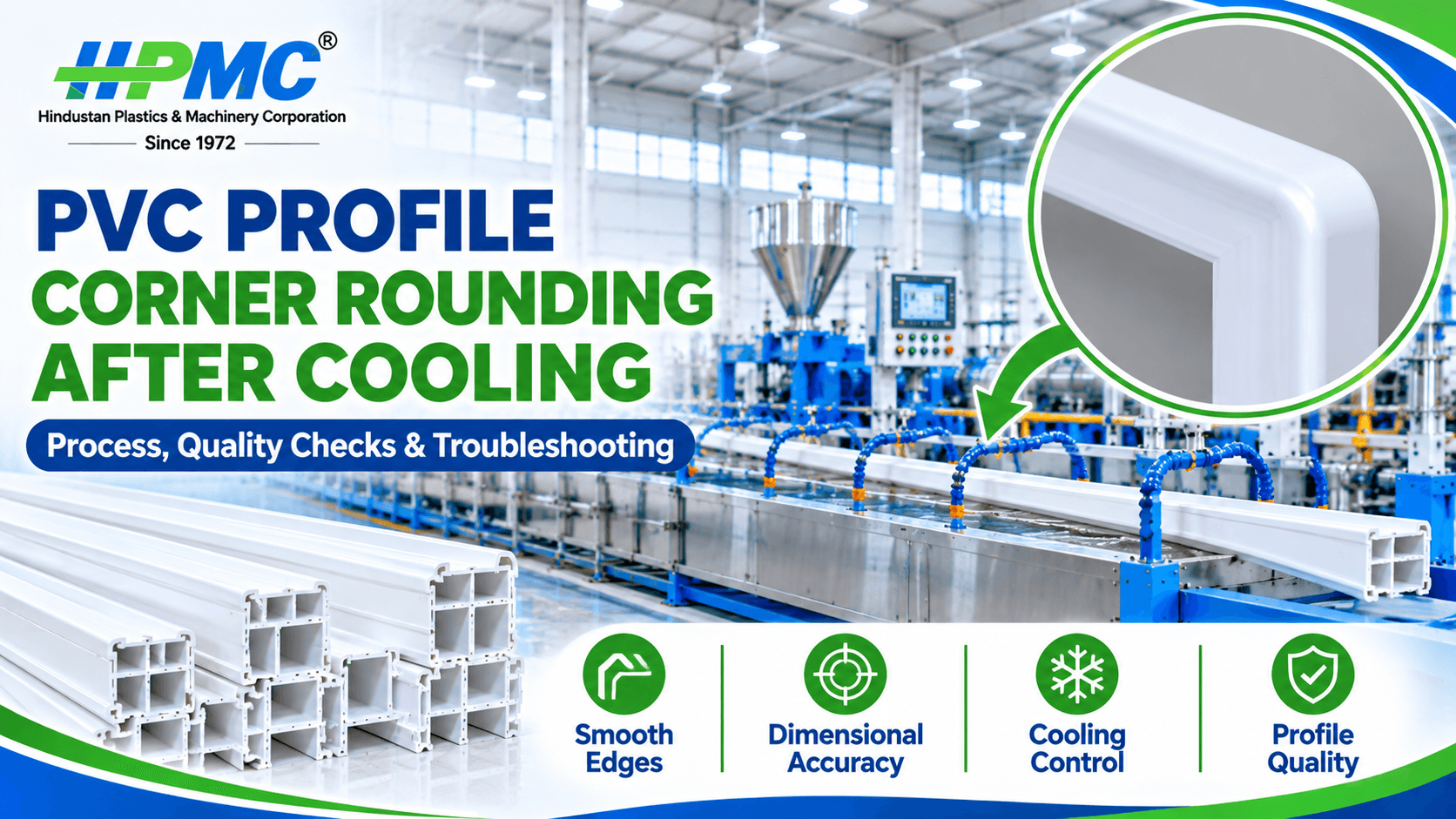
PVC Profile Corner Rounding After Cooling refers to the process of creating or refining smooth, rounded edges on PVC profiles after they have cooled and stabilised. This operation helps remove sharp edges, improve the finished appearance and prepare profiles for further fabrication or assembly. It is particularly relevant for PVC window profiles, door sections, decorative profiles and other products where edge quality matters.
The quality of corner rounding depends on profile design, material condition, cooling stability, tooling, machining settings and operator control. Incorrect finishing can cause scratches, uneven edges, dimensional changes and visible surface defects. Understanding the process and following suitable quality-control practices helps manufacturers achieve consistent PVC profile finishing.
What Is PVC Profile Corner Rounding After Cooling?
PVC profile corner rounding after cooling is a finishing operation in which selected corners or edges of a cooled PVC profile are shaped to achieve a specified radius or smoother edge. The operation may be performed through suitable routing, milling, trimming, sanding or specialised profile-finishing equipment, depending on the product design.
The main objective is to create consistent edges without damaging the profile surface or affecting important dimensions. The required corner shape should be defined in the product drawing or finishing specification.
Not every PVC profile requires additional corner rounding. Some profiles already have rounded corners formed directly by the extrusion die. Additional finishing may be necessary when a design requires a particular edge radius, a modified corner, a smooth joint or preparation for further assembly.
Why Is Corner Rounding Required in PVC Profile Manufacturing?
Corner rounding can provide several practical advantages when it is required by the product design.
1. Smooth Edge Finishing
Sharp or rough edges can affect the appearance and handling of a finished profile. Controlled corner rounding helps create a smoother transition between adjoining surfaces.
2. Improved Product Appearance
Visible profile edges are important in applications such as window frames, door sections and decorative PVC components. Consistent rounding can improve the overall finish of the product.
3. Better Handling
Removing unnecessarily sharp edges can make certain profiles easier to handle during fabrication, assembly and installation. Appropriate workplace safety procedures are still necessary.
4. Improved Assembly Preparation
Some profile designs require specific edge conditions before joining, welding, fitting or further fabrication. Corner finishing can help prepare the product for the next manufacturing stage.
5. Consistent Product Quality
When corner rounding is controlled according to a defined specification, manufacturers can reduce variations in edge appearance between different production batches.
How Does PVC Profile Corner Rounding After Cooling Work?
The process generally involves several stages. The exact sequence depends on the profile design, equipment configuration and finishing requirements.
1. PVC Profile Extrusion
The process begins when the prepared PVC compound enters the extrusion machine. Controlled heating and screw movement process the material before it reaches the profile die. The die forms the required cross-sectional shape.
2. Calibration
After leaving the die, the hot profile enters the calibration system. Calibration helps establish and maintain the required profile geometry while the material begins to cool.
3. Cooling and Stabilisation
The profile passes through the cooling arrangement, where its temperature gradually decreases. Sufficient cooling and stabilisation are important before additional finishing operations are performed.
4. Profile Inspection
Before corner rounding, the profile should be checked for dimensions, straightness, surface condition and visible defects. The operator should confirm that the profile is suitable for the planned finishing operation.
5. Corner Rounding Operation
The cooled profile is positioned in the appropriate finishing equipment. Depending on the required radius and profile geometry, a suitable cutter, router or finishing tool is used to shape the specified corner.
6. Edge Cleaning
After machining, loose particles, chips and residues should be removed using an approved cleaning method. The finished edge should be checked for burrs, scratches and irregularities.
7. Final Quality Inspection
The finished profile is inspected against the approved drawing or product specification. Important checks include corner radius, surface finish, dimensional accuracy and consistency along the processed section.
Common Problems During PVC Profile Corner Rounding
Incorrect tooling, unsuitable machining conditions and poor profile support can create finishing problems.
1. Uneven Corner Radius
An inconsistent radius may develop when the profile is not positioned correctly or the finishing tool does not maintain a stable cutting path. Check the fixture, tool condition and equipment alignment.
2. Rough or Scratched Edges
Roughness and scratches may result from damaged tools, unsuitable cutting conditions, contamination or improper handling. Inspect the tool and contact surfaces before continuing production.
3. Excessive Material Removal
Removing too much material can change the intended profile dimensions and weaken the finished edge. Follow the approved drawing and use controlled machining settings.
4. Chipped PVC Corners
Chipping may occur when the material is not properly supported or the cutting tool is unsuitable for the PVC formulation and profile geometry. Review the tool condition and machining arrangement.
5. Surface Discolouration
Unusual surface marks or discolouration may be associated with friction, heat generation, contamination or damaged finishing tools. Inspect the affected area and review the machining process.
6. Inconsistent Finishing Between Profiles
Differences between finished profiles may occur because of changing tool conditions, incorrect positioning, inconsistent operator settings or variations in the incoming profile dimensions.
Important Factors Affecting Corner Rounding Quality
Manufacturers should evaluate the following factors before establishing a finishing process.
Profile Design and Geometry
The profile cross-section determines which corners can be rounded and how the finishing tool can access them. Hollow chambers, reinforcement sections and decorative surfaces must be considered before machining.
Cooling and Material Stability
The profile should be sufficiently cooled and stable before additional machining. Temperature differences and dimensional changes can affect how the profile is positioned and finished.
Tool Selection
The cutter or finishing tool should be suitable for the PVC material, required radius and profile geometry. Incorrect tooling can produce rough edges or remove excessive material.
Machining Speed and Feed
Tool speed and feed conditions should follow equipment and tooling recommendations. Unsuitable settings may contribute to surface damage, vibration or inconsistent edge finishing.
Profile Holding and Support
The profile must be supported securely during finishing. Poor support can cause movement, vibration or uneven material removal.
Operator Skill
Operators should understand the product drawing, finishing requirements, machine settings and inspection procedure. Proper training helps reduce avoidable finishing variations.
How to Improve PVC Profile Corner Rounding Accuracy
A consistent finishing process requires suitable equipment, proper preparation and regular inspection.
1. Follow the Product Drawing
Define the required corner radius, finished dimensions and acceptable surface condition before production begins.
2. Inspect Incoming Profiles
Check the cooled profiles for dimensional variation, surface defects and deformation. Do not assume that every incoming section is suitable for immediate finishing.
3. Use Suitable Finishing Tools
Select tools according to the PVC material and required edge geometry. Inspect cutters regularly and replace damaged or excessively worn tools.
4. Maintain Proper Profile Support
Use suitable fixtures and supports to prevent movement during machining. The profile should remain correctly positioned throughout the operation.
5. Maintain Consistent Operating Settings
Record approved machining parameters and avoid unnecessary adjustments during production. Any changes should be evaluated through sample inspection.
6. Check Finished Edges Regularly
Inspect samples at suitable production intervals. Compare the finished radius and appearance with the approved product specification.
7. Maintain Finishing Equipment
Clean the machine, inspect moving parts and follow the manufacturer's maintenance recommendations. Proper equipment maintenance supports consistent finishing performance.
Quality Control Checklist for PVC Profile Corner Rounding
A structured inspection routine helps manufacturers maintain the required finishing standards.
- Check incoming profile dimensions.
- Confirm that the profile is sufficiently cooled and stabilised.
- Inspect the profile for existing scratches or deformation.
- Verify the required corner radius from the product drawing.
- Check the finishing tool condition.
- Confirm correct profile positioning and support.
- Inspect for chipped or rough edges.
- Check for excessive material removal.
- Verify finished dimensions after machining.
- Record inspection results and recurring defects.
Inspection frequency should depend on production volume, profile design, finishing equipment and customer requirements.
Role of the PVC Profile Extrusion Line in Final Finishing
Corner rounding takes place after the extrusion and cooling stages, but the quality of the incoming profile still depends on the complete production line.
The main equipment involved includes the extruder, profile die, calibration table, cooling system, haul-off unit and cutting equipment. Each component contributes to the dimensions and condition of the profile before it reaches the finishing section.
A stable extrusion process helps provide consistent profiles for downstream operations. If the incoming profile has dimensional variations, deformation or surface defects, these problems may complicate corner rounding.
Manufacturers should therefore evaluate the complete PVC Profile Machine and its downstream equipment when planning a production setup.
Difference Between Corner Rounding and Extrusion Die Corner Design
Corner rounding after cooling and corner formation through the extrusion die are two different operations.
Extrusion Die Corner Design: The profile die forms the initial cross-sectional geometry. If the drawing specifies rounded corners, the die can be designed to produce those corners during extrusion.
Post-Cooling Corner Rounding: This is an additional finishing operation performed after the profile has cooled. It is used when the product requires further edge modification, a specific finishing radius or a smoother corner.
Manufacturers should identify which operation is required before selecting tooling or planning the production process. Unnecessary machining can increase production time and may affect profile dimensions.
Benefits of Proper PVC Profile Finishing
A well-controlled corner rounding process can support several manufacturing objectives.
Better Surface Appearance
Consistent rounded edges contribute to a cleaner finished appearance, particularly on visible profile sections.
Improved Dimensional Control
Following defined machining specifications helps maintain the intended edge geometry and overall profile dimensions.
Reduced Finishing Defects
Regular tool inspection, correct positioning and suitable machining conditions can help reduce roughness, chipping and uneven corners.
Better Production Consistency
Documented operating procedures make it easier to reproduce the same finishing quality across production batches.
Easier Downstream Handling
Suitable edge finishing can support subsequent fabrication, assembly and handling requirements.
How to Select Equipment for PVC Profile Corner Rounding
Manufacturers planning a new finishing operation should evaluate equipment according to their profile designs and production requirements.
Check Profile Compatibility
Confirm that the equipment can accommodate the required profile dimensions, shapes and corner locations.
Evaluate Tooling Options
Discuss available cutters, routing tools and finishing arrangements according to the specified corner radius.
Consider Production Capacity
The finishing equipment should match the expected production volume without creating an unnecessary bottleneck after extrusion.
Check Adjustment and Control
Suitable adjustment facilities help operators maintain consistent positioning and finishing conditions.
Evaluate Safety Features
Check machine guarding, emergency stops, dust or chip management and other safety provisions according to the equipment design.
Consider Maintenance and Technical Support
Review spare-part availability, tool replacement procedures, installation support and operator training before selecting equipment.
Manufacturers looking at rigid PVC processing equipment can also explore HPMC's Conical Twin Screw Plant for PVC Profile.
Why Choose HPMC for PVC Profile Extrusion Machinery?
Hindustan Plastics and Machinery Corporation (HPMC) has been associated with plastic extrusion machinery manufacturing since 1972. The company provides machinery solutions for different plastic processing and extrusion applications.
For PVC profile manufacturers, selecting the right extrusion machinery involves more than evaluating the extruder alone. The profile die, calibration arrangement, cooling system, haul-off and cutting equipment should be considered according to the intended product design and production requirements.
HPMC helps manufacturers explore suitable machinery configurations for their extrusion applications. For window and door profile manufacturing requirements, its Window Profile Machine Guide provides additional information about the production line and important machine-selection considerations.
Conclusion
PVC Profile Corner Rounding After Cooling is a finishing operation used when a PVC profile requires smooth, controlled or modified corner geometry after extrusion and cooling. The quality of this operation depends on profile stability, tool selection, machine alignment, material support and proper inspection.
Manufacturers should follow the approved product drawing, inspect incoming profiles, use suitable finishing tools and maintain consistent machining conditions. Regular quality checks can help identify uneven radii, chipped corners, rough edges and excessive material removal before defective products move to the next production stage.
A properly planned extrusion and finishing process helps manufacturers maintain product appearance, dimensional consistency and reliable production quality. For machinery planning and technical guidance, manufacturers can contact HPMC to discuss their PVC profile production requirements.
Contact Hindustan Plastics and Machinery Corporation (HPMC)
Company: Hindustan Plastics and Machinery Corporation (HPMC)
Address: 5, Category II, DSIDC Industrial Area, Nangloi, Delhi – 110041, India
Phone: +91 95605 96392
Email: info@hindustanplastics.com
Website: https://www.hindustanplastics.com/
Request a Quote: Contact HPMC
Google Business Profile: View HPMC on Google
When contacting HPMC, share your PVC profile type, cross-sectional design, required corner radius, profile dimensions, expected production capacity and existing machinery configuration to discuss suitable extrusion machinery solutions.
Contact HPMC today to discuss your PVC profile extrusion requirements and explore suitable machinery solutions for consistent manufacturing quality.
Frequently Asked Questions
Find quick answers to the most common questions about this topic.
It is a finishing operation in which selected corners of a cooled PVC profile are shaped or refined to achieve a specified radius or smoother edge.
Cooling helps stabilise the extruded profile before additional machining. This provides a more suitable condition for controlled finishing, depending on the profile and equipment.
Depending on the application, manufacturers may use routing machines, milling equipment, trimming tools or specialised PVC profile finishing machines.
No. Some profiles already have the required rounded corners formed through the extrusion die. Additional finishing is only needed when the product design or application requires it.
Common causes include incorrect profile positioning, worn tools, unsuitable machining settings, poor support and inconsistent incoming profile dimensions.
Yes. Excessive material removal or incorrect machining can change the profile's dimensions. Finishing should follow the approved product drawing.
Use suitable finishing tools, maintain proper profile support, inspect tool condition and follow the equipment manufacturer's machining recommendations.
Manufacturers can inspect the finished radius, edge smoothness, surface condition and profile dimensions against the approved drawing or quality specification.
Die corner design forms the initial profile shape during extrusion, whereas post-cooling corner rounding is an additional operation performed after the profile has stabilised.
Important factors include profile geometry, required corner radius, production capacity, tooling compatibility, machine adjustment, operator safety, maintenance and technical support.