
Introduction
Double Wall Corrugated (DWC) pipes are widely used in underground drainage, sewerage systems, stormwater management and cable protection applications. These pipes are designed with a corrugated outer wall and a smooth inner wall to provide structural strength and efficient flow characteristics. During manufacturing, maintaining consistent pipe dimensions is important, and cutting accuracy is one of the key factors that influence the quality of the finished product.
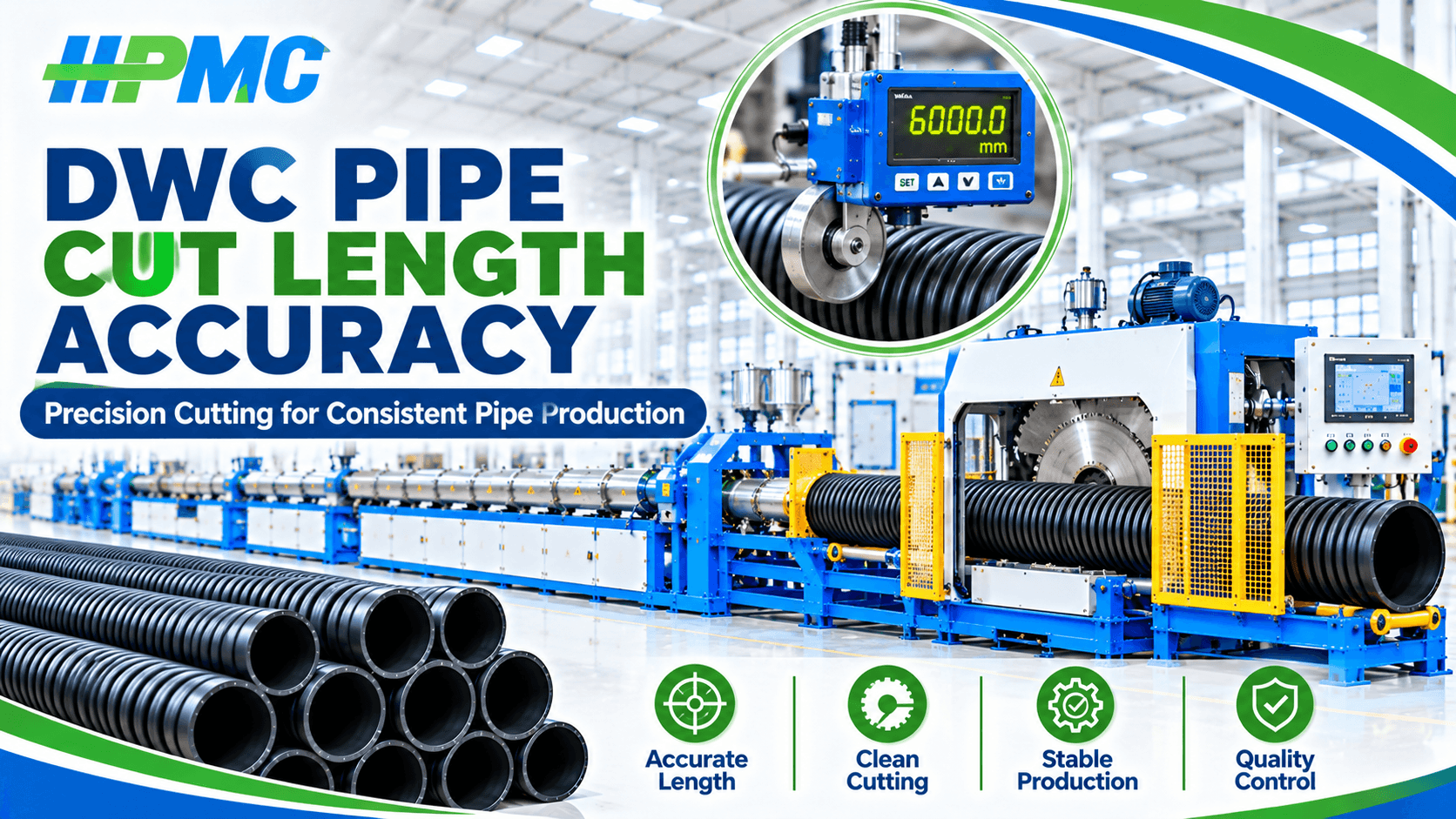
DWC Pipe Cut Length Accuracy refers to the ability of a manufacturing line to cut corrugated pipes according to the required length with minimum variation. Accurate cutting helps manufacturers maintain product consistency, reduce material waste and ensure that pipes meet customer specifications.
In a modern DWC pipe extrusion line, the cutting system works together with the extruder, corrugator, cooling arrangement and haul-off unit. If these components are not properly coordinated, manufacturers may experience incorrect pipe lengths, uneven cutting edges or production interruptions.
For manufacturers planning a complete plastic pipe production facility, understanding the working process of a PVC Pipe Extrusion Line can also provide useful information about extrusion, downstream handling and automatic cutting arrangements.
This guide explains the importance of DWC pipe cut length accuracy, the factors affecting cutting performance, common problems, troubleshooting methods and practical ways to maintain consistent production quality.
What Is DWC Pipe Cut Length Accuracy?
DWC Pipe Cut Length Accuracy is the measurement of how closely the actual length of a finished corrugated pipe matches its specified cutting length.
During production, the extrusion line continuously manufactures pipe. The cutting machine separates this continuous product into individual sections according to the required dimensions.
The cutting system must identify the correct cutting position and operate at the appropriate time. This becomes particularly important when the production line runs continuously at a changing speed.
For example, if a manufacturer requires pipes of a particular standard length, the automatic cutting system should consistently produce sections that remain within the applicable dimensional tolerance.
The acceptable tolerance depends on the relevant product standard, customer specification and manufacturing requirements.
Maintaining accurate cut lengths supports:
- Consistent finished pipe dimensions.
- Easier transportation and storage.
- Better installation planning.
- Reduced material wastage.
- Improved production efficiency.
- Fewer customer complaints and rejected products.
How Does the DWC Pipe Cutting Process Work?
A DWC pipe cutting system operates as part of the complete extrusion and corrugation line. Each production stage contributes to the accuracy of the final cut.
1. Pipe Extrusion
The process begins when the polymer material enters the extrusion system. The extruder melts and conveys the material towards the double-wall die head.
The die forms the inner and outer walls required for the DWC pipe structure.
2. Corrugation and Pipe Formation
The molten outer wall enters the corrugator, where moving mould blocks create the required corrugated profile.
The inner wall is formed and joined with the outer wall according to the product design.
3. Cooling and Stabilisation
The formed pipe passes through the required cooling arrangement. Cooling helps the pipe retain its dimensions and structural shape before cutting.
4. Haul-Off Operation
The haul-off unit moves the pipe through the downstream equipment at a controlled speed.
Its operation must be coordinated with the extrusion and corrugation process. Unstable pulling conditions can influence the movement and dimensions of the pipe.
5. Length Measurement
The measuring arrangement monitors the pipe movement and identifies when the required cutting length has been reached.
Depending on the machine configuration, this may involve an encoder, measuring wheel, sensor or other automatic length-control arrangement.
6. Automatic Cutting
Once the required length is detected, the cutting system performs the cutting operation.
The cutter must be appropriately coordinated with the moving pipe to avoid unnecessary pulling, deformation or uneven cutting.
7. Collection and Inspection
After cutting, the finished pipes are transferred to the collection section.
Operators inspect the length, cut edges and overall pipe condition before approving the products for packaging and dispatch.
Why Is DWC Pipe Cut Length Accuracy Important?
Cutting accuracy is important because it affects manufacturing quality, material utilisation and customer satisfaction.
Consistent Product Dimensions
Customers generally expect every pipe in an order to meet the specified dimensions. Consistent cutting helps manufacturers maintain uniform finished products.
Reduced Material Waste
Incorrect cutting can result in rejected sections or unnecessary material loss. Maintaining the correct cutting settings helps reduce avoidable waste.
Better Installation Convenience
Pipes manufactured according to the required dimensions are easier to plan, transport and install.
Consistent lengths also help contractors organise pipe sections during underground drainage and infrastructure projects.
Improved Production Efficiency
A properly coordinated cutting system helps reduce repeated adjustments and unnecessary production interruptions.
Better Customer Satisfaction
Manufacturers supplying products with consistent dimensions can improve order reliability and reduce complaints related to incorrect pipe lengths.
Factors Affecting DWC Pipe Cut Length Accuracy
Several mechanical and operational factors influence cutting performance.
1. Haul-Off Speed
The haul-off unit controls the movement of the pipe through the production line.
If the pulling speed changes unexpectedly, the measuring and cutting system must respond correctly.
Poor coordination between the haul-off and cutter may cause length variations.
2. Encoder and Measuring System
The measuring system identifies how far the pipe has travelled.
An encoder or measuring wheel that provides inconsistent readings may trigger cutting at the wrong position.
Regular inspection and suitable calibration procedures help maintain measurement reliability.
3. Corrugated Pipe Surface
DWC pipes have a corrugated external structure rather than a completely smooth surface.
Depending on the measuring arrangement, contact with the corrugated surface may influence measurement repeatability.
Manufacturers should use a suitable measuring arrangement designed for the pipe profile and machine configuration.
4. Cutter Synchronisation
The cutting machine must operate in coordination with the continuously moving pipe.
If synchronisation is incorrect, the cutting system may create inaccurate lengths or damage the pipe during operation.
5. Machine Vibration
Excessive vibration can affect mechanical stability and the performance of measuring or cutting components.
Regular inspection of the machine structure, drive system and mounting arrangement helps reduce this problem.
6. Pipe Temperature and Cooling
The pipe should be sufficiently stabilised before cutting according to the production process.
Temperature and cooling variations may affect dimensional stability and handling conditions.
7. Cutting Blade Condition
Worn or damaged cutting components can create rough edges, incomplete cuts and unnecessary mechanical resistance.
Regular blade inspection is important for maintaining consistent cutting quality.
Common DWC Pipe Cutting Problems and Their Solutions
Manufacturers may experience different cutting problems during regular production.
1. Incorrect Pipe Length
The finished pipe may be longer or shorter than the required specification.
Possible Causes:
- Incorrect cutting-length settings.
- Measuring system errors.
- Encoder malfunction.
- Unstable haul-off movement.
- Incorrect cutter synchronisation.
Solutions:
- Verify the required cutting length.
- Inspect the measuring arrangement.
- Check encoder signals and connections.
- Review haul-off speed.
- Test the cutter according to the machine manufacturer's procedure.
2. Uneven Cutting Edges
Some pipes may have rough, irregular or angled cut ends.
Possible Causes:
- Worn cutting blade.
- Incorrect cutter alignment.
- Unstable pipe support.
- Mechanical vibration.
- Incorrect cutting conditions.
Solutions:
- Inspect the cutting blade.
- Check the cutter alignment.
- Verify the pipe support arrangement.
- Inspect the cutting mechanism.
- Replace worn components when necessary.
3. Variation Between Consecutive Pipe Lengths
Finished pipe sections may show inconsistent lengths even when the same cutting setting is used.
Possible Causes:
- Inconsistent measurement signals.
- Measuring wheel slippage.
- Changes in production speed.
- Loose mechanical connections.
- Control-system issues.
Solutions:
- Inspect the measuring wheel and its contact arrangement.
- Check the encoder and control signals.
- Review speed variations.
- Inspect mechanical connections.
- Compare measurements from several consecutive pipes.
4. Pipe Deformation During Cutting
The corrugated structure may become damaged during the cutting operation.
Possible Causes:
- Incorrect cutting method.
- Insufficient pipe support.
- Improper blade condition.
- Excessive cutting force.
- Incorrect machine settings.
Solutions:
- Check the cutting mechanism.
- Maintain suitable pipe support.
- Inspect the cutting blade.
- Verify the equipment configuration.
- Follow the approved operating procedure.
5. Inconsistent Cutting During Speed Changes
Cut length may become inconsistent when the production line accelerates or slows down.
Possible Causes:
- Poor speed synchronisation.
- Incorrect control-system response.
- Measuring delays.
- Inconsistent encoder signals.
Solutions:
- Check the relationship between haul-off and cutter speed.
- Inspect the PLC and drive settings.
- Verify measuring-system performance.
- Test the equipment under approved operating conditions.
How to Improve DWC Pipe Cut Length Accuracy
Manufacturers can improve cutting performance through regular monitoring and proper equipment maintenance.
Maintain the Measuring System
Inspect the encoder, measuring wheel, sensors and electrical connections. Ensure that the measuring arrangement is suitable for the corrugated pipe profile.
Check Cutter Synchronisation
Verify that the cutting machine operates according to the movement of the pipe. Review synchronisation settings whenever production conditions change.
Maintain Stable Haul-Off Operation
The haul-off should pull the pipe smoothly without unnecessary tension or speed fluctuations.
Inspect Cutting Components
Check blade condition, alignment, mechanical movement and supporting arrangements.
Follow Regular Calibration Procedures
Use an approved measurement reference to verify the length-measuring system. Calibration frequency should follow the machine manufacturer's recommendations.
Record Finished Pipe Measurements
Collect samples at regular production intervals and compare their measured lengths with the approved product specifications.
Train Machine Operators
Operators should understand the measuring system, cutter operation, safety procedures and basic troubleshooting methods.
Role of Automation in DWC Pipe Cut Length Accuracy
Automation plays an important role in modern DWC pipe manufacturing.
PLC-based control systems can coordinate selected machine functions and help operators monitor production parameters through a central control panel.
Depending on the equipment design, automatic cutting systems may use encoders, sensors and programmed length settings to identify the cutting position.
Variable frequency drives can also support controlled motor operation and coordination between connected equipment.
However, automation does not remove the need for regular inspection. Measuring devices, mechanical components and control systems must remain in suitable operating condition.
For manufacturers comparing different cutting arrangements, HPMC's Two Pipe PVC Conduit Plant provides an example of an automated cutting configuration with independent cutting arrangements and PLC-based control.
DWC Pipe Cut Length Quality Control Checklist
A consistent inspection procedure helps manufacturers identify cutting problems before products are dispatched.
Important inspection points include:
- Verify the specified pipe cutting length.
- Measure finished pipes using a suitable measuring instrument.
- Check the measuring system and encoder.
- Inspect the cutter blade condition.
- Verify cutter alignment.
- Check haul-off and cutter synchronisation.
- Inspect cut edges for irregularities.
- Check the pipe for deformation.
- Record measurements from consecutive production samples.
- Maintain inspection and maintenance records.
The acceptance limits should always follow the applicable product standard and customer requirements.
How to Select a Suitable DWC Pipe Cutting System
Selecting the correct cutting arrangement is important when installing a new extrusion line or upgrading existing production equipment.
Before selecting a machine, manufacturers should evaluate the following factors:
Required Pipe Diameter Range
The cutting system should support the intended pipe diameter range and corrugated profile.
Cutting Length Requirements
Confirm the required standard lengths and whether the machine supports adjustable cutting settings.
Production Speed
The cutting arrangement should be compatible with the expected production speed and downstream equipment.
Automation Features
Evaluate the available measuring system, PLC controls, sensors and automatic cutting functions.
Cutting Quality
Inspect the cutting mechanism and confirm that it can produce suitable cut edges without damaging the pipe structure.
Maintenance Requirements
Check the availability of replacement components, technical support and maintenance instructions.
Complete Line Compatibility
The cutting system should work properly with the extruder, corrugator, cooling arrangement and haul-off unit.
For additional information about production performance and downstream coordination, manufacturers can explore HPMC's HDPE Pipe Extrusion Line Output Calculation Guide.
Maintenance Tips for DWC Pipe Cutting Equipment
Regular maintenance helps improve machine reliability and reduce unexpected interruptions.
Inspect the cutting blade and replace worn components according to the manufacturer's recommendations.
Check encoder connections, measuring wheels, sensors and other length-measuring components.
Inspect the cutter drive, bearings, mechanical connections and supporting structure.
Keep the cutting area clean and remove material deposits using approved maintenance procedures.
Check the electrical control panel and safety arrangements through qualified personnel.
Maintain a record of machine inspections, cutting settings, production issues and corrective actions.
Preventive maintenance is especially important for manufacturers operating continuous production lines.
Why Choose HPMC for Plastic Extrusion Machinery?
Hindustan Plastics & Machine Corporation (HPMC) has been associated with plastic extrusion machinery manufacturing since 1972.
The company provides plastic extrusion machinery solutions for industrial manufacturing applications.
Manufacturers planning a DWC pipe production project should consider the complete production arrangement, including extrusion, corrugation, cooling, haul-off, cutting and collection systems.
The correct equipment configuration depends on the intended pipe diameter, material, production capacity, cutting requirements and automation preferences.
Before finalising a machinery purchase, buyers should discuss their production requirements, installation needs, commissioning and technical support with the HPMC team.
For further information about machine installation and production preparation, manufacturers can read HPMC's PVC Pipe Line Commissioning Checklist.
Conclusion
DWC Pipe Cut Length Accuracy is an important part of maintaining consistent quality in double-wall corrugated pipe manufacturing. The performance of the measuring system, haul-off unit, cutting mechanism and automation controls directly influences the length consistency of finished pipes.
Incorrect measurement, poor synchronisation, worn cutting components and unstable pipe movement can create length variations and production defects.
Manufacturers can reduce these problems through regular equipment inspection, suitable calibration procedures, stable production conditions and systematic quality checks.
A properly selected and maintained cutting system helps improve product consistency, reduce avoidable waste and support efficient manufacturing operations.
HPMC provides plastic extrusion machinery solutions for industrial manufacturing applications. Manufacturers planning a new DWC pipe production line or upgrading an existing facility can contact HPMC to discuss their machinery requirements.
Contact Hindustan Plastics & Machine Corporation (HPMC)
Company: Hindustan Plastics & Machine Corporation (HPMC)
Address: 5, Category II, DSIDC Industrial Area, Nangloi, Delhi – 110041, India
Phone: +91 95605 96392
Email: info@hindustanplastics.com
Website: https://www.hindustanplastics.com/
Contact HPMC for information about plastic extrusion machinery, production requirements and technical assistance.
Frequently Asked Questions
Find quick answers to the most common questions about this topic.
DWC Pipe Cut Length Accuracy refers to how closely the actual length of a finished double-wall corrugated pipe matches its specified cutting length.
Accurate cutting helps maintain consistent product dimensions, reduce material waste, improve installation convenience and meet customer specifications.
Incorrect cutting length may result from measuring-system errors, encoder problems, unstable haul-off speed, incorrect settings or poor cutter synchronisation.
An encoder provides movement-related measurement signals to the control system. These signals help identify when the required cutting length has been reached.
Yes. Changes in haul-off speed can influence the coordination between pipe movement, measurement and cutting operations.
Uneven cutting edges may be associated with worn blades, incorrect cutter alignment, poor pipe support or mechanical instability.
Inspection frequency should follow the machine manufacturer's maintenance schedule. Measuring devices, cutting blades, drives and electrical connections should be checked regularly.
A PLC can coordinate cutting operations, process measurement signals and control selected machine functions according to the equipment configuration.
Manufacturers can reduce defects through suitable measuring systems, proper cutter synchronisation, regular calibration, stable haul-off operation and routine quality inspection.
Important factors include pipe diameter, required cutting lengths, production speed, automation features, cutting quality, maintenance requirements and compatibility with the complete extrusion line.