
Introduction
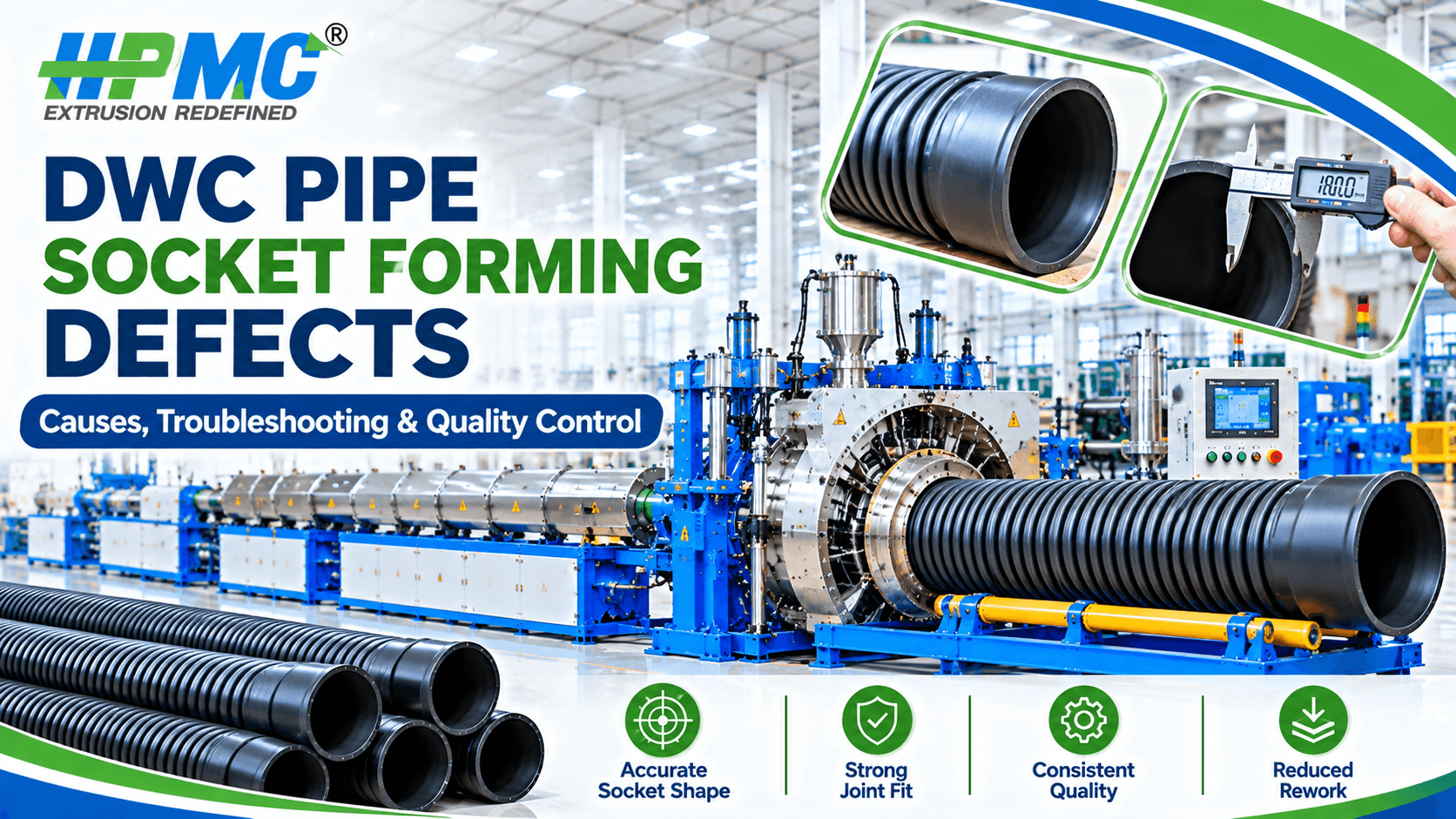
Double Wall Corrugated (DWC) pipes are widely used in underground drainage, sewerage, stormwater management and cable protection systems. These pipes feature a corrugated outer wall and a relatively smooth inner wall, providing a combination of structural strength and functional performance. During manufacturing, socket formation is an important process because it allows pipes to connect securely with other pipe sections.
DWC Pipe Socket Forming Defects can affect joint fitting, dimensional accuracy, sealing performance and the overall quality of the finished pipe. Problems such as incorrect socket diameter, uneven socket walls, cracks, ovality and poor joint alignment can create difficulties during installation and may lead to product rejection.
Socket formation requires proper control of material condition, heating, forming equipment, tooling, cooling and dimensional inspection. Even a small variation in the forming process can affect the final socket shape and connection quality.
Manufacturers using modern extrusion technology should understand the relationship between pipe production and socket forming to maintain consistent results. HPMC provides plastic extrusion machinery solutions for industrial manufacturing. For a broader understanding of double-wall pipe production, manufacturers can explore HPMC's DWC HDPE Corrugated Pipe Plant Guide.
This guide explains the common DWC pipe socket forming defects, their possible causes, troubleshooting methods and practical quality control measures.
What Is DWC Pipe Socket Forming?
DWC pipe socket forming is a manufacturing process in which one end of a pipe is shaped to create a socket for connecting another compatible pipe section.
The socket is designed according to the required joint arrangement and product specifications. Depending on the pipe design, it may accommodate a compatible spigot end, sealing ring or other specified joining arrangement.
The forming process must maintain the required socket diameter, depth, roundness and wall structure.
Unlike the corrugated body of the pipe, the socket area may require a different geometry to achieve the intended connection. Therefore, suitable tooling and controlled forming conditions are important.
A properly formed socket helps achieve:
- Correct pipe-to-pipe fitting.
- Consistent joint dimensions.
- Suitable sealing arrangement.
- Better installation compatibility.
- Reduced rejection during quality inspection.
How Does DWC Pipe Socket Forming Work?
The exact socketing process depends on the machine configuration and pipe design. However, a typical manufacturing arrangement involves several important stages.
1. Pipe Preparation
The finished DWC pipe is prepared for socket formation. The pipe end is checked for dimensional consistency, surface condition and cutting accuracy.
2. Material Conditioning
Where thermal forming is used, the socket area is conditioned according to the material and equipment requirements. Uniform conditioning helps avoid uneven forming.
3. Socket Forming
The prepared pipe end is shaped using suitable socket-forming tooling. The tooling establishes the required internal and external geometry.
4. Cooling and Stabilisation
After forming, the socket is allowed to stabilise under controlled conditions. Proper cooling helps the socket retain its intended shape.
5. Dimensional Inspection
The finished socket is inspected for diameter, roundness, depth, wall condition and compatibility with the intended joining arrangement.
6. Final Quality Approval
The pipe is checked against the relevant product specification before packaging and dispatch.
Common DWC Pipe Socket Forming Defects
Understanding individual defects makes it easier to identify their possible causes and select appropriate corrective actions.
1. Incorrect Socket Diameter
Incorrect socket diameter is one of the common dimensional problems in socket forming.
The socket may become too large or too small compared with the specified dimensions. This can create fitting difficulties during pipe installation.
Possible Causes:
- Incorrect forming tool dimensions.
- Unsuitable material conditioning.
- Improper forming pressure or positioning.
- Tool wear or dimensional variation.
- Inconsistent cooling conditions.
Troubleshooting:
- Measure the socket diameter using suitable instruments.
- Check the forming mandrel and tooling dimensions.
- Review the material conditioning process.
- Inspect the cooling arrangement.
- Compare finished dimensions with the approved product specification.
2. Socket Ovality
Socket ovality occurs when the socket does not maintain a sufficiently circular shape.
An oval socket may create uneven fitting conditions and affect the compatibility of the pipe joint.
Possible Causes:
- Uneven heating or material conditioning.
- Incorrect tooling alignment.
- Uneven support during forming.
- Premature handling before stabilisation.
- Mechanical issues in the socket-forming unit.
Troubleshooting:
- Measure the socket at different positions.
- Inspect the tooling and supporting arrangement.
- Check the forming machine alignment.
- Review cooling conditions.
- Maintain a consistent inspection procedure.
3. Cracks Around the Socket Area
Cracks near the socket may reduce the reliability of the finished pipe and can indicate problems with material condition or forming operations.
Possible Causes:
- Excessive forming stress.
- Unsuitable material conditioning.
- Damaged or worn tooling.
- Incorrect forming sequence.
- Material degradation or contamination.
Troubleshooting:
- Inspect the socket surface carefully.
- Review the material and processing history.
- Check the forming tool for sharp edges or damage.
- Verify that the process follows the machine manufacturer's recommendations.
- Reject pipes that do not meet the applicable quality requirements.
4. Uneven Socket Wall Thickness
Uneven wall thickness occurs when the socket has inconsistent material distribution around its circumference or along its length.
This can affect dimensional consistency and the intended joint performance.
Possible Causes:
- Uneven initial pipe dimensions.
- Incorrect tooling alignment.
- Inconsistent material conditioning.
- Excessive or uneven forming deformation.
- Variations in the socket-forming setup.
Troubleshooting:
- Measure wall thickness at multiple positions.
- Check the initial pipe dimensions.
- Inspect the forming mandrel and supporting tools.
- Review the forming process.
- Compare measurements with the product specification.
5. Incomplete Socket Formation
Incomplete socket formation occurs when the pipe end does not achieve the required shape or dimensions.
The socket may have an insufficient depth, incomplete profile or irregular opening.
Possible Causes:
- Incorrect forming tool configuration.
- Unsuitable material condition.
- Improper positioning of the pipe.
- Incomplete forming operation.
- Mechanical or control-system problems.
Troubleshooting:
- Verify the required socket depth.
- Check the tooling arrangement.
- Inspect pipe positioning.
- Review the forming sequence.
- Confirm that the machine completes the required operation.
6. Rough or Irregular Socket Surface
A rough socket surface can affect the appearance and may indicate problems with material preparation or tooling.
Possible Causes:
- Contamination on forming surfaces.
- Damaged tooling.
- Unsuitable material conditioning.
- Material degradation.
- Incorrect forming conditions.
Troubleshooting:
- Inspect the socket surface and tooling.
- Clean equipment according to approved procedures.
- Check material quality.
- Review processing conditions.
- Monitor finished sockets during production.
7. Socket Misalignment
Socket misalignment occurs when the formed socket is not properly aligned with the pipe body.
This may create problems during joint assembly and installation.
Possible Causes:
- Incorrect pipe positioning.
- Misaligned forming equipment.
- Improper clamping.
- Mechanical wear.
- Uneven support during forming.
Troubleshooting:
- Check the alignment of the pipe and forming unit.
- Inspect the clamping arrangement.
- Verify tooling positioning.
- Examine the socket and pipe body together.
- Correct mechanical issues before restarting production.
8. Socket Deformation After Cooling
Sometimes a socket appears acceptable immediately after forming but changes shape during cooling or subsequent handling.
Possible Causes:
- Inadequate cooling.
- Uneven temperature distribution.
- Premature handling.
- Residual forming stress.
- Insufficient support during stabilisation.
Troubleshooting:
- Review the cooling procedure.
- Check the socket after complete stabilisation.
- Inspect handling and storage arrangements.
- Verify the forming process.
- Record dimensional changes during inspection.
Main Factors Affecting DWC Pipe Socket Forming Quality
Several manufacturing conditions influence the quality of the finished socket.
Material Quality
The polymer grade and material condition influence forming behaviour. Variations in material quality may create inconsistent results.
Manufacturers should use approved materials and maintain proper material handling practices.
Temperature Control
Where thermal socket forming is used, temperature control is important for consistent material conditioning.
Excessive or insufficient heating may affect forming quality. The correct settings depend on the polymer, pipe structure and machine configuration.
Forming Tool Design
The forming mandrel and other tooling components determine the required socket geometry.
Tooling should match the intended pipe dimensions and joining arrangement.
Machine Alignment
Incorrect alignment can create uneven socket dimensions and misalignment between the socket and pipe body.
Regular mechanical inspection helps identify these problems.
Cooling Conditions
Cooling allows the formed socket to retain its required dimensions.
Inconsistent cooling may contribute to ovality or deformation.
Operator Experience
Operators must understand the equipment, material behaviour and inspection requirements. Proper training helps maintain repeatable production conditions.
How to Prevent DWC Pipe Socket Forming Defects
Preventive process control is more effective than correcting repeated defects after production.
1. Check Raw Material Quality
Use approved polymer grades and maintain consistent material handling practices. Investigate unexpected changes in material batches.
2. Maintain Correct Tooling
Inspect the forming mandrel, supporting tools and other material-contact surfaces for wear or damage.
3. Monitor Forming Conditions
Maintain the machine settings according to the pipe specification and manufacturer's recommendations.
4. Control Cooling
Ensure that the socket receives suitable cooling and stabilisation before handling or inspection.
5. Inspect Every Production Batch
Measure socket diameter, depth, roundness and other specified dimensions at defined inspection intervals.
6. Maintain Production Records
Record material batches, machine settings, inspection results and corrective actions. These records help identify recurring defects.
7. Train Machine Operators
Operators should understand socket forming procedures, equipment safety and product acceptance criteria.
For additional guidance on production output and equipment coordination, manufacturers can refer to HPMC's HDPE Pipe Extrusion Line Output Calculation Guide.
DWC Pipe Socket Quality Inspection Checklist
A consistent inspection process helps manufacturers identify problems before pipes are approved for dispatch.
Important inspection points include:
- Socket outside diameter.
- Socket inside diameter, where specified.
- Socket depth and length.
- Socket roundness and ovality.
- Wall thickness distribution.
- Surface cracks and irregularities.
- Socket-to-pipe alignment.
- Compatibility with the specified joining arrangement.
- Sealing-ring groove dimensions, where applicable.
- Overall appearance and product identification.
The inspection method and acceptance limits should follow the applicable product standard, customer specification and approved manufacturing procedure.
How Socket Forming Defects Affect Pipe Joint Performance
Socket quality directly influences the connection between two compatible pipe sections.
An incorrectly sized socket may create loose or excessively tight fitting conditions. Ovality may result in uneven contact, while surface damage or cracks can affect joint reliability.
Incorrect socket depth may also prevent the pipe from reaching the intended insertion position.
Where sealing rings are used, the socket geometry and groove dimensions must match the approved joint design.
Manufacturers should therefore inspect the socket and compatible spigot as a complete joint arrangement rather than evaluating socket dimensions alone.
Role of Machinery in Reducing Socket Forming Defects
Suitable machinery plays an important role in maintaining consistent socket quality.
A well-configured socket-forming system should support:
- Repeatable pipe positioning.
- Suitable forming tooling.
- Consistent operating conditions.
- Controlled cooling and stabilisation.
- Accurate dimensional inspection.
- Safe and reliable machine operation.
The equipment should be selected according to pipe diameter, wall structure, socket design, material and expected production requirements.
For general manufacturing troubleshooting and machine-related guidance, manufacturers can also explore HPMC's Common Pipe Extrusion Defects and Their Causes.
Why Choose HPMC for Plastic Extrusion Machinery?
Hindustan Plastics & Machine Corporation (HPMC) has been associated with plastic extrusion machinery manufacturing since 1972.
The company provides plastic extrusion machinery solutions for industrial manufacturing applications.
Manufacturers planning a DWC pipe production facility or considering improvements to their existing production setup should evaluate the complete machinery configuration, including extrusion, corrugation, downstream handling and socket-forming requirements.
Before selecting equipment, buyers should discuss pipe diameter, material grade, required socket dimensions, production capacity and automation requirements with the technical team.
For additional machinery and manufacturing information, visit HPMC's Frequently Asked Questions section.
Maintenance Tips for DWC Pipe Socket Forming Equipment
Regular maintenance helps maintain machine reliability and reduce avoidable production interruptions.
Inspect the forming mandrel and tooling for wear, damage and contamination. Check the mechanical alignment, clamping arrangement and pipe positioning system.
Monitor temperature-control components where thermal forming is used. Inspect cooling equipment and ensure that the stabilisation arrangement works according to the machine configuration.
Electrical connections, sensors, drives and control systems should be checked by qualified personnel.
Any repeated dimensional variation, unusual vibration or machine malfunction should be investigated before continuing normal production.
Conclusion
DWC Pipe Socket Forming Defects can affect dimensional accuracy, joint fitting and the overall quality of finished corrugated pipes. Problems such as incorrect socket diameter, ovality, cracks, uneven wall thickness and incomplete forming require proper inspection and corrective action.
Manufacturers can reduce these defects by maintaining suitable material conditions, inspecting forming tools, controlling the process, improving cooling arrangements and following a consistent quality inspection routine.
Selecting suitable machinery and maintaining accurate production records also help improve manufacturing consistency.
HPMC provides plastic extrusion machinery solutions for industrial applications. Manufacturers planning a DWC pipe manufacturing project can contact the company to discuss their production requirements and suitable machinery configurations.
Contact Hindustan Plastics & Machine Corporation (HPMC)
Company: Hindustan Plastics & Machine Corporation (HPMC)
Address: 5, Category II, DSIDC Industrial Area, Nangloi, Delhi – 110041, India
Phone: +91 95605 96392
Email: info@hindustanplastics.com
Website: https://www.hindustanplastics.com/
Frequently Asked Questions
Find quick answers to the most common questions about this topic.
DWC Pipe Socket Forming Defects are manufacturing problems that affect the shape, dimensions, surface condition or quality of the socket formed at the end of a double-wall corrugated pipe.
Incorrect socket diameter may result from unsuitable tooling dimensions, improper material conditioning, incorrect forming settings or dimensional variation in the equipment.
Socket ovality may occur because of uneven material conditioning, tooling misalignment, inadequate support or deformation during cooling and handling.
Cracks may be associated with excessive forming stress, unsuitable material conditions, damaged tooling or material degradation. The actual cause should be confirmed through inspection.
Manufacturers should check the initial pipe dimensions, inspect forming tools, verify machine alignment and monitor material conditioning and forming conditions.
Incomplete formation may result from incorrect tooling, improper pipe positioning, unsuitable material conditions or problems with the forming machine.
Socket quality can be evaluated by checking diameter, depth, roundness, wall thickness, alignment and compatibility with the intended joint arrangement.
Cooling helps the formed socket retain its intended geometry. Inadequate or uneven cooling may cause dimensional changes or deformation.
Yes. Incorrect dimensions, cracks, ovality or improper alignment may affect fitting and the intended sealing performance of the pipe joint.
Manufacturers can reduce defects through suitable tooling, consistent material preparation, controlled forming conditions, proper cooling, regular maintenance and systematic quality inspection.