
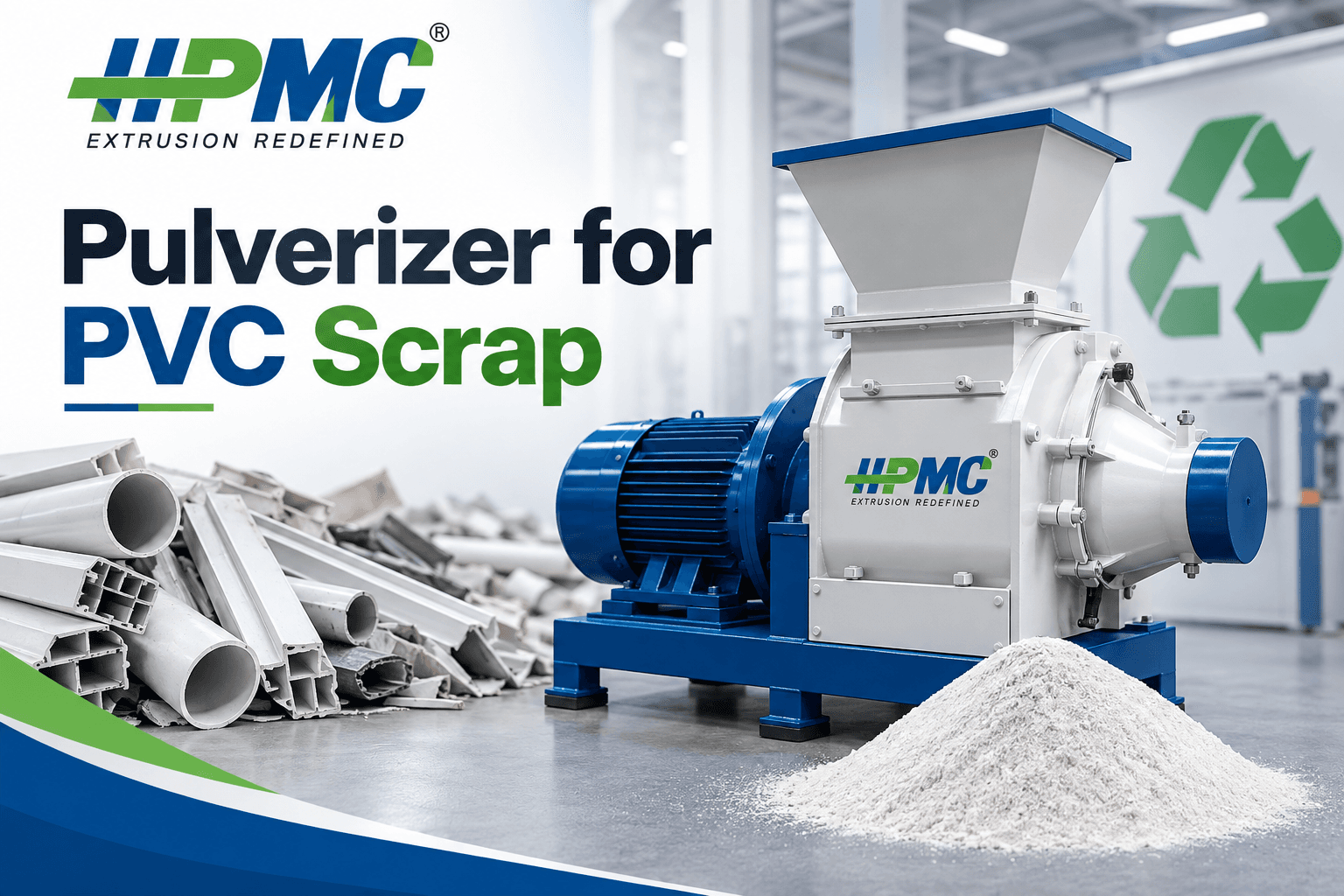
PVC scrap is generated from various manufacturing and processing applications, including pipes, profiles, sheets, cables, flooring products, and other PVC products. Instead of disposing of this scrap, manufacturers can process suitable PVC waste and convert it into reusable material for further production.
A Pulverizer for PVC Scrap is a specialized size-reduction machine used to grind PVC scrap into fine particles or powder. The pulverized material can then be reused in suitable PVC processing applications, depending on its quality, formulation, and particle characteristics.
For manufacturers involved in PVC recycling and reprocessing, selecting the right pulverizer is important for achieving consistent particle size, efficient processing, and reliable operation.
This guide explains what a PVC scrap pulverizer is, how it works, its major components, applications, benefits, and the factors manufacturers should consider before purchasing a PVC Pulverizer Machine.
What is a Pulverizer for PVC Scrap?
A Pulverizer for PVC Scrap is a grinding machine designed to reduce suitable PVC scrap into fine particles or powder.
The machine uses a high-speed grinding mechanism to process PVC material into the required particle size. The exact output depends on the machine configuration, screen or grinding arrangement, feed material, and processing requirements.
PVC scrap may come from:
- PVC pipes
- PVC profiles
- PVC sheets
- PVC flooring
- PVC cable insulation
- PVC production scrap
- Rigid PVC components
- Other suitable PVC processing waste
The pulverized PVC can potentially be reused in manufacturing when the material is properly sorted and its quality is suitable for the intended application.
Why is PVC Scrap Pulverizing Important?
PVC scrap can have different sizes, shapes, and physical characteristics depending on its source.
Large or irregular PVC waste is generally not suitable for direct reuse in many processing applications. Size reduction makes the material easier to handle and can prepare it for further recycling or reprocessing.
A PVC Scrap Pulverizing Machine can help manufacturers:
- Reduce PVC scrap size
- Produce more uniform particles
- Prepare material for further processing
- Improve material handling
- Recover suitable production waste
- Support PVC recycling operations
- Reduce dependence on disposal of usable scrap
The final reuse of pulverized PVC depends on material cleanliness, formulation, contamination, and the requirements of the downstream process.
How Does a Pulverizer for PVC Scrap Work?
The pulverizing process generally begins with collecting and sorting PVC scrap.
The material should be checked to ensure that unsuitable materials and major contaminants are removed before grinding.
The basic process can be represented as:
PVC Scrap → Sorting → Pre-Size Reduction if Required → Feeding → Pulverizing → Particle Separation → Collection
The prepared scrap is introduced into the feeding system.
The material then enters the grinding chamber, where high-speed grinding components reduce the PVC scrap into smaller particles.
As the material reaches the required size, it passes through the appropriate separation arrangement and is collected for further processing.
Depending on the application, the pulverized material may subsequently be blended with other raw materials or used in a suitable PVC manufacturing process.
The actual grinding conditions should be established according to the PVC formulation, scrap characteristics, required particle size, and machine configuration.
Major Components of a PVC Pulverizer Machine
Feeding System
The feeding system introduces PVC scrap into the pulverizing chamber.
A suitable feeding arrangement helps maintain a consistent material flow and supports stable machine operation.
Grinding Chamber
The grinding chamber is where the PVC scrap undergoes size reduction.
Its design plays an important role in achieving the desired grinding performance.
Grinding Components
The grinding mechanism is responsible for reducing PVC scrap into fine particles.
The design and condition of these components influence grinding efficiency and particle consistency.
Screen or Particle Separation System
A suitable screen or separation arrangement can help control the size of the processed material.
The selected configuration should match the required particle characteristics.
Drive System
The drive system provides the mechanical power required for the grinding process.
Motor and drive selection should be appropriate for the material type and required processing conditions.
Cooling Arrangement
PVC grinding can generate heat due to friction and mechanical processing.
An appropriate cooling arrangement can help manage operating temperatures and maintain stable processing conditions.
Collection System
After pulverizing and separation, the processed material needs to be collected efficiently.
The collection system should be designed according to the machine configuration and production requirements.
Control System
The control system allows operators to manage and monitor important machine functions.
Suitable controls can improve operational convenience and help maintain consistent processing conditions.
What PVC Scrap Can Be Processed?
A Pulverizer for PVC Scrap can be used for suitable PVC waste generated from different manufacturing processes.
Potential materials include:
- Rigid PVC scrap
- PVC pipe scrap
- PVC profile scrap
- PVC sheet scrap
- PVC flooring scrap
- PVC cable-related scrap
- PVC production rejects
- Clean PVC processing waste
The suitability of the material depends on its formulation, hardness, contamination level, moisture content, and required final particle size.
Different PVC materials may require different grinding configurations, so the machine should be selected according to the actual scrap being processed.
Applications of PVC Scrap Pulverizing Machines
PVC Pipe Scrap Processing
PVC pipe manufacturing can generate offcuts and production scrap. Suitable clean scrap can be pulverized for potential reuse in appropriate applications.
PVC Profile Scrap Recycling
Profiles and extrusion products can generate production waste that can be processed through a suitable pulverizing system.
PVC Sheet Scrap Processing
Suitable PVC sheet waste can be reduced into smaller particles for further processing.
PVC Flooring Scrap
Certain PVC flooring production waste can be pulverized when the material composition and contamination level are appropriate.
PVC Manufacturing Waste
Production rejects and clean processing scrap can be processed to recover usable material.
PVC Reprocessing
Pulverized PVC can be incorporated into suitable reprocessing operations, depending on the formulation and required product quality.
Benefits of a Pulverizer for PVC Scrap
Using a properly configured Pulverizer for PVC Scrap can provide several benefits for PVC processors.
Efficient Size Reduction
The machine reduces suitable PVC scrap into fine particles, making it easier to handle and process.
Scrap Recovery
Manufacturers can recover suitable production waste instead of sending usable material directly for disposal.
Consistent Particle Size
An appropriate grinding and separation system can help produce more uniform material.
Improved Material Handling
Pulverized PVC is generally easier to store, transport, mix, and feed into suitable downstream processes.
Support for Recycling
The machine can become an important part of a broader PVC Recycling Machine or PVC reprocessing setup.
Reduced Material Waste
Recovering suitable production scrap can help manufacturers improve material utilization.
Integration with PVC Processing
Pulverized PVC can potentially be integrated into suitable PVC formulations or reprocessing systems according to product requirements.
Pulverizer vs PVC Scrap Grinding Machine
The terms PVC Pulverizer Machine and PVC grinding machine are sometimes used interchangeably, but the actual machine configuration and resulting particle size can vary.
A conventional grinding system may be used for general size reduction, while a pulverizer is typically selected when finer material is required.
The appropriate technology depends on:
- Type of PVC scrap
- Initial material size
- Required final particle size
- Production requirement
- Material formulation
- Cooling requirements
- Downstream application
Manufacturers should therefore discuss the actual material and desired output with the machinery supplier before selecting the machine.
How to Choose a Pulverizer for PVC Scrap
Choosing the right machine requires evaluation of the complete material processing requirement.
Identify the PVC Scrap Type
Determine whether the material consists of rigid PVC pipes, profiles, sheets, flooring waste, cable scrap, or another PVC product.
The physical characteristics of the scrap influence the required machine configuration.
Check the Feed Size
The size and shape of the PVC scrap should be evaluated before selecting the pulverizer.
Oversized or irregular pieces may require pre-shredding or cutting before pulverizing.
Define the Required Particle Size
Determine the desired final particle size according to the intended application.
This helps in selecting the appropriate grinding and separation configuration.
Determine Production Requirements
Estimate the amount of PVC scrap that needs to be processed over a given period.
The machine should be appropriately matched to the required production volume.
Consider Cooling Requirements
PVC processing can generate heat during grinding.
A suitable cooling arrangement should be considered according to the material and operating conditions.
Evaluate Material Cleanliness
Contaminated PVC scrap may require sorting, cleaning, or other preprocessing before pulverizing.
Clean production scrap is generally easier to process than mixed or heavily contaminated waste.
Consider Downstream Processing
Think about what will happen after pulverizing.
The material may be used for blending, compounding, extrusion, or another suitable manufacturing process.
This downstream requirement should influence the selection of the pulverizer.
Evaluate Maintenance and Spare Parts
Before purchasing, manufacturers should consider accessibility of wear components, maintenance requirements, spare parts availability, and technical support.
Pulverizer in a PVC Recycling Process
A Pulverizer for PVC Scrap can be incorporated into a broader PVC recycling or reprocessing workflow.
A typical process may look like:
PVC Scrap → Sorting → Shredding/Cutting → Pulverizing → Material Separation → Blending/Compounding → PVC Extrusion → Finished Product
Not every recycling process requires all of these stages.
For example, relatively small and clean PVC scrap may require less preprocessing, while larger or irregular scrap may require size reduction before entering the pulverizer.
The correct process depends on the type of PVC waste and the intended application of the recovered material.
Maintenance of a PVC Pulverizer Machine
Regular maintenance is important for maintaining grinding efficiency and machine reliability.
Important areas to inspect include:
- Grinding components
- Grinding chamber
- Screens
- Bearings
- Drive system
- Motor
- Feeding system
- Cooling arrangement
- Collection system
- Electrical controls
Grinding components and screens should be inspected periodically for wear.
Accumulated material should be removed from relevant machine areas, and the cooling system should be maintained according to the manufacturer's recommendations.
Operators should also follow proper feeding practices and avoid introducing unsuitable materials into the machine.
Why Choose HPMC for PVC Scrap Processing Machinery?
HPMC provides machinery solutions for plastic extrusion, PVC processing, recycling, reprocessing, compounding, and related polymer applications.
A Pulverizer for PVC Scrap can be selected according to the type of PVC scrap, feed size, required particle characteristics, production requirements, cooling needs, and downstream processing application.
Businesses looking for a PVC Pulverizer Machine, PVC recycling equipment, or PVC reprocessing machinery can discuss their material and production requirements with HPMC to determine a suitable machine configuration.
Selecting the complete processing setup according to the characteristics of the PVC scrap can help support efficient material recovery and consistent downstream processing.
Conclusion
A Pulverizer for PVC Scrap is an important size-reduction solution for manufacturers looking to process suitable PVC waste into fine particles for further recycling or reprocessing.
By converting PVC scrap into a more manageable and consistent material, a pulverizer can support scrap recovery, material handling, and downstream PVC processing.
The right machine should be selected according to the type of PVC scrap, initial size, required particle size, production requirements, cooling needs, material cleanliness, and final application.
For manufacturers evaluating a PVC Pulverizer Machine, it is also important to consider machine construction, wear components, maintenance requirements, technical support, and integration with the overall PVC recycling or reprocessing process.
A properly selected Pulverizer for PVC Scrap can become a valuable part of a controlled PVC scrap recovery system and help manufacturers make better use of suitable production waste.
Frequently Asked Questions
Find quick answers to the most common questions about this topic.
A Pulverizer for PVC Scrap is a size-reduction machine designed to grind suitable PVC scrap into fine particles or powder for further processing or potential reuse.
Suitable rigid PVC pipes, profiles, sheets, flooring waste, production scrap, and other compatible PVC materials can be processed, depending on the machine configuration.
Yes, suitable PVC pipe scrap can be processed through an appropriately configured pulverizer. Larger pipe pieces may require pre-cutting or size reduction before pulverizing.
A shredder is generally used for initial size reduction of larger or irregular plastic waste, while a pulverizer is typically used to produce much finer particles.
Suitable clean PVC scrap can potentially be reused in appropriate PVC processing applications. The reuse depends on the material formulation, contamination, particle characteristics, and final product requirements.
Cooling may be required because grinding can generate heat. The appropriate cooling arrangement depends on the material, machine design, processing conditions, and production requirements.
Consider the type of PVC scrap, feed size, required particle size, production requirement, material cleanliness, cooling arrangement, downstream application, maintenance requirements, and technical support.
Yes. A pulverizer can be incorporated into a suitable PVC recycling or reprocessing setup along with shredding, sorting, blending, compounding, and extrusion equipment where required.