
INTRODUCTION
Plastic pelletizing is an important stage in polymer recycling, extrusion, and compounding. After plastic material is melted and processed through an extruder, it must be converted into pellets suitable for further manufacturing.
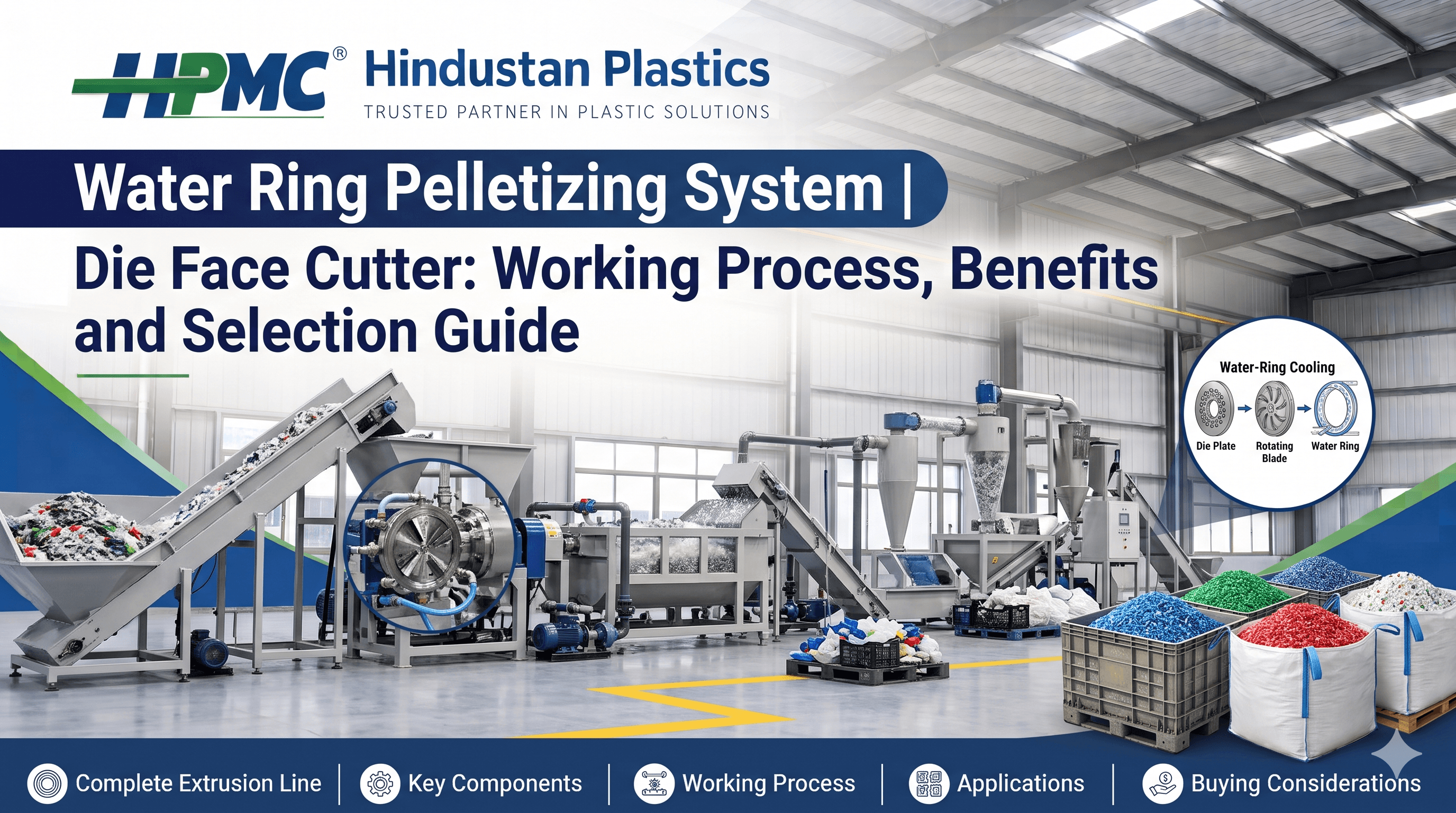
A Water Ring Pelletizing System uses a die-face cutting mechanism to cut molten plastic into pellets while circulating water cools and transports them. This method is used in suitable PP, PE, and selected recycled or filled polymer applications.
HPMC (Hindustan Plastics and Machinery Corporation), Delhi, India, provides plastic extrusion and recycling machinery solutions. This guide explains the working process, components, benefits, material compatibility, maintenance, and selection factors of a water ring pelletizer.
What Is a Water Ring Pelletizing System?
A Water Ring Pelletizing System is a die-face hot-cut pelletizing arrangement designed to convert molten polymer into pellets.
As molten plastic passes through openings in the die plate, rotating blades cut the material close to the die face. Circulating water then cools and transports the pellets towards the separation and collection stages.
Unlike conventional strand pelletizing, where plastic strands are cooled before cutting, a die-face cutter performs the cutting operation directly at the die outlet.
The system's suitability depends on polymer characteristics, melt behaviour, processing conditions, and the connected extrusion equipment.
How Does a Water Ring Pelletizing System Work?
A typical process involves the following stages:
Material Preparation → Extrusion → Melt Filtration → Die-Face Cutting → Water-Ring Cooling → Water Separation → Pellet Collection
The exact configuration may vary according to the application.
1. Material Preparation and Extrusion
Plastic material is prepared and fed into an extrusion system.
The extruder melts and conveys the polymer towards the die head. In recycling applications, suitable feedstock preparation and melt filtration may be necessary to reduce contamination.
For more information about related extrusion equipment, explore HPMC's Vented Type Extruder for Waste Plastic Recycling.
2. Die Plate and Rotating Cutter
The molten polymer passes through openings in the die plate.
Rotating cutter blades cut the emerging material into pellets at or near the die face.
Important operating factors include:
- Cutter speed and blade condition
- Die temperature and cleanliness
- Melt flow consistency
- Blade alignment
- Polymer formulation
These factors can influence pellet formation and operating stability.
3. Water-Ring Cooling
After cutting, circulating water cools and transports the pellets away from the cutting area.
Water temperature and circulation must be suitable for the polymer being processed.
The system should be configured to provide stable pellet handling and appropriate cooling conditions.
4. Water Separation and Pellet Collection
The pellets move towards the water-separation equipment.
Depending on the system configuration, additional dewatering or drying may be required before collection, packaging, or further processing.
Main Components of a Water Ring Pelletizing System
Die Head and Die Plate
The die head distributes molten plastic through specially designed openings.
Its design should be compatible with the extruder, polymer formulation, and required processing conditions.
Rotating Cutter Assembly
The cutter assembly uses rotating blades to cut polymer melt at the die face.
Blade sharpness, alignment, and maintenance are important for reliable cutting performance.
Water Circulation System
The water circuit cools and transports pellets.
Its configuration may include circulation equipment, temperature management, and water filtration.
Pellet Separation Equipment
The separation system removes process water from the pellets.
Additional drying equipment may be included depending on downstream requirements.
Control System
Controls help operators monitor relevant processing conditions and coordinate the pelletizing equipment with the extrusion line.
Which Plastics Can Be Processed?
Water ring pelletizers may be suitable for several compatible thermoplastic materials.
Polypropylene (PP)
Selected polypropylene grades and formulations can be processed using an appropriately configured system.
Polyethylene (PE)
Suitable polyethylene materials may be processed for recycling or compounding applications.
Recycled Plastic Materials
Prepared recycled polymer material may be processed when melt quality, filtration, and system compatibility are appropriate.
For a broader explanation of recycling and granule production, read HPMC's Plastic Granule Making Machine guide.
Filled Polymer Compounds
Certain filled polymer formulations may also be compatible.
However, filler type and concentration can influence wear, processing behaviour, and pellet formation.
Material suitability should always be confirmed before selecting the equipment.
Benefits of a Water Ring Pelletizing System
1. Direct Die-Face Cutting
The system cuts molten polymer directly at the die face without requiring a separate strand-cutting stage.
2. Integrated Cooling
The water-ring arrangement combines pellet cooling and transport within the pelletizing process.
3. Compact Process Arrangement
Depending on the equipment design, die-face pelletizing may offer a compact alternative to some strand pelletizing arrangements.
4. Integration with Extrusion Lines
A suitable pelletizer can form part of a connected plastic extrusion, recycling, or compounding line.
5. Pellet Handling
The water circuit transports cut pellets towards downstream separation equipment.
Actual pellet quality, output, and operating efficiency depend on the material, machine configuration, and process settings.
Water Ring Pelletizing vs Strand Pelletizing
FeatureWater Ring PelletizingStrand Pelletizing
Cutting location
At the die face
After strand cooling
Cooling method
Water-ring cooling
Separate strand-cooling stage
Material handling
Cut pellets are transported by water
Continuous strands are handled before cutting
Equipment arrangement
Integrated die-face cutting
Separate downstream cutter
Selection
Depends on polymer and process requirements
Depends on polymer and process requirements
Neither system is automatically better for every material.
The correct choice depends on polymer characteristics, desired pellet specifications, throughput requirements, and plant configuration.
Factors Affecting Pellet Quality
Cutter Blade Condition
Worn or incorrectly aligned blades can affect cutting performance.
Regular inspection and replacement according to manufacturer recommendations are important.
Die Plate Condition
Die openings should remain suitable for the material and operating conditions.
Melt Flow Consistency
Stable melt preparation supports more consistent pellet formation.
Water Circulation
Water flow and temperature influence cooling and pellet transport.
Material Formulation
Polymer properties, additives, fillers, and recycled material quality can affect processing behaviour.
Common Operating Problems and Their Causes
Irregular Pellet Shape
Possible contributing factors include cutter wear, blade alignment, melt-flow variation, and unsuitable process settings.
Pellet Agglomeration
Pellets may stick together when cooling or material conditions are unsuitable.
Inconsistent Cutting
Potential causes include cutter condition, die-related issues, or unstable melt delivery.
Water-Separation Problems
Poor separation or excessive residual moisture may indicate issues with the configured dewatering or separation equipment.
Troubleshooting should follow the manufacturer's instructions and appropriate safety procedures.
Integration with Plastic Recycling Plants
A water ring pelletizer is generally one part of a larger plastic processing system.
Depending on the application, a recycling line may include feeding, extrusion, melt filtration, pelletizing, cooling, and pellet collection.
For related upstream processing, HPMC's Two Stage Plastic Reprocess Extrusion Line guide explains another important recycling equipment arrangement.
The pelletizer must be compatible with the extruder, die design, material characteristics, and downstream handling equipment.
How to Select the Right Water Ring Pelletizing System
Before purchasing, evaluate the following factors.
Polymer Type
Identify whether the material is PP, PE, recycled polymer, or a filled compound.
Required Production Capacity
Share the expected throughput and operating requirements with the supplier.
Pellet Specifications
Define the desired pellet size, shape, and downstream application.
Extruder Compatibility
Confirm compatibility with the existing or proposed extrusion system.
Water Management
Consider water circulation, cooling, separation, and maintenance requirements.
Maintenance Requirements
Review cutter replacement, die cleaning, spare parts, and service accessibility.
Supplier Support
Ask about installation, commissioning, operator guidance, and after-sales service.
Maintenance of a Water Ring Pelletizing System
Routine maintenance supports stable equipment operation.
Important areas include:
- Cutter blade inspection
- Die plate cleaning
- Water circulation checks
- Pump and filter maintenance
- Pellet separation equipment
- Drive components and controls
- Safety guards and operating procedures
Maintenance should follow the equipment manufacturer's recommendations.
Why Choose HPMC for Plastic Pelletizing Machinery?
HPMC (Hindustan Plastics and Machinery Corporation) provides machinery solutions for plastic extrusion, recycling, and reprocessing applications.
When enquiring about a Water Ring Pelletizing System, buyers should share their polymer grade, formulation, required output, extrusion equipment details, and pellet specifications.
These details help determine the equipment configuration that requires technical evaluation.
Conclusion
A Water Ring Pelletizing System combines die-face cutting and water-ring cooling to convert suitable molten polymers into pellets.
Its effectiveness depends on material compatibility, extrusion conditions, cutter and die design, water management, and downstream separation.
Understanding these factors helps manufacturers and recyclers evaluate a pelletizing system for their production requirements.
For a suitable Water Ring Pelletizing System or Die Face Cutter configuration, contact HPMC with your material and processing requirements.
Contact HPMC
HPMC (Hindustan Plastics and Machinery Corporation)
Address: 5, Category II, DSIDC Industrial Area, Nangloi, Delhi – 110041, India
Website: https://www.hindustanplastics.com/
Phone: ]
Email: info@hindustanplastics.com
Google Business Profile: https://share.googl
Frequently Asked Questions
Find quick answers to the most common questions about this topic.
It is a die-face pelletizing system that cuts molten polymer into pellets and uses circulating water for cooling and transport.
A die-face cutter is a rotating cutting mechanism positioned at or near the extrusion die outlet.
Depending on its configuration, it may process compatible PP, PE, and selected recycled or filled polymer formulations.
It can be suitable for certain recycling applications when the feedstock, extrusion process, filtration, and pelletizer configuration are compatible.
Circulating water cools and transports the pellets after cutting.
Die openings, cutter condition, cutter speed, melt flow, polymer properties, and operating conditions can influence pellet formation.
Water ring systems cut at the die face, while strand pelletizing systems cool continuous strands before cutting them separately.
Some filled formulations may be compatible, but filler type and content should be evaluated before selection.
The need for additional dewatering or drying depends on the system configuration and downstream requirements.
Maintenance may include blade inspection, alignment checks, die cleaning, and replacement of worn components.