
INTRODUCTION
Producing consistent plastic pellets requires more than simply cutting extruded polymer. The material must first form stable strands, cool sufficiently, lose excess surface moisture, and enter the cutting unit under suitable conditions.
A Strand Pelletizing Line combines these operations to convert molten thermoplastic material into cylindrical pellets for compounding, recycling, and further manufacturing.
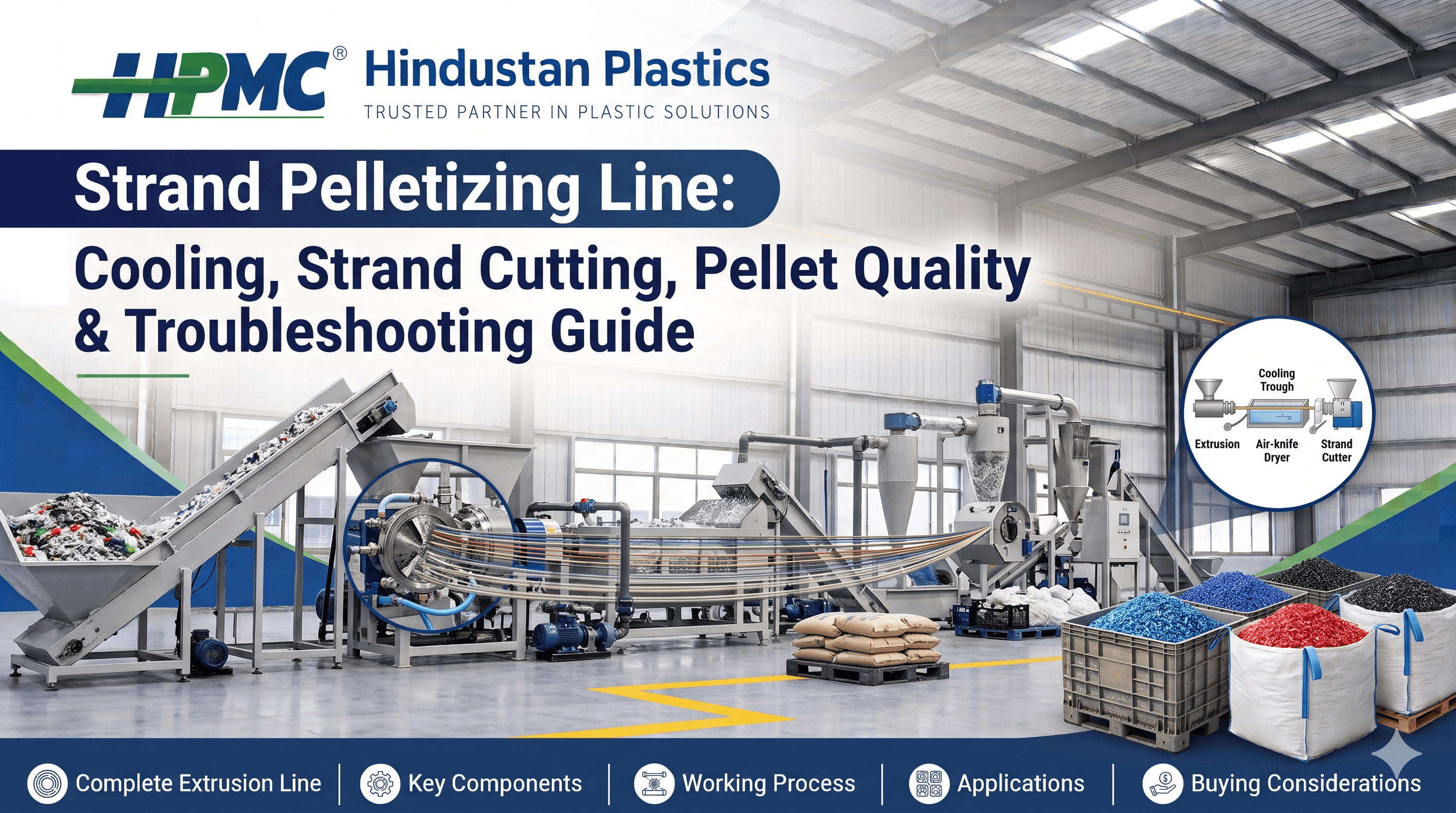
The line generally includes a strand die, water-cooling trough, air-knife dryer, strand cutter, and pellet collection equipment. Each section influences strand stability, pellet dimensions, and overall processing performance.
HPMC (Hindustan Plastics and Machinery Corporation), Delhi NCR, India, provides machinery solutions for plastic extrusion and recycling applications.
This guide focuses on the working process, cooling and cutting requirements, pellet quality, common production problems, and practical equipment selection considerations.
What Is a Strand Pelletizing Line?
A Strand Pelletizing Line is a downstream extrusion system designed to convert continuous polymer strands into plastic pellets.
Molten polymer passes through a strand die and enters a cooling trough. Once the strands have cooled sufficiently, surface water is removed before they reach the strand cutter.
The cutter then converts the strands into pellets with dimensions determined by the strand diameter, cutter design, and operating conditions.
Unlike die-face pelletizing, the polymer is cooled before cutting.
This makes strand stability, cooling conditions, moisture removal, and consistent strand feeding important aspects of the process.
How Does a Strand Pelletizing Line Work?
The basic production sequence is:
Extrusion → Strand Formation → Water Cooling → Surface Drying → Strand Cutting → Pellet Collection
The exact configuration depends on the polymer and production requirements.
1. Polymer Extrusion and Strand Formation
Prepared polymer material is melted and conveyed through an extrusion system.
The molten material exits through openings in a strand die, forming continuous polymer strands.
Stable melt delivery helps maintain consistent strand dimensions.
For applications involving mixing and compounding, HPMC's Twin Screw Extruder is a related upstream equipment option.
2. Cooling Through a Water Trough
The extruded strands enter a water-cooling trough.
Cooling helps the polymer solidify before reaching the cutting section.
The required cooling conditions depend on factors such as polymer type, strand diameter, extrusion output, and trough configuration.
Insufficient cooling may affect strand handling and pellet cutting.
3. Surface Moisture Removal
After cooling, the strands pass through an air-knife dryer or another suitable moisture-removal arrangement.
The purpose is to remove surface water before the strands enter the cutter.
The drying section should be compatible with the strand arrangement and line speed.
4. Strand Cutting
The cooled strands enter the cutting unit.
The cutter converts continuous strands into pellets.
Pellet dimensions depend on strand size, feed consistency, cutter configuration, and operating settings.
5. Pellet Collection
Finished pellets are collected for packaging, storage, or further manufacturing.
Depending on the application, additional screening or material-handling equipment may be included.
Main Components of a Strand Pelletizing Line
Strand Die
The strand die forms molten polymer into continuous strands.
Die design should match the material, extrusion equipment, and required strand dimensions.
Water-Cooling Trough
The cooling trough provides the required cooling stage before pellet cutting.
Important considerations include water circulation, trough dimensions, strand guidance, and maintenance access.
Air-Knife Dryer
An air-knife dryer removes surface water from the cooled strands.
Its effectiveness depends on strand arrangement, air delivery, and processing conditions.
Strand Cutter
The strand cutter converts cooled polymer strands into pellets.
Cutting performance depends on blade condition, cutter alignment, strand feeding, and operating settings.
Pellet Collection System
The collection system receives finished pellets.
Its arrangement depends on the required material handling and downstream process.
Why Cooling Is Important in Strand Pelletizing
Cooling is one of the most important stages in strand pelletizing.
The strands must reach a suitable condition before entering the cutting unit.
Inadequate Cooling
If strands are insufficiently cooled, they may become difficult to handle or cut consistently.
Uneven Cooling
Different cooling conditions across strands can contribute to inconsistent handling.
Cooling Trough Configuration
Trough length, water circulation, and strand guidance should be selected according to the polymer and production requirements.
Material Properties
Different thermoplastic formulations have different cooling characteristics.
The cooling arrangement should therefore be evaluated for the intended material rather than selected using a fixed assumption.
Role of the Air-Knife Dryer
An air-knife dryer helps remove surface moisture after the cooling stage.
This is important because water carried into the cutting section can affect material handling and equipment conditions.
Important factors include:
- Strand arrangement
- Air delivery
- Line speed
- Surface water removal
- Maintenance accessibility
The air-knife arrangement should be matched to the strand dimensions and operating conditions.
Factors Affecting Pellet Quality
Strand Diameter
Strand diameter influences the dimensions of the final pellets.
Consistent extrusion conditions support more uniform strand formation.
Cooling Conditions
The polymer should be sufficiently cooled before cutting.
Cutter Blade Condition
Worn or incorrectly aligned cutting components can affect pellet quality.
Strand Feeding
Stable feeding helps maintain consistent cutting.
Polymer Formulation
Material properties, additives, fillers, and recycled content can affect strand behaviour.
Equipment Coordination
The extrusion, cooling, drying, and cutting stages should operate as a coordinated system.
Common Strand Pelletizing Problems and Troubleshooting
1. Strand Breakage
Possible causes:
- Unstable melt delivery
- Unsuitable cooling conditions
- Material-related strand instability
- Inconsistent strand handling
Recommended checks:
Review the extrusion process, strand formation, cooling arrangement, and strand guidance.
Repeated strand breakage should be investigated across the complete line rather than attributed to a single component.
2. Uneven Pellet Length
Possible causes:
- Inconsistent strand feeding
- Cutter wear
- Incorrect cutter alignment
- Unstable processing conditions
Recommended checks:
Inspect the strand-feeding arrangement, cutter condition, and relevant operating settings according to the manufacturer's instructions.
3. Irregular Pellet Shape
Possible causes:
- Strand diameter variation
- Insufficient cooling
- Cutting-related problems
- Material behaviour
Recommended checks:
Evaluate strand formation, cooling consistency, and cutter condition.
4. Excess Surface Moisture
Possible causes:
- Ineffective moisture removal
- Unsuitable air-knife arrangement
- Inconsistent strand movement
Recommended checks:
Inspect the drying section and confirm that it is suitable for the operating conditions.
5. Excessive Pellet Fines
Possible causes:
- Cutter wear
- Material brittleness
- Unsuitable cutting conditions
- Inconsistent strand feeding
Recommended checks:
Review the cutter and strand-feeding system while considering the material formulation.
All troubleshooting and maintenance should follow the equipment manufacturer's safety procedures.
Which Materials Can Be Processed?
Strand pelletizing may be suitable for different thermoplastic materials depending on their processing characteristics.
Engineering Plastics
Suitable engineering thermoplastics may be processed using an appropriately configured strand pelletizing line.
Cooling and cutting requirements should be evaluated for the specific polymer grade.
Filled Compounds
Certain filled polymer formulations may be processed using compatible equipment.
Filler characteristics can influence equipment wear and strand behaviour.
Recycled Thermoplastics
Prepared recycled polymers may be suitable when material quality, melt preparation, and extrusion conditions are appropriate.
For related recycling equipment, explore HPMC's Vented Type Extruder for Waste Plastic Recycling.
Polypropylene and Polyethylene
Compatible PP and PE grades may be processed through strand pelletizing arrangements.
Suitability depends on the polymer formulation and equipment configuration.
Strand Pelletizing vs Water Ring Pelletizing
Both systems convert molten polymer into pellets, but their cutting arrangements differ.
FeatureStrand PelletizingWater Ring Pelletizing
Cutting location
After strand cooling
At the die face
Cooling method
Water trough
Water ring
Material before cutting
Cooled continuous strands
Molten polymer
Main process consideration
Strand stability
Die-face cutting conditions
Equipment arrangement
Separate cooling and cutter stages
Integrated die-face cutting
The correct technology depends on material behaviour, pellet requirements, output, and equipment compatibility.
Integration with Extrusion Systems
A strand pelletizing line operates downstream of an extruder.
The system may be connected to compatible single-screw, twin-screw, or specialized extrusion equipment.
For applications using conventional polymer extrusion, HPMC's Single Screw Extruder provides related equipment information.
For mixing and compounding applications, twin-screw extrusion may be considered where appropriate.
The pelletizing line must be matched to the extruder's melt delivery, strand die, and required processing conditions.
Strand Pelletizing in Plastic Recycling
Strand pelletizing can be used in suitable recycling applications after the material has undergone appropriate preparation and extrusion.
The process may include melt filtration before strand formation, depending on the feedstock.
HPMC's Two Stage Plastic Reprocess Extrusion Line provides additional context about recycling extrusion arrangements.
The selected pelletizing system should be compatible with the polymer, contamination level, extrusion process, and desired recycled pellet specifications.
How to Select a Strand Pelletizing Line
1. Identify the Material
Specify the polymer grade, additives, filler content, and whether the material is virgin or recycled.
2. Define Production Requirements
Share the required throughput and operating conditions with the supplier.
3. Confirm Pellet Dimensions
Identify the desired pellet size and downstream application.
4. Evaluate Cooling Requirements
Review the cooling trough arrangement and the polymer's cooling characteristics.
5. Assess the Drying Section
Confirm that the moisture-removal equipment is suitable for the strands and processing conditions.
6. Review Cutter Compatibility
Evaluate the cutter design, blade maintenance, and pellet specifications.
7. Confirm Extruder Integration
Ensure the extrusion system, strand die, cooling trough, dryer, and cutter are technically compatible.
8. Consider Maintenance and Support
Ask about installation, commissioning, spare parts, operator training, and after-sales service.
Maintenance of a Strand Pelletizing Line
Routine maintenance helps maintain equipment condition and consistent operation.
Important inspection areas include:
- Strand die cleanliness
- Cooling trough condition
- Water circulation equipment
- Strand guides
- Air-knife dryer
- Cutter blades
- Strand-feeding components
- Pellet collection equipment
- Drives and controls
Maintenance intervals should follow the equipment manufacturer's recommendations.
Why Consider HPMC?
HPMC (Hindustan Plastics and Machinery Corporation) provides machinery solutions for plastic extrusion, recycling, and compounding applications.
When requesting information about a Strand Pelletizing Line, buyers should share the polymer grade, formulation, target throughput, extruder type, cooling requirements, and desired pellet dimensions.
These details help determine the equipment configuration that requires technical evaluation.
Conclusion
A Strand Pelletizing Line converts molten polymer into cylindrical pellets through strand formation, water cooling, moisture removal, and cutting.
Consistent pellet quality depends on extrusion stability, strand cooling, drying effectiveness, cutter condition, and coordinated equipment operation.
Understanding these factors helps manufacturers and recyclers evaluate a suitable strand pelletizing system for their processing requirements.
For Strand Pelletizing Line and Plastic Granulator Machine enquiries, contact HPMC with your material specifications and production requirements.
Contact HPMC
HPMC (Hindustan Plastics and Machinery Corporation)
Address: 5, Category II, DSIDC Industrial Area, Nangloi, Delhi – 110041, India
Website: https://www.hindustanplastics.com/
Phone: +91 95605 96392
Email: info@hindustanplastics.com
Google Business Profile: https://share.google/lBK4uD53HqY891ynv
Frequently Asked Questions
Find quick answers to the most common questions about this topic.
A Strand Pelletizing Line converts extruded polymer strands into pellets after cooling and surface drying.
It is a cutting machine designed to convert cooled polymer strands into granules or pellets. The term plastic granulator can also refer to size-reduction equipment, so the application should be specified.
Molten polymer is extruded into strands, cooled, dried, and cut into pellets.
A cooling trough helps solidify extruded polymer strands before cutting.
It removes surface water from cooled strands before they enter the cutter.
Strand pelletizers commonly produce cylindrical pellets.
Depending on the configuration, suitable engineering plastics, filled compounds, PP, PE, and recycled thermoplastics may be processed.
Yes, when the extruder, strand die, cooling system, and cutter are compatible.
Possible causes include unstable extrusion, unsuitable cooling, material behaviour, and inconsistent strand handling.
Cutter wear, inconsistent strand feeding, and unstable processing conditions can contribute to uneven pellet length.