
Introduction
PVC cable trunking is widely used to organize electrical wiring in residential, commercial, and industrial buildings. It provides a structured route for cables and helps maintain neat electrical installations. However, producing consistent PVC trunking requires more than simply processing PVC material through an extrusion machine.
The quality of a finished trunking profile depends on several interconnected factors, including die design, material formulation, extrusion conditions, calibration, cooling, and cutting accuracy. Small variations during production can affect profile dimensions, surface finish, straightness, and the fit between casing and capping.
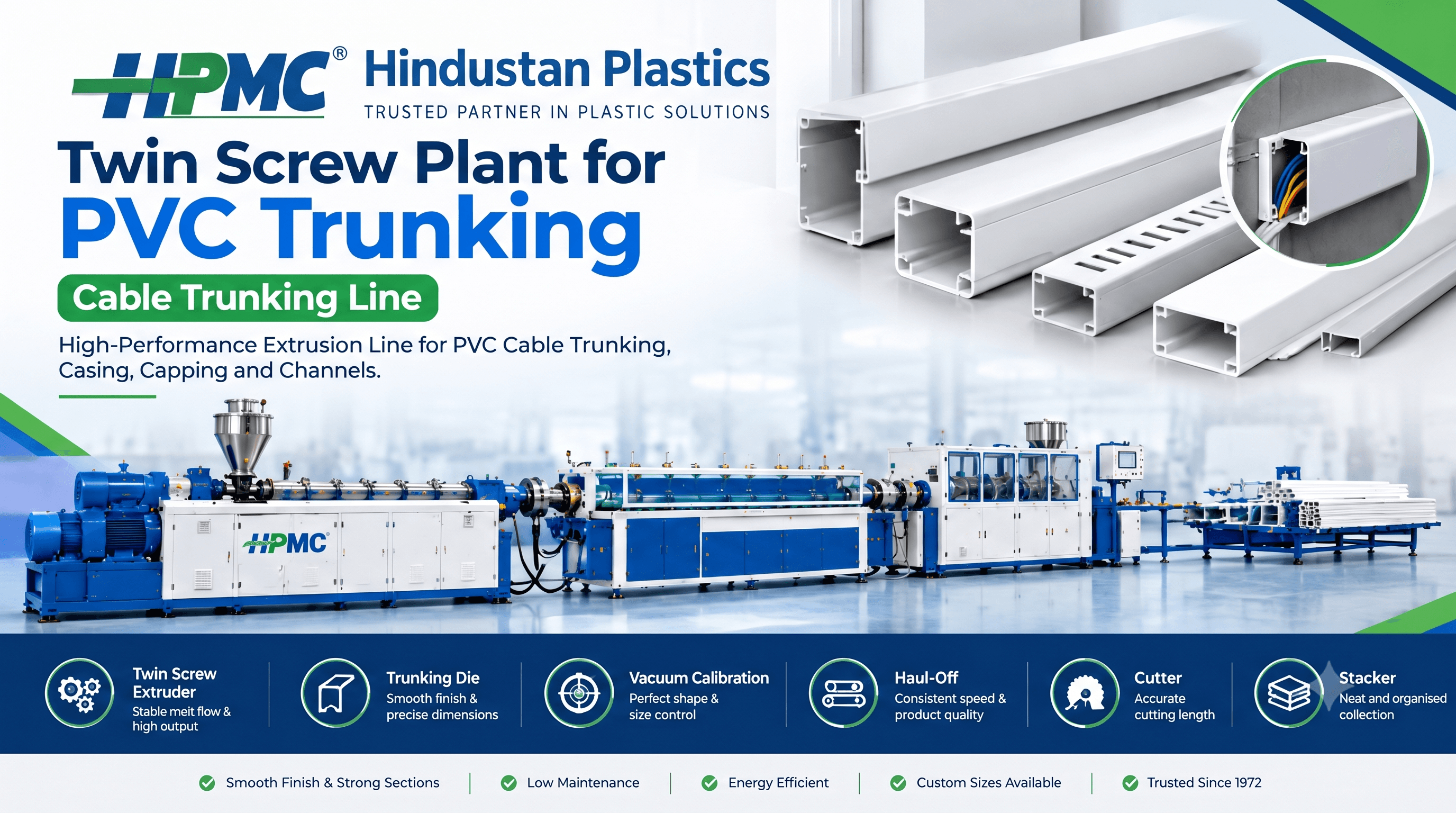
For manufacturers, understanding these factors is essential for maintaining product consistency and reducing avoidable production defects. A properly configured Twin Screw Plant for PVC Trunking combines extrusion and downstream equipment to manufacture profiles according to the required specifications.
This article explains the role of trunking die design, the importance of dimensional accuracy, practical quality-control checks, and common production issues that manufacturers should monitor.
Why Die Design Matters in PVC Trunking Production
The extrusion die is one of the most important components in a PVC trunking production line. It shapes the processed PVC compound into the required cross-sectional profile.
Unlike a simple round product, cable trunking may include flat surfaces, corners, side walls, cover-retaining features, and interlocking sections. These features make die design particularly important.
1. Cross-Sectional Profile Accuracy
The die must be designed around the required profile drawing. Important dimensions may include:
- Overall width and height
- Wall thickness
- Side-wall geometry
- Corner and edge details
- Cover-fitting or locking features
- Internal space available for cable routing
The appropriate dimensions depend on the intended product and its specifications. A die should be designed and adjusted according to the required cross-section rather than relying on a generic profile.
2. Uniform Material Flow
PVC compound must flow through the die in a consistent manner to form the intended profile. Uneven flow may contribute to differences in wall thickness, surface irregularities, or dimensional variation.
Die geometry, material formulation, temperature conditions, and extrusion settings can all influence material flow. These factors should be evaluated together when diagnosing profile-quality issues.
3. Casing and Capping Compatibility
Many cable trunking products consist of a base section and a separate cover. These components must fit together according to the intended design.
The die design should account for the dimensions and geometry of both parts. If the casing and cover are produced on separate tooling or production setups, each should be checked against the approved product specifications.
4. Surface Finish
Die condition and material flow can affect the appearance of the finished profile. Deposits, wear, contamination, or unsuitable processing conditions may contribute to surface marks and irregularities.
Routine inspection and appropriate die maintenance help manufacturers identify potential issues before they affect larger production batches.
How Dimensional Accuracy Affects PVC Cable Trunking Quality
Dimensional accuracy refers to how closely the finished profile matches its specified measurements. It is important for product consistency, installation, and compatibility between matching components.
Overall Width and Height
The trunking width and height determine the profile's overall shape and available internal space. Measurements should be compared with the approved drawing or product specification.
Wall Thickness
Wall thickness influences material usage and the physical characteristics of the finished profile. Variation can result from inconsistent material flow, tooling issues, or changes in processing conditions.
Manufacturers should measure wall thickness at suitable locations to identify irregularities across the profile.
Straightness and Shape Retention
A trunking profile should retain its intended geometry after extrusion and cooling. Warping, twisting, or bending may occur if the profile is not adequately supported or stabilized.
Calibration, cooling conditions, and haul-off alignment should be checked when shape-related defects appear.
Casing and Cover Fit
The casing and capping should fit together as intended. Excessive variation in their dimensions can cause fitting difficulties or inconsistent closure.
Quality checks should therefore examine the two components together, not only as separate profiles.
Cutting Length
Finished trunking sections must meet the specified length requirements. The cutting system and measurement settings should be checked regularly to maintain consistency.
Key Stages That Influence PVC Trunking Quality
Quality control should cover the complete production process rather than focusing only on the finished product.
1. PVC Compound Preparation
Material consistency is important for stable processing. Changes in the PVC formulation, mixing, additives, or raw-material batches may affect extrusion behaviour and finished-profile characteristics.
Manufacturers should follow an approved formulation and maintain suitable material-handling procedures.
2. Twin Screw Extrusion
The extruder processes and conveys the PVC compound to the die. Screw speed, feed rate, temperature settings, and the condition of machine components may influence the stability of material output.
These parameters should be monitored according to the material formulation and machine manufacturer's recommendations.
3. Die Setup
The die must match the intended trunking design. Incorrect tooling setup or uneven material flow may contribute to profile variation.
Before production begins, confirm the tooling configuration and inspect the initial profiles against the required dimensions.
4. Calibration and Cooling
Calibration helps the profile retain its intended geometry after leaving the die. Cooling stabilizes the profile before it reaches the haul-off and cutting stages.
The appropriate arrangement depends on the profile design and production-line configuration. Insufficient or uneven stabilization may contribute to deformation.
5. Haul-Off and Cutting
The haul-off pulls the profile through the production line at a controlled speed. Its operation should be coordinated with the extrusion output.
The cutting unit then produces sections of the required length. Incorrect synchronization or cutting settings can affect finished dimensions.
Quality Control Checklist for PVC Trunking Manufacturers
A structured inspection routine helps manufacturers identify variation and maintain consistent production records.
Quality checkWhat to inspectWhy it matters
Overall dimensions
Width and height
Confirms profile conformity
Wall thickness
Measurements at defined points
Identifies thickness variation
Surface finish
Marks, streaks, roughness or discoloration
Helps detect processing or tooling issues
Profile shape
Straightness, twisting and deformation
Checks shape retention
Cover fit
Compatibility between casing and capping
Supports correct assembly
Cutting length
Length against specified tolerance
Maintains consistent finished sections
Material consistency
Approved formulation and batch records
Helps identify material-related variation
Tooling condition
Die cleanliness, wear and setup
Supports stable profile formation
Inspection frequency and acceptance limits should be established according to the product specification, customer requirements, and applicable standards.
Common PVC Trunking Defects and Their Possible Causes
Production defects can have more than one cause. Manufacturers should inspect the relevant process stages before making adjustments.
1. Uneven Wall Thickness
Possible causes:
- Uneven material flow through the die
- Incorrect tooling setup
- Inconsistent extrusion output
- Variations in processing conditions
What to check: Measure wall thickness at defined locations, inspect the die setup, and review material flow and operating records.
2. Rough or Irregular Surface
Possible causes:
- Die deposits or surface wear
- Material contamination
- Inconsistent material processing
- Unsuitable extrusion conditions
What to check: Inspect the material and die condition, then review processing parameters according to the manufacturer's instructions.
3. Warped or Twisted Profiles
Possible causes:
- Uneven cooling
- Insufficient support during stabilization
- Haul-off misalignment
- Inconsistent pulling speed
What to check: Review calibration, cooling, alignment, and the coordination between extrusion output and haul-off speed.
4. Poor Casing and Cover Fit
Possible causes:
- Incorrect profile dimensions
- Tooling mismatch
- Variation between production runs
- Changes in profile shape during cooling
What to check: Measure both components and compare their dimensions and fit with the approved drawing.
5. Inconsistent Cutting Length
Possible causes:
- Incorrect cutting settings
- Measurement-system errors
- Poor synchronization with line speed
What to check: Verify the length settings, inspect the cutting mechanism, and confirm that the cutting cycle is coordinated with profile movement.
Changes to machine settings should be controlled and documented. For recurring defects, consult the machinery manufacturer or a qualified technician.
How to Improve PVC Trunking Production Consistency
Maintaining consistent quality requires repeatable production practices and regular inspection.
Establish Approved Product Specifications
Maintain clear drawings and specifications for each trunking size. These should define dimensions, tolerances, profile geometry, and casing-to-cover fit requirements.
Record Important Production Parameters
Record relevant operating conditions, material batches, inspection results, and tooling changes. These records can help identify patterns when a defect appears.
Inspect the First Production Samples
After a setup or tooling change, inspect initial samples before proceeding with the full production run. Confirm that the dimensions and profile geometry meet the approved requirements.
Maintain Dies and Calibration Equipment
Follow an appropriate maintenance schedule for dies, calibration equipment, cooling systems, and other production-line components. Cleaning and inspection procedures should follow the equipment manufacturer's recommendations.
Monitor Finished Profiles Regularly
Use suitable measuring instruments and a consistent inspection method. Keep records of results to help identify gradual changes in dimensions or surface quality.
Train Operators in Defect Identification
Operators should understand the product specifications, inspection process, and correct escalation procedure for recurring defects. This supports more consistent production decisions.
Selecting a Suitable Twin Screw Plant for PVC Trunking
The production line should match the trunking products a manufacturer intends to produce. Important considerations include:
- Required profile dimensions and designs
- PVC compound and processing requirements
- Extruder configuration and intended output
- Trunking die design and tooling availability
- Calibration and cooling arrangements
- Haul-off and cutting requirements
- Quality inspection procedures
- Maintenance, spare parts, and technical support
Businesses should share their product drawings, target dimensions, material details, and production requirements with the machinery supplier before confirming the configuration.
You can explore HPMC's PVC Trunking Machine Manufacturer – Complete Buying Guide for additional information about machine selection.
PVC Trunking Production Solutions from HPMC
Hindustan Plastics and Machine Corporation (HPMC), based in Delhi, India, manufactures plastic extrusion machinery for industrial applications. The company has been active in the machinery sector since 1972.
HPMC offers a Twin Screw Plant for PVC Trunking for businesses looking to manufacture cable trunking and related PVC profiles.
When evaluating a suitable production line, manufacturers should discuss their required profile dimensions, casing and capping designs, material formulation, tooling needs, and production targets with the HPMC team.
The appropriate machine configuration should be confirmed according to the intended product and production requirements.
Contact HPMC
Company: Hindustan Plastics and Machine Corporation
Address: 5, Category II, DSIDC Industrial Area, Nangloi, Delhi – 110041, India
Website: https://www.hindustanplastics.com/
Phone: +91 95605 96392
Email: info@hindustanplastics.com
Google Business Profile: https://share.google/lBK4uD53HqY891ynv
Contact HPMC to discuss your PVC trunking production requirements and request a quotation.
Conclusion
Consistent PVC trunking production depends on accurate die design, controlled extrusion conditions, suitable calibration, effective cooling, and reliable dimensional inspection. These factors influence the finished profile's shape, surface finish, wall thickness, and casing-to-cover fit.
By maintaining clear product specifications, monitoring production parameters, inspecting finished profiles, and following preventive maintenance practices, manufacturers can identify quality issues and improve process consistency.
Before selecting a Twin Screw Plant for PVC Trunking, evaluate the complete production line and confirm that its tooling and downstream equipment are suitable for your intended profile designs.
Frequently Asked Questions
Find quick answers to the most common questions about this topic.
The die determines the profile's cross-sectional shape and dimensions. Suitable die design helps achieve the intended geometry and consistent material distribution.
mportant factors include die geometry, material consistency, extrusion conditions, calibration, cooling, and haul-off speed.
Use suitable measuring instruments to check width, height, wall thickness, straightness, and cutting length against approved specifications.
Possible causes include uneven material flow, tooling issues, inconsistent output, or variations in processing conditions. The actual cause should be confirmed through inspection.
Uneven cooling, insufficient support, calibration issues, or haul-off misalignment may contribute to warping or twisting.
Checking both components helps confirm that their dimensions and design features allow them to fit together as intended.
Cooling helps stabilize the extruded profile. Unsuitable or uneven cooling may contribute to deformation or dimensional variation.
Inspection frequency should depend on the product specifications, production process, customer requirements, and the manufacturer's quality-control plan.
Inspecting and maintaining the die can help identify deposits, wear, or other issues that may affect material flow and surface finish.
The haul-off pulls the profile through the production line at a controlled speed. It should operate in coordination with extrusion output to support consistent production.