
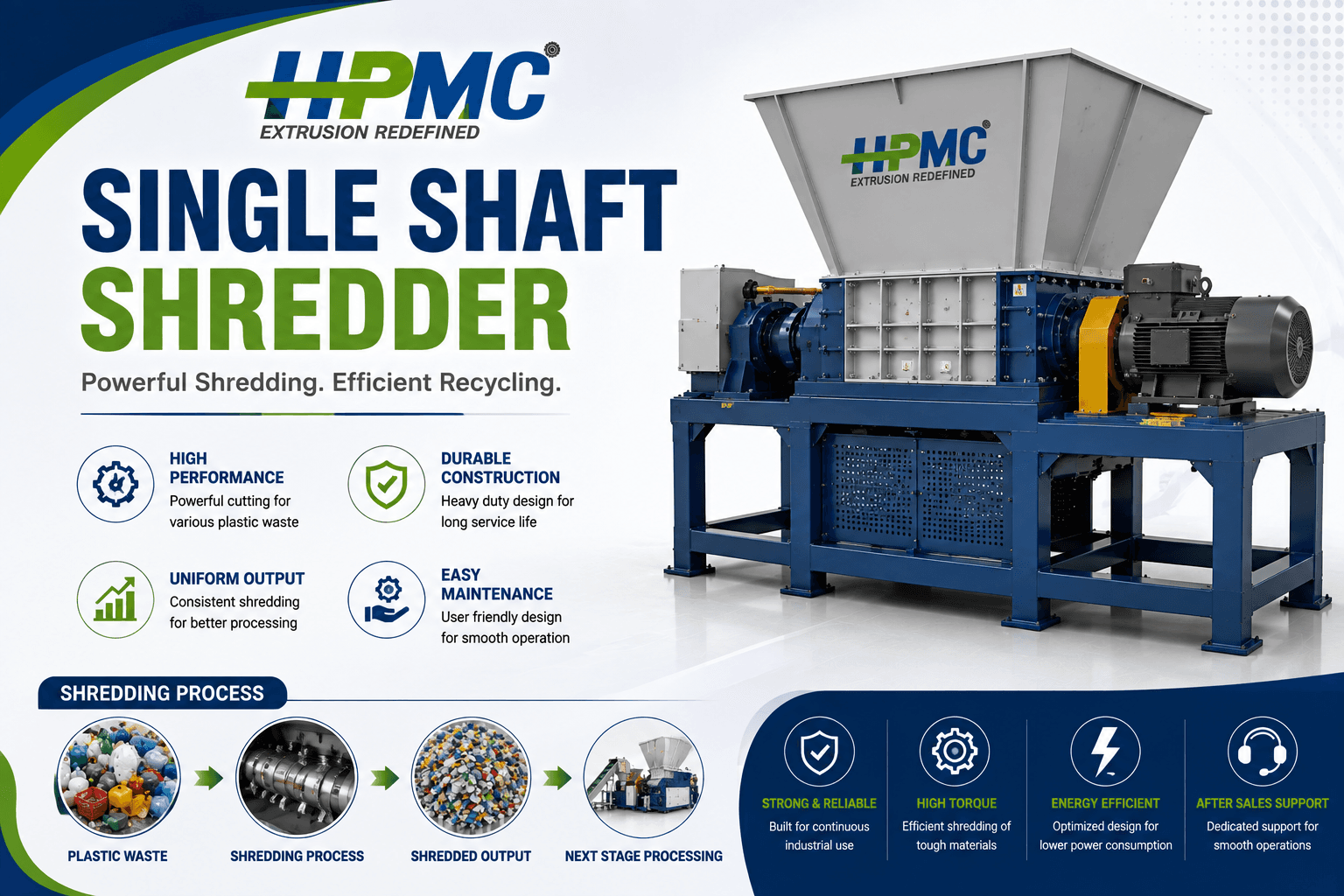
Plastic waste is generated in large quantities across manufacturing, packaging, construction, agriculture, consumer products, and industrial operations. Before this waste can be recycled, washed, granulated, or processed through an extrusion line, it often needs to be reduced into smaller and more manageable pieces.
A Single Shaft Shredder is an industrial size-reduction machine designed to process different types of plastic waste using a rotating shaft fitted with cutting blades. Depending on its configuration, the machine can be used for rigid plastic scrap, production waste, lumps, sheets, containers, and other suitable materials.
For businesses involved in plastic recycling and reprocessing, selecting the right shredding machine can improve material handling and prepare waste for subsequent recycling operations.
This guide explains how a Single Shaft Shredder Machine works, its applications, key components, benefits, and the factors to consider before purchasing one.
What is a Single Shaft Shredder?
A Single Shaft Shredder is a mechanical size-reduction machine that uses one rotating rotor fitted with cutting blades to shred plastic waste.
The rotor works against fixed blades or a counter-cutting system to reduce the incoming material into smaller pieces. Many industrial single shaft shredders also use a hydraulic or mechanical pusher to move material toward the rotor.
Unlike fine granulators, which are generally designed to produce smaller and more uniform particles, a single shaft shredder is commonly used for initial or intermediate size reduction.
The shredded material can then be transferred to washing, granulation, extrusion, or other downstream recycling equipment.
A typical single shaft shredding system may include:
- Feeding hopper
- Hydraulic or mechanical pusher
- Single rotating shaft
- Rotor blades
- Fixed blades
- Shredding chamber
- Gearbox
- Electric motor
- Control panel
- Discharge system
The exact configuration depends on the type of material, required throughput, input size, and desired output size.
How Does a Single Shaft Shredder Work?
The shredding process begins when plastic waste is loaded into the feeding hopper.
The material is moved toward the rotating rotor using a hydraulic or mechanical pusher. As the material reaches the cutting chamber, the rotor blades engage with it.
The rotating blades work against fixed blades to cut and tear the plastic into smaller pieces.
The material continues to be processed until it reaches the required size or passes through the appropriate discharge arrangement.
The shredded plastic can then be transferred to the next stage of the recycling process.
The relatively controlled rotor speed and high torque of an industrial single shaft shredder allow it to handle many types of rigid and bulky plastic waste.
Why is Shredding Important in Plastic Recycling?
Shredding is often an important first step in a plastic recycling process.
Large plastic products and bulky scrap can be difficult to transport, wash, feed, or process directly. Reducing the material size makes it more manageable and can improve the efficiency of downstream equipment.
A plastic shredder can help:
- Reduce bulky plastic waste
- Improve material handling
- Prepare waste for washing
- Prepare scrap for granulation
- Improve feeding into recycling equipment
- Reduce storage volume
- Support continuous recycling operations
The required output size depends on the next stage of processing.
What Types of Plastic Waste Can Be Processed?
The suitability of a Single Shaft Plastic Shredder depends on the machine design, rotor configuration, cutter arrangement, motor capacity, and material characteristics.
Potential applications include suitable:
- Plastic lumps
- Rigid plastic scrap
- Plastic sheets
- Plastic containers
- Production rejects
- Injection moulding waste
- Blow moulding waste
- Plastic pipes
- Plastic profiles
- Industrial plastic waste
The material should be assessed before selecting the machine, particularly if it contains metal, stones, or other foreign contaminants.
Key Components of a Single Shaft Shredder Machine
Understanding the major components can help businesses evaluate different machines.
Single Rotating Rotor
The rotor is the primary cutting component. It carries multiple blades that engage with the plastic material.
Cutting Blades
Blade design, thickness, material, and arrangement influence the shredding performance. The cutter configuration should be selected according to the material being processed.
Hydraulic Pusher
Many single shaft shredders use a hydraulic pusher to move material toward the rotor. This helps maintain controlled feeding, particularly when processing bulky materials.
Fixed Blades
Fixed blades work with the rotor blades to cut the incoming plastic into smaller pieces.
Gearbox
The gearbox transfers power from the motor to the rotor while providing the torque required for shredding.
Drive Motor
The motor provides the power required to process the material. Motor capacity should be selected according to the material type and required throughput.
Shredding Chamber
The chamber houses the rotor and cutting system. Its dimensions influence the size and quantity of material that can be processed.
Control System
The control panel allows operators to start, stop, monitor, and control the shredding machine.
Benefits of a Single Shaft Shredder
A properly configured Single Shaft Shredder for Plastic Recycling can provide several operational advantages.
Controlled Size Reduction
The cutting system can reduce larger plastic waste into smaller pieces suitable for subsequent processing.
High-Torque Processing
Industrial single shaft shredders can be designed to provide substantial torque for processing difficult plastic materials.
Suitable for Rigid Plastic Waste
The machine can be useful for bulky and rigid materials that are difficult to feed directly into smaller size-reduction equipment.
Improved Material Handling
Shredded material is easier to convey, store, wash, and process than large pieces.
Hydraulic Feeding
A hydraulic pusher can help move bulky material toward the cutting chamber and support controlled shredding.
Integration with Recycling Lines
The machine can be integrated into larger plastic recycling systems involving washing, drying, granulation, compaction, or extrusion.
Single Shaft Shredder vs Twin Shaft Shredder
Single shaft and twin shaft shredders are both used for plastic waste processing, but their operating principles are different.
A single shaft shredder uses one rotor with cutting blades and commonly incorporates a hydraulic pusher to move material toward the cutting chamber.
A twin shaft shredder uses two rotating shafts fitted with cutting tools. The two shafts work together to grab and tear incoming material.
The appropriate choice depends on the type of plastic waste, material dimensions, required throughput, desired output size, and downstream process.
A single shaft machine can be particularly useful where controlled rotor-based size reduction and hydraulic feeding are beneficial.
A twin shaft machine may be preferred for certain bulky or irregular materials where the interaction of two cutting shafts provides the required feeding and shredding action.
Therefore, businesses should select the machine according to the actual material and production requirements rather than choosing solely based on machine type.
How to Choose the Right Single Shaft Shredder
Before purchasing a Single Shaft Shredder Machine, consider the following factors.
Identify the Plastic Material
Determine whether the machine will process rigid plastic, lumps, sheets, pipes, profiles, production scrap, or another material.
Different plastics have different hardness, density, and feeding characteristics.
Evaluate Input Material Size
Consider the maximum dimensions of the incoming plastic waste.
Large or bulky materials may require a larger hopper and shredding chamber.
Determine Required Capacity
Calculate the required throughput in kilograms per hour.
The rotor size, motor capacity, feeding system, and cutting configuration should be selected according to the desired production capacity.
Define the Required Output Size
Determine the approximate particle size needed for the next stage of processing.
If the material needs to be reduced to a very fine and uniform size, additional granulation equipment may be required.
Check Rotor and Cutter Design
The rotor and blade configuration should match the material being processed.
Blade quality and replaceability should also be considered when evaluating long-term operating costs.
Evaluate Drive System
The motor and gearbox should provide sufficient power and torque for the intended material.
Consider Maintenance
Ask about blade sharpening or replacement, rotor maintenance, hydraulic system servicing, gearbox maintenance, and spare parts availability.
Check Safety Features
The machine should have appropriate safety controls, emergency stop systems, and protective arrangements for industrial operation.
Applications of Single Shaft Shredders
Single shaft shredders can be used across a variety of plastic recycling and reprocessing applications.
Common applications include:
- Plastic waste shredding
- Industrial plastic scrap processing
- Production waste recycling
- Plastic lump shredding
- Rigid plastic recycling
- Plastic pipe size reduction
- Plastic profile size reduction
- Pre-shredding before washing
- Material preparation before granulation
- Material preparation before extrusion
The machine configuration should always be selected according to the intended application.
Single Shaft Shredder in a Plastic Recycling Line
A shredder is generally one part of a complete plastic recycling process.
Depending on the material, a recycling line may follow a process such as:
Sorting → Shredding → Washing → Drying → Compaction → Extrusion → Filtration → Pelletizing
Not every plastic recycling operation requires all these stages.
For clean industrial scrap, shredded material may proceed directly to granulation or extrusion.
For contaminated plastic waste, additional washing and drying may be necessary.
For lightweight film waste, a compactor can help improve the bulk density and feeding characteristics of the material before extrusion.
This is why the shredding machine should be selected as part of the complete recycling workflow.
Single Shaft Shredder for Plastic Recycling Businesses
For recycling businesses processing rigid and bulky plastic waste, a Single Shaft Shredder can provide an effective initial size-reduction solution.
The machine can help convert large pieces of plastic into smaller material that is easier to handle and process.
However, businesses should avoid selecting a machine solely according to advertised capacity. Actual performance depends on the plastic type, input dimensions, moisture, contamination, feeding method, cutter configuration, and desired output.
Providing representative material samples and detailed production requirements to the machinery manufacturer can help in selecting an appropriate machine configuration.
Why Choose HPMC for Plastic Recycling Machinery?
HPMC provides plastic recycling, extrusion, reprocessing, compounding, and size-reduction machinery for different polymer processing applications.
Our solutions can be configured according to material type, input size, required production capacity, desired output, downstream processing requirements, and automation level.
Businesses looking for a Single Shaft Shredder can discuss their plastic waste characteristics and production requirements with HPMC to determine a suitable shredding solution.
The focus is on appropriate machine configuration, reliable components, controlled operation, and technical support for long-term recycling applications.
Conclusion
A Single Shaft Shredder can be an important part of a plastic recycling operation where bulky, rigid, or difficult-to-handle plastic waste needs to be reduced before further processing.
Its rotating rotor, cutting blades, and controlled feeding system can help convert large plastic waste into smaller and more manageable pieces suitable for subsequent washing, granulation, or extrusion.
Before purchasing a Single Shaft Plastic Shredder, businesses should evaluate their actual material, required capacity, input dimensions, desired output size, and complete recycling workflow.
Selecting an experienced plastic recycling machinery manufacturer can help ensure that the shredder is configured appropriately for reliable, efficient, and long-term operation.
Frequently Asked Questions
Find quick answers to the most common questions about this topic.
A Single Shaft Shredder is an industrial size-reduction machine that uses one rotating rotor fitted with cutting blades to reduce suitable plastic waste into smaller pieces.
It can be used for shredding suitable plastic lumps, rigid scrap, sheets, pipes, profiles, containers, production rejects, and other bulky plastic materials.
Yes. It can be used as a size-reduction stage in suitable plastic recycling and reprocessing operations.
A single shaft shredder uses one rotor and commonly uses a hydraulic pusher to feed material into the cutting chamber. A twin shaft shredder uses two interacting shafts to pull and tear material. The right option depends on the material and application.
A single shaft shredder is generally designed for shredding and coarse size reduction rather than fine granulation. A granulator may be required if a smaller and more uniform particle size is needed.
Consider the material type, input dimensions, required capacity, desired output size, rotor and blade design, motor and gearbox specifications, hydraulic system, maintenance requirements, safety features, and after-sales support.