
Introduction
A soft PVC garden hose must do more than carry water. It should remain flexible during handling, maintain a consistent diameter and withstand the conditions for which it is designed. Problems such as kinking, inconsistent wall thickness, poor coiling and leakage can affect product usability and customer satisfaction.
For manufacturers, producing a reliable garden hose requires attention to material formulation, hose construction, extrusion conditions and finished-product inspection.
This guide explains the key quality factors involved in manufacturing soft PVC garden hoses, how plain and reinforced hoses differ, and which checks manufacturers can use to assess finished products.
What Determines the Quality of a Soft PVC Garden Hose?
The quality of a flexible PVC hose depends on several factors working together.
1. Material Formulation
Soft PVC formulations contain PVC resin and suitable additives, including plasticizers and stabilizers. The formulation influences flexibility, processing behaviour and the finished hose's properties.
Manufacturers should select a formulation appropriate for the intended application and follow the recommendations of their material suppliers.
2. Wall Thickness Consistency
Uneven wall thickness can affect the hose's dimensions and performance. Regular measurements help identify variations and support consistent production.
3. Flexibility
A garden hose should bend sufficiently for its intended use without developing unwanted deformation. Flexibility depends on the formulation, wall thickness, hose diameter and construction.
4. Surface Finish
A smooth, consistent surface contributes to the finished product's appearance and helps manufacturers identify visible production irregularities.
5. Dimensional Stability
The hose should maintain its specified dimensions throughout production. Consistent extrusion, cooling, pulling and winding conditions help support dimensional control.
Why Do Soft PVC Garden Hoses Kink?
Kinking occurs when a hose bends sharply and its cross-section becomes restricted or distorted. This can interrupt water flow and make the hose difficult to handle.
Several factors may contribute to kinking:
- Material formulation: The compound may not provide the properties required for the intended application.
- Wall thickness: The hose construction may not provide sufficient resistance to deformation.
- Hose diameter: Smaller or larger diameters can behave differently when bent.
- Construction: Reinforcement can influence how a hose responds to bending and handling.
- Storage and handling: Tight bends, unsuitable coiling or improper storage may contribute to deformation.
Manufacturers should evaluate the complete hose design rather than assuming that one material or machine adjustment will solve every kinking problem.
Finished hoses can be checked using a consistent bending procedure appropriate to the product specification. The results should be compared against the manufacturer's acceptance criteria.
Plain PVC Garden Hose vs Reinforced PVC Hose
Plain and reinforced hoses are designed for different product requirements.
FeaturePlain PVC Garden HoseReinforced PVC Hose
Construction
Flexible PVC wall
PVC construction with a reinforcement layer
Reinforcement
Usually none
May use a braided reinforcement
Flexibility
Depends on formulation and dimensions
Depends on formulation, reinforcement and construction
Manufacturing setup
Suitable PVC extrusion line
Extrusion plus a suitable reinforcement process
Selection factors
Diameter, flexibility and intended use
Reinforcement, flexibility and required pressure rating
Reinforcement does not automatically make a hose suitable for every pressure application. The finished product should be tested and rated for its intended operating conditions.
How to Evaluate Garden Hose Flexibility
Flexibility should be assessed consistently rather than judged only by touching or bending a sample by hand.
Manufacturers can consider the following checks:
Bend Test
Bend the hose around a specified radius and observe whether it develops kinks, cracks or unwanted deformation. Use a defined procedure so that results can be compared between samples.
Recovery After Bending
After bending, inspect whether the hose returns to its expected shape. The acceptance criteria should be based on the product's design and applicable requirements.
Handling Test
Check how easily the hose can be moved and coiled under normal intended conditions.
Temperature Considerations
PVC flexibility can change with temperature. Where a hose is intended for varying environmental conditions, evaluate its performance within the specified operating range.
Testing should follow the manufacturer's product specification or relevant standards rather than relying on an arbitrary bend radius or temperature.
Important Quality Checks for Finished PVC Garden Hoses
1. Outside Diameter
Measure the hose at suitable intervals to confirm that it remains within the specified dimensional range.
2. Wall Thickness
Check wall thickness at multiple points around the circumference and along the hose. Record variations for quality monitoring.
3. Visual Inspection
Look for surface marks, bubbles, cracks, discolouration and other visible irregularities.
4. Leakage Testing
Use a suitable test procedure to check the finished hose for leakage. The test pressure and duration must follow the applicable product specification.
5. Pressure Testing
Where the product is designed for pressurised water, verify that it meets its intended pressure rating using an appropriate test method.
6. Flexibility and Kinking
Assess bending performance and inspect for unwanted flattening or flow restriction under the defined test conditions.
7. Coil Quality
Inspect the finished coil for consistent winding, excessive tightness, unwanted kinks and deformation caused by handling or storage.
How the Extrusion Process Influences Hose Quality
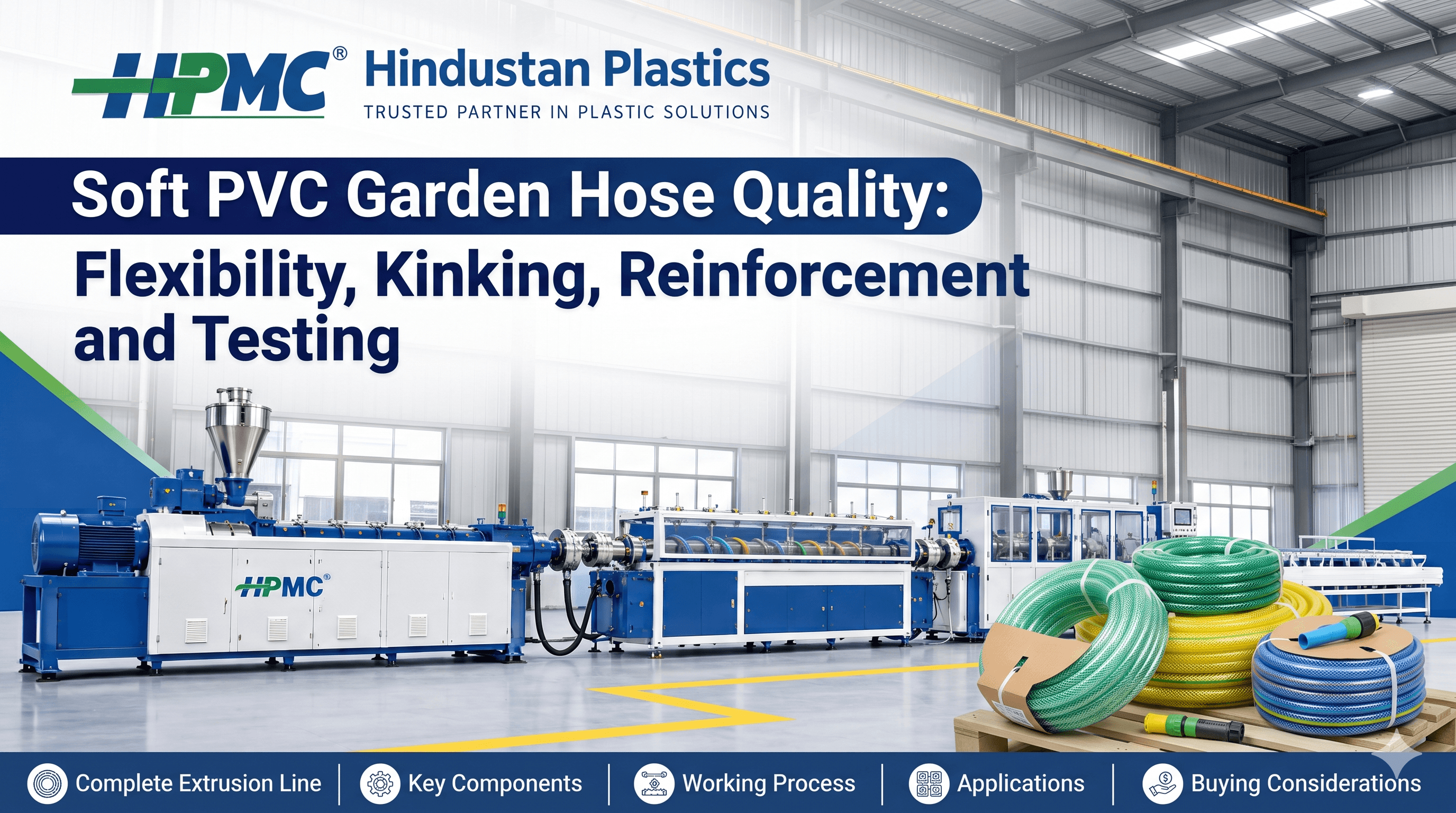
A soft PVC garden hose production line typically includes an extruder, pipe die, cooling section, haul-off unit and winder or coiler. Reinforced hoses may require additional equipment.
Each stage can influence the finished product.
- Extruder: Processes the PVC compound under controlled conditions.
- Die: Forms the hose and helps establish its dimensions.
- Cooling section: Helps stabilise the hose after it leaves the die.
- Haul-off unit: Pulls the hose through the line at a controlled speed.
- Winder or coiler: Collects the finished hose for handling and packaging.
- Reinforcement equipment: Adds the required reinforcement where applicable.
The correct settings depend on the material formulation, hose dimensions and equipment configuration. Manufacturers should follow machine-specific guidance instead of applying the same settings to every product.
For details about HPMC's equipment, see the Soft PVC Garden Pipe Extrusion Line product page.
Common Quality Issues and What to Inspect
Quality issueAreas to investigate
Hose kinking
Formulation, wall thickness, construction and bending conditions
Die setup, material flow, cooling and haul-off
Surface irregularities
Material consistency, processing conditions and die condition
Leakage
Wall integrity, damage and finished-product test results
Poor coil appearance
Winding tension, coil size and handling
Inconsistent flexibility
Formulation, dimensions and material variation
These are starting points for investigation, not definitive diagnoses. A quality issue may have more than one cause.
How Manufacturers Can Improve Quality Consistency
Standardise the Material Formulation
Maintain approved formulation records and investigate unexpected changes in material behaviour.
Keep Process Records
Record relevant settings, production observations and quality measurements. This can help identify recurring variations.
Inspect Equipment Regularly
Follow the machine manufacturer's maintenance instructions for the extruder, die, cooling system, haul-off and coiling equipment.
Use Consistent Test Procedures
Apply the same measurement and inspection methods to comparable samples. Document results and investigate failures.
Review Packaging and Storage
Avoid storage and handling practices that create sharp bends, crushing or unwanted deformation.
Conclusion
Consistent soft PVC garden hose quality depends on material selection, dimensional control, flexibility, construction and finished-product testing. Manufacturers should evaluate these factors together to produce hoses suited to their intended applications.
A structured inspection process can help identify quality variations, while suitable extrusion equipment supports consistent production when correctly configured and operated.
For machine-specific information, manufacturers can contact HPMC and discuss their hose specifications, production targets and equipment requirements.
Contact HPMC
HPMC (Hindustan Plastics & Machinery Corporation)
Address: 5, Category II, DSIDC Industrial Area, Nangloi, Delhi – 110041, India
Website: https://www.hindustanplastics.com/
Phone: +91 95605 96392
Email: info@hindustanplastics.com
Google Business Profile: https://share.google/lBK4uD53HqY891ynv
Frequently Asked Questions
Find quick answers to the most common questions about this topic.
Flexibility depends on the PVC formulation, wall thickness, diameter, construction and temperature conditions.
Kinking can result from the hose's construction, material properties, dimensions, bending conditions or handling practices.
Neither is universally better. The suitable design depends on the intended application, flexibility requirements and required pressure rating.
Wall thickness can be measured at several points around the hose and at different positions along its length using an appropriate measuring method.
They can use a defined bending test and inspect for kinking, cracking, flattening and recovery according to the product specification.
Controlled cooling helps the extruded hose stabilise and retain its required dimensions.
Use an appropriate leakage test under defined conditions, following the product specification and applicable safety procedures.
Not automatically. Pressure suitability depends on the complete hose design and verified test results.
Check its dimensions, surface condition and flexibility, and ensure that the winding process does not introduce kinks or deformation.
Consider the required hose dimensions, material formulation, target output, plain or reinforced construction, cooling arrangement, haul-off and winding requirements.