
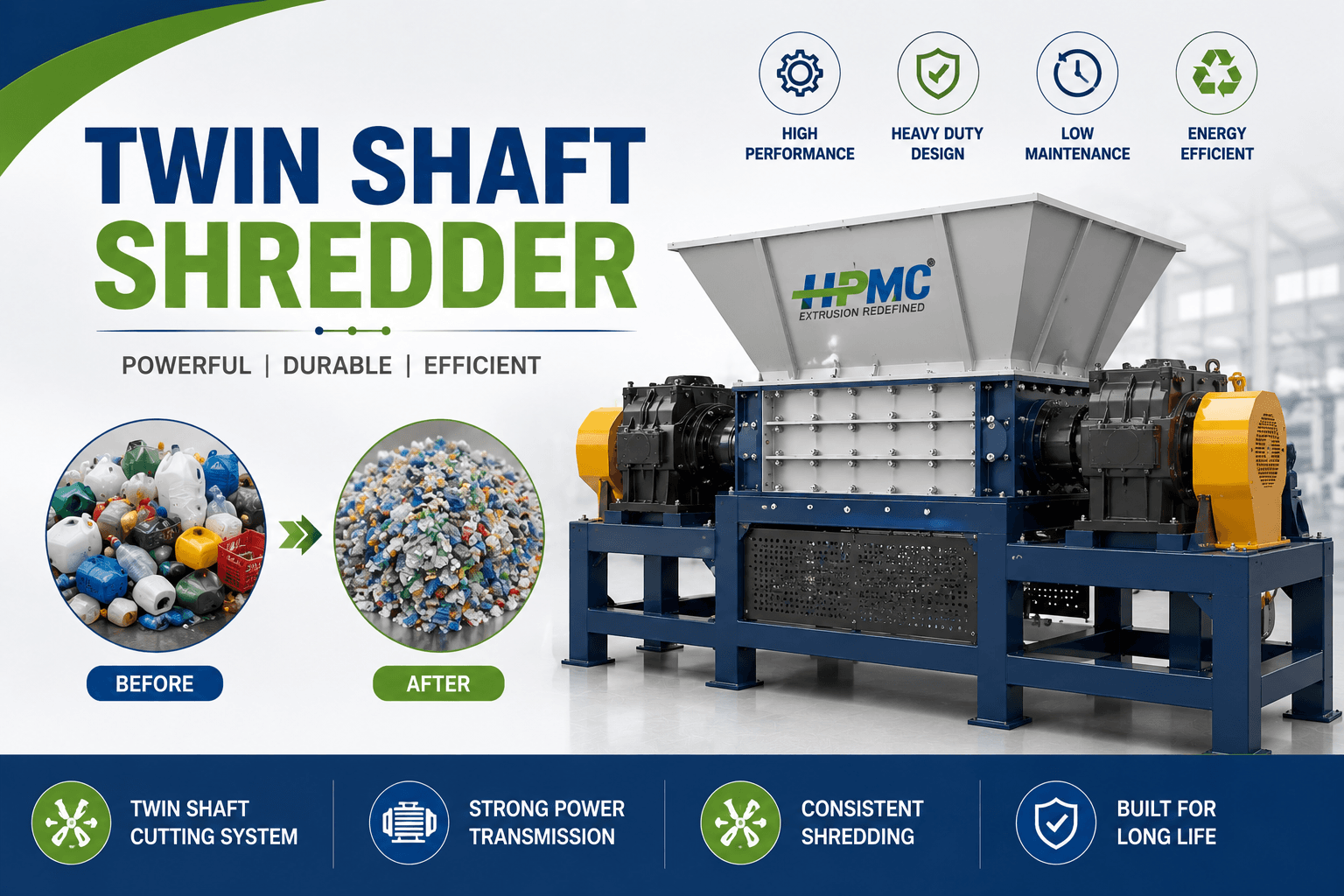
Plastic waste comes in many forms, including bulky products, production scrap, containers, pipes, sheets, lumps, and other post-industrial or post-consumer materials. Before plastic waste can be washed, recycled, reprocessed, or converted into granules, it often needs to be reduced to a manageable size.
A Twin Shaft Shredder is an industrial size-reduction machine designed to process various types of plastic waste using two rotating shafts fitted with cutting tools. Its robust construction and high torque make it suitable for processing bulky and difficult-to-handle materials.
For plastic recycling businesses, selecting the right shredding equipment can improve material handling and prepare plastic waste for subsequent recycling processes.
This guide explains how a Twin Shaft Shredder Machine works, its applications, benefits, important components, and the factors businesses should consider before purchasing one.
What is a Twin Shaft Shredder?
A Twin Shaft Shredder is a mechanical size-reduction machine that uses two counter-rotating shafts equipped with cutting blades or discs.
The shafts work together to grab and tear incoming material into smaller pieces. Unlike machines designed primarily for fine grinding, twin shaft shredders are generally used for coarse shredding and volume reduction.
The shredded material can then be transferred to subsequent processing equipment such as conveyors, washing systems, granulators, or plastic recycling extrusion lines.
A typical twin shaft shredding system can include:
- Feeding hopper
- Two rotating shafts
- Cutting blades or cutters
- Gearbox
- Electric motors
- Main frame
- Hydraulic or mechanical drive components
- Discharge section
- Electrical control panel
The exact configuration depends on the type of plastic waste, required throughput, desired output size, and downstream recycling process.
How Does a Twin Shaft Shredder Work?
The shredding process begins when plastic waste is loaded into the feed hopper.
The material enters the shredding chamber, where two rotating shafts fitted with cutting tools engage with the waste.
The shafts rotate in a coordinated manner and pull the material between the cutters. The plastic is then cut, torn, and reduced into smaller pieces.
The shredded material exits through the discharge section and can be transferred to the next stage of the recycling process.
Unlike high-speed granulation equipment, a twin shaft shredder generally relies on high torque and relatively low rotational speed to handle bulky or difficult materials.
This makes it useful for initial size reduction before further plastic processing.
Why is Shredding Important in Plastic Recycling?
Size reduction is an important stage in many plastic recycling processes.
Large or bulky plastic waste can be difficult to feed into washing, conveying, extrusion, or granulation equipment.
Shredding can help:
- Reduce material size
- Improve material handling
- Make bulky waste easier to transport
- Prepare plastic for washing
- Improve feeding into downstream equipment
- Reduce storage volume
- Support continuous recycling operations
The required shredding size depends on the next stage of the recycling process.
For example, material intended for washing may require a different output size from material being prepared for a granulation or extrusion system.
What Types of Plastic Waste Can Be Processed?
The suitability of a Twin Shaft Plastic Shredder depends on its design, cutter configuration, motor capacity, and the characteristics of the material.
Potential applications include suitable:
- Plastic lumps
- Plastic scrap
- Bulky plastic waste
- Plastic containers
- Industrial plastic waste
- Production rejects
- Plastic sheets
- Selected plastic pipes
- Rigid plastic products
- Post-industrial plastic waste
Material should be evaluated before selecting the machine, particularly when the waste contains foreign materials or other contaminants.
Key Components of a Twin Shaft Shredder Machine
Understanding the main components can help buyers evaluate different shredding machines.
Twin Rotating Shafts
The two shafts carry the cutting tools and work together to pull and tear the incoming plastic material.
Cutting Blades
The cutters determine how the material is engaged and reduced. Cutter design should be selected according to the material being processed.
Gearbox
The gearbox transfers power from the drive motor to the shredding shafts while providing the required torque.
Drive Motor
The motor provides the power required for shredding. Motor capacity should be matched to the type and volume of material being processed.
Shredding Chamber
The chamber houses the rotating shafts and cutting system. Its dimensions influence the size and quantity of material that can be processed.
Feeding Hopper
The hopper provides a safe and controlled area for loading material into the shredding chamber.
Control System
The electrical control system allows operators to start, stop, monitor, and control the machine.
Twin Shaft Shredder vs Single Shaft Shredder
Both twin shaft and single shaft shredders are used in plastic recycling, but their working characteristics differ.
A twin shaft shredder uses two interacting shafts to grab and tear material. This can make it suitable for bulky, irregular, and difficult-to-feed waste.
A single shaft shredder typically uses one rotor and may operate with a hydraulic pusher or similar feeding mechanism to push material toward the cutting system.
The best choice depends on the material, required throughput, desired output size, feeding characteristics, and downstream equipment.
If you are deciding between different shredding technologies, understanding your actual waste material is more important than selecting a machine based only on its name or advertised capacity.
Benefits of a Twin Shaft Shredder
A properly configured Twin Shaft Shredder for Plastic Recycling can provide several operational advantages.
High Torque Processing
Twin shaft systems can be designed to deliver substantial torque for handling bulky and difficult plastic materials.
Effective Size Reduction
The cutting action helps reduce large plastic waste into smaller and more manageable pieces.
Suitable for Bulky Materials
The machine can be useful for plastic waste that is too large or irregular for direct feeding into downstream equipment.
Improved Material Handling
Shredded plastic is generally easier to convey, store, wash, and process than large bulky pieces.
Continuous Operation
Industrial shredders can be integrated into continuous recycling processes.
Supports Downstream Recycling
The output from a shredder can be prepared for further stages such as washing, drying, granulation, or extrusion.
How to Choose the Right Twin Shaft Shredder
Before purchasing a Twin Shaft Shredder Machine, businesses should evaluate several factors.
Identify the Material
Determine the type of plastic waste you intend to process.
Different materials have different hardness, shape, density, and feeding characteristics.
Determine Material Dimensions
Consider the maximum size of the incoming material. Large bulky waste may require a larger feeding chamber.
Define Required Capacity
Determine how many kilograms of material need to be processed per hour.
The machine should be appropriately sized for the required throughput.
Consider Desired Output Size
Shredding is generally a coarse size-reduction process. If you require a specific smaller particle size, additional granulation or size-reduction equipment may be necessary.
Evaluate Cutter Design
Cutter geometry, material, thickness, and configuration can influence shredding performance and maintenance requirements.
Check Motor and Gearbox Specifications
The drive system should provide sufficient torque for the intended application.
Consider Maintenance Requirements
Ask about cutter replacement, shaft maintenance, gearbox servicing, lubrication, and availability of spare parts.
Evaluate Safety Features
Industrial shredders should include appropriate safety systems and controls to reduce operational risks.
Applications of Twin Shaft Shredders
Twin shaft shredders can be used across different plastic recycling and waste-processing operations.
Common applications include:
- Plastic waste shredding
- Industrial plastic scrap processing
- Plastic recycling
- Production scrap size reduction
- Bulky plastic waste processing
- Pre-shredding before washing
- Pre-shredding before granulation
- Material preparation before extrusion
The machine configuration should always be matched to the intended application.
Twin Shaft Shredder in a Plastic Recycling Line
A shredder is often only one part of a complete recycling system.
Depending on the material, a plastic recycling line may include:
Sorting → Shredding → Washing → Drying → Compaction → Extrusion → Filtration → Pelletizing
Not every recycling application requires every stage.
For clean industrial plastic scrap, shredding may be followed directly by extrusion or granulation.
For contaminated post-consumer plastic waste, additional sorting, washing, and drying may be required before extrusion.
For lightweight films, a compactor can help improve feeding characteristics before extrusion.
Understanding the entire process allows businesses to select the correct shredding capacity and output configuration.
Twin Shaft Shredder for Plastic Recycling Businesses
Recycling businesses handling bulky plastic waste need machinery that can reliably process incoming material and prepare it for subsequent operations.
A Twin Shaft Shredder can serve as an initial size-reduction machine where high-torque shredding is required.
However, the machine should not be selected based only on the maximum advertised capacity. The type of plastic, material dimensions, contamination, desired output size, operating hours, and downstream equipment should all be considered.
A machinery manufacturer can use these details to recommend a suitable configuration.
Why Choose HPMC for Plastic Recycling Machinery?
HPMC provides plastic recycling, extrusion, reprocessing, compounding, and size-reduction machinery for different polymer processing applications.
Our solutions can be configured according to material type, required production capacity, input size, desired output, downstream processing requirements, and automation level.
Businesses looking for a Twin Shaft Shredder can discuss their plastic waste characteristics and production requirements with HPMC to determine an appropriate shredding solution.
The focus is on suitable machine configuration, reliable components, controlled operation, and technical support for long-term recycling applications.
Conclusion
A Twin Shaft Shredder can be an important part of a plastic recycling operation when bulky or difficult-to-handle plastic waste needs to be reduced before further processing.
Its two-shaft cutting mechanism and high-torque operation make it suitable for various size-reduction applications. However, the right machine configuration depends on the type and dimensions of the plastic waste, required throughput, desired output size, and downstream recycling process.
Before purchasing a Twin Shaft Plastic Shredder, businesses should evaluate their complete recycling workflow and select equipment that can integrate effectively with subsequent washing, drying, granulation, or extrusion stages.
Choosing an experienced plastic recycling machinery manufacturer can help ensure that the shredder is appropriately configured for reliable and efficient operation.
Frequently Asked Questions
Find quick answers to the most common questions about this topic.
A Twin Shaft Shredder is an industrial size-reduction machine that uses two rotating shafts fitted with cutting tools to tear and reduce bulky materials into smaller pieces.
It can be used for coarse shredding of suitable plastic waste, industrial scrap, bulky plastic products, production rejects, and other materials requiring initial size reduction.
Yes. Twin shaft shredders can be used as a size-reduction stage in suitable plastic recycling processes.
A twin shaft shredder uses two interacting shafts to pull and tear material, while a single shaft shredder uses one main rotor and commonly incorporates a feeding mechanism to push material toward the cutting system. The appropriate choice depends on the material and application.
A twin shaft shredder is generally intended for coarse size reduction rather than fine granulation. Additional granulation equipment may be required when a smaller and more uniform particle size is needed.
Consider the plastic type, input material dimensions, required capacity, desired output size, cutter configuration, motor and gearbox specifications, maintenance requirements, safety features, and after-sales support.